New cross-border framework aims to address water quality, river transport safety, and environmental pressure along a vital Southeast Asian trade and ecology corridor
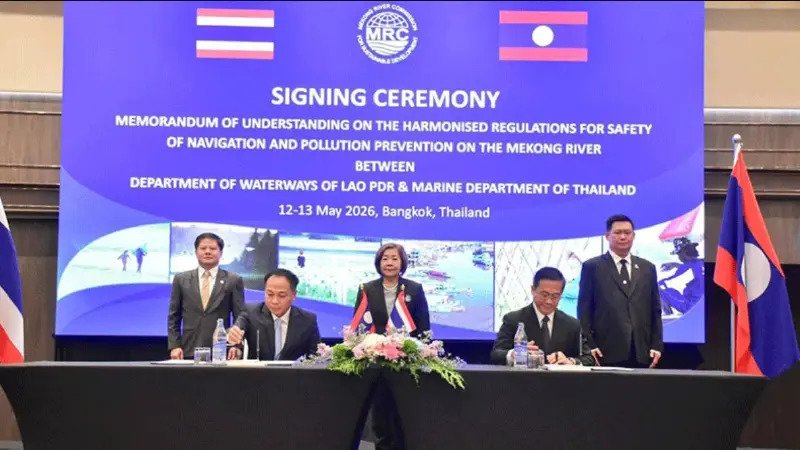
SYSTEM-DRIVEN cooperation between Thailand and Laos has advanced with the introduction of new joint measures focused on safety standards and pollution control along the Mekong River, one of Southeast Asia’s most economically and environmentally significant waterways.
The Mekong functions as both a natural boundary and a critical transport and resource artery, supporting fisheries, agriculture, hydropower infrastructure, and cross-border trade.
At the same time, it has become increasingly exposed to environmental stress, including industrial runoff, plastic waste, sediment disruption, and the downstream effects of dam construction across the wider Mekong basin.
The new cooperation framework between Bangkok and Vientiane is designed to coordinate how both countries monitor and manage these pressures.
What is confirmed is that the agreement focuses on aligning standards for river safety and pollution response, with an emphasis on improving coordination between relevant agencies on both sides of the border.
The practical aim is to reduce inconsistencies in enforcement that have historically complicated cross-border environmental management.
A central issue in the Mekong basin is that pollution and ecological change do not respect national boundaries.
Waste discharged upstream can affect fisheries and drinking water systems downstream within days or weeks, while river traffic safety risks are shared between both countries’ commercial fleets and local communities.
The agreement reflects an acknowledgment that unilateral action has limited effectiveness in a shared river system.
The mechanism behind the new rules is expected to rely on increased data sharing, joint inspections in sensitive zones, and coordinated responses to incidents such as chemical spills, illegal dumping, or navigational hazards.
It also signals a gradual shift toward treating the Mekong less as a divided jurisdiction and more as a managed ecological corridor requiring synchronized governance.
The stakes are high.
The Mekong supports tens of millions of livelihoods across the region, particularly in agriculture and inland fisheries.
Any deterioration in water quality or river stability directly affects food security, rural income, and local supply chains.
At the same time, the river is increasingly integrated into regional logistics strategies, making safety standards a commercial as well as environmental concern.
While the agreement marks a formal step forward, its effectiveness will depend on enforcement capacity, funding for monitoring systems, and sustained political coordination.
Previous regional environmental initiatives along the Mekong have often struggled with uneven implementation and competing national priorities, particularly in relation to development projects and hydropower expansion.
The latest framework therefore represents not a resolution, but a structured attempt to reduce friction in managing a shared natural system under growing ecological and economic pressure.
Its practical impact will be measured in how consistently both countries can translate joint commitments into operational controls on the river itself.
The Mekong functions as both a natural boundary and a critical transport and resource artery, supporting fisheries, agriculture, hydropower infrastructure, and cross-border trade.
At the same time, it has become increasingly exposed to environmental stress, including industrial runoff, plastic waste, sediment disruption, and the downstream effects of dam construction across the wider Mekong basin.
The new cooperation framework between Bangkok and Vientiane is designed to coordinate how both countries monitor and manage these pressures.
What is confirmed is that the agreement focuses on aligning standards for river safety and pollution response, with an emphasis on improving coordination between relevant agencies on both sides of the border.
The practical aim is to reduce inconsistencies in enforcement that have historically complicated cross-border environmental management.
A central issue in the Mekong basin is that pollution and ecological change do not respect national boundaries.
Waste discharged upstream can affect fisheries and drinking water systems downstream within days or weeks, while river traffic safety risks are shared between both countries’ commercial fleets and local communities.
The agreement reflects an acknowledgment that unilateral action has limited effectiveness in a shared river system.
The mechanism behind the new rules is expected to rely on increased data sharing, joint inspections in sensitive zones, and coordinated responses to incidents such as chemical spills, illegal dumping, or navigational hazards.
It also signals a gradual shift toward treating the Mekong less as a divided jurisdiction and more as a managed ecological corridor requiring synchronized governance.
The stakes are high.
The Mekong supports tens of millions of livelihoods across the region, particularly in agriculture and inland fisheries.
Any deterioration in water quality or river stability directly affects food security, rural income, and local supply chains.
At the same time, the river is increasingly integrated into regional logistics strategies, making safety standards a commercial as well as environmental concern.
While the agreement marks a formal step forward, its effectiveness will depend on enforcement capacity, funding for monitoring systems, and sustained political coordination.
Previous regional environmental initiatives along the Mekong have often struggled with uneven implementation and competing national priorities, particularly in relation to development projects and hydropower expansion.
The latest framework therefore represents not a resolution, but a structured attempt to reduce friction in managing a shared natural system under growing ecological and economic pressure.
Its practical impact will be measured in how consistently both countries can translate joint commitments into operational controls on the river itself.