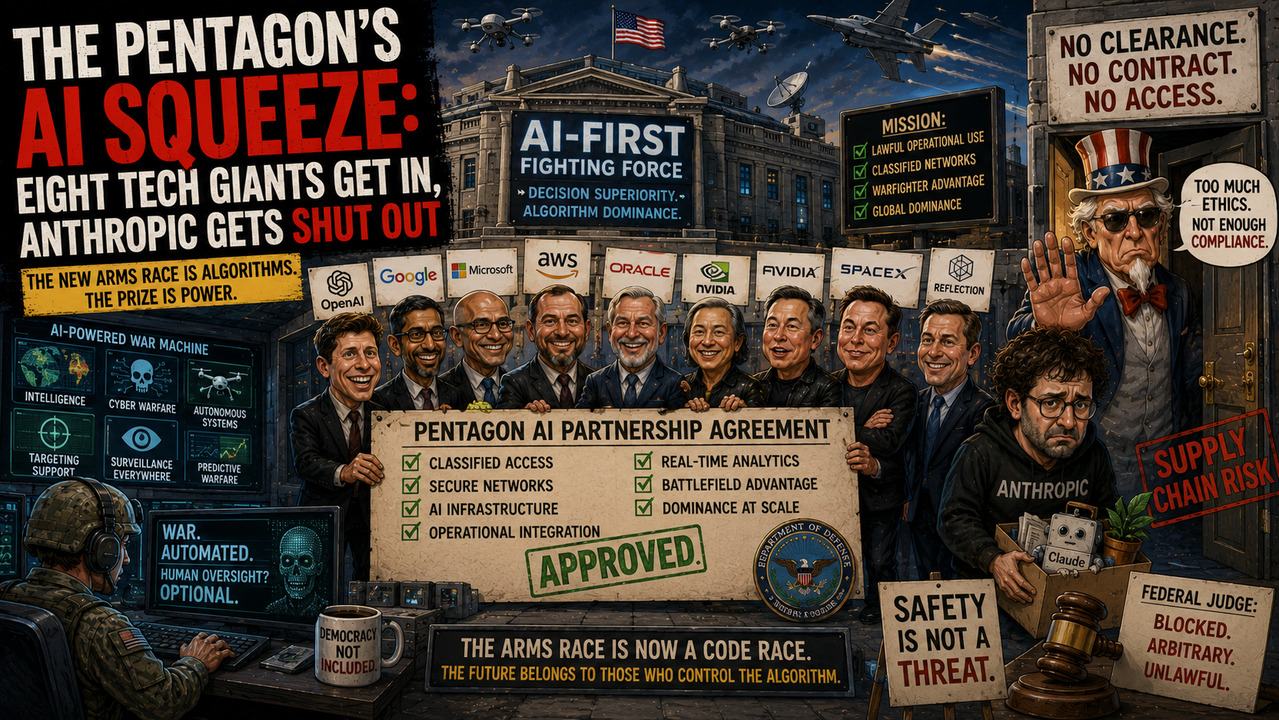
For years, Silicon Valley told the world that artificial intelligence would help humanity write emails faster, summarize meetings, generate prettier presentations, and recommend better restaurants. Now the masks are coming off. The real race was never about productivity apps. It was about war.

In a move that should alarm anyone paying attention to the collision between Big Tech, artificial intelligence, and military power, the United States Department of Defense has signed sweeping AI agreements with eight of the most powerful technology companies on Earth.

The message is unmistakable:

America is no longer experimenting with military AI.

It is operationalizing it.

And the companies building the future of consumer technology are now deeply embedded in the machinery of modern warfare.


The New Military-Industrial Complex Is Digital

The companies now tied into the Pentagon’s classified AI infrastructure read like a list of modern technological empires:

  • OpenAI
  • Google
  • Microsoft
  • Amazon Web Services
  • Oracle
  • Nvidia
  • SpaceX
  • Reflection

Together, these firms already dominate cloud computing, chips, AI models, satellites, communications infrastructure, and large portions of the internet itself.

Now they are becoming the nervous system of America’s military future.

The Pentagon says these systems will support “lawful operational use” and help create an “AI-first fighting force.”

That phrase alone should send chills down the spine of anyone who remembers how every technological arms race in history eventually expanded beyond its original limits.

Because “AI-first fighting force” is not corporate jargon.

It is a declaration that the United States military is restructuring itself around machine intelligence.


The Anthropic Blacklisting Reveals the Real Story

But perhaps the most revealing part of this story is not who got the contracts.

It is who did not.

Anthropic — maker of the Claude AI system — was notably excluded after clashing with the Trump administration over military AI safeguards.

Anthropic reportedly insisted on restrictions governing how its models could be used in warfare, surveillance, and autonomous military systems.

The administration’s response was extraordinary.

The company was labeled a “supply chain risk,” language historically associated with foreign adversaries or national security threats.

In other words:

A U.S. AI company was treated almost like a hostile entity because it hesitated to give the government unrestricted access to advanced AI capabilities.

That should terrify people.

Not because Anthropic is necessarily morally pure — it is still an AI corporation racing for profit like everyone else — but because the punishment revealed the new rules of the game:

In the emerging AI arms race, reluctance itself may become unacceptable.

The pressure on AI companies is no longer simply to innovate.

It is to comply.


Silicon Valley’s Moral Transformation Is Complete

The cultural shift inside the tech industry is staggering.

A decade ago, employees at major technology companies openly protested military contracts. Engineers at Google once revolted over Project Maven, fearing the company’s AI tools would help improve drone warfare.

Executives spoke constantly about ethics, responsibility, and safeguarding humanity.

Now nearly every major AI company is aggressively pursuing defense contracts.

Why?

Because the economics are irresistible.

Governments are preparing to spend hundreds of billions of dollars on AI infrastructure, cyberwarfare systems, autonomous defense technologies, battlefield intelligence, surveillance systems, and military automation.

That money is simply too large for Silicon Valley to ignore.

The AI boom has already burned staggering amounts of investor capital. Most major AI companies remain under immense pressure to prove long-term profitability.

Defense spending offers exactly what Wall Street loves:

  • massive budgets,
  • recurring contracts,
  • geopolitical urgency,
  • and virtually unlimited demand.

The Pentagon is no longer just a customer.

It is becoming one of the most important growth markets in artificial intelligence.


The AI Arms Race Is Escalating Faster Than the Public Realizes

The most dangerous part is how quickly normalization is happening.

Terms that once sounded dystopian are now casually discussed in press releases:

  • autonomous systems,
  • AI battlefield coordination,
  • offensive cyber operations,
  • machine-assisted targeting,
  • predictive intelligence,
  • decision superiority.

Notice the language carefully.

The military no longer talks about AI as experimental support software.

It talks about AI as strategic infrastructure.

That means the global AI race is increasingly inseparable from military dominance.

The United States fears China.
China fears the United States.
Both fear falling behind.

And history shows that when nations fear technological inferiority, ethical caution tends to evaporate.


The Most Dangerous Weapons May Never Fire a Bullet

The public still imagines military AI mainly through killer robots and autonomous drones.

But the real revolution may be quieter.

AI systems are becoming capable of:

  • analyzing global intelligence data,
  • identifying cyber vulnerabilities,
  • generating attack scenarios,
  • conducting digital espionage,
  • influencing information warfare,
  • automating surveillance,
  • and accelerating military decision-making beyond human speed.

Anthropic’s own controversial “Mythos” system reportedly demonstrated capabilities that could identify cybersecurity threats — but also potentially map pathways for sophisticated attacks.

That dual-use reality is what makes modern AI uniquely dangerous.

The same systems that defend networks can attack them.
The same models that detect threats can optimize warfare.
The same algorithms that improve productivity can scale mass surveillance.

AI is not inherently civilian or military anymore.

The boundary is dissolving.


Democracy Is Not Moving Fast Enough

Perhaps the most disturbing aspect of all this is how little public debate is occurring relative to the stakes involved.

Most citizens have no idea:

  • which AI systems are entering military infrastructure,
  • what safeguards exist,
  • how autonomous these systems may become,
  • how targeting decisions could evolve,
  • or how much influence private corporations now hold over national defense.

The speed of deployment is vastly outpacing democratic oversight.

And once military systems become dependent on AI infrastructure owned by private corporations, disentangling governments from tech monopolies may become nearly impossible.

The relationship becomes symbiotic:

  • governments need AI companies for technological dominance,
  • AI companies need governments for money, protection, and strategic power.

This is the birth of a new military-industrial order.

Not built around tanks and oil.

But around algorithms, chips, cloud servers, satellites, and machine intelligence.


The Most Important Question Is No Longer Science Fiction

For years, debates about artificial intelligence focused on hypothetical futures:

  • Could AI become conscious?
  • Could it replace humanity?
  • Could it destroy civilization someday?

But the real transformation is already here.

The question now is much more immediate:

What happens when the world’s most powerful governments merge with the world’s most powerful AI companies during a global technological arms race?

Because once military superiority becomes tied to AI supremacy, slowing down may no longer feel politically possible.

And that is when technological competition becomes truly dangerous.

Not when machines become sentient.

But when humans become too afraid to stop building them.


The Pentagon’s AI Power Grab Has Begun

The military is no longer treating artificial intelligence as a laboratory curiosity. It is wiring it into classified systems, turning frontier AI into an instrument of state power, and telling the world’s biggest tech companies that the next great contract fight is not for consumers, but for war. 

The Department of Defense announced on Friday that it has reached agreements with eight major technology companies — SpaceX, OpenAI, Google, Nvidia, Reflection, Microsoft, Amazon Web Services and Oracle — to deploy their AI tools on the Pentagon’s classified networks for what it called “lawful operational use.” The department said the deals are designed to accelerate the shift toward an “AI-first fighting force” and strengthen “decision superiority” across every domain of warfare. It also said its GenAI.mil platform has already been used by more than 1.3 million Defense Department personnel, generating tens of millions of prompts and hundreds of thousands of agents in just five months. 

The glaring omission is Anthropic. Until recently, Claude was the only AI model available inside the Pentagon’s classified network, but the Trump administration moved to sever ties after Anthropic refused to accept terms that would have allowed the military to use its model for “all lawful purposes,” including autonomous weapons and mass surveillance. The Pentagon then branded Anthropic a “supply chain risk” — language usually reserved for companies tied to hostile foreign threats — in a move that effectively pushed the company toward the edge of the government market. A federal judge in San Francisco later blocked that designation for now, calling the government’s action arbitrary and potentially crippling. 

That clash matters because this is no longer just about ideology or safety language. It is about leverage, revenue and control. By signing Anthropic’s rivals, the Pentagon has given itself options and given the company a brutal lesson in how fast a lucrative government market can close. Reuters reported that the military has been trying to shorten onboarding for new AI vendors from roughly eighteen months to under three, as it seeks to avoid “vendor lock” and spread access across more suppliers. In practical terms, the Pentagon is not waiting for the market to mature; it is forcing the market to move on its timetable. 

The result is a stark new reality for Silicon Valley. The biggest AI firms are no longer merely chasing user growth or chatbot dominance. They are competing to become the operating layer for the state’s most sensitive systems. That means classified networks, cyber defense, logistics, planning, targeting support and intelligence workflows — the kinds of functions that can shape military advantage long before a shot is fired. The Pentagon’s own language makes the point plainly: it wants faster data synthesis, sharper situational awareness and more effective warfighter decision-making. 

Anthropic has not disappeared from the picture entirely. Reuters reported that President Donald Trump recently said the company was “shaping up,” suggesting the door has not been shut forever. The White House has also reopened discussions with Anthropic in recent weeks, according to the original reporting, after the company unveiled new technical breakthroughs and a cyber tool that has drawn attention across the security world. But for now, the message from Washington is unmistakable: comply, scale, and move fast — or watch competitors take the contract, the influence and the money. 

What is unfolding is not a routine procurement story. It is the next phase of the AI arms race, with the Pentagon using procurement power to shape the market and the leading AI companies racing to secure a seat inside the machinery of American power. The winner will not just sell software. It will help define how the United States fights, decides and defends itself in the age of machine intelligence. 

Voiceover script: The Pentagon has signed AI deals with eight major tech companies, including OpenAI, Google, Microsoft, Amazon Web Services, Oracle, Nvidia, SpaceX and Reflection. The tools will be used on classified networks to help build what the department calls an “AI-first fighting force.” One company was left out: Anthropic. The Trump administration moved against it after Anthropic refused to accept safety terms that could allow military use in autonomous weapons and mass surveillance. A federal judge later blocked the Pentagon’s blacklisting for now. The bigger story is that Washington is now racing to put frontier AI inside the heart of military operations, and the fight is no longer just about technology — it is about power, leverage and who shapes the future of war. 

Thai Airways has finalized orders for new widebody aircraft to expand long-haul routes, supporting Thailand’s strategy to reinforce Bangkok’s position as a leading aviation and transit hub in Southeast Asia.
The Japan International Cooperation Agency has launched a multi-province teacher training initiative in Laos, aimed at improving education quality and supporting long-term human capital development.
Myanmar’s energy authorities are urging foreign investors to support distributed solar projects as the country seeks to address electricity shortages and reduce reliance on unstable centralized infrastructure.
Malaysia’s parliament has approved new transport regulations targeting commercial and private road users, aiming to strengthen safety standards and reduce fatalities along key national freight corridors.
The 51st ASEAN Audit Committee meeting in Jakarta has adopted updated protocols on financial transparency, cybersecurity auditing, and internal accountability under the Philippines’ chairmanship.
Singtel has announced a multi-year partnership to deploy advanced artificial intelligence systems across its networks, strengthening digital infrastructure and data sovereignty capabilities across Southeast Asia.
AI company Wonderful has secured major funding and established its regional headquarters in Singapore, aiming to accelerate enterprise adoption of artificial intelligence across Southeast Asian corporate markets.
Palm oil benchmark prices in Kuala Lumpur declined sharply amid a stronger ringgit and changing global energy dynamics, with traders adjusting expectations ahead of new Indonesian biodiesel policy developments.
Thai authorities and the Dutch embassy have inaugurated a joint initiative to position Bangkok as a regional hub for water technology, focusing on flood management, climate resilience, and sustainable infrastructure planning.
Indonesia has launched a long-term housing finance program aimed at expanding homeownership among younger citizens while channeling substantial investment into construction and urban infrastructure sectors.
Environmental and meteorological agencies across Southeast Asia have raised alerts over potential transboundary haze linked to weather conditions and agricultural fires, prompting coordinated monitoring and emergency preparedness measures.
Intensifying competition among global digital platforms is driving significant investment in Thailand’s online retail sector, pushing up data consumption and reinforcing the country’s position as a leading Southeast Asian digital commerce hub.
Thailand’s central bank has upgraded its economic forecast after stronger-than-expected tourism revenue, aviation expansion, and consumer spending, reinforcing the country’s role as a key regional hub in mainland Southeast Asia.
Senior officials meeting in Jakarta have endorsed a long-term ASEAN-Canada action plan covering cybersecurity, artificial intelligence, and trade, with the goal of deepening integration between Southeast Asian and Canadian supply chains.
The Philippine National Maritime Council has restated its rejection of China’s territorial claims ahead of the 10th anniversary of the 2016 ruling, reaffirming that the UN Convention on the Law of the Sea remains the legal basis for maritime rights.
Thailand’s Board of Investment has approved a major semiconductor roadmap alongside more than 900 billion baht in digital infrastructure projects, aiming to attract global data center investment and strengthen the country’s position in power chips, sensors, and photonics manufacturing.
A government strategy review has recommended Singapore move beyond competing on data center scale and instead focus on regulatory sandboxes, computing resources, and targeted funding to help local firms scale artificial intelligence applications globally.
The Indonesian government has launched an ambitious investment drive targeting the nickel and minerals sector, aiming to develop a fully integrated electric vehicle ecosystem and position the country as a major hub in Asia’s clean mobility transition.
Vietnam’s National Statistics Office reported a 35% year-on-year rise in inbound investment in the first five months of the year, with capital flows led by Singapore, South Korea, and China into electronics manufacturing, processing industries, and energy infrastructure.
Prime Minister Anutin Charnvirakul has launched a new inter-agency FastPass framework at Government House designed to cut regulatory approval timelines in half, aiming to speed up factory construction for advanced electronics, aerospace, and precision machinery projects across Thailand.
Thailand’s coalition government is preparing a constitutional amendment debate that could allow citizens to elect a new drafting assembly, marking a significant step in discussions over long-term political and institutional reform in the country.
India received Myanmar military leader Min Aung Hlaing for bilateral discussions focused on security cooperation, a move reflecting New Delhi’s efforts to stabilise its northeastern border region while balancing regional geopolitical pressures.
Malaysia has introduced a nationwide restriction on social media accounts for users under 16, citing rising concerns over cybercrime, online exploitation and the psychological effects of unregulated digital platforms on minors.
Russian President Vladimir Putin hosted ASEAN leaders at a commemorative summit in Kazan, highlighting continued energy and economic cooperation and underscoring the region’s preference for multi-vector diplomacy amid pressure from Western governments.
The Thai Ministry of Finance has rolled out a large-scale co-payment programme aimed at supporting household spending and stimulating provincial retail markets, injecting billions of baht into the economy as part of ongoing post-pandemic recovery efforts.
Indonesia announced a series of agreements worth $3.5 billion following President Prabowo Subianto’s visit to France, covering aerospace, green technology and defence cooperation as Jakarta seeks to broaden its strategic partnerships.
Manila and Hanoi have upgraded bilateral ties to strengthen maritime domain awareness and coast guard coordination, reflecting closer alignment between the two ASEAN members as tensions continue to rise in contested South China Sea waters.
ASEAN and Canada agreed to accelerate negotiations on a comprehensive free trade agreement following their latest dialogue in Jakarta, alongside a new five-year action plan aimed at expanding digital integration and private sector access across the Pacific.
The Monetary Authority of Singapore maintained its growth outlook, citing strong global demand for AI-related chips and hardware as a key buffer against disruptions linked to Middle East tensions and shipping risks in the Strait of Hormuz.
Chinese state-owned contractor PowerChina has signalled interest in financing and building seven major transport corridors across Thailand, strengthening Bangkok’s ambition to develop into a regional logistics and aviation hub linking mainland Southeast Asia with global supply chains.
Prime Minister Anutin Charnvirakul has launched the FastPass initiative at Government House, fast-tracking approvals for an initial 25 multinational projects as Thailand seeks to position itself as Southeast Asia’s leading destination for high-technology and industrial investment.
Malaysia’s FTSE Bursa Malaysia KLCI has risen sharply, supported by institutional buying in healthcare, telecommunications and plantation stocks. The gains helped offset broader uncertainty linked to global interest rate expectations.
A fatal school shooting in Leyte involving teenage suspects has intensified debate in the Philippines over proposals to lower the age of criminal responsibility. Interior Secretary Jonvic Remulla has voiced support for stricter accountability measures in juvenile crime cases.
President Prabowo Subianto has reaffirmed agriculture and fisheries as central to Indonesia’s national resilience strategy. He pledged stronger state intervention to shield domestic food production from global commodity price volatility.
The dissolution of the alliance between Malaysia’s Pan-Malaysian Islamic Party and Bersatu has reshaped the country’s political landscape ahead of upcoming state elections. The split introduces new uncertainty for Prime Minister Anwar Ibrahim’s coalition government.
Renewable energy developer VinEnergo is investing nearly $99 million to build two onshore wind farms in central Vietnam. The projects are intended to support rising industrial energy demand from multinational manufacturers and technology firms.
Royal Caribbean Group has expanded its Asia-Pacific leadership structure in Singapore, appointing Ben Bouldin as managing director for the region. The move reflects growing demand for cruise tourism across Southeast Asia following the post-pandemic recovery in travel.
Thailand’s Interior Ministry has outlined new regulations allowing registered displaced people from Myanmar to access legal employment opportunities. The framework is intended to address labour shortages while managing humanitarian pressures linked to ongoing conflict across the border.
The Philippines is accelerating negotiations with Japan to formalise maritime boundary protocols and deepen defence coordination. The talks come amid heightened tensions in the South China Sea and increasing concerns over regional security dynamics.
Hundreds of free meal distribution centres in Indonesia have temporarily halted operations due to administrative and funding delays. The disruption highlights early implementation challenges in the government’s flagship nutrition programme under President Prabowo Subianto’s incoming administration.
Vietnamese authorities and the United Nations Development Programme have issued warnings that a strengthening El Niño event could trigger extreme heat, drought and intense storms. Officials say the conditions threaten agriculture, hydropower generation and wider economic stability in the Mekong Delta.
US cyber-intelligence units have carried out coordinated operations targeting digital infrastructure used by transnational scam networks operating in Myanmar border regions. Authorities say the action significantly reduces the groups’ ability to defraud victims and launder cryptocurrency.
Singapore’s government innovation centre Hatch, working with Classiq and Amazon Web Services, has completed a proof-of-concept combining quantum and classical computing for chemistry applications. The project is being positioned as an early test case for practical quantum computing use in public safety systems.
Vietnam’s central bank has introduced a special lending mechanism allowing commercial banks to exclude loans tied to 18 major infrastructure projects from credit growth limits. The measure is designed to maintain financing flows for large-scale urban and transport development projects.
ASEAN and Canada have endorsed a new implementation framework aimed at accelerating negotiations toward a comprehensive free trade agreement. Officials say the plan could strengthen integration between Southeast Asian manufacturing networks and North American supply chains if concluded.
Index provider MSCI has postponed its review of Indonesia’s market classification until November. The delay temporarily spares Indonesia from a possible downgrade from emerging market status, while maintaining pressure on regulators to improve disclosure standards and free-float reforms.
Malaysia and China have agreed to deepen joint research and technology transfer programmes focused on artificial intelligence, renewable energy and advanced materials. The agreement was reached during the Fourth Malaysia–China Joint Committee Meeting co-chaired by Science, Technology and Innovation Minister Chang Lih Kang.
Thailand’s government says cybercrime networks and illicit foreign-owned proxy businesses have fallen by about 60 percent after a coordinated enforcement campaign. Officials say the decline strengthens investor confidence and reinforces efforts to curb digital fraud and nominee structures in the economy.
Japanese Technology Firm Fujitsu Launches Advanced Artificial Intelligence Tool for Corporate Disclosures
South Africa Officially Launches Nationwide Campaign for Highly Contested Local Government Elections
United Kingdom Commits Additional Funding for Unexploded Ordnance Clearance in Laos
Singapore Announces Stringent New Greenhouse Gas Regulations for Commercial Cooling Systems
Cambodia and Thailand Hold High-Level Border Security Talks at United Nations Headquarters
Myanmar Military Government and China Sign Major Agreement to Upgrade Media and Cultural Cooperation
Knife Attack at Swiss Train Station Leaves Three Injured in Suspected Act of Domestic Terrorism
Transnational Extortion Gang Threatens Canadian Police With Army of One Thousand Armed Operatives
Australia Imposes Forty-Two-Day Quarantine on Cruise Ship Passengers Following Deadly Hantavirus Outbreak
International Monetary Fund Unlocks Seven Hundred Million United States Dollars for Sri Lanka Following Economic Reforms
China and Canada Foreign Ministers Meet in Ottawa in Effort to Stabilize Strained Diplomatic Ties
Indonesia Demands Urgent United Nations Security Council Reform Amid Escalating Global Conflicts
Extreme Weather Patterns Trigger Severe Drought in Madagascar and Destructive Flooding in East Africa
Indian State of Karnataka Faces Political Upheaval as Chief Minister Siddaramaiah Abruptly Resigns
Philippines and Japan Reaffirm Defense Ties as Crucial for Indo-Pacific Regional Stability
Norway Joins French Nuclear Deterrence Initiative in Major Shift for European Security Architecture
Global Critical Mineral Alliances Expand as Western Nations Move to Counter Chinese Supply Dominance
United States Imposes Fifty Percent Tariffs on Mexican Steel and Aluminum Ahead of Trade Pact Review
European Union and China Head Toward Major Trade Conflict Over Clean Technology Exports
United States Economic Growth Severely Downgraded to One Point Six Percent as Stagflation Fears Mount
World Health Organization Warns Central African Ebola Epidemic is Outpacing Containment Efforts
United States Treasury Department Conditions Sanctions Relief on Reopening of the Strait of Hormuz
Iranian Air Defenses Intercept and Destroy United States Military Drone Over Bushehr Province
Iranian Armed Forces Launch Ballistic Missiles Toward Unspecified Targets Prompting Regional Condemnation
United Nations Secretary-General Warns Global Order Facing Highest Level of Conflict Since 1945
Israel Issues Sweeping Evacuation Orders in Southern Lebanon Amid Intensified Hezbollah Conflict
Russia Announces Systemic Military Strikes Targeting Ukrainian Defense and Energy Infrastructure
United States and Iranian Negotiators Reach Draft Agreement to Extend Ceasefire and Resume Nuclear Talks
United Nations Security Council Deeply Divided Over United States Capture of Venezuelan President
US and Iran Exchange Direct Military Strikes Amid Fragile Gulf Ceasefire
World Health Organization Warns of Catastrophic Ebola Outbreak in DR Congo
Russia Threatens New Wave of Strikes on Ukrainian Infrastructure and Embassies
Scientists Warn Atlantic Ocean Currents Could Collapse Faster Than Projected
Anthropic Reaches $900 Billion Valuation in Historic AI Funding Round
Washington Imposes Crippling Sanctions on Iranian Maritime Authority
Japan and the Philippines Initiate Strategic Intelligence-Sharing Pact
Microsoft Deploys Autonomous Computer-Using AI Agents to Global Markets
Anthropic Secures $45 Billion Compute Infrastructure Agreement With SpaceX
U.S. Director of National Intelligence Resigns Amid Administration Shakeup
Micron Technology Crosses Trillion-Dollar Valuation Amid Unprecedented Hardware Demand
Canada and Germany Finalize Historic Long-Term LNG Export Agreement
China Expands International Travel Restrictions on Domestic AI Researchers
Japan Approves Sweeping Overhaul of National Intelligence Apparatus
Global Airlines Scramble Logistics as Middle East Airspace Remains Fractured
Japan's Naphtha Imports Plunge 47 Percent Amid Strait of Hormuz Closure
Global Crude Prices Retreat Below $96 as Gulf Tensions Momentarily Ease
Generative AI Outperforms Human Baselines in Landmark Global Creativity Study
NASA Partners With Private Aerospace to Unveil Permanent Lunar Base Architecture
South Korean Equity Markets Surge on Next-Generation Memory Chip Frenzy
U.S. Treasury Yields Slip as Energy-Driven Inflation Anxiety Cools