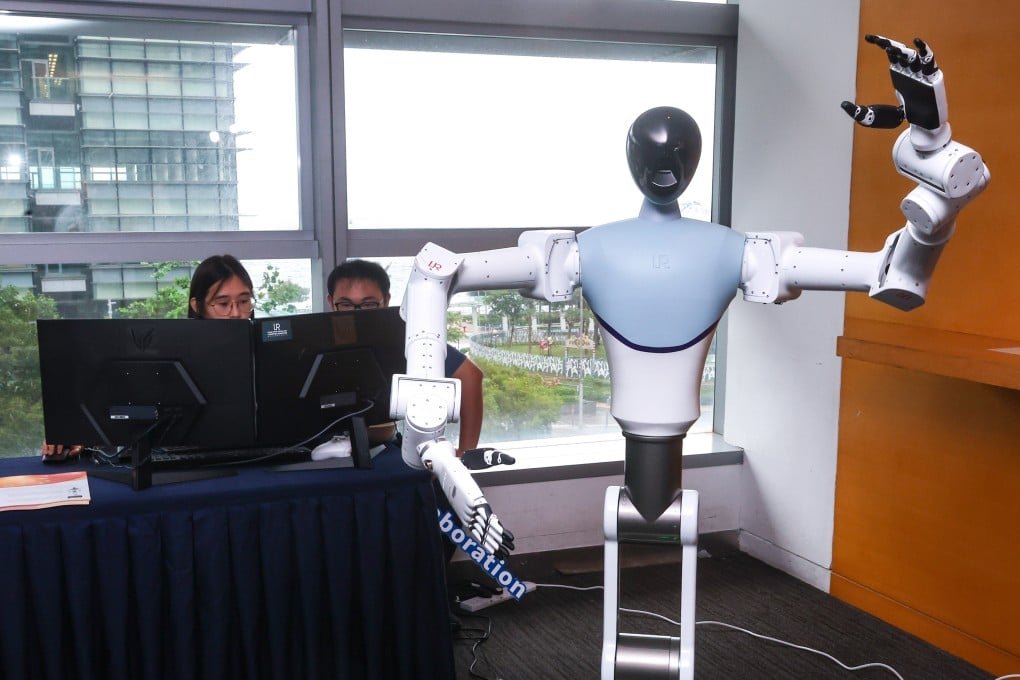
The new initiative at the Chinese University of Hong Kong focuses on humanoid robotics and real-world artificial intelligence applications amid intensifying global competition in advanced robotics.
The Chinese University of Hong Kong is establishing a dedicated humanoid robotics laboratory aimed at accelerating research in embodied artificial intelligence, a field that focuses on machines capable of perceiving, learning, and acting in physical environments rather than only in digital systems.
The initiative reflects a broader shift in global AI development toward robotics systems that can operate in the real world, including tasks that require movement, perception, and physical interaction.
At its core, humanoid robotics combines multiple disciplines: machine learning, computer vision, mechanical engineering, and control systems.
Unlike software-only AI models, humanoid systems must continuously interpret sensor data, maintain balance, navigate unpredictable environments, and interact safely with people and objects.
This makes the field both technically complex and strategically important, particularly as countries and institutions compete to build the next generation of intelligent machines.
The new lab positions Hong Kong’s academic research ecosystem within this global race.
Universities in the United States, mainland China, Japan, and Europe have all increased investment in robotics and embodied AI, driven by expectations that such systems will eventually play roles in manufacturing, elder care, logistics, and service industries.
For Hong Kong, which has traditionally been stronger in finance and services than deep industrial robotics, the move signals an effort to deepen its presence in frontier technology development.
The research direction also aligns with growing demand for automation in aging societies and high-density urban environments.
Humanoid robots are being explored for assistance in healthcare settings, repetitive industrial tasks, and environments where human labor is either costly or physically constrained.
However, the technology remains in early stages, with persistent challenges in dexterity, energy efficiency, safety, and reliable real-world decision-making.
By concentrating expertise in a dedicated lab, CUHK is aiming to consolidate research talent and improve collaboration between academia and industry.
The long-term goal is not only academic output but also the development of deployable systems that can transition from laboratory prototypes to practical applications.
This includes potential partnerships with technology companies and robotics firms seeking advanced algorithms and hardware integration.
The launch underscores a broader strategic shift in artificial intelligence research toward physical-world deployment, where success is measured not only by computational performance but by the ability of machines to function reliably in human environments, shaping the next phase of automation across multiple sectors.
The initiative reflects a broader shift in global AI development toward robotics systems that can operate in the real world, including tasks that require movement, perception, and physical interaction.
At its core, humanoid robotics combines multiple disciplines: machine learning, computer vision, mechanical engineering, and control systems.
Unlike software-only AI models, humanoid systems must continuously interpret sensor data, maintain balance, navigate unpredictable environments, and interact safely with people and objects.
This makes the field both technically complex and strategically important, particularly as countries and institutions compete to build the next generation of intelligent machines.
The new lab positions Hong Kong’s academic research ecosystem within this global race.
Universities in the United States, mainland China, Japan, and Europe have all increased investment in robotics and embodied AI, driven by expectations that such systems will eventually play roles in manufacturing, elder care, logistics, and service industries.
For Hong Kong, which has traditionally been stronger in finance and services than deep industrial robotics, the move signals an effort to deepen its presence in frontier technology development.
The research direction also aligns with growing demand for automation in aging societies and high-density urban environments.
Humanoid robots are being explored for assistance in healthcare settings, repetitive industrial tasks, and environments where human labor is either costly or physically constrained.
However, the technology remains in early stages, with persistent challenges in dexterity, energy efficiency, safety, and reliable real-world decision-making.
By concentrating expertise in a dedicated lab, CUHK is aiming to consolidate research talent and improve collaboration between academia and industry.
The long-term goal is not only academic output but also the development of deployable systems that can transition from laboratory prototypes to practical applications.
This includes potential partnerships with technology companies and robotics firms seeking advanced algorithms and hardware integration.
The launch underscores a broader strategic shift in artificial intelligence research toward physical-world deployment, where success is measured not only by computational performance but by the ability of machines to function reliably in human environments, shaping the next phase of automation across multiple sectors.