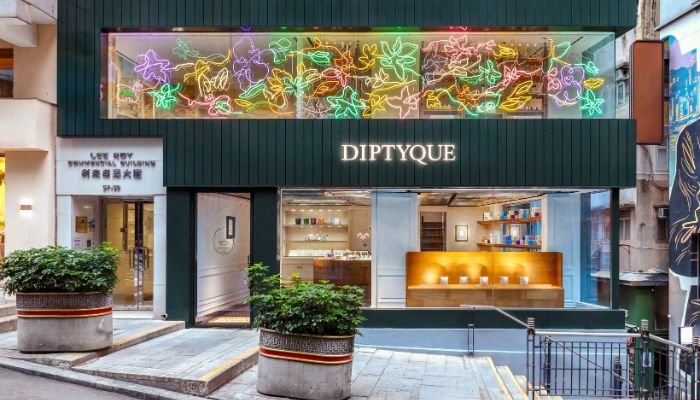
The French fragrance house is expanding its Asia strategy through a new Hong Kong concept store that merges Parisian design with local heritage, signaling how global luxury brands are adapting to changing consumer behavior in the region.
French luxury fragrance and lifestyle brand Diptyque has opened a new concept flagship in Hong Kong designed to blend Parisian interiors with references to the city’s cultural identity, underscoring how international luxury companies are reshaping retail strategy around immersive physical experiences rather than simple storefront sales.
What is confirmed is that the new flagship incorporates design elements tied to Hong Kong’s architectural and cultural history while maintaining Diptyque’s established Paris-inspired aesthetic.
The store forms part of the company’s broader expansion across Asia, where luxury groups continue to view affluent regional consumers and tourism recovery as critical growth drivers.
The opening comes during a transitional period for Hong Kong’s retail economy.
The city remains one of Asia’s most important luxury markets, but consumer behavior has shifted sharply since the pandemic period, mainland Chinese spending slowdown and increased competition from domestic Chinese luxury retail hubs such as Shanghai, Shenzhen and Hainan.
The mechanism behind the strategy is increasingly clear across the global luxury sector: flagship stores are no longer primarily transactional spaces.
They are being redesigned as branded environments intended to deepen emotional engagement, generate social media visibility and reinforce exclusivity.
Luxury groups are investing heavily in architecture, hospitality-style service, art installations and localized storytelling to attract customers who can increasingly purchase products online or while traveling.
Diptyque’s Hong Kong concept reflects that trend directly.
The store reportedly integrates materials, textures and visual references associated with the city’s older neighborhoods and design traditions while preserving the company’s recognizable Parisian identity.
The objective is not simply localization for aesthetic purposes.
It is commercial positioning aimed at affluent consumers seeking products that feel culturally aware, experiential and differentiated from standardized global retail chains.
The stakes are significant because Asia remains central to luxury industry growth despite current economic pressures.
Chinese consumers still account for a large share of global luxury spending, both domestically and abroad.
However, spending patterns have become more cautious and fragmented.
Wealthier customers increasingly prioritize experiences, craftsmanship, personalization and emotional connection over conspicuous consumption alone.
Hong Kong occupies an especially sensitive position within this transition.
The city’s luxury retail sector suffered severe disruption from pandemic-era travel restrictions and the collapse of international tourism.
Although visitor arrivals and retail activity have improved, recovery remains uneven.
Commercial landlords and luxury brands are therefore competing aggressively to restore Hong Kong’s image as a high-end shopping destination distinct from mainland China.
For global luxury houses, maintaining a strong Hong Kong presence still carries strategic importance beyond immediate sales figures.
The city remains a regional showcase market with international financial connectivity, a concentration of wealth and a consumer base familiar with premium Western brands.
High-profile flagship openings serve both branding and signaling functions, demonstrating long-term commitment to the region.
The move also reflects broader structural changes in luxury retail economics.
E-commerce growth and slowing discretionary spending have forced brands to reduce dependence on volume-based expansion.
Instead, companies are concentrating resources into fewer but more elaborate stores intended to maximize prestige, customer retention and cross-category spending.
Localized luxury design has become particularly important in Asia, where younger affluent consumers often expect global brands to acknowledge regional identity rather than impose standardized Western aesthetics.
International brands are increasingly incorporating local art, architecture, culinary references and historical motifs into retail environments to create stronger cultural resonance.
Hong Kong’s heritage itself has become commercially valuable in this context.
As redevelopment transforms many traditional districts, brands are using references to the city’s older urban culture, craftsmanship and architectural textures as symbols of authenticity and nostalgia.
Luxury retailers see this as a way to distinguish flagship experiences from the more uniform atmosphere of luxury malls worldwide.
The practical consequence is that luxury competition in Asia is increasingly shifting from product access to experiential differentiation.
Brands are no longer competing only on handbags, fragrance or fashion collections.
They are competing on atmosphere, storytelling, cultural fluency and the ability to turn physical retail into a destination experience.
Diptyque’s investment signals confidence that Hong Kong still matters in that equation.
The new flagship represents more than a store opening.
It reflects a broader recalibration underway across the luxury industry as global brands attempt to reconnect prestige, locality and experience in an increasingly saturated and digitally driven market.
What is confirmed is that the new flagship incorporates design elements tied to Hong Kong’s architectural and cultural history while maintaining Diptyque’s established Paris-inspired aesthetic.
The store forms part of the company’s broader expansion across Asia, where luxury groups continue to view affluent regional consumers and tourism recovery as critical growth drivers.
The opening comes during a transitional period for Hong Kong’s retail economy.
The city remains one of Asia’s most important luxury markets, but consumer behavior has shifted sharply since the pandemic period, mainland Chinese spending slowdown and increased competition from domestic Chinese luxury retail hubs such as Shanghai, Shenzhen and Hainan.
The mechanism behind the strategy is increasingly clear across the global luxury sector: flagship stores are no longer primarily transactional spaces.
They are being redesigned as branded environments intended to deepen emotional engagement, generate social media visibility and reinforce exclusivity.
Luxury groups are investing heavily in architecture, hospitality-style service, art installations and localized storytelling to attract customers who can increasingly purchase products online or while traveling.
Diptyque’s Hong Kong concept reflects that trend directly.
The store reportedly integrates materials, textures and visual references associated with the city’s older neighborhoods and design traditions while preserving the company’s recognizable Parisian identity.
The objective is not simply localization for aesthetic purposes.
It is commercial positioning aimed at affluent consumers seeking products that feel culturally aware, experiential and differentiated from standardized global retail chains.
The stakes are significant because Asia remains central to luxury industry growth despite current economic pressures.
Chinese consumers still account for a large share of global luxury spending, both domestically and abroad.
However, spending patterns have become more cautious and fragmented.
Wealthier customers increasingly prioritize experiences, craftsmanship, personalization and emotional connection over conspicuous consumption alone.
Hong Kong occupies an especially sensitive position within this transition.
The city’s luxury retail sector suffered severe disruption from pandemic-era travel restrictions and the collapse of international tourism.
Although visitor arrivals and retail activity have improved, recovery remains uneven.
Commercial landlords and luxury brands are therefore competing aggressively to restore Hong Kong’s image as a high-end shopping destination distinct from mainland China.
For global luxury houses, maintaining a strong Hong Kong presence still carries strategic importance beyond immediate sales figures.
The city remains a regional showcase market with international financial connectivity, a concentration of wealth and a consumer base familiar with premium Western brands.
High-profile flagship openings serve both branding and signaling functions, demonstrating long-term commitment to the region.
The move also reflects broader structural changes in luxury retail economics.
E-commerce growth and slowing discretionary spending have forced brands to reduce dependence on volume-based expansion.
Instead, companies are concentrating resources into fewer but more elaborate stores intended to maximize prestige, customer retention and cross-category spending.
Localized luxury design has become particularly important in Asia, where younger affluent consumers often expect global brands to acknowledge regional identity rather than impose standardized Western aesthetics.
International brands are increasingly incorporating local art, architecture, culinary references and historical motifs into retail environments to create stronger cultural resonance.
Hong Kong’s heritage itself has become commercially valuable in this context.
As redevelopment transforms many traditional districts, brands are using references to the city’s older urban culture, craftsmanship and architectural textures as symbols of authenticity and nostalgia.
Luxury retailers see this as a way to distinguish flagship experiences from the more uniform atmosphere of luxury malls worldwide.
The practical consequence is that luxury competition in Asia is increasingly shifting from product access to experiential differentiation.
Brands are no longer competing only on handbags, fragrance or fashion collections.
They are competing on atmosphere, storytelling, cultural fluency and the ability to turn physical retail into a destination experience.
Diptyque’s investment signals confidence that Hong Kong still matters in that equation.
The new flagship represents more than a store opening.
It reflects a broader recalibration underway across the luxury industry as global brands attempt to reconnect prestige, locality and experience in an increasingly saturated and digitally driven market.