For years, Silicon Valley told the world that artificial intelligence would help humanity write emails faster, summarize meetings, generate prettier presentations, and recommend better restaurants. Now the masks are coming off. The real race was never about productivity apps. It was about war.
In a move that should alarm anyone paying attention to the collision between Big Tech, artificial intelligence, and military power, the United States Department of Defense has signed sweeping AI agreements with eight of the most powerful technology companies on Earth.
The message is unmistakable:
America is no longer experimenting with military AI.
It is operationalizing it.
And the companies building the future of consumer technology are now deeply embedded in the machinery of modern warfare.
The New Military-Industrial Complex Is Digital
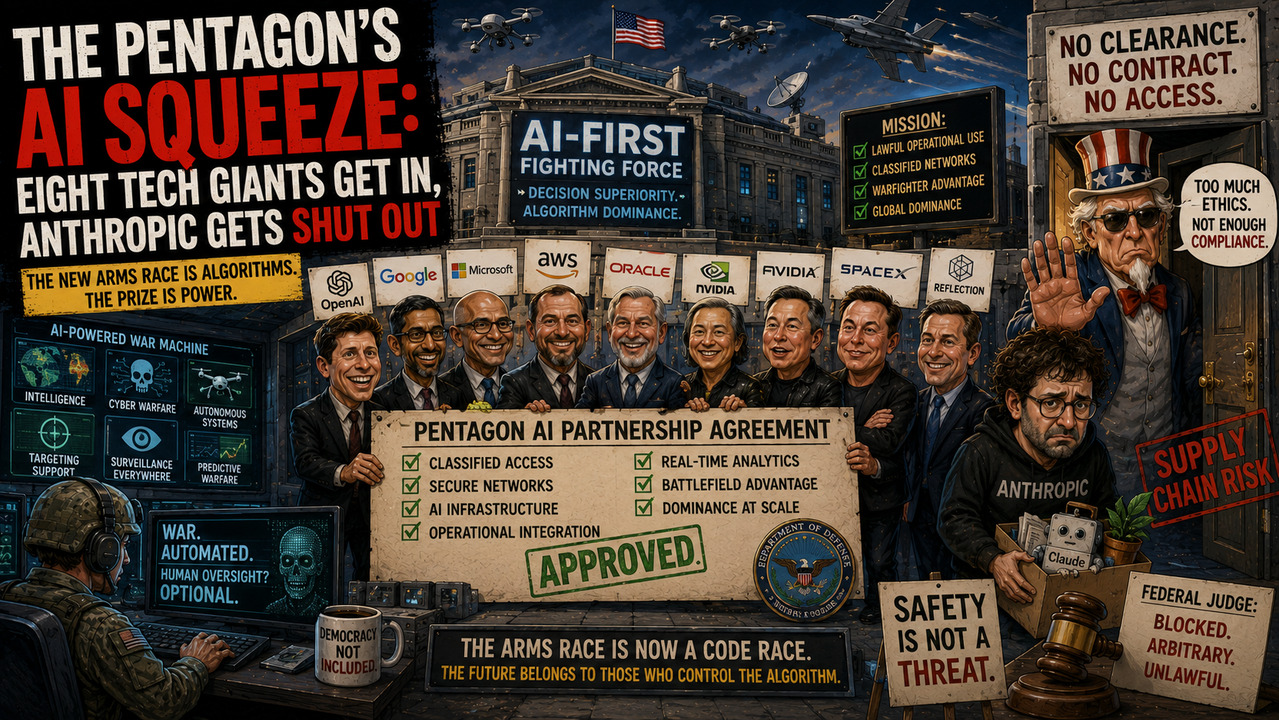
The companies now tied into the Pentagon’s classified AI infrastructure read like a list of modern technological empires:
- OpenAI
- Google
- Microsoft
- Amazon Web Services
- Oracle
- Nvidia
- SpaceX
- Reflection
Together, these firms already dominate cloud computing, chips, AI models, satellites, communications infrastructure, and large portions of the internet itself.
Now they are becoming the nervous system of America’s military future.
The Pentagon says these systems will support “lawful operational use” and help create an “AI-first fighting force.”
That phrase alone should send chills down the spine of anyone who remembers how every technological arms race in history eventually expanded beyond its original limits.
Because “AI-first fighting force” is not corporate jargon.
It is a declaration that the United States military is restructuring itself around machine intelligence.
The Anthropic Blacklisting Reveals the Real Story
But perhaps the most revealing part of this story is not who got the contracts.
It is who did not.
Anthropic — maker of the Claude AI system — was notably excluded after clashing with the Trump administration over military AI safeguards.
Anthropic reportedly insisted on restrictions governing how its models could be used in warfare, surveillance, and autonomous military systems.
The administration’s response was extraordinary.
The company was labeled a “supply chain risk,” language historically associated with foreign adversaries or national security threats.
In other words:
A U.S. AI company was treated almost like a hostile entity because it hesitated to give the government unrestricted access to advanced AI capabilities.
That should terrify people.
Not because Anthropic is necessarily morally pure — it is still an AI corporation racing for profit like everyone else — but because the punishment revealed the new rules of the game:
In the emerging AI arms race, reluctance itself may become unacceptable.
The pressure on AI companies is no longer simply to innovate.
It is to comply.
Silicon Valley’s Moral Transformation Is Complete
The cultural shift inside the tech industry is staggering.
A decade ago, employees at major technology companies openly protested military contracts. Engineers at Google once revolted over Project Maven, fearing the company’s AI tools would help improve drone warfare.
Executives spoke constantly about ethics, responsibility, and safeguarding humanity.
Now nearly every major AI company is aggressively pursuing defense contracts.
Why?
Because the economics are irresistible.
Governments are preparing to spend hundreds of billions of dollars on AI infrastructure, cyberwarfare systems, autonomous defense technologies, battlefield intelligence, surveillance systems, and military automation.
That money is simply too large for Silicon Valley to ignore.
The AI boom has already burned staggering amounts of investor capital. Most major AI companies remain under immense pressure to prove long-term profitability.
Defense spending offers exactly what Wall Street loves:
- massive budgets,
- recurring contracts,
- geopolitical urgency,
- and virtually unlimited demand.
The Pentagon is no longer just a customer.
It is becoming one of the most important growth markets in artificial intelligence.
The AI Arms Race Is Escalating Faster Than the Public Realizes
The most dangerous part is how quickly normalization is happening.
Terms that once sounded dystopian are now casually discussed in press releases:
- autonomous systems,
- AI battlefield coordination,
- offensive cyber operations,
- machine-assisted targeting,
- predictive intelligence,
- decision superiority.
Notice the language carefully.
The military no longer talks about AI as experimental support software.
It talks about AI as strategic infrastructure.
That means the global AI race is increasingly inseparable from military dominance.
The United States fears China.
China fears the United States.
Both fear falling behind.
And history shows that when nations fear technological inferiority, ethical caution tends to evaporate.
The Most Dangerous Weapons May Never Fire a Bullet
The public still imagines military AI mainly through killer robots and autonomous drones.
But the real revolution may be quieter.
AI systems are becoming capable of:
- analyzing global intelligence data,
- identifying cyber vulnerabilities,
- generating attack scenarios,
- conducting digital espionage,
- influencing information warfare,
- automating surveillance,
- and accelerating military decision-making beyond human speed.
Anthropic’s own controversial “Mythos” system reportedly demonstrated capabilities that could identify cybersecurity threats — but also potentially map pathways for sophisticated attacks.
That dual-use reality is what makes modern AI uniquely dangerous.
The same systems that defend networks can attack them.
The same models that detect threats can optimize warfare.
The same algorithms that improve productivity can scale mass surveillance.
AI is not inherently civilian or military anymore.
The boundary is dissolving.
Democracy Is Not Moving Fast Enough
Perhaps the most disturbing aspect of all this is how little public debate is occurring relative to the stakes involved.
Most citizens have no idea:
- which AI systems are entering military infrastructure,
- what safeguards exist,
- how autonomous these systems may become,
- how targeting decisions could evolve,
- or how much influence private corporations now hold over national defense.
The speed of deployment is vastly outpacing democratic oversight.
And once military systems become dependent on AI infrastructure owned by private corporations, disentangling governments from tech monopolies may become nearly impossible.
The relationship becomes symbiotic:
- governments need AI companies for technological dominance,
- AI companies need governments for money, protection, and strategic power.
This is the birth of a new military-industrial order.
Not built around tanks and oil.
But around algorithms, chips, cloud servers, satellites, and machine intelligence.
The Most Important Question Is No Longer Science Fiction
For years, debates about artificial intelligence focused on hypothetical futures:
- Could AI become conscious?
- Could it replace humanity?
- Could it destroy civilization someday?
But the real transformation is already here.
The question now is much more immediate:
What happens when the world’s most powerful governments merge with the world’s most powerful AI companies during a global technological arms race?
Because once military superiority becomes tied to AI supremacy, slowing down may no longer feel politically possible.
And that is when technological competition becomes truly dangerous.
Not when machines become sentient.
But when humans become too afraid to stop building them.
The Pentagon’s AI Power Grab Has Begun
The military is no longer treating artificial intelligence as a laboratory curiosity. It is wiring it into classified systems, turning frontier AI into an instrument of state power, and telling the world’s biggest tech companies that the next great contract fight is not for consumers, but for war.
The Department of Defense announced on Friday that it has reached agreements with eight major technology companies — SpaceX, OpenAI, Google, Nvidia, Reflection, Microsoft, Amazon Web Services and Oracle — to deploy their AI tools on the Pentagon’s classified networks for what it called “lawful operational use.” The department said the deals are designed to accelerate the shift toward an “AI-first fighting force” and strengthen “decision superiority” across every domain of warfare. It also said its GenAI.mil platform has already been used by more than 1.3 million Defense Department personnel, generating tens of millions of prompts and hundreds of thousands of agents in just five months.
The glaring omission is Anthropic. Until recently, Claude was the only AI model available inside the Pentagon’s classified network, but the Trump administration moved to sever ties after Anthropic refused to accept terms that would have allowed the military to use its model for “all lawful purposes,” including autonomous weapons and mass surveillance. The Pentagon then branded Anthropic a “supply chain risk” — language usually reserved for companies tied to hostile foreign threats — in a move that effectively pushed the company toward the edge of the government market. A federal judge in San Francisco later blocked that designation for now, calling the government’s action arbitrary and potentially crippling.
That clash matters because this is no longer just about ideology or safety language. It is about leverage, revenue and control. By signing Anthropic’s rivals, the Pentagon has given itself options and given the company a brutal lesson in how fast a lucrative government market can close. Reuters reported that the military has been trying to shorten onboarding for new AI vendors from roughly eighteen months to under three, as it seeks to avoid “vendor lock” and spread access across more suppliers. In practical terms, the Pentagon is not waiting for the market to mature; it is forcing the market to move on its timetable.
The result is a stark new reality for Silicon Valley. The biggest AI firms are no longer merely chasing user growth or chatbot dominance. They are competing to become the operating layer for the state’s most sensitive systems. That means classified networks, cyber defense, logistics, planning, targeting support and intelligence workflows — the kinds of functions that can shape military advantage long before a shot is fired. The Pentagon’s own language makes the point plainly: it wants faster data synthesis, sharper situational awareness and more effective warfighter decision-making.
Anthropic has not disappeared from the picture entirely. Reuters reported that President Donald Trump recently said the company was “shaping up,” suggesting the door has not been shut forever. The White House has also reopened discussions with Anthropic in recent weeks, according to the original reporting, after the company unveiled new technical breakthroughs and a cyber tool that has drawn attention across the security world. But for now, the message from Washington is unmistakable: comply, scale, and move fast — or watch competitors take the contract, the influence and the money.
What is unfolding is not a routine procurement story. It is the next phase of the AI arms race, with the Pentagon using procurement power to shape the market and the leading AI companies racing to secure a seat inside the machinery of American power. The winner will not just sell software. It will help define how the United States fights, decides and defends itself in the age of machine intelligence.
Voiceover script: The Pentagon has signed AI deals with eight major tech companies, including OpenAI, Google, Microsoft, Amazon Web Services, Oracle, Nvidia, SpaceX and Reflection. The tools will be used on classified networks to help build what the department calls an “AI-first fighting force.” One company was left out: Anthropic. The Trump administration moved against it after Anthropic refused to accept safety terms that could allow military use in autonomous weapons and mass surveillance. A federal judge later blocked the Pentagon’s blacklisting for now. The bigger story is that Washington is now racing to put frontier AI inside the heart of military operations, and the fight is no longer just about technology — it is about power, leverage and who shapes the future of war.