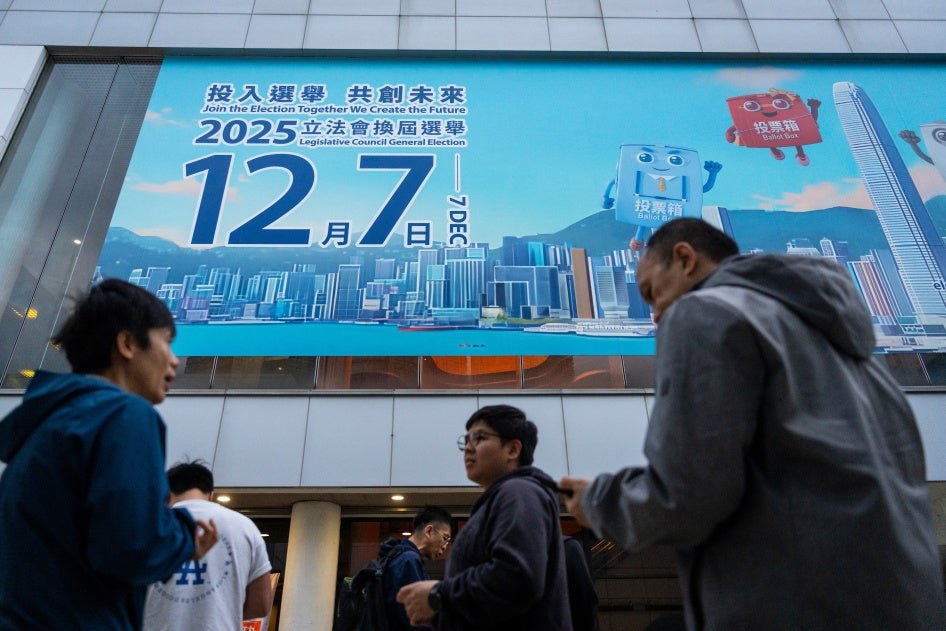
Legislative vote proceeds on December 7 despite exclusion of all pro-democracy voices and widespread public disengagement
Hong Kong is set to hold elections for its 90-seat Legislative Council on December 7 — the city’s second “patriots-only” election after the sweeping changes instituted in 2021. Observers say the upcoming vote represents the completion of Beijing’s consolidation of power over the territory’s legislature, effectively eliminating any meaningful political opposition.
Under the reforms, only candidates deemed loyal to Beijing — so-called “patriots” — are permitted to run.
Directly elected seats have been reduced from thirty-five to twenty, with the remainder filled through tightly controlled selection mechanisms.
The last remaining pro-democracy groups dissolved ahead of the candidacy deadline, leaving no independent voices in the race.
In parallel with the structural overhaul, authorities removed many long-serving pro-Beijing legislators as part of a generational reshuffle.
A dozen lawmakers aged over seventy stepped aside, citing retirement, with analysts noting that the transition appears designed to install new compliance-oriented figures with deep ties to the mainland.
The near-total exclusion of dissenting candidates has amplified domestic skepticism, with public enthusiasm at multiyear lows.
Voter registration has dropped sharply, and many residents view the upcoming vote as largely symbolic.
The election unfolds under the somber backdrop of the city’s deadliest fire in decades, which killed at least one hundred fifty-nine people days earlier.
Campaign activities have been suspended during the mourning period, further dampening turnout expectations.
For many observers, the vote marks a decisive moment in Hong Kong’s political evolution.
With the legislature now firmly aligned under Beijing’s vision and independent political activity increasingly suppressed, future policymaking is set to be dominated by a small circle of vetted loyalists aligned with the “patriots administer Hong Kong” doctrine.
Under the reforms, only candidates deemed loyal to Beijing — so-called “patriots” — are permitted to run.
Directly elected seats have been reduced from thirty-five to twenty, with the remainder filled through tightly controlled selection mechanisms.
The last remaining pro-democracy groups dissolved ahead of the candidacy deadline, leaving no independent voices in the race.
In parallel with the structural overhaul, authorities removed many long-serving pro-Beijing legislators as part of a generational reshuffle.
A dozen lawmakers aged over seventy stepped aside, citing retirement, with analysts noting that the transition appears designed to install new compliance-oriented figures with deep ties to the mainland.
The near-total exclusion of dissenting candidates has amplified domestic skepticism, with public enthusiasm at multiyear lows.
Voter registration has dropped sharply, and many residents view the upcoming vote as largely symbolic.
The election unfolds under the somber backdrop of the city’s deadliest fire in decades, which killed at least one hundred fifty-nine people days earlier.
Campaign activities have been suspended during the mourning period, further dampening turnout expectations.
For many observers, the vote marks a decisive moment in Hong Kong’s political evolution.
With the legislature now firmly aligned under Beijing’s vision and independent political activity increasingly suppressed, future policymaking is set to be dominated by a small circle of vetted loyalists aligned with the “patriots administer Hong Kong” doctrine.