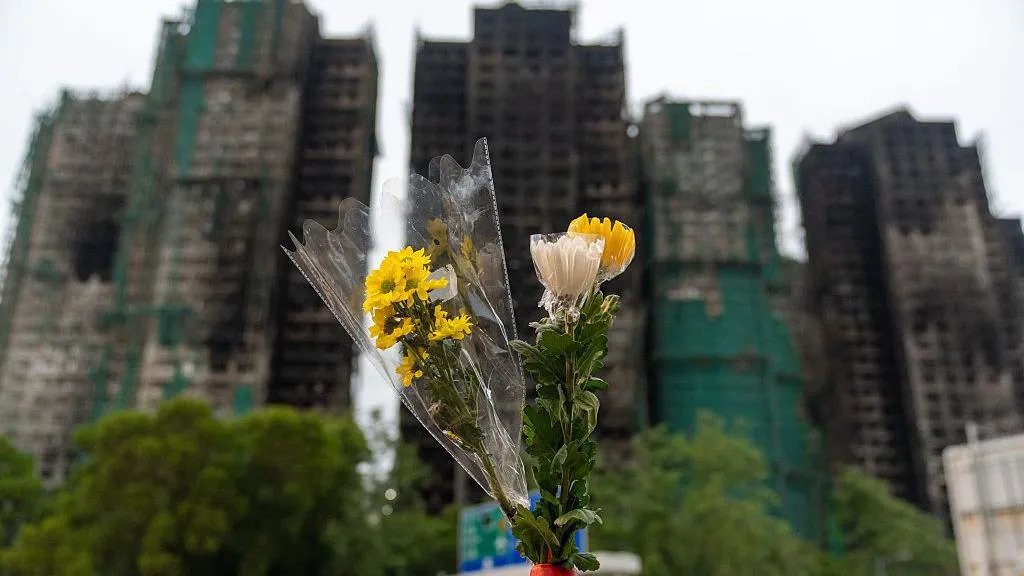
Authorities detain suspected negligent contractors and civilians calling for answers after deadly Tai Po blaze at Wang Fuk Court
A sweeping wave of arrests has followed the catastrophic fire that ravaged the Wang Fuk Court residential estate in Hong Kong’s Tai Po district, leaving well over 150 dead and intensifying public anger over safety failures and alleged negligence.
The arrests include not only construction-related personnel but also civilians calling for accountability — raising questions about the boundary between justice and suppression of dissent.
Official investigations have identified substandard building materials and shoddy renovation practices as critical causes of the blaze.
Authorities say flammable plastic scaffolding nets and foam insulation boards used during renovation greatly accelerated the spread of the fire.
They also report that fire alarms were faulty or deactivated — meaning many residents never received warning as flames engulfed seven of the estate’s eight towers.
So far, more than a dozen individuals connected to the renovation work have been detained on suspicion of manslaughter and corruption.
Among them are directors and consultants from the main contractor, Prestige Construction & Engineering Company, along with subcontractors and other staff.
In a separate development, at least two civilians — including a university student who launched an online petition calling for an independent inquiry and guaranteed support for victims — have been arrested under national-security charges for alleged “seditious intent.” Their detentions have triggered alarm among residents and rights observers, some of whom warn that citizens seeking transparency may now face the same consequences as the contractors blamed for the deadly disaster.
The city’s leader has ordered a judge-led independent inquiry into both the fire’s cause and the apparent failure of regulatory oversight.
Officials have promised sweeping reforms to building-safety inspection, scaffolding standards, and renovation-authorization procedures.
Meanwhile, displaced families and survivors — now displaced and grieving — await clarity on who is held accountable, how safety will be restored, and whether legitimate civic demands will be treated as crimes rather than rights.
The unfolding investigation may set a stark precedent: calling for accountability in a tragedy of this scale could bring severe legal consequences — even as the state prosecutes those alleged to have caused it.
The arrests include not only construction-related personnel but also civilians calling for accountability — raising questions about the boundary between justice and suppression of dissent.
Official investigations have identified substandard building materials and shoddy renovation practices as critical causes of the blaze.
Authorities say flammable plastic scaffolding nets and foam insulation boards used during renovation greatly accelerated the spread of the fire.
They also report that fire alarms were faulty or deactivated — meaning many residents never received warning as flames engulfed seven of the estate’s eight towers.
So far, more than a dozen individuals connected to the renovation work have been detained on suspicion of manslaughter and corruption.
Among them are directors and consultants from the main contractor, Prestige Construction & Engineering Company, along with subcontractors and other staff.
In a separate development, at least two civilians — including a university student who launched an online petition calling for an independent inquiry and guaranteed support for victims — have been arrested under national-security charges for alleged “seditious intent.” Their detentions have triggered alarm among residents and rights observers, some of whom warn that citizens seeking transparency may now face the same consequences as the contractors blamed for the deadly disaster.
The city’s leader has ordered a judge-led independent inquiry into both the fire’s cause and the apparent failure of regulatory oversight.
Officials have promised sweeping reforms to building-safety inspection, scaffolding standards, and renovation-authorization procedures.
Meanwhile, displaced families and survivors — now displaced and grieving — await clarity on who is held accountable, how safety will be restored, and whether legitimate civic demands will be treated as crimes rather than rights.
The unfolding investigation may set a stark precedent: calling for accountability in a tragedy of this scale could bring severe legal consequences — even as the state prosecutes those alleged to have caused it.