Deadly blaze at Tai Po’s Wang Fuk Court raises public anger; arrests under national-security law follow calls for accountability
A catastrophic fire at the Wang Fuk Court housing estate in Hong Kong’s Tai Po district has rapidly transformed into both a crisis of building safety and a flashpoint in political tensions.
As the death toll climbs past 150 and investigations expose the use of dangerously flammable materials, authorities have moved swiftly — arresting renovation contractors and, separately, individuals calling for an independent probe under national-security laws.
Many view the crackdown as aimed at suppressing dissent and limiting public scrutiny amid mounting outrage.
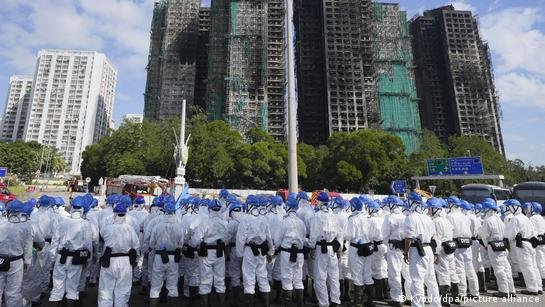
The blaze — the deadliest in decades — engulfed seven of the estate’s eight towers late November.
Investigators found substandard netting and foam insulation on scaffolding, major fire-alarm failures and ignored warnings about hazards.
The city’s leader ordered a judge-led inquiry into the causes of the fire and oversight failures, as nearly 2,500 residents remain displaced and hundreds remain missing or unaccounted for.
Simultaneously, police have arrested multiple people on manslaughter and corruption charges linked to the renovation, but also detained at least two civilians for allegedly inciting hatred against the government — raising fears that the disaster is being used to justify broader enforcement of sweeping national-security measures.
Critics warn that the move threatens civil-liberties protections and signals shrinking space for public accountability.
Beijing has backed the crackdown.
The Hong Kong security chief defended the actions as necessary to “protect national security,” while central authorities ordered a sweeping fire-safety inspection across mainland and Hong Kong high-rises.
Experts and residents caution, however, that unless deeper problems — lax regulation, enforcement failures and construction corruption — are addressed, the risk of similar tragedies remains high.
For many in Hong Kong, the fire represents more than a tragedy.
It is now a measuring stick for whether the city’s institutions still uphold public safety and transparency — or whether security concerns and political control have begun to override them.
As the death toll climbs past 150 and investigations expose the use of dangerously flammable materials, authorities have moved swiftly — arresting renovation contractors and, separately, individuals calling for an independent probe under national-security laws.
Many view the crackdown as aimed at suppressing dissent and limiting public scrutiny amid mounting outrage.
The blaze — the deadliest in decades — engulfed seven of the estate’s eight towers late November.
Investigators found substandard netting and foam insulation on scaffolding, major fire-alarm failures and ignored warnings about hazards.
The city’s leader ordered a judge-led inquiry into the causes of the fire and oversight failures, as nearly 2,500 residents remain displaced and hundreds remain missing or unaccounted for.
Simultaneously, police have arrested multiple people on manslaughter and corruption charges linked to the renovation, but also detained at least two civilians for allegedly inciting hatred against the government — raising fears that the disaster is being used to justify broader enforcement of sweeping national-security measures.
Critics warn that the move threatens civil-liberties protections and signals shrinking space for public accountability.
Beijing has backed the crackdown.
The Hong Kong security chief defended the actions as necessary to “protect national security,” while central authorities ordered a sweeping fire-safety inspection across mainland and Hong Kong high-rises.
Experts and residents caution, however, that unless deeper problems — lax regulation, enforcement failures and construction corruption — are addressed, the risk of similar tragedies remains high.
For many in Hong Kong, the fire represents more than a tragedy.
It is now a measuring stick for whether the city’s institutions still uphold public safety and transparency — or whether security concerns and political control have begun to override them.