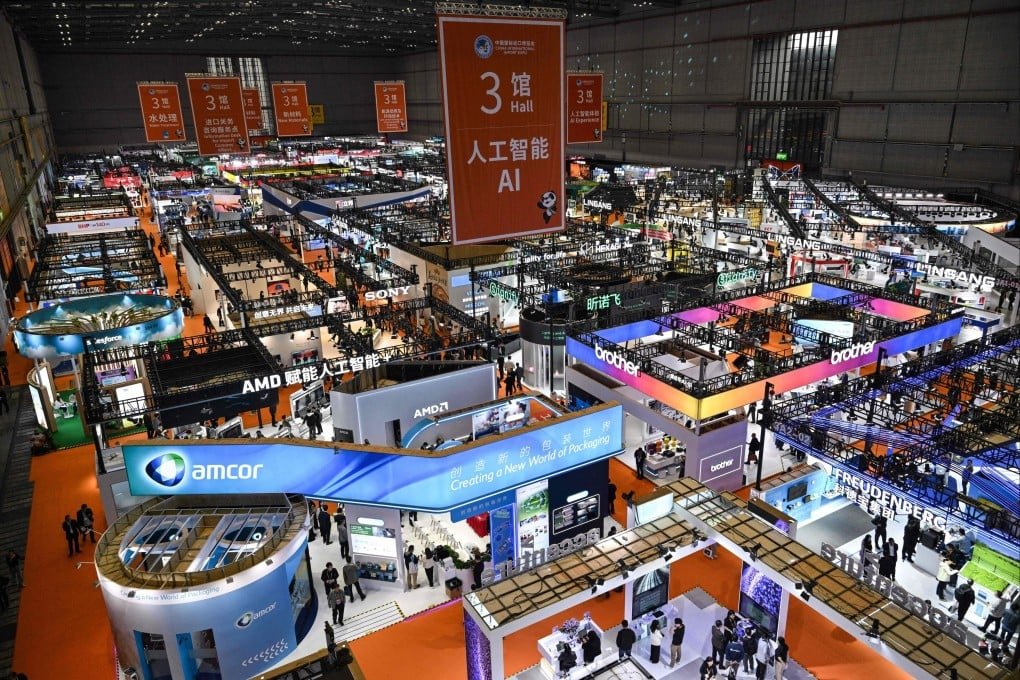
Hong Kong firms say the import expo has opened new investor links and manufacturing partnerships with mainland counterparts
Hong Kong-based exhibitors at the eighth China International Import Expo (CIIE) in Shanghai report that the event has become a critical gateway to mainland Chinese manufacturing and distribution opportunities.
Participants said they leveraged the fair not just for product showcasing but for securing investment inquiries and manufacturing collaborations.
One standout example is the Hong Kong start-up HairCoSys, which uses artificial-intelligence to analyse hair quality.
Founder Wong Ho-yin said that the company met large mainland investors, including private clinics, who expressed interest in their system during the exhibition.
He described the event as a “golden chance” to promote his business among corporate buyers rather than individual consumers.
HairCoSys, backed by the HK Tech 300 innovation programme of City University of Hong Kong, told how the CIIE enabled access to mainland clients such as salons and medical-beauty chains—markets the firm found previously difficult to penetrate.
The opportunity reflects a broader trend as Hong Kong firms use the expo to position themselves as bridges between global innovation and the mainland consumer-industrial ecosystem.
Hong Kong’s government and trade-body delegations underscore the city’s role as a “super-connector” under the “one country, two systems” framework.
At the CIIE opening, the city’s Chief Executive visited the Hong Kong Pavilion and highlighted that a record number of local enterprises are participating this year underlining confidence in using the platform to expand into high-growth mainland sectors.
Exhibitors at the CIIE said the event’s value lies not only in booth traffic but also in post-show match-making: from negotiations with manufacturers to inbound investment leads for eastern-manufacturing hubs.
One Hong Kong-based consultant specialising in cross-border services observed that the CIIE has evolved beyond an exhibition into an investment-launch and market-entry platform.
As Hong Kong firms prepare for the next edition of the expo, the emphasis is shifting from pure export to deeper integration: leveraging Hong Kong’s financial, regulatory and service-ecosystem strengths to connect mainland Chinese manufacturers with global markets.
Local participants say that this multi-sector, mainland-focused approach at the CIIE is helping redefine the city’s brand as not only “Made in Hong Kong” but “Connect via Hong Kong to China and beyond.”
Sources familiar with the arrangements indicate that over 380 Hong Kong enterprises are expected at the upcoming CIIE—another increase on previous editions—signaling the city’s ambition to further support their mainland-market access and international expansion plans.
Participants said they leveraged the fair not just for product showcasing but for securing investment inquiries and manufacturing collaborations.
One standout example is the Hong Kong start-up HairCoSys, which uses artificial-intelligence to analyse hair quality.
Founder Wong Ho-yin said that the company met large mainland investors, including private clinics, who expressed interest in their system during the exhibition.
He described the event as a “golden chance” to promote his business among corporate buyers rather than individual consumers.
HairCoSys, backed by the HK Tech 300 innovation programme of City University of Hong Kong, told how the CIIE enabled access to mainland clients such as salons and medical-beauty chains—markets the firm found previously difficult to penetrate.
The opportunity reflects a broader trend as Hong Kong firms use the expo to position themselves as bridges between global innovation and the mainland consumer-industrial ecosystem.
Hong Kong’s government and trade-body delegations underscore the city’s role as a “super-connector” under the “one country, two systems” framework.
At the CIIE opening, the city’s Chief Executive visited the Hong Kong Pavilion and highlighted that a record number of local enterprises are participating this year underlining confidence in using the platform to expand into high-growth mainland sectors.
Exhibitors at the CIIE said the event’s value lies not only in booth traffic but also in post-show match-making: from negotiations with manufacturers to inbound investment leads for eastern-manufacturing hubs.
One Hong Kong-based consultant specialising in cross-border services observed that the CIIE has evolved beyond an exhibition into an investment-launch and market-entry platform.
As Hong Kong firms prepare for the next edition of the expo, the emphasis is shifting from pure export to deeper integration: leveraging Hong Kong’s financial, regulatory and service-ecosystem strengths to connect mainland Chinese manufacturers with global markets.
Local participants say that this multi-sector, mainland-focused approach at the CIIE is helping redefine the city’s brand as not only “Made in Hong Kong” but “Connect via Hong Kong to China and beyond.”
Sources familiar with the arrangements indicate that over 380 Hong Kong enterprises are expected at the upcoming CIIE—another increase on previous editions—signaling the city’s ambition to further support their mainland-market access and international expansion plans.