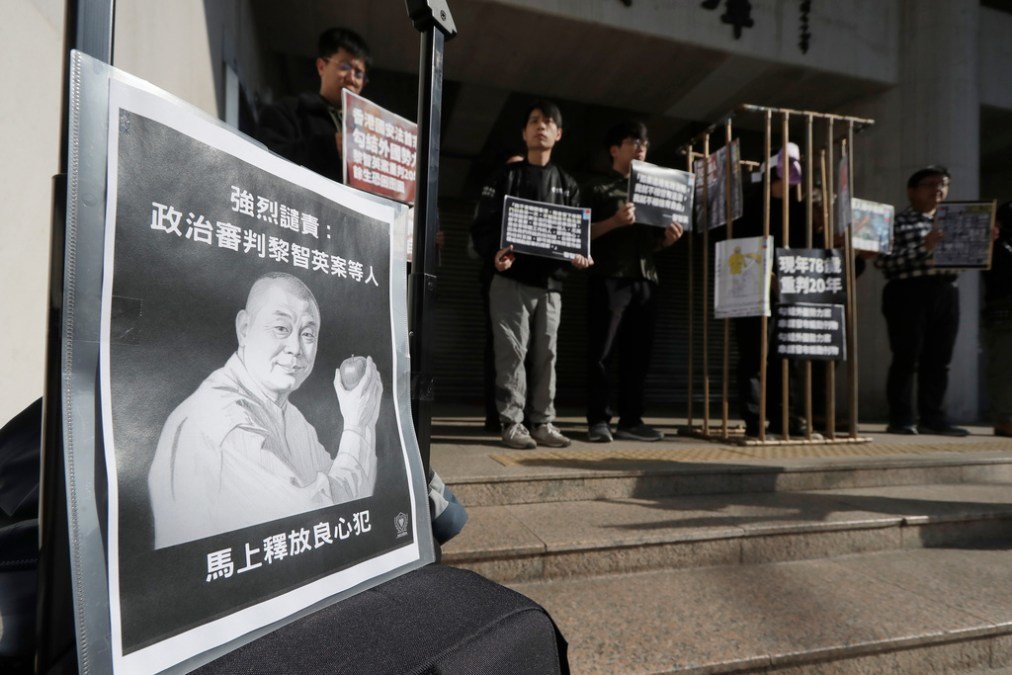
Taiwanese leaders and civic groups interpret the landmark prison term as evidence of risks to civil liberties and democratic freedoms under Beijing’s model.
Pro-democracy media tycoon Jimmy Lai’s sentencing to twenty years in prison under Hong Kong’s national security legislation has reverberated across Taiwan, where politicians, activists and analysts framed the ruling as a stark signal about the vulnerabilities of civil liberties under the “one country, two systems” framework.
Lai, aged seventy-eight, was convicted of conspiring to collude with foreign forces and publishing seditious materials, marking the harshest sentence yet under the security law since its enactment in 2020. His punishment has drawn international scrutiny and domestic condemnation in Taiwan, where authorities said the outcome not only strips him of personal liberty but also undermines freedoms of speech and press once protected in Hong Kong.
Taiwan’s Mainland Affairs Council described the ruling as trampling basic rights and urged citizens to see Lai’s fate as a caution for their own hard-won democratic system.
Taiwan’s president said the sentence exposed the security law as a tool of political persecution that imperils universal rights and freedoms.
The government’s response underscored deep scepticism about the viability of “one country, two systems” as a model for Taiwan’s future, noting that the framework was originally promoted to facilitate peaceful reunification but has instead coincided with an erosion of promised autonomy in Hong Kong, according to analysts.
Civic groups, including Hong Kong exiles residing in Taiwan, rallied outside the legislature to express solidarity with Lai and protest what they described as politically motivated repression.
They warned that China’s expansive interpretation of security offences could be used to constrict public discourse, academic exchange and civil society on the island.
Lai’s sentence has also prompted international reactions, with human rights groups and foreign governments urging respect for freedoms and calling for his release while China and Hong Kong authorities insisted the ruling reflected legitimate enforcement of national security.
The case has become a pivotal reference point in cross-strait discourse over democratic resilience, press freedom and the limits of Beijing’s influence beyond its jurisdiction.
Lai, aged seventy-eight, was convicted of conspiring to collude with foreign forces and publishing seditious materials, marking the harshest sentence yet under the security law since its enactment in 2020. His punishment has drawn international scrutiny and domestic condemnation in Taiwan, where authorities said the outcome not only strips him of personal liberty but also undermines freedoms of speech and press once protected in Hong Kong.
Taiwan’s Mainland Affairs Council described the ruling as trampling basic rights and urged citizens to see Lai’s fate as a caution for their own hard-won democratic system.
Taiwan’s president said the sentence exposed the security law as a tool of political persecution that imperils universal rights and freedoms.
The government’s response underscored deep scepticism about the viability of “one country, two systems” as a model for Taiwan’s future, noting that the framework was originally promoted to facilitate peaceful reunification but has instead coincided with an erosion of promised autonomy in Hong Kong, according to analysts.
Civic groups, including Hong Kong exiles residing in Taiwan, rallied outside the legislature to express solidarity with Lai and protest what they described as politically motivated repression.
They warned that China’s expansive interpretation of security offences could be used to constrict public discourse, academic exchange and civil society on the island.
Lai’s sentence has also prompted international reactions, with human rights groups and foreign governments urging respect for freedoms and calling for his release while China and Hong Kong authorities insisted the ruling reflected legitimate enforcement of national security.
The case has become a pivotal reference point in cross-strait discourse over democratic resilience, press freedom and the limits of Beijing’s influence beyond its jurisdiction.