An AI system named PackingStar delivers record results on a classic geometry challenge with implications for data storage and telecommunications.
Chinese scientists say they have achieved record-breaking advances on a more than three-century-old mathematical puzzle by harnessing artificial intelligence, marking a significant step forward in high-dimensional geometry research.
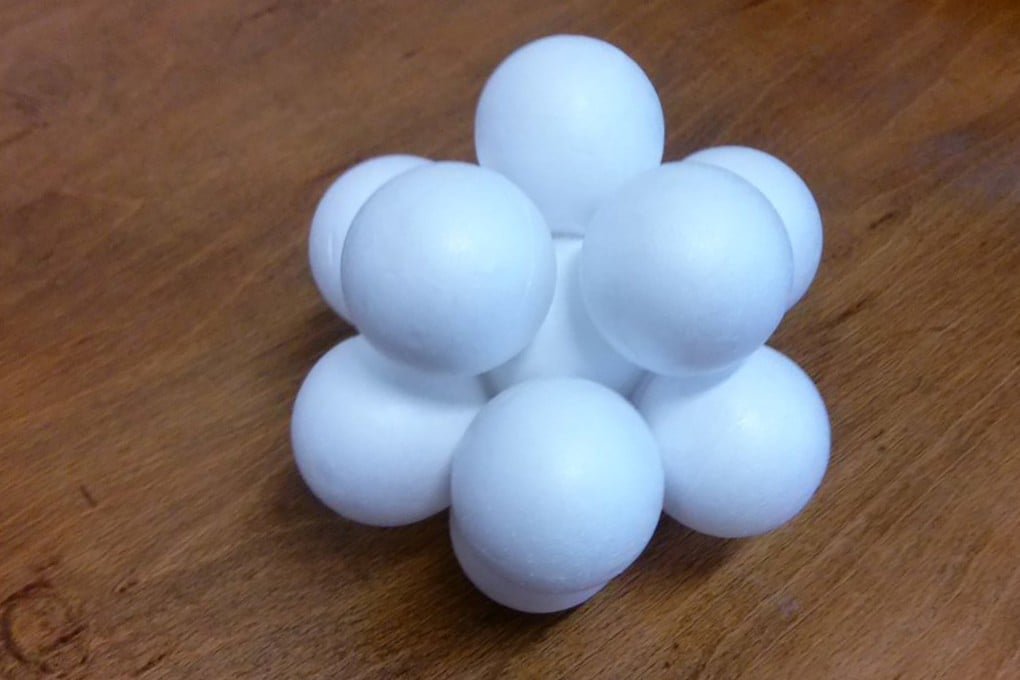
The team used an AI system called PackingStar to tackle the “kissing number” problem, a long-standing challenge in geometry that asks how many non-overlapping spheres can simultaneously touch a central sphere.
First debated in 1694 by English polymath Isaac Newton and Scottish mathematician David Gregory, the problem has remained notoriously difficult to solve in higher dimensions.
According to a research paper published in November on the open-access repository arXiv, the AI-driven approach enabled the researchers to surpass what they described as the limits of human geometric intuition and conventional computing techniques.
The work has not yet undergone peer review.
The researchers, drawn from Peking University, Fudan University and the Shanghai Academy of AI for Science, said their results demonstrated AI’s ability to navigate and analyse complex, high-dimensional spaces that are often beyond traditional mathematical reasoning.
In a video released by Peking University, the team described their collaboration with the system as a “romance” between scientists and machines exploring science together.
The kissing number problem is of more than theoretical interest.
Advances in understanding sphere packings and high-dimensional configurations have applications in coding theory, large-scale data storage and advanced telecommunications, where efficient signal transmission and error correction depend on optimal geometric arrangements.
By combining machine-driven search strategies with human mathematical oversight, the researchers reported establishing new lower bounds in specific high-dimensional cases, pushing beyond previously known results.
They argued that the findings highlight how artificial intelligence can reshape established mathematical intuitions and accelerate progress on problems that have resisted solution for centuries.
The work contributes to a growing body of research in which AI systems are deployed not merely as computational tools but as active partners in mathematical discovery, offering fresh perspectives on classical problems.
The team used an AI system called PackingStar to tackle the “kissing number” problem, a long-standing challenge in geometry that asks how many non-overlapping spheres can simultaneously touch a central sphere.
First debated in 1694 by English polymath Isaac Newton and Scottish mathematician David Gregory, the problem has remained notoriously difficult to solve in higher dimensions.
According to a research paper published in November on the open-access repository arXiv, the AI-driven approach enabled the researchers to surpass what they described as the limits of human geometric intuition and conventional computing techniques.
The work has not yet undergone peer review.
The researchers, drawn from Peking University, Fudan University and the Shanghai Academy of AI for Science, said their results demonstrated AI’s ability to navigate and analyse complex, high-dimensional spaces that are often beyond traditional mathematical reasoning.
In a video released by Peking University, the team described their collaboration with the system as a “romance” between scientists and machines exploring science together.
The kissing number problem is of more than theoretical interest.
Advances in understanding sphere packings and high-dimensional configurations have applications in coding theory, large-scale data storage and advanced telecommunications, where efficient signal transmission and error correction depend on optimal geometric arrangements.
By combining machine-driven search strategies with human mathematical oversight, the researchers reported establishing new lower bounds in specific high-dimensional cases, pushing beyond previously known results.
They argued that the findings highlight how artificial intelligence can reshape established mathematical intuitions and accelerate progress on problems that have resisted solution for centuries.
The work contributes to a growing body of research in which AI systems are deployed not merely as computational tools but as active partners in mathematical discovery, offering fresh perspectives on classical problems.