Global nickel prices fell after reports that Indonesia could raise production quotas at major mines, although the Energy and Mineral Resources Ministry said any increase remains under review and must be aligned with long-term downstream manufacturing capacity.
As data centres multiply, technology companies are competing for electricity, grid connections and round-the-clock generation.
Nvidia may supply the chips that power much of the artificial-intelligence boom, but no company “owns” AI. The industry depends on a longer chain: chip designers, cloud providers, data-centre builders, network operators, utilities, fuel suppliers, grid planners and governments that decide where new power lines and generation can be built.
Increasingly, the scarce part of that chain is electricity that is available in the right place, at the right time.
AI runs in data centres: large buildings packed with servers, networking equipment and cooling systems.
Training and operating advanced models requires vast clusters of specialised chips working continuously.
The chips are expensive, but they cannot produce an answer, image or prediction without power and a connection to the grid.
The scale is moving quickly.
The International Energy Agency projects global electricity use by data centres will rise from about 460 terawatt-hours in 2024 to more than 1,000 terawatt-hours in 2030 in its base-case outlook.
A terawatt-hour is one billion kilowatt-hours.
The agency’s projection is not a certainty; it depends on how rapidly AI is adopted, how efficiently systems improve and how much infrastructure actually gets built.
But it captures a change already visible in utility planning: data centres are becoming major industrial customers.
That changes who has leverage.
A leading chipmaker profits when customers buy more computing equipment.
A cloud company profits when it rents that computing capacity.
But an AI campus also needs land, substations, transmission lines, water or other cooling arrangements, permits and long-term electricity contracts.
A project can have financing and a queue of customers yet still wait years for a grid connection.
The result is a rush for dependable power.
Technology companies have pursued renewable-energy contracts, natural-gas-backed capacity and nuclear agreements in an effort to secure electricity with lower carbon emissions and around-the-clock availability.
Microsoft’s 20-year agreement with Constellation is intended to support the restart of Unit 1 at Pennsylvania’s Three Mile Island site, now called the Crane Clean Energy Center.
Constellation has said the restarted unit could add about 835 megawatts of carbon-free capacity to the grid, subject to the work and approvals required for a planned 2027 return.
Google has made a separate agreement with Kairos Power to develop a fleet of advanced nuclear projects totaling 500 megawatts by 2035. That agreement is a pathway, not power already flowing to data centres.
Its value lies in what it signals: large technology companies are no longer treating electricity as a routine bill paid after construction.
They are trying to help secure future generation years before their data centres need it.
Utilities are central to this story, but they do not simply own an unlimited reservoir of electrons.
They must balance new industrial demand with reliability for homes, hospitals and existing businesses.
New transmission and generation can take years to permit and construct.
In some regions, the cost of grid upgrades and the terms for connecting large new loads are becoming contentious public questions.
There is also a climate tension.
AI can help utilities forecast demand, manage grids and improve industrial efficiency.
At the same time, a rapid buildout of data centres can increase demand for gas-fired generation where clean power and transmission are not ready.
Whether AI’s energy footprint becomes cleaner or dirtier will depend less on slogans than on the generation mix, the speed of grid construction and the efficiency of the models and hardware being deployed.
The more accurate answer to who profits from AI is therefore plural.
Nvidia remains a critical supplier, while cloud platforms sell access to compute and data-centre developers build the physical factories of the AI economy.
But electricity providers, grid owners, nuclear developers, renewable developers and equipment makers are becoming indispensable partners.
The next AI race will be fought not only over faster chips, but over who can deliver reliable power to the places where those chips are installed.
Increasingly, the scarce part of that chain is electricity that is available in the right place, at the right time.
AI runs in data centres: large buildings packed with servers, networking equipment and cooling systems.
Training and operating advanced models requires vast clusters of specialised chips working continuously.
The chips are expensive, but they cannot produce an answer, image or prediction without power and a connection to the grid.
The scale is moving quickly.
The International Energy Agency projects global electricity use by data centres will rise from about 460 terawatt-hours in 2024 to more than 1,000 terawatt-hours in 2030 in its base-case outlook.
A terawatt-hour is one billion kilowatt-hours.
The agency’s projection is not a certainty; it depends on how rapidly AI is adopted, how efficiently systems improve and how much infrastructure actually gets built.
But it captures a change already visible in utility planning: data centres are becoming major industrial customers.
That changes who has leverage.
A leading chipmaker profits when customers buy more computing equipment.
A cloud company profits when it rents that computing capacity.
But an AI campus also needs land, substations, transmission lines, water or other cooling arrangements, permits and long-term electricity contracts.
A project can have financing and a queue of customers yet still wait years for a grid connection.
The result is a rush for dependable power.
Technology companies have pursued renewable-energy contracts, natural-gas-backed capacity and nuclear agreements in an effort to secure electricity with lower carbon emissions and around-the-clock availability.
Microsoft’s 20-year agreement with Constellation is intended to support the restart of Unit 1 at Pennsylvania’s Three Mile Island site, now called the Crane Clean Energy Center.
Constellation has said the restarted unit could add about 835 megawatts of carbon-free capacity to the grid, subject to the work and approvals required for a planned 2027 return.
Google has made a separate agreement with Kairos Power to develop a fleet of advanced nuclear projects totaling 500 megawatts by 2035. That agreement is a pathway, not power already flowing to data centres.
Its value lies in what it signals: large technology companies are no longer treating electricity as a routine bill paid after construction.
They are trying to help secure future generation years before their data centres need it.
Utilities are central to this story, but they do not simply own an unlimited reservoir of electrons.
They must balance new industrial demand with reliability for homes, hospitals and existing businesses.
New transmission and generation can take years to permit and construct.
In some regions, the cost of grid upgrades and the terms for connecting large new loads are becoming contentious public questions.
There is also a climate tension.
AI can help utilities forecast demand, manage grids and improve industrial efficiency.
At the same time, a rapid buildout of data centres can increase demand for gas-fired generation where clean power and transmission are not ready.
Whether AI’s energy footprint becomes cleaner or dirtier will depend less on slogans than on the generation mix, the speed of grid construction and the efficiency of the models and hardware being deployed.
The more accurate answer to who profits from AI is therefore plural.
Nvidia remains a critical supplier, while cloud platforms sell access to compute and data-centre developers build the physical factories of the AI economy.
But electricity providers, grid owners, nuclear developers, renewable developers and equipment makers are becoming indispensable partners.
The next AI race will be fought not only over faster chips, but over who can deliver reliable power to the places where those chips are installed.
The company founded by Jensen Huang built machines that can do many small calculations at once—exactly what modern artificial intelligence needs.
Nvidia became one of the world’s most valuable technology companies by making a type of computer chip that was originally designed to make video games look better.
Its decisive advantage was not that it invented artificial intelligence, but that it spent decades building hardware and software unusually well suited to the enormous amount of calculation that modern AI requires.
The simple version is this: a traditional computer processor is like one very clever worker handling jobs in sequence.
An Nvidia graphics processing unit, or GPU, is like a vast team of less specialised workers handling many small jobs at the same time.
That is useful for drawing millions of pixels on a screen.
It is also useful for training neural networks, which improve by repeating huge numbers of mathematical operations across vast datasets.
Jensen Huang co-founded Nvidia in 1993. The company first made chips for computer graphics, then introduced what it called the GPU in 1999. Its central bet was that computing would not always rely on one all-purpose processor doing most of the work.
Some problems, especially visual and scientific ones, could be accelerated by sending thousands of similar calculations to a processor built for parallel work.
For years, that idea was most visible in gaming.
Players wanted smoother movement, more detailed landscapes and more lifelike lighting.
Nvidia supplied the machinery.
But the company also built CUDA, a software platform introduced in 2006 that allowed programmers to use its graphics chips for work beyond graphics.
This was the less glamorous but crucial part of the strategy: a powerful chip is far more valuable when developers have tools, libraries and a reason to build their work around it.
The significance of that foundation became unmistakable in 2012. A neural network called AlexNet used Nvidia GPUs to win the ImageNet image-recognition competition by a striking margin.
The result helped demonstrate that deep learning could outperform older, hand-crafted approaches to recognizing images.
It also showed researchers and companies that the chips sitting in gaming computers could become engines for a very different kind of computing.
That shift eventually transformed Nvidia’s business.
Generative AI systems, recommendation engines, scientific models and large cloud services all require immense quantities of parallel computation.
Nvidia’s data-center products now combine GPUs with networking equipment and software, enabling customers to assemble large systems rather than merely buy individual chips.
The scale is visible in its latest reported results.
For the first quarter of fiscal 2027, which ended April 26, 2026, Nvidia reported $81.6 billion in revenue.
Its data-center division accounted for $75.2 billion of that total.
Those figures explain why the company’s fortunes are now tied far more closely to the global race to build AI infrastructure than to the gaming market that made its name.
The success is not automatic or permanent.
Nvidia faces intense competition, supply-chain dependence, export restrictions and customers with strong incentives to design their own chips.
AI demand can also change quickly if the economics of building and running large models change.
Yet the company’s position rests on more than a fast chip.
It rests on an ecosystem that took years to assemble: hardware, networking, software, developer tools and a generation of engineers who learned to make their programs run on Nvidia machines.
That is the real explanation for Nvidia’s rise.
It did not simply catch an AI wave.
It built much of the computational machinery that made the wave possible, then found itself holding the bottleneck when the rest of the technology industry rushed to use it.
Its decisive advantage was not that it invented artificial intelligence, but that it spent decades building hardware and software unusually well suited to the enormous amount of calculation that modern AI requires.
The simple version is this: a traditional computer processor is like one very clever worker handling jobs in sequence.
An Nvidia graphics processing unit, or GPU, is like a vast team of less specialised workers handling many small jobs at the same time.
That is useful for drawing millions of pixels on a screen.
It is also useful for training neural networks, which improve by repeating huge numbers of mathematical operations across vast datasets.
Jensen Huang co-founded Nvidia in 1993. The company first made chips for computer graphics, then introduced what it called the GPU in 1999. Its central bet was that computing would not always rely on one all-purpose processor doing most of the work.
Some problems, especially visual and scientific ones, could be accelerated by sending thousands of similar calculations to a processor built for parallel work.
For years, that idea was most visible in gaming.
Players wanted smoother movement, more detailed landscapes and more lifelike lighting.
Nvidia supplied the machinery.
But the company also built CUDA, a software platform introduced in 2006 that allowed programmers to use its graphics chips for work beyond graphics.
This was the less glamorous but crucial part of the strategy: a powerful chip is far more valuable when developers have tools, libraries and a reason to build their work around it.
The significance of that foundation became unmistakable in 2012. A neural network called AlexNet used Nvidia GPUs to win the ImageNet image-recognition competition by a striking margin.
The result helped demonstrate that deep learning could outperform older, hand-crafted approaches to recognizing images.
It also showed researchers and companies that the chips sitting in gaming computers could become engines for a very different kind of computing.
That shift eventually transformed Nvidia’s business.
Generative AI systems, recommendation engines, scientific models and large cloud services all require immense quantities of parallel computation.
Nvidia’s data-center products now combine GPUs with networking equipment and software, enabling customers to assemble large systems rather than merely buy individual chips.
The scale is visible in its latest reported results.
For the first quarter of fiscal 2027, which ended April 26, 2026, Nvidia reported $81.6 billion in revenue.
Its data-center division accounted for $75.2 billion of that total.
Those figures explain why the company’s fortunes are now tied far more closely to the global race to build AI infrastructure than to the gaming market that made its name.
The success is not automatic or permanent.
Nvidia faces intense competition, supply-chain dependence, export restrictions and customers with strong incentives to design their own chips.
AI demand can also change quickly if the economics of building and running large models change.
Yet the company’s position rests on more than a fast chip.
It rests on an ecosystem that took years to assemble: hardware, networking, software, developer tools and a generation of engineers who learned to make their programs run on Nvidia machines.
That is the real explanation for Nvidia’s rise.
It did not simply catch an AI wave.
It built much of the computational machinery that made the wave possible, then found itself holding the bottleneck when the rest of the technology industry rushed to use it.

The former president’s son described the advanced prostate cancer as painful and debilitating, while public details of his current condition remain limited.
Former President Joe Biden’s prostate cancer has spread beyond his bones and is causing substantial pain and weakness, his son Hunter Biden said in a recent BBC interview, offering the most personal public account yet of the illness’s impact on the family.
Joe Biden’s office announced in May 2025 that he had been diagnosed with an aggressive form of prostate cancer.
The statement said the cancer had a Gleason score of 9, placing it among the highest-grade forms of the disease, and that it had metastasized to bone.
It also said the cancer appeared hormone-sensitive, a characteristic that can make it responsive to treatment.
In October 2025, a spokesperson said Biden was receiving radiation therapy and hormone treatment as part of his care.
Those announcements established the seriousness of the diagnosis but gave little detail about his day-to-day condition or long-term outlook.
Hunter Biden’s interview added a more intimate description.
He said the cancer had spread into his father’s bones and further, and called the disease very painful and debilitating.
His comments are a family account rather than a formal medical update.
Biden’s medical team has not publicly set out where any additional disease has been identified, whether his treatment has changed, or how the cancer is responding.
That distinction matters.
Metastatic prostate cancer can follow very different courses from one patient to another.
Its management depends on the extent and location of the disease, response to hormone therapy and other treatments, symptoms, and a patient’s general health.
Public information does not allow an independent assessment of Joe Biden’s prognosis.
The interview also returned attention to Biden’s difficult June 2024 debate performance against Donald Trump, after which he withdrew from the presidential race.
Hunter Biden said he had been alarmed by the appearance and believed his father had been physically exhausted from extensive travel.
He also wondered whether the cancer diagnosed the following year might already have been affecting him.
No public medical evidence has established that the disease caused or contributed to the debate performance.
Hunter Biden also discussed the presidential pardon his father granted him shortly before leaving office.
He described the decision as harmful to his father’s public legacy while defending it as an act of parental loyalty.
The pardon covered federal gun and tax cases connected to Hunter Biden’s past drug use and was issued before sentencing.
The confirmed record remains clear: Joe Biden has an aggressive, metastatic prostate cancer diagnosis that was disclosed in 2025; radiation and hormone treatment were later confirmed; and his son has now described the illness as painful and debilitating.
Any fuller account of his current health will depend on further information from Biden or his medical team.
Joe Biden’s office announced in May 2025 that he had been diagnosed with an aggressive form of prostate cancer.
The statement said the cancer had a Gleason score of 9, placing it among the highest-grade forms of the disease, and that it had metastasized to bone.
It also said the cancer appeared hormone-sensitive, a characteristic that can make it responsive to treatment.
In October 2025, a spokesperson said Biden was receiving radiation therapy and hormone treatment as part of his care.
Those announcements established the seriousness of the diagnosis but gave little detail about his day-to-day condition or long-term outlook.
Hunter Biden’s interview added a more intimate description.
He said the cancer had spread into his father’s bones and further, and called the disease very painful and debilitating.
His comments are a family account rather than a formal medical update.
Biden’s medical team has not publicly set out where any additional disease has been identified, whether his treatment has changed, or how the cancer is responding.
That distinction matters.
Metastatic prostate cancer can follow very different courses from one patient to another.
Its management depends on the extent and location of the disease, response to hormone therapy and other treatments, symptoms, and a patient’s general health.
Public information does not allow an independent assessment of Joe Biden’s prognosis.
The interview also returned attention to Biden’s difficult June 2024 debate performance against Donald Trump, after which he withdrew from the presidential race.
Hunter Biden said he had been alarmed by the appearance and believed his father had been physically exhausted from extensive travel.
He also wondered whether the cancer diagnosed the following year might already have been affecting him.
No public medical evidence has established that the disease caused or contributed to the debate performance.
Hunter Biden also discussed the presidential pardon his father granted him shortly before leaving office.
He described the decision as harmful to his father’s public legacy while defending it as an act of parental loyalty.
The pardon covered federal gun and tax cases connected to Hunter Biden’s past drug use and was issued before sentencing.
The confirmed record remains clear: Joe Biden has an aggressive, metastatic prostate cancer diagnosis that was disclosed in 2025; radiation and hormone treatment were later confirmed; and his son has now described the illness as painful and debilitating.
Any fuller account of his current health will depend on further information from Biden or his medical team.
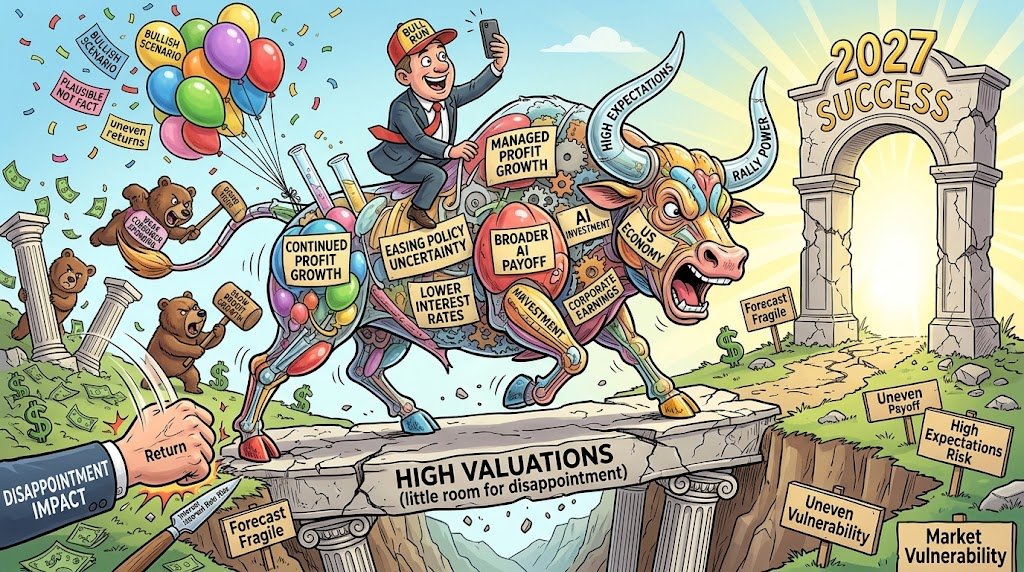
A bullish case rests on continued profit growth, easing policy uncertainty and a broader payoff from AI investment; high valuations leave little room for disappointment.
The case for a strong stock market in 2027 begins with corporate earnings.
Share prices ultimately reflect two things: how much profit companies make, and how much investors are willing to pay for each dollar of that profit.
If earnings continue to rise while inflation, interest rates and recession risks remain manageable, stocks can advance even after an already powerful rally.
The optimistic view is that the United States economy may enter 2027 with several current uncertainties reduced.
Businesses and investors will have more clarity on monetary policy, the path of inflation and the scale of capital spending on artificial intelligence.
A clearer environment can support investment decisions, hiring and corporate planning, especially if borrowing costs stop rising or begin to ease.
Artificial intelligence is central to this outlook.
Large companies are spending heavily on chips, data centres, power, software and networks in the expectation that AI will create new revenue and make existing work more productive.
If those investments begin to show up in sales growth, lower costs or wider profit margins, the benefits could spread beyond a narrow group of technology companies to industrial firms, utilities, software providers, financial companies and businesses that use AI to automate routine work.
That is the bullish scenario.
It is plausible, but it is not a forecast that can be treated as fact.
Markets are already pricing in a substantial amount of good news.
When valuations are elevated, companies must not only deliver strong results; they must often deliver results that exceed expectations.
A slower improvement in profits, a rise in bond yields or evidence that AI spending is failing to earn an adequate return could all prompt a reassessment.
Inflation remains especially important.
Persistent price pressure can keep interest rates higher for longer, increasing the returns investors can earn from safer assets and reducing the present value of future corporate profits.
That tends to weigh most heavily on companies whose share prices rely on strong growth far into the future.
A weaker labour market or an abrupt decline in consumer spending would create a different problem: lower demand and pressure on earnings.
Market concentration adds another vulnerability.
The biggest companies account for an unusually large share of major equity indexes, meaning that disappointment from a small number of firms can have an outsized effect on the apparent health of the whole market.
AI enthusiasm may broaden into a more durable economic expansion, but it could also remain concentrated in infrastructure spending that produces uneven returns.
A strong 2027 would therefore require more than optimistic sentiment.
It would require earnings growth to remain durable, inflation to cool without damaging demand, interest rates to stay compatible with high valuations and AI investment to translate into measurable economic value.
If those conditions align, stocks could have meaningful room to rise.
If they do not, the same high expectations that support the market today could become its most immediate risk.
Share prices ultimately reflect two things: how much profit companies make, and how much investors are willing to pay for each dollar of that profit.
If earnings continue to rise while inflation, interest rates and recession risks remain manageable, stocks can advance even after an already powerful rally.
The optimistic view is that the United States economy may enter 2027 with several current uncertainties reduced.
Businesses and investors will have more clarity on monetary policy, the path of inflation and the scale of capital spending on artificial intelligence.
A clearer environment can support investment decisions, hiring and corporate planning, especially if borrowing costs stop rising or begin to ease.
Artificial intelligence is central to this outlook.
Large companies are spending heavily on chips, data centres, power, software and networks in the expectation that AI will create new revenue and make existing work more productive.
If those investments begin to show up in sales growth, lower costs or wider profit margins, the benefits could spread beyond a narrow group of technology companies to industrial firms, utilities, software providers, financial companies and businesses that use AI to automate routine work.
That is the bullish scenario.
It is plausible, but it is not a forecast that can be treated as fact.
Markets are already pricing in a substantial amount of good news.
When valuations are elevated, companies must not only deliver strong results; they must often deliver results that exceed expectations.
A slower improvement in profits, a rise in bond yields or evidence that AI spending is failing to earn an adequate return could all prompt a reassessment.
Inflation remains especially important.
Persistent price pressure can keep interest rates higher for longer, increasing the returns investors can earn from safer assets and reducing the present value of future corporate profits.
That tends to weigh most heavily on companies whose share prices rely on strong growth far into the future.
A weaker labour market or an abrupt decline in consumer spending would create a different problem: lower demand and pressure on earnings.
Market concentration adds another vulnerability.
The biggest companies account for an unusually large share of major equity indexes, meaning that disappointment from a small number of firms can have an outsized effect on the apparent health of the whole market.
AI enthusiasm may broaden into a more durable economic expansion, but it could also remain concentrated in infrastructure spending that produces uneven returns.
A strong 2027 would therefore require more than optimistic sentiment.
It would require earnings growth to remain durable, inflation to cool without damaging demand, interest rates to stay compatible with high valuations and AI investment to translate into measurable economic value.
If those conditions align, stocks could have meaningful room to rise.
If they do not, the same high expectations that support the market today could become its most immediate risk.
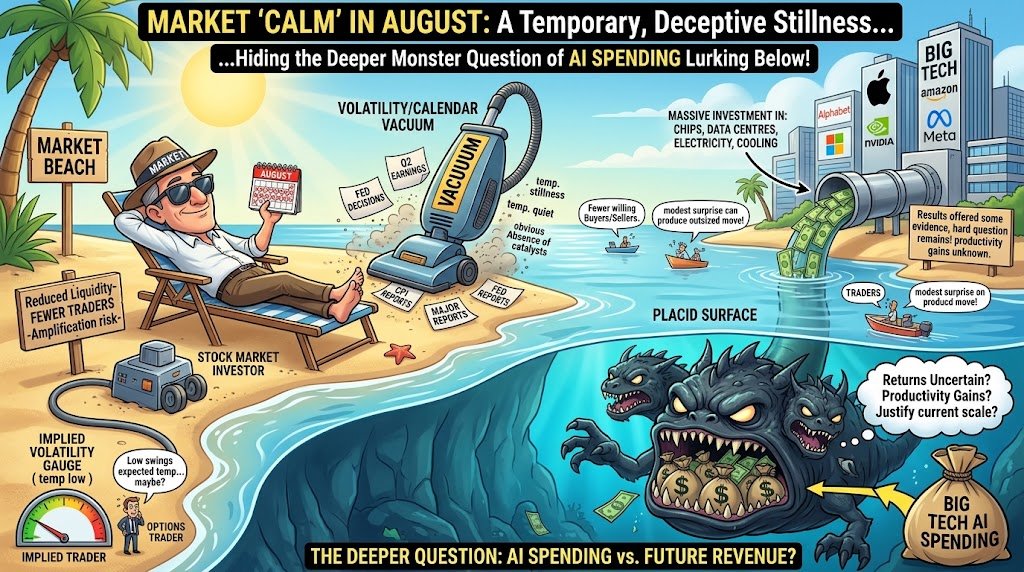
A lighter calendar can suppress expected stock swings temporarily, while AI spending remains the deeper question for investors.
After a closely watched second-quarter earnings season, equity markets may enter a quieter August period with fewer scheduled events forcing investors to rapidly reprice stocks.
That can create what derivatives strategists call a volatility vacuum: not an absence of risk, but a temporary shortage of obvious catalysts.
The distinction matters.
Markets can appear calm because investors are confident, but they can also appear calm because the next decisive piece of information has not arrived.
Central-bank decisions, major economic releases and the biggest corporate earnings reports often concentrate attention into a handful of dates.
Once those events have passed, expected near-term price swings can fall.
The market’s underlying concern has not disappeared.
It remains focused on the largest technology companies and their spending on artificial intelligence.
These companies are investing heavily in chips, data centres, networking equipment and electricity.
Their results have so far offered investors important evidence about demand, but they have also raised the harder question: will the future revenue and productivity gains from AI justify the scale of today’s investment?
That question reaches well beyond technology stocks.
Large cloud operators influence demand for semiconductors, construction, power generation, grid connections and cooling equipment.
Because the largest technology companies carry substantial weight in major stock indexes, their forecasts can shape the mood of the wider market.
Options markets offer one view of this uncertainty.
Options are contracts used to speculate on or protect against changes in asset prices.
Their prices incorporate expected volatility: the size of moves traders think may occur over a given period.
Lower implied volatility suggests expectations of smaller near-term swings.
It does not predict whether stocks will rise or fall, and it offers no assurance against a sudden shock.
August can make the picture more complicated.
Holiday periods often reduce trading activity and liquidity.
In a thinner market, a modest surprise can sometimes produce an outsized move because there are fewer willing buyers or sellers immediately available.
A calm-looking market may therefore be stable, or merely under-responsive until news breaks the stillness.
The next test will arrive with a new catalyst: a change in inflation or employment data, a policy decision, geopolitical developments, or fresh evidence about the returns on AI investment.
Until then, quieter trading should be read as a condition of the calendar and market positioning—not as proof that the risks surrounding valuations and AI spending have been resolved.
That can create what derivatives strategists call a volatility vacuum: not an absence of risk, but a temporary shortage of obvious catalysts.
The distinction matters.
Markets can appear calm because investors are confident, but they can also appear calm because the next decisive piece of information has not arrived.
Central-bank decisions, major economic releases and the biggest corporate earnings reports often concentrate attention into a handful of dates.
Once those events have passed, expected near-term price swings can fall.
The market’s underlying concern has not disappeared.
It remains focused on the largest technology companies and their spending on artificial intelligence.
These companies are investing heavily in chips, data centres, networking equipment and electricity.
Their results have so far offered investors important evidence about demand, but they have also raised the harder question: will the future revenue and productivity gains from AI justify the scale of today’s investment?
That question reaches well beyond technology stocks.
Large cloud operators influence demand for semiconductors, construction, power generation, grid connections and cooling equipment.
Because the largest technology companies carry substantial weight in major stock indexes, their forecasts can shape the mood of the wider market.
Options markets offer one view of this uncertainty.
Options are contracts used to speculate on or protect against changes in asset prices.
Their prices incorporate expected volatility: the size of moves traders think may occur over a given period.
Lower implied volatility suggests expectations of smaller near-term swings.
It does not predict whether stocks will rise or fall, and it offers no assurance against a sudden shock.
August can make the picture more complicated.
Holiday periods often reduce trading activity and liquidity.
In a thinner market, a modest surprise can sometimes produce an outsized move because there are fewer willing buyers or sellers immediately available.
A calm-looking market may therefore be stable, or merely under-responsive until news breaks the stillness.
The next test will arrive with a new catalyst: a change in inflation or employment data, a policy decision, geopolitical developments, or fresh evidence about the returns on AI investment.
Until then, quieter trading should be read as a condition of the calendar and market positioning—not as proof that the risks surrounding valuations and AI spending have been resolved.
Thailand is combining strong tourism receipts with major new investment in artificial intelligence, data centers and advanced electronics, while other Southeast Asian economies compete for technology capital by emphasizing infrastructure, skilled workers and predictable investment policies.
Nestlé Vietnam’s chief executive said predictable government policies, skilled workers and strong local supporting industries are becoming more important to multinational investors than traditional tax incentives, highlighting changing priorities for foreign direct investment in Vietnam.
The Electric Vehicle Association of Thailand says domestic electric vehicle demand is moving beyond early adopters toward broader consumer acceptance, with future growth increasingly dependent on charging infrastructure, technology and confidence in ownership rather than government price subsidies alone.
Beijing has confirmed that two China Coast Guard sailors died during a collision involving a Chinese warship while pursuing a Philippine Coast Guard vessel near Scarborough Shoal a year ago, underscoring the risks surrounding the continuing maritime confrontation between China and the Philippines.
Political and public pressure is growing in Malaysia for a temporary halt to new data center approvals in Johor and Selangor, where planned artificial intelligence and cloud infrastructure is approaching two thousand megawatts and raising concerns over electricity reliability, water supplies and household utility costs.
Thailand Welcomes More Than Eighteen Point Five Million International Tourists in First Seven Months
Thailand received more than eighteen point five million foreign visitors in the first seven months of the year, generating eight hundred and ninety-six billion baht in tourism revenue as resilient European and South Korean demand helped offset reduced capacity on some regional flights.
Thailand’s Board of Investment has approved nine projects worth one point nine nine billion dollars focused on artificial intelligence infrastructure, data centers and advanced electronics, reinforcing the country’s push to attract next-generation technology manufacturing and digital investment.
Thai Prime Minister Anutin Charnvirakul hosted Myanmar President U Min Aung Hlaing in Bangkok for agreements covering border security, labor migration and transboundary water management, underscoring Thailand’s effort to deepen engagement with Myanmar and support its participation in ASEAN.
AI’s Next Bottleneck Is Power, Not Just Nvidia Chips
Nvidia Turned Gaming Chips Into the Engine of the AI Boom
Joe Biden’s Cancer Has Spread Beyond His Bones, Hunter Biden Says
Why 2027 Could Be a Strong Year for Stocks—and Why the Forecast Is Fragile
Why Markets May Look Quiet in August After Big Tech Earnings
UFO: Pentagon Releases Video of Unidentified Object Tracked Over Middle East
Ukraine Tells Senate Republicans Its Drone War Offers a Blueprint for America
Weight-Loss Drug Boom Tests the Limits of Prescription Advertising Rules
Taiwan’s President Joins Wartime Command Drill as China Pressure Grows
Lightning Strike Kills Yala FC Player During Match in Southern Thailand
AI Is Remaking the US Economy, From GDP Growth to iPhone Prices
Indonesia’s Free School Meals Plan Has Been Hit by Poisoning, Corruption and Cuts
US and Japan Step In to Support the Yen in Rare Joint Intervention
FIFA’s Retreat Leaves a Larger Question Over Who Guards the Game
Valued at $109 Million: F-35B Fighter Jet Crashes in Southern California
US Says It Has Carried Out Heavy Strikes on Iran After Attempted Attacks on Its Forces
Over 24 Hours in the Air: Qantas Airbus Completes Record-Breaking Test Flight
Nvidia Reportedly Takes Vast Texas Data-Centre Lease to Underwrite AI Expansion
FIFA’s Private-Investment Plan for World Cup Rights Draws European Revolt
Following OpenAI's Cyberattack: 'Most Companies Still Do Not Understand What Is Coming'
OpenAI Sued After ChatGPT Allegedly Discouraged Emergency Care Before Near-Fatal Embolism
Miliband Sets Climate and International Law at Centre of UK Diplomacy
Trump Readies New Tariffs as Temporary Global Levy Nears Expiry
EU Imposes Record €550 Million Digital Services Fine on AliExpress
Between Deliveries, Wang Jibing Wrote His Way to China’s Literary Heights
Morgan Stanley Builds a Wall Street Lead in AI Infrastructure Finance
High Prices Push Coffee Drinkers Toward Whole Beans and Home Brewing
Trump Draws Boos and Podium Scrutiny at Spain’s World Cup Triumph
Spain Defeats Argentina in Extra Time to Win Second World Cup
Police Block Cockroach Janta Party’s March to Parliament as Education Protests Intensify
Singapore Considers Lower Taxes for Fund Managers as Hong Kong Intensifies Talent Contest
Proposed U.S.-Saudi Nuclear Pact Could Permit Limited Uranium Enrichment Under International Safeguards
Why Kentucky Fried Chicken Became KFC—and Why the False Explanations Persist
Ukrainian Drones Strike Wildberries Warehouses Deep Inside Russia
Reported CIA Mission Helped Clear the UAE’s Path to Advanced US AI Chips
Artificial Intelligence Capital Fuels Markets While Governments and Regulators Face Mounting Strategic Tests
China’s Moonshot’s Kimi K3 Narrows the Gap With Anthropic Through Scale, Openness and Lower Cost
Gold and Cash Seizure Puts Indonesia’s Senior Anti-Corruption Prosecutor Under Investigation
The Ledger Will Not Trust on Faith
Ukraine’s Leadership Rift Spills Into the Streets as Protesters Target Army Chief
The Ten World Cup Finals That Defined Football History
Smartphones Are Getting More Expensive, Sales Are Collapsing, and Even Apple Admits: "Prices Will Rise"
Leadership Change and Strategic Rivalry Redraw the Political Map
The AI Race Enters Its Infrastructure Era
Britain Nationalises British Steel to Protect Scunthorpe Production and Strategic Supply
French National Assembly Overrides Senate to Pass Historic Assisted-Dying Legislation
Thomas Tuchel Faces Fierce Backlash After Tactical Retreat Costs England World Cup Final Berth
A Quiet Bastille Day: France Grapples with World Cup Heartbreak and Leftover Fireworks
Spain in Ecstasy: "We Feel Unbeatable, We Taught the Whole World a Lesson"
Harvard Astrophysicist to Lead U.S. Scientific Advisory on Unidentified Aerial Phenomena