English manager's defensive substitutions and post-match remarks ignite a national controversy following a late collapse against Argentina in the semi-final.
The decisive factor driving this post-match crisis is actor-driven: the controversial tactical decisions and unrepentant defensive posture of England manager Thomas Tuchel.
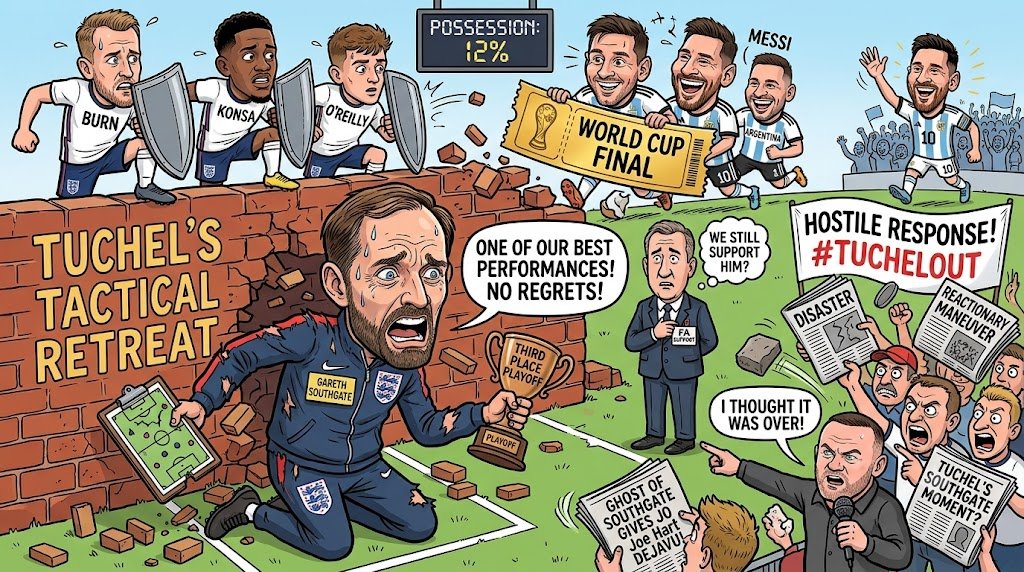
During the World Cup semi-final in Atlanta, England appeared poised to reach their first tournament final since 1966 after Anthony Gordon secured a lead in the fifty-fifth minute.
However, the manager immediately pivoted to an ultra-defensive strategy, substituting Gordon for defender Ezri Konsa and subsequently introducing defenders Dan Burn and Nico O'Reilly.
This reactive maneuver surrendered all offensive momentum, restricting England to just twelve percent possession between their opening goal and the final whistle.
Argentina capitalized on the invitation, with Enzo Fernández equalizing in the eighty-fifth minute and Lautaro Martínez heading home the winner in stoppage time, both assisted by Lionel Messi.
What is confirmed is that the English Football Association continues to support the manager, but the public and media response has been overwhelmingly hostile.
Former internationals and media pundits have roundly condemned the tactical retreat.
Critics labeled the in-game management a disaster, pointing out that introducing three defensive players while holding a narrow lead invited relentless pressure from an opponent of Argentina's caliber.
Former captain Wayne Rooney observed that such defensive substitutions instantly demoralize attacking players on the pitch, creating a climate of panic rather than composure.
Former goalkeeper Joe Hart noted that despite the high expectations surrounding the manager's appointment, his decisions closely mirrored the highly criticized, risk-averse approaches of his predecessor, Gareth Southgate, in previous major finals.
International commentators have been equally unsparing, with former Spanish captain Iker Casillas characterizing England's performance as a self-inflicted defeat, and German veteran Thomas Müller questioning the decision to invite uncontested crosses into the penalty area.
Adding to the domestic outrage, the manager defended the team's performance, declaring it perhaps their finest collective display of the tournament and insisting he harbored no regrets.
While the manager explained that switching to a back-five formation was intended to neutralize Argentina's wide threats, the tactical failure leaves England facing a third-place playoff, raising familiar questions about the national team's ability to manage high-stakes international fixtures.
During the World Cup semi-final in Atlanta, England appeared poised to reach their first tournament final since 1966 after Anthony Gordon secured a lead in the fifty-fifth minute.
However, the manager immediately pivoted to an ultra-defensive strategy, substituting Gordon for defender Ezri Konsa and subsequently introducing defenders Dan Burn and Nico O'Reilly.
This reactive maneuver surrendered all offensive momentum, restricting England to just twelve percent possession between their opening goal and the final whistle.
Argentina capitalized on the invitation, with Enzo Fernández equalizing in the eighty-fifth minute and Lautaro Martínez heading home the winner in stoppage time, both assisted by Lionel Messi.
What is confirmed is that the English Football Association continues to support the manager, but the public and media response has been overwhelmingly hostile.
Former internationals and media pundits have roundly condemned the tactical retreat.
Critics labeled the in-game management a disaster, pointing out that introducing three defensive players while holding a narrow lead invited relentless pressure from an opponent of Argentina's caliber.
Former captain Wayne Rooney observed that such defensive substitutions instantly demoralize attacking players on the pitch, creating a climate of panic rather than composure.
Former goalkeeper Joe Hart noted that despite the high expectations surrounding the manager's appointment, his decisions closely mirrored the highly criticized, risk-averse approaches of his predecessor, Gareth Southgate, in previous major finals.
International commentators have been equally unsparing, with former Spanish captain Iker Casillas characterizing England's performance as a self-inflicted defeat, and German veteran Thomas Müller questioning the decision to invite uncontested crosses into the penalty area.
Adding to the domestic outrage, the manager defended the team's performance, declaring it perhaps their finest collective display of the tournament and insisting he harbored no regrets.
While the manager explained that switching to a back-five formation was intended to neutralize Argentina's wide threats, the tactical failure leaves England facing a third-place playoff, raising familiar questions about the national team's ability to manage high-stakes international fixtures.