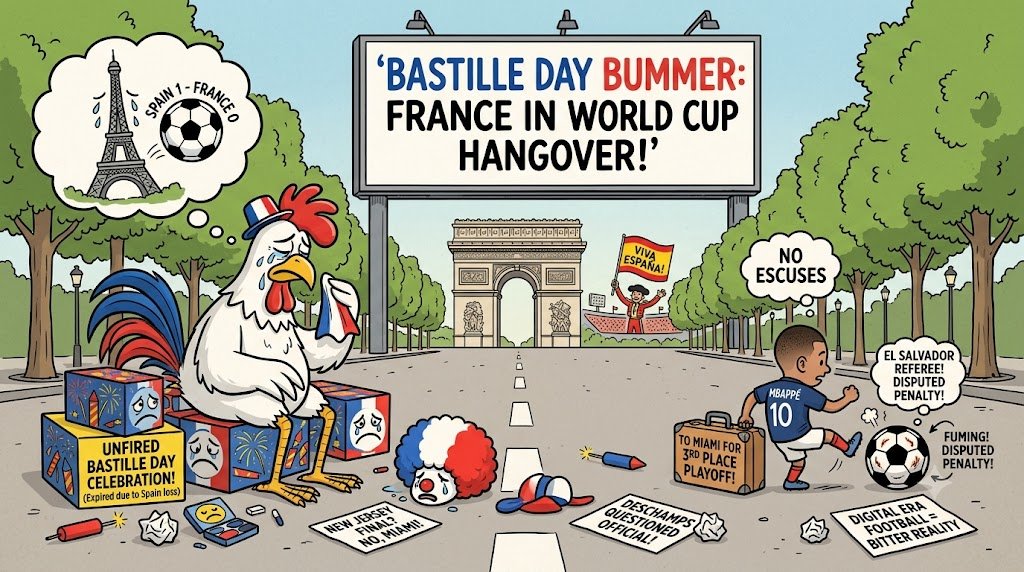
After a devastating semi-final loss to Spain on their national holiday, French fans experience the bitter reality of digital-era football as the national team heads south for a third-place playoff.
The single primary factor driving this story is actor-driven: the decisive sporting triumph of the Spanish national football team, which shattered French ambitions on the most sacred day of the French calendar.
On Bastille Day, the celebrated French national holiday, the streets of Paris underwent an eerie transformation.
The iconic Champs-Élysées, usually a roaring epicenter of national military parades followed by boisterous public revelry, fell completely silent.
The Place de la République, a historic stage for massive public demonstrations and celebratory football crowds, stood vacant.
What is confirmed is that France’s highly anticipated run to the final match in New Jersey was abruptly cut short, rerouting the disappointed squad to Miami, Florida, for a bittersweet third-place play-off.
The emotional toll of the defeat was visible in cafes across the nation, where tearful supporters clad in elaborate tricolor face paint, chicken-shaped hats, and afro wigs quietly packed up their belongings.
On-screen, midfielder Rayan Cherki offered a blunt post-match assessment, admitting that the team failed to play their brand of football and allowed Spain to dictate the match.
French captain Kylian Mbappé echoed this sentiment, refusing to make excuses and stating that the team simply did not perform at the level required for a World Cup semi-final.
Yet, a distinct sense of grievance quickly took root among the crestfallen French fanbase.
Social media channels and public forums filled with criticism directed at match referee Iván Barton of El Salvador.
French manager Didier Deschamps subtly questioned whether the officiating matched the gravity of the fixture, specifically pointing to a highly disputed penalty awarded to Spain's Lamine Yamal after a challenge by Lucas Digne.
Despite these grievances, Cherki maintained a self-critical stance, asserting that the only team that truly defeated France was France itself.
The sporting disappointment coincided with an already emotionally charged national holiday, marked by a solemn memorial service commemorating the tenth anniversary of the Nice truck attack, alongside reports of severe forest fires burning on the outskirts of Paris.
As night fell, frustration spilled into minor civil unrest in several urban centers.
While local authorities arrested twenty individuals in Lyon and one hundred and forty-one in Paris, the most notable incident occurred in Lyon, where local rioters targeted a temporarily vacant fire station.
Firefighter spokesperson Éric Brocardi publicly condemned the act, expressing disbelief that emergency services—heavily deployed to combat the regional wildfires—would be targeted in such a manner.
Despite the localized tension, the majority of supporters expressed a resilient optimism, pledging to support the squad in their final match on Saturday as they look toward the tournament in twenty-thirty.
On Bastille Day, the celebrated French national holiday, the streets of Paris underwent an eerie transformation.
The iconic Champs-Élysées, usually a roaring epicenter of national military parades followed by boisterous public revelry, fell completely silent.
The Place de la République, a historic stage for massive public demonstrations and celebratory football crowds, stood vacant.
What is confirmed is that France’s highly anticipated run to the final match in New Jersey was abruptly cut short, rerouting the disappointed squad to Miami, Florida, for a bittersweet third-place play-off.
The emotional toll of the defeat was visible in cafes across the nation, where tearful supporters clad in elaborate tricolor face paint, chicken-shaped hats, and afro wigs quietly packed up their belongings.
On-screen, midfielder Rayan Cherki offered a blunt post-match assessment, admitting that the team failed to play their brand of football and allowed Spain to dictate the match.
French captain Kylian Mbappé echoed this sentiment, refusing to make excuses and stating that the team simply did not perform at the level required for a World Cup semi-final.
Yet, a distinct sense of grievance quickly took root among the crestfallen French fanbase.
Social media channels and public forums filled with criticism directed at match referee Iván Barton of El Salvador.
French manager Didier Deschamps subtly questioned whether the officiating matched the gravity of the fixture, specifically pointing to a highly disputed penalty awarded to Spain's Lamine Yamal after a challenge by Lucas Digne.
Despite these grievances, Cherki maintained a self-critical stance, asserting that the only team that truly defeated France was France itself.
The sporting disappointment coincided with an already emotionally charged national holiday, marked by a solemn memorial service commemorating the tenth anniversary of the Nice truck attack, alongside reports of severe forest fires burning on the outskirts of Paris.
As night fell, frustration spilled into minor civil unrest in several urban centers.
While local authorities arrested twenty individuals in Lyon and one hundred and forty-one in Paris, the most notable incident occurred in Lyon, where local rioters targeted a temporarily vacant fire station.
Firefighter spokesperson Éric Brocardi publicly condemned the act, expressing disbelief that emergency services—heavily deployed to combat the regional wildfires—would be targeted in such a manner.
Despite the localized tension, the majority of supporters expressed a resilient optimism, pledging to support the squad in their final match on Saturday as they look toward the tournament in twenty-thirty.