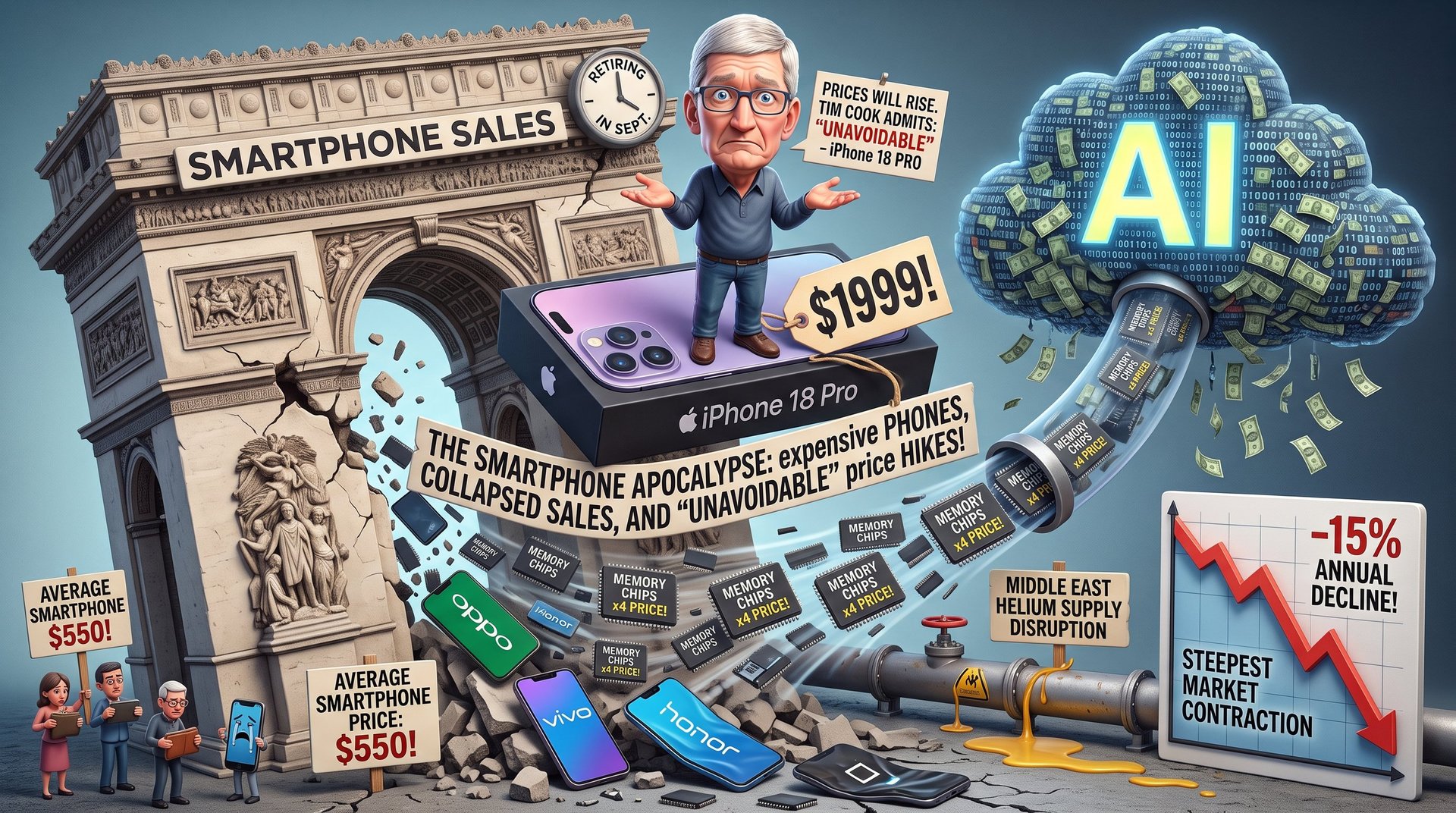
Surging memory prices, soaring demand for artificial intelligence hardware and supply chain disruptions are driving smartphone prices higher while analysts forecast the steepest annual market contraction on record.
The global smartphone market is facing an unprecedented upheaval that is expected to reshape the technology consumer landscape.

A combination of sharply rising memory component prices, geopolitical pressures affecting the supply of critical raw materials, and mounting demand for artificial intelligence hardware has prompted leading analysts to dramatically lower their sales forecasts.

According to research firms IDC and Omdia, the market is expected to contract by roughly thirteen to fifteen percent this year, marking the steepest annual decline in the industry's history.

Shipment volumes are projected to fall back to levels last seen more than a decade ago.

Apple Chief Executive Officer Tim Cook acknowledged in an interview yesterday that consumer price increases have become unavoidable.

Cook, who is expected to retire this September after fifteen years as Apple's chief executive, described the surge in memory costs as a "once-in-a-century flood."

He said Apple had made extensive efforts to absorb higher costs in order to shield customers from price increases, but maintaining that strategy was no longer economically sustainable.

As a result, consumers are expected to pay more beginning with the iPhone eighteen lineup, which is scheduled to be unveiled this autumn.

Preliminary estimates from research firms suggest that the Pro models alone could rise in price by several hundred dollars in order to preserve Apple's profit margins.

The primary driver of the crisis is the large-scale reallocation of manufacturing capacity by major memory producers, including Samsung, SK hynix and Micron.

The rapid expansion of generative artificial intelligence has forced these companies to devote most of their production capacity to high-bandwidth memory, or HBM, used in artificial intelligence servers and data centers.

As a consequence, the supply of DRAM and NAND memory chips for consumer electronics has tightened significantly, while prices have climbed to more than four times their level of a year ago.

The situation has been compounded by security tensions in the Middle East, which have disrupted the global supply chain for helium gas, a critical material used in semiconductor manufacturing.

While Apple and Samsung possess the purchasing power to secure component supplies well in advance, the crisis is hitting smaller and mid-sized Android manufacturers far more severely, particularly Chinese brands such as Oppo, Vivo and Honor.

These companies, which rely on narrow margins in lower-priced devices, are facing manufacturing cost increases of as much as thirty percent.

Analysts therefore expect the overall Android market to shrink by approximately twenty percent this year, while the average global selling price of a smartphone is projected to climb to a record level of about five hundred and fifty dollars.

Memory components have traditionally been among the least expensive and most readily available parts used in smartphone manufacturing.

Increasing storage capacity or random-access memory was once a simple and cost-effective way for manufacturers to improve performance without substantially raising retail prices.

That dynamic has now changed.

The demanding requirements of on-device artificial intelligence applications, which run directly on smartphones and require significantly larger memory capacities, have transformed what was once an inexpensive component into the industry's most costly bottleneck.

The shift is driven by the need to adopt newer memory standards capable of supporting these advanced artificial intelligence workloads.

Looking ahead, the crisis is expected to accelerate a broader restructuring of the consumer electronics market.

Weaker brands that cannot pass higher costs on to consumers may be forced to exit the market, while larger manufacturers are likely to reduce the number of entry-level models and concentrate on premium smartphones and foldable devices, segments that have remained comparatively resilient and continue to grow.

Analysts expect pricing stability will not return before the middle of twenty twenty-seven.

Even then, smartphone prices are expected to remain permanently higher than they were before the current crisis.
Development of U-Tapao International Airport and the Eastern Aviation City continues to increase Thailand's aviation capacity, strengthening its role as a regional gateway for tourism and business travel in Southeast Asia.
ASEAN negotiators are refining the Digital Economy Framework Agreement, an initiative intended to reduce digital trade barriers and establish common rules for cross-border data flows by twenty twenty-seven.
Thailand and Vietnam are expanding efforts to attract investment in food technology and resource-efficient agriculture as both countries seek leadership in high-value agricultural exports.
ASEAN foreign ministers are expected to devote closed-door sessions in Manila to maritime security and progress on a code of conduct, reaffirming the bloc's role in promoting stability along one of the world's busiest trade routes.
Philippine economic agencies are engaging civil society groups to help shape fiscal policies aligned with the ASEAN Community Vision Twenty Forty-Five, with the goal of supporting inclusive and sustainable economic growth.
Growing demand for artificial intelligence computing is driving fresh investment in data centre infrastructure across ASEAN, with Singapore and Thailand emerging as key locations for large-scale regional capacity.
Thai authorities are speeding up the country's accession process to the Organisation for Economic Co-operation and Development, viewing membership as a way to improve governance standards and reinforce long-term regulatory credibility.
Member states are expanding the One ASEAN One Response initiative by improving technology-based monitoring and coordinated emergency response systems to better manage increasingly frequent climate-related disasters.
Malaysia has launched an artificial intelligence avatar representing Prime Minister Anwar Ibrahim on messaging platforms, reflecting a broader regional trend toward using generative AI to strengthen public engagement.
ASEAN member states and China have begun implementing enhancements to their free trade agreement, reinforcing regional supply chains and supporting stable market access amid changing global trade conditions.
Thailand is broadening development plans for the Eastern Economic Corridor by prioritizing large-scale data centre investment alongside advanced digital infrastructure to capture growing regional demand for cloud computing services.
ASEAN foreign ministers are expected to operationalize an updated petroleum security agreement that will establish coordinated fuel-sharing arrangements during major disruptions to global oil supplies.
Indonesia and Vietnam are advancing cooperation on electric vehicle battery standards as Southeast Asian economies work to integrate regional supply chains and strengthen their position in the global transition to sustainable mobility.
Speaking at the World Artificial Intelligence Conference, ASEAN Secretary-General Kao Kim Hourn urged member states to develop harmonized artificial intelligence governance frameworks that support secure cross-border innovation and inclusive digital transformation.
Following meetings with an EU-ASEAN business delegation, Thailand is promoting itself as a destination for green manufacturing by offering incentives designed to attract European technology and support carbon-neutral industrial production.
Marco Rubio is expected to hold a series of bilateral meetings alongside ASEAN gatherings in Manila to strengthen maritime security cooperation and address economic uncertainty affecting the Indo-Pacific region.
Thai economic planners confirmed a long-term infrastructure pipeline worth twenty-one trillion baht, including high-speed rail projects and the Eastern Aviation City, to strengthen the country's position as a regional logistics, manufacturing and transport hub.
As ASEAN's rotating chair for two thousand twenty-six, the Philippines is leading ministerial discussions aimed at strengthening economic integration and reinforcing the bloc's central diplomatic role amid growing competition between major powers.
Foreign ministers from ASEAN, together with counterparts from the United States, China, Russia and Australia, are meeting in Manila to discuss regional security and are expected to formalize the ASEAN Petroleum Security Agreement to strengthen resilience against global energy supply disruptions.
Prime Minister Srettha Thavisin has introduced the Thailand FastPass initiative to streamline investment approvals and speed up major infrastructure projects as the country advances its OECD accession bid and seeks an upgraded Free Trade Agreement with the European Union.
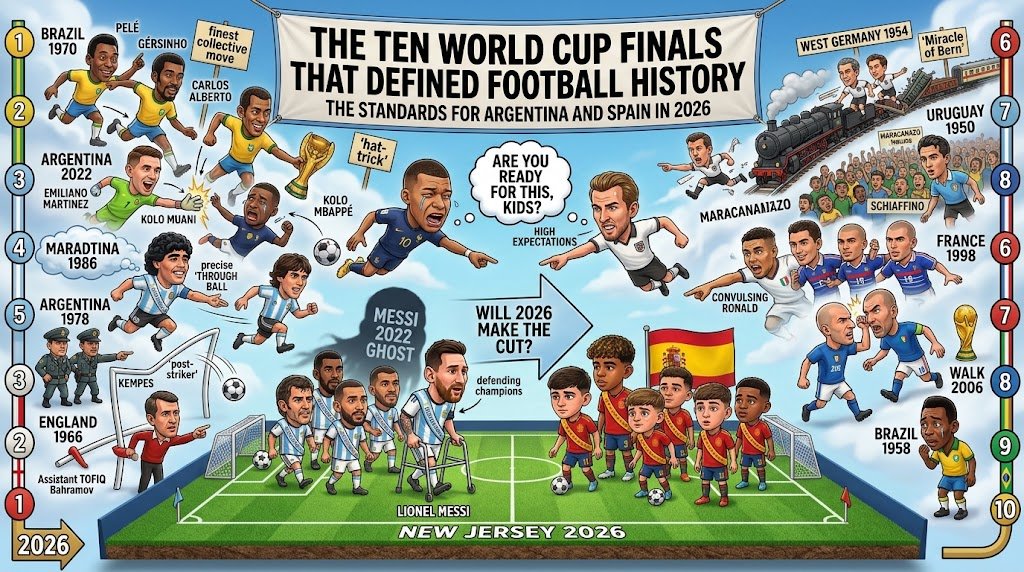
From Pelé’s emergence in Sweden and Uruguay’s shock at the Maracanã to Zidane’s final act and Messi’s triumph in Qatar, these matches set the standard awaiting Argentina and Spain in the 2026 final.
Argentina and Spain will enter the 2026 World Cup final carrying the ingredients of a historic occasion: the defending champions against the reigning European champions, Lionel Messi at thirty-nine against a Spanish side led by a new generation, and the possibility of Argentina becoming the first nation since Brazil in 1962 to retain the trophy.

Yet reputation, symbolism and anticipation do not make a great final by themselves.

The match must also produce the football, tension or human drama that survives long after the result.

That distinction matters because the World Cup final has repeatedly delivered more than a champion.

Its greatest editions have launched careers, broken national confidence, transformed players into symbols and produced controversies that remain unresolved decades later.

The following ranking measures not only technical quality, but also competitive tension, historical consequence and the durability of the images each match left behind.

At number ten is Brazil’s 5–2 victory over Sweden in 1958, the afternoon when the wider football world first encountered Pelé.

Brazil fell behind against the host nation before Vavá scored twice and a gifted attacking side took control.

Garrincha unsettled the Swedish defence, Didi conducted play from midfield and the seventeen-year-old Pelé scored twice.

His first goal, lifting the ball over a defender before striking it on the volley, became one of the tournament’s defining images.

Brazil won its first World Cup, while Pelé’s tears at full time marked the arrival of the player who would become the competition’s most enduring icon.

Italy’s penalty-shootout victory over France in 2006 ranks ninth because its decisive image was not a goal but an expulsion.

Zinedine Zidane gave France the lead with an audacious chipped penalty before Marco Materazzi equalised with a header.

Deep into extra time, after an exchange between the two scorers, Zidane drove his head into Materazzi’s chest and was sent off in the final match of his career.

Italy converted all five of its penalties to win a fourth world title.

Zidane’s walk past the trophy on his way to the dressing room remains one of football’s starkest portraits of brilliance ending in self-destruction.

France’s 3–0 defeat of Brazil in 1998 occupies eighth place.

The uncertainty surrounding Ronaldo dominated the hours before kickoff after the Brazilian forward suffered a convulsive episode, was initially removed from the starting lineup and then reinstated.

Once the match began, France controlled it.

Zidane scored two headers from corners, Emmanuel Petit added a late third and the host nation claimed its first World Cup.

The victory also acquired a larger civic meaning inside France: a multicultural national team, led by the son of Algerian immigrants, became a temporary emblem of national cohesion.

The 1950 meeting between Uruguay and Brazil is seventh, although it was technically the last fixture of a four-team final round rather than a conventional final.

Brazil needed only a draw and took the lead through Friaça before an enormous crowd at the Maracanã.

Uruguay equalised through Juan Alberto Schiaffino, then Alcides Ghiggia scored the winner to secure a 2–1 victory.

The silence inside the stadium became almost as famous as the result.

Brazil named the trauma the Maracanazo, the blow of the Maracanã, and the defeat became part of the country’s national memory even as later generations accumulated five world titles.

West Germany’s 3–2 victory over Hungary in 1954 ranks sixth.

Hungary entered the final unbeaten for four years and had defeated the same opponent 8–3 during the group stage.

Ferenc Puskás and Zoltán Czibor put the favourites two goals ahead inside eight minutes, but Max Morlock quickly reduced the deficit and Helmut Rahn equalised.

Rahn scored again in the eighty-fourth minute to complete one of the greatest reversals in international football.

The Miracle of Bern became a symbol of West Germany’s postwar recovery, although later allegations that German players may have received performance-enhancing injections placed a lasting shadow over the triumph.

No conclusive finding has overturned the result.

England’s 4–2 extra-time victory over West Germany in 1966 stands fifth.

Geoff Hurst’s second goal remains the most disputed moment in World Cup final history.

His shot struck the crossbar, bounced down near the line and was awarded after the referee consulted assistant Tofiq Bahramov.

Hurst later completed the only hat-trick scored in a men’s World Cup final until Kylian Mbappé matched the feat in 2022. England won its first and, so far, only world title.

The argument over whether the ball fully crossed the line has outlived nearly everyone involved.

Argentina’s 3–1 extra-time victory over the Netherlands in 1978 ranks fourth.

The host nation staged the tournament under a military dictatorship that sought political advantage from the event.

On the field, Mario Kempes gave Argentina the lead before Dick Nanninga equalised late in normal time.

Rob Rensenbrink then struck the post in the final seconds, coming within centimetres of winning the World Cup for the Dutch.

Kempes restored Argentina’s advantage during extra time and Daniel Bertoni completed the victory, delivering the country’s first title amid celebrations inseparable from the authoritarian setting in which they occurred.

Argentina’s 3–2 victory over West Germany in 1986 is third.

José Luis Brown and Jorge Valdano established a two-goal lead, but Karl-Heinz Rummenigge and Rudi Völler scored seven minutes apart to bring West Germany level.

With momentum shifting, Diego Maradona produced the pass that resolved the final.

His precise through ball released Jorge Burruchaga, who ran beyond the defence and scored the winner.

Maradona did not score in the match, but the assist completed an extraordinary individual tournament and secured Argentina’s second World Cup.

The 2022 final between Argentina and France ranks second.

Argentina led 2–0 and controlled the match for nearly eighty minutes before Mbappé scored twice in less than two minutes.

Messi restored Argentina’s lead in extra time, only for Mbappé to complete his hat-trick from the penalty spot.

Emiliano Martínez then denied Randal Kolo Muani with a crucial late save before Argentina prevailed 4–2 in the shootout.

Messi finally lifted the World Cup, while Mbappé became only the second player to score three times in a men’s final.

The match combined elite performance, abrupt reversals and individual rivalry at a level rarely seen on the sport’s largest stage.

Brazil’s 4–1 victory over Italy in 1970 remains the benchmark.

Pelé opened the scoring with a header, Roberto Boninsegna equalised and Gérson restored Brazil’s lead with a powerful shot from outside the penalty area.

Jairzinho scored the third, becoming the first player to find the net in every match of a single World Cup, before Carlos Alberto completed one of football’s finest collective moves.

Brazil’s patient sequence of passes drew Italy across the field, Pelé paused and released the advancing captain, and Carlos Alberto drove the ball into the far corner.

The victory delivered Brazil’s third championship and permanent possession of the Jules Rimet Trophy.

More than half a century later, it remains the clearest example of a dazzling attacking team reproducing its finest football under the pressure of a World Cup final.

Argentina and Spain will now play for the same permanence in New Jersey.

The result will decide the champion, but the quality and drama of the contest will determine whether the 2026 final joins the small group of matches remembered as more than victories.
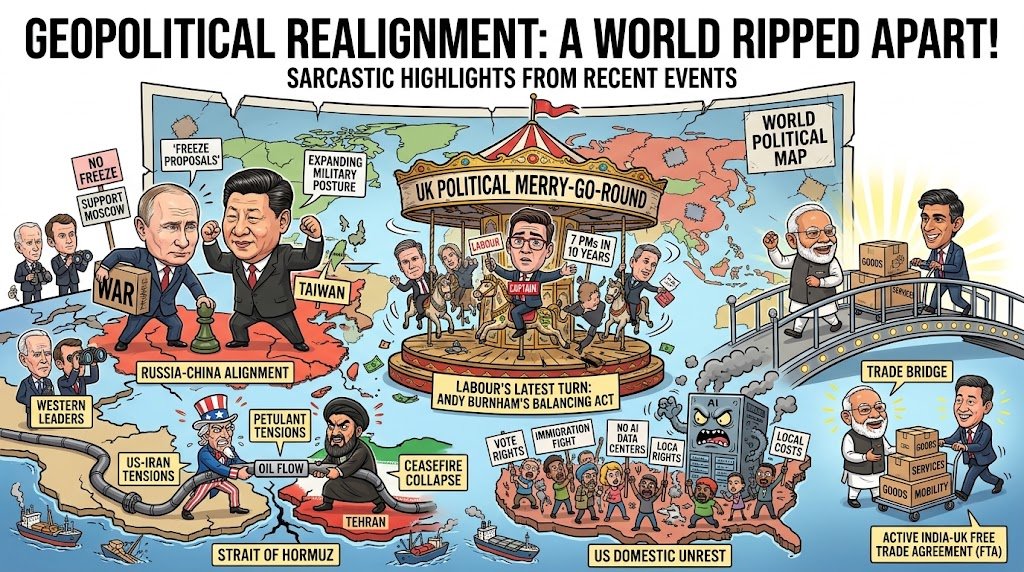
Britain’s political transition, renewed pressure between Washington and Tehran, domestic unrest in the United States, closer Russia-China alignment and a new India-United Kingdom trade framework defined a week of widening geopolitical realignment.
Britain’s leadership transition became the week’s central political development as Labour selected Andy Burnham to succeed Keir Starmer, positioning the country for its seventh prime minister in a decade.

Burnham moved quickly to shape a new administration, placing Shabana Mahmood at the center of economic policy while attempting to balance Labour’s competing factions ahead of the next general election.

That domestic reset unfolded against renewed pressure between the United States and Iran following the collapse of their previous ceasefire.

Political and military tensions kept the Strait of Hormuz at the center of global attention, with governments monitoring the consequences for energy security, maritime trade and regional stability.

The dispute over state power was also visible inside the United States, where demonstrations focused on immigration enforcement, voting rights and the expansion of artificial-intelligence data centers.

The protests brought together separate political disputes over federal authority, election administration and the local costs of large-scale technological infrastructure.

A broader strategic contest is taking shape across Eastern Europe and the Indo-Pacific.

Russia continued to reject proposals for freezing the war in Ukraine, while China expanded its military posture near Taiwan and strengthened its support for Moscow, reinforcing coordination between the two powers as Western governments reassessed their security priorities.

That geopolitical fragmentation is also driving new partnerships.

India and the United Kingdom formally brought their free-trade agreement into force, reducing barriers across goods, services and professional mobility and placing the new bilateral economic framework into active operation.
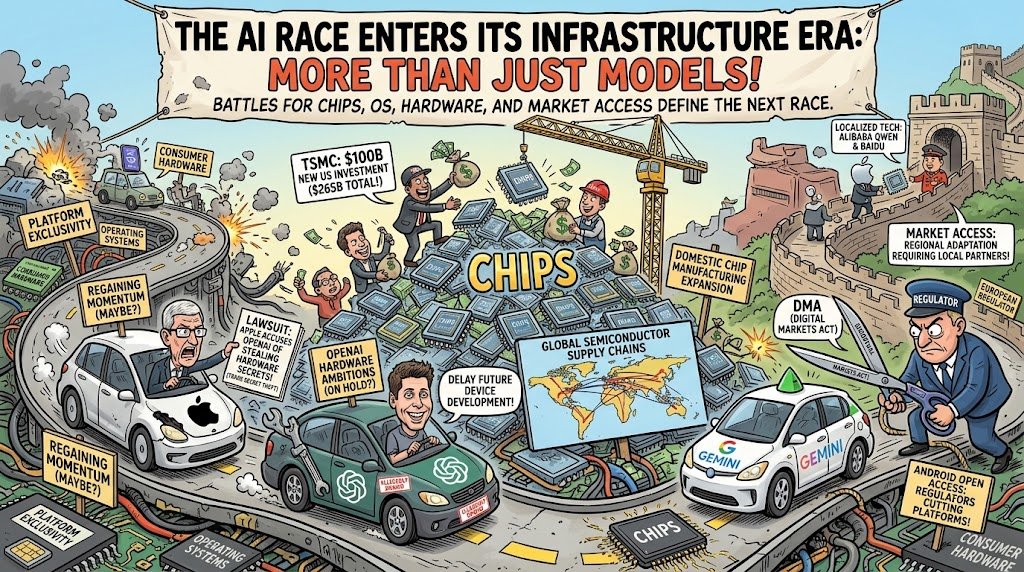
The past week showed the artificial intelligence competition expanding far beyond better models, as battles over chips, operating systems, consumer hardware and national markets increasingly determine who will shape the next generation of technology.
The defining technology story of the week was not the release of another artificial intelligence model but the accelerating fight for control of the ecosystem that surrounds AI. Apple filed a lawsuit accusing OpenAI of improperly acquiring hardware trade secrets through the recruitment of former Apple employees, allegations that OpenAI denies.

The dispute could complicate OpenAI's consumer hardware ambitions, delay future device development and potentially influence longer-term business plans, highlighting how competition has shifted from software alone to the physical products intended to deliver AI experiences.

That battle over devices is unfolding alongside an equally important contest for the semiconductor capacity required to power them.

Taiwan Semiconductor Manufacturing Company reported sharply higher earnings driven by demand for AI chips while announcing another one hundred billion dollars in planned investment in the United States, bringing its total American commitment to roughly two hundred sixty-five billion dollars.

The expansion strengthens domestic chip manufacturing while reinforcing the strategic importance of semiconductor supply chains in the global AI economy.

Control of the user experience is becoming just as valuable as control of the chips themselves.

Apple expanded access to its redesigned AI-powered Siri through the iOS twenty-seven public beta, marking an important attempt to regain momentum against ChatGPT, Gemini and other generative AI assistants before the full operating system launches.

Across Europe, regulators are pursuing the opposite objective by reducing platform exclusivity.

Under the Digital Markets Act, Google will be required to provide competing AI assistants with comparable access to key Android capabilities, a decision intended to prevent Gemini from becoming the permanently preferred assistant on Android devices.

The competition is also becoming increasingly regional rather than global.

Apple Intelligence reportedly received approval for deployment in mainland China through localized technology built around Alibaba's Qwen, with Baidu expected to provide additional capabilities.

The development secures access to one of Apple's most important markets while illustrating how leading AI systems are increasingly being adapted to national regulatory frameworks, local technology partners and regional strategic priorities.

Taken together, the week's developments demonstrate that the next phase of the AI race will be decided as much by ownership of chips, operating systems, hardware and market access as by advances in the underlying models themselves.
Thailand's consumer protection authorities have launched nationwide inspections of electric vehicle dealerships as aggressive price competition among Chinese manufacturers raises concerns over warranties, spare parts availability and resale values.
Taiwan will continue visa-free entry for Philippine passport holders through 2027, supporting labour mobility and helping sustain the flow of skilled Filipino workers into Taiwan's technology and manufacturing industries.
Government officials, industry leaders and investors gathered in Bangkok to highlight advances in artificial intelligence-powered mobility, hydrogen technologies and autonomous driving as Thailand seeks to strengthen its position as Southeast Asia's automotive hub.
Authorities in Laos charged the owner of a local distillery with operating an illegal business after fatal methanol poisonings involving foreign tourists, while several governments continue to press for greater transparency and stronger criminal accountability.
Cambodia has proposed direct commercial flights to the Philippines to strengthen tourism, labour mobility and investment while reducing reliance on regional transit hubs.
Severe monsoon rains triggered deadly landslides in Lai Chau province, cutting National Highway 32 and damaging hundreds of hectares of farmland, highlighting the region's growing climate resilience challenges.
Singapore President Tharman Shanmugaratnam concluded his state visit to Malaysia after discussions centred on expanding the Johor-Singapore Special Economic Zone and strengthening bilateral investment.
Myanmar's anti-junta alliance told the ASEAN special envoy during talks hosted by Thailand that any political dialogue must include broader democratic reforms rather than focusing solely on ending armed conflict.
Thailand reduced visa-free stays from sixty days to thirty days for visitors from fifty-nine countries while extending equal visa-free access across the European Union, seeking to balance tourism growth with a higher-value travel strategy.
The United States confirmed that Secretary of State Marco Rubio will travel to the Philippines for high-level ASEAN meetings, underscoring Washington's continued strategic engagement in the Indo-Pacific.
Thai Prime Minister Anutin Charnvirakul and Malaysian Prime Minister Anwar Ibrahim inaugurated a new road link connecting the Sadao and Bukit Kayu Hitam border checkpoints to improve cross-border trade and manufacturing supply chains.
President Prabowo Subianto officially launched construction of the Abadi Masela liquefied natural gas project, one of Indonesia's largest energy developments, shortly after completing a major defence procurement agreement with India.
Thailand's Ministry of Finance said Bangkok is prepared to host the 2026 International Monetary Fund and World Bank Annual Meetings, highlighting the country's digital public infrastructure, including PromptPay and cross-border QR payment systems, as evaluation teams continue their assessment.
The Philippine Department of Foreign Affairs demanded the removal of an artificial intelligence-generated video by China Daily that depicted Filipinos as monkeys, calling the content racist and harmful to bilateral relations over the South China Sea dispute.
Chinese President Xi Jinping called on Thai Prime Minister Anutin Charnvirakul and Cambodian Prime Minister Hun Manet to pursue peaceful negotiations over their border dispute during meetings at the 2026 World Artificial Intelligence Conference in Shanghai.
President Prabowo Subianto announced that Indonesia has halted all diesel imports, saying wider use of palm oil-based B50 biodiesel will strengthen energy independence and redirect more spending toward the domestic economy.
Singapore reported robust second-quarter growth, with advanced manufacturing, electronics and precision engineering benefiting from sustained global demand for semiconductor equipment and artificial intelligence-related technologies.
Malaysia's economy expanded by five point eight percent in the second quarter, exceeding expectations as booming semiconductor exports and resilient domestic demand offset supply chain disruptions linked to tensions in the Middle East.
Vietnam's economy expanded by eight point three nine percent in the second quarter, supported by strong foreign investment and resilient manufacturing, reinforcing its role as a key link in global technology supply chains.
Thailand has approved thirty-four new data centre and cloud infrastructure projects since last year, with Prime Minister Anutin Charnvirakul saying the investment will reinforce the country's ambition to become mainland Southeast Asia's leading digital economy and artificial intelligence hub.
The rapid expansion of tourism and luxury resort development in Bali is increasing pressure on local water resources, prompting Indonesian authorities to review zoning policies and resource management to protect surrounding agricultural communities.
Cambodian authorities have intensified action against prominent business figures accused of supporting transnational cybercrime and human trafficking networks in an effort to strengthen investor confidence.
Indonesia has designated 15 priority regions for education and industrial investment as policymakers seek to translate a growing young workforce into sustained economic growth while managing rising external debt.
Indonesia and Vietnam are using their extensive nickel and rare earth resources to encourage international manufacturers to establish battery processing and electric vehicle production within the region.
The Ten World Cup Finals That Defined Football History
Smartphones Are Getting More Expensive, Sales Are Collapsing, and Even Apple Admits: "Prices Will Rise"
Leadership Change and Strategic Rivalry Redraw the Political Map
The AI Race Enters Its Infrastructure Era
Britain Nationalises British Steel to Protect Scunthorpe Production and Strategic Supply
French National Assembly Overrides Senate to Pass Historic Assisted-Dying Legislation
Thomas Tuchel Faces Fierce Backlash After Tactical Retreat Costs England World Cup Final Berth
A Quiet Bastille Day: France Grapples with World Cup Heartbreak and Leftover Fireworks
Spain in Ecstasy: "We Feel Unbeatable, We Taught the Whole World a Lesson"
Harvard Astrophysicist to Lead U.S. Scientific Advisory on Unidentified Aerial Phenomena
Emergency Sirens Activated Across Bahrain as Interior Ministry Issues Shelter Directives
World Cup Visitors Turn American Big-Box Stores Into Souvenir Stops
Netflix Weighs Always-On Channels, Bundles and Short-Form Video
The AI Invoice Shock: Layoffs Didn't Save Managers Money — They Cost Them More
Concern: Sexually Transmitted Bacterium Among Men Develops Antibiotic Resistance
Following Massive Investor Demand: SK Hynix Raises 26.5 Billion Dollars on Nasdaq
Passenger Partially Pulled Out of Ryanair Jet After Cabin Window Fails Mid-Flight
Severe Heatwave Drives Dangerous Ground-Level Ozone Pollution Across Two Thirds of European Union
Flight Instructor Jumped to His Death — Student Landed the Plane: "You Know What You Need to Do"
The Physical and Electronic Barriers Disrupting Domestic Wireless Networks
France and Morocco Open World Cup Quarter-Finals as Collina Defends Refereeing
Tech Pulse: The Future of AI and Screen Culture
Global News Briefing: Escalating Geopolitical Tensions and Corporate Shakeups
Global News Brief: Escalating Conflicts, Public Health Crises, and World Cup Drama
Europe's Growing Struggle with Extreme Heat and Air Conditioning
Anthropic Reengineers Agentic Architecture to Shift Autonomous Workplace Automation to the Cloud
Apple Advances Late-Stage Operating Systems with Fourth Beta Deployments
Global Crisis Alert: Escalating Middle East Tensions and UK Political Upheaval
"A New Era of Testing": The Rare Launch of a Missile from a Chinese Nuclear Submarine - That Could Reach U.S. Soil
Japanese Technology Firm Fujitsu Launches Advanced Artificial Intelligence Tool for Corporate Disclosures
South Africa Officially Launches Nationwide Campaign for Highly Contested Local Government Elections
United Kingdom Commits Additional Funding for Unexploded Ordnance Clearance in Laos
Singapore Announces Stringent New Greenhouse Gas Regulations for Commercial Cooling Systems
Cambodia and Thailand Hold High-Level Border Security Talks at United Nations Headquarters
Myanmar Military Government and China Sign Major Agreement to Upgrade Media and Cultural Cooperation
Knife Attack at Swiss Train Station Leaves Three Injured in Suspected Act of Domestic Terrorism
Transnational Extortion Gang Threatens Canadian Police With Army of One Thousand Armed Operatives
Australia Imposes Forty-Two-Day Quarantine on Cruise Ship Passengers Following Deadly Hantavirus Outbreak
International Monetary Fund Unlocks Seven Hundred Million United States Dollars for Sri Lanka Following Economic Reforms
China and Canada Foreign Ministers Meet in Ottawa in Effort to Stabilize Strained Diplomatic Ties
Indonesia Demands Urgent United Nations Security Council Reform Amid Escalating Global Conflicts
Extreme Weather Patterns Trigger Severe Drought in Madagascar and Destructive Flooding in East Africa
Indian State of Karnataka Faces Political Upheaval as Chief Minister Siddaramaiah Abruptly Resigns
Philippines and Japan Reaffirm Defense Ties as Crucial for Indo-Pacific Regional Stability
Norway Joins French Nuclear Deterrence Initiative in Major Shift for European Security Architecture
Global Critical Mineral Alliances Expand as Western Nations Move to Counter Chinese Supply Dominance
United States Imposes Fifty Percent Tariffs on Mexican Steel and Aluminum Ahead of Trade Pact Review
European Union and China Head Toward Major Trade Conflict Over Clean Technology Exports
United States Economic Growth Severely Downgraded to One Point Six Percent as Stagflation Fears Mount
World Health Organization Warns Central African Ebola Epidemic is Outpacing Containment Efforts