Leading telecommunications companies across Singapore, Thailand, Indonesia, and Malaysia expanded standalone fifth-generation network deployment to provide the low-latency digital infrastructure needed for enterprise artificial intelligence and industrial automation.
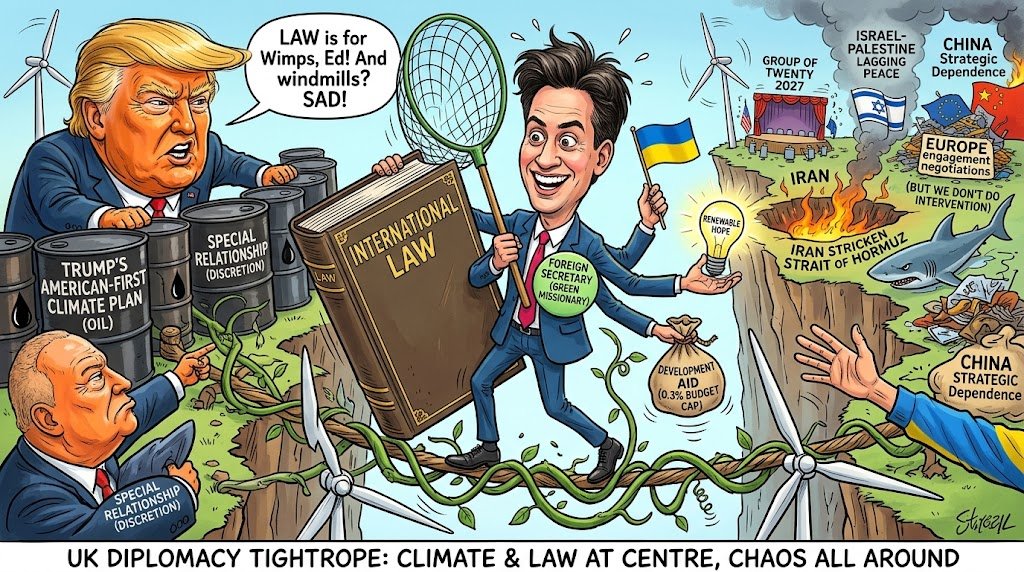
Britain’s new foreign secretary promises continuity on Ukraine and the American alliance while signalling greater emphasis on climate action, development and legal restraint.
Ed Miliband has taken control of British foreign policy with a promise to restore climate diplomacy, defend international law and maintain the country’s principal alliances, including its strategically indispensable but politically difficult relationship with the United States.
His appointment by Prime Minister Andy Burnham signals a change of emphasis more than an immediate rupture with the policies inherited from the previous government.
Miliband became foreign, commonwealth and development secretary on July 20 after two years overseeing energy security and the transition to net zero.
A former Labour leader and climate secretary, he arrives with greater cabinet experience and a more clearly defined ideological record than many newly appointed foreign ministers.
That record combines Atlanticism, European engagement, environmental activism and a longstanding reluctance to treat military intervention as the default response to international crises.
His initial commitments were deliberately broad.
He identified continued support for Ukraine, preservation of Britain’s special relationship with the United States, a sustainable peace between Israel and the Palestinians, and the reopening of the Strait of Hormuz as immediate priorities.
He also placed climate change and international development among the threats to justice and security that the Foreign Office must address.
The American relationship will provide the earliest test.
Britain depends on the United States for intelligence cooperation, nuclear deterrence, advanced defence technology and much of the military capacity underpinning the North Atlantic alliance.
Burnham has already spoken with President Donald Trump and indicated that he intends to engage candidly while preserving practical cooperation.
Miliband has promised to nurture that alliance despite substantial differences with the Trump administration.
Those disagreements encompass climate policy, North Sea drilling and aspects of the war with Iran.
Trump has criticised Britain’s restrictions on new offshore oil and gas development, while Miliband spent his tenure as energy secretary arguing that renewable power and reduced exposure to volatile fossil-fuel markets offer the more durable route to energy security.
The foreign secretary’s challenge will be to compartmentalise those disputes.
Britain can continue intelligence, defence and diplomatic coordination with Washington without adopting every American policy.
The more openly London invokes international law or questions military escalation, however, the more friction it may encounter with an administration that places greater weight on national discretion and coercive leverage.
Iran illustrates the tension.
Britain has a direct interest in restoring safe passage through the Strait of Hormuz, a crucial route for global oil and gas supplies.
It also has military facilities, citizens and commercial interests exposed to regional escalation.
Miliband is likely to support measures protecting navigation while applying a more exacting test to British participation in offensive operations, particularly where parliamentary authority, strategic objectives or the legal basis remain contested.
That caution reflects his political history.
As Labour leader in 2013, Miliband prevented the government from securing parliamentary approval for military action in Syria after a chemical-weapons attack.
Supporters viewed the decision as necessary scrutiny of an inadequately defined intervention; critics argued that it weakened deterrence.
The episode established his preference for explicit evidence, legal justification and a credible plan before Britain uses force.
Policy toward Ukraine is expected to remain substantially unchanged.
Miliband has reaffirmed support for Kyiv and characterised Russia’s invasion as a violation of international law.
Britain is therefore likely to continue military assistance, sanctions and diplomatic coordination with European and transatlantic partners, subject to the spending decisions of Burnham’s government.
Relations with Europe may acquire greater political energy.
Burnham inherited negotiations intended to reduce post-Brexit trade barriers, expand security cooperation and connect British and European climate policies.
Miliband’s multilateral instincts and familiarity with European energy institutions should support that reset, although the government has not proposed rejoining the European Union, its single market or its customs union.
The appointment of a dedicated minister for European relations strengthens that division of labour.
Practical negotiations will concentrate on food trade, emissions markets, security and youth mobility.
Progress will still require compromises over regulatory alignment, financial contributions and movement between Britain and the continent, matters that remain sensitive within domestic politics.
Climate policy is the clearest prospective departure.
Miliband treats global warming not as a specialist environmental portfolio but as a foreign-policy issue affecting migration, food security, debt, conflict and geopolitical influence.
He is expected to use diplomatic missions, development finance and trade relationships to promote emissions reduction, renewable investment and adaptation in countries most exposed to extreme weather.
That approach could restore climate diplomacy as a prominent component of British soft power.
It also creates difficult choices.
Britain wants affordable clean technologies and resilient supply chains, yet the global solar-panel, battery and critical-mineral industries depend heavily on China.
Miliband will have to balance decarbonisation against concerns about strategic dependence, subsidies, forced labour, industrial competition and human rights.
The tension cannot be resolved by treating China solely as either a partner or an adversary.
Cooperation is necessary for meaningful global emissions reductions, while economic security requires diversification and enforceable standards.
British policy is consequently likely to combine engagement on climate with greater scrutiny of investment, technology transfer and vulnerable supply chains.
The Middle East may produce more visible change.
Miliband is Jewish and the son of refugees from Nazi persecution, and he has consistently defended Israel’s right to security while criticising settlement expansion and military actions he considered disproportionate.
He supports Palestinian statehood, opposes boycotts of Israel and regards Hamas as a terrorist organisation.
As foreign secretary, he has committed himself to a sustainable peace for both Palestinians and Israelis.
His emphasis on the rule of law may lead to firmer public scrutiny of conduct by every party, including Israel, Iran and armed groups such as Hamas.
Yet decisions on recognition, sanctions, arms exports or diplomatic pressure belong to the government collectively, and no immediate policy reversal has been announced.
International development presents a more concrete constraint.
Britain is reducing official development assistance toward 0.3 percent of gross national income by the 2027–28 financial year, down from the earlier 0.5 percent level.
The reductions were designed partly to finance higher defence expenditure and include severe cuts to bilateral programmes in several fragile African states.
Miliband wants development restored as an instrument of foreign policy, but rhetoric cannot replace funding.
Reversing the scheduled reductions would require agreement from the Treasury and difficult choices elsewhere in the budget.
Without additional resources, he will have to concentrate spending, rely more heavily on multilateral institutions and pursue reforms that allow poorer countries to mobilise investment without expanding unsustainable debt.
Britain’s presidency of the Group of Twenty in 2027 will give him a platform for that agenda.
Climate finance, sovereign debt, development-bank reform, taxation and illicit financial flows could connect his environmental and development priorities with the interests of emerging economies.
Success will depend on persuading governments with sharply different strategic interests that British proposals offer material benefits rather than moral instruction.
The broad direction is now visible: closer European engagement, continuity on Ukraine, disciplined management of the American alliance and a stronger role for climate, development and international law.
The actual change will be measured through decisions on Iran, Israel, China, aid funding and the use of force.
Miliband’s first task is to convert those principles into policy while preserving the alliances on which Britain’s security still depends.
His appointment by Prime Minister Andy Burnham signals a change of emphasis more than an immediate rupture with the policies inherited from the previous government.
Miliband became foreign, commonwealth and development secretary on July 20 after two years overseeing energy security and the transition to net zero.
A former Labour leader and climate secretary, he arrives with greater cabinet experience and a more clearly defined ideological record than many newly appointed foreign ministers.
That record combines Atlanticism, European engagement, environmental activism and a longstanding reluctance to treat military intervention as the default response to international crises.
His initial commitments were deliberately broad.
He identified continued support for Ukraine, preservation of Britain’s special relationship with the United States, a sustainable peace between Israel and the Palestinians, and the reopening of the Strait of Hormuz as immediate priorities.
He also placed climate change and international development among the threats to justice and security that the Foreign Office must address.
The American relationship will provide the earliest test.
Britain depends on the United States for intelligence cooperation, nuclear deterrence, advanced defence technology and much of the military capacity underpinning the North Atlantic alliance.
Burnham has already spoken with President Donald Trump and indicated that he intends to engage candidly while preserving practical cooperation.
Miliband has promised to nurture that alliance despite substantial differences with the Trump administration.
Those disagreements encompass climate policy, North Sea drilling and aspects of the war with Iran.
Trump has criticised Britain’s restrictions on new offshore oil and gas development, while Miliband spent his tenure as energy secretary arguing that renewable power and reduced exposure to volatile fossil-fuel markets offer the more durable route to energy security.
The foreign secretary’s challenge will be to compartmentalise those disputes.
Britain can continue intelligence, defence and diplomatic coordination with Washington without adopting every American policy.
The more openly London invokes international law or questions military escalation, however, the more friction it may encounter with an administration that places greater weight on national discretion and coercive leverage.
Iran illustrates the tension.
Britain has a direct interest in restoring safe passage through the Strait of Hormuz, a crucial route for global oil and gas supplies.
It also has military facilities, citizens and commercial interests exposed to regional escalation.
Miliband is likely to support measures protecting navigation while applying a more exacting test to British participation in offensive operations, particularly where parliamentary authority, strategic objectives or the legal basis remain contested.
That caution reflects his political history.
As Labour leader in 2013, Miliband prevented the government from securing parliamentary approval for military action in Syria after a chemical-weapons attack.
Supporters viewed the decision as necessary scrutiny of an inadequately defined intervention; critics argued that it weakened deterrence.
The episode established his preference for explicit evidence, legal justification and a credible plan before Britain uses force.
Policy toward Ukraine is expected to remain substantially unchanged.
Miliband has reaffirmed support for Kyiv and characterised Russia’s invasion as a violation of international law.
Britain is therefore likely to continue military assistance, sanctions and diplomatic coordination with European and transatlantic partners, subject to the spending decisions of Burnham’s government.
Relations with Europe may acquire greater political energy.
Burnham inherited negotiations intended to reduce post-Brexit trade barriers, expand security cooperation and connect British and European climate policies.
Miliband’s multilateral instincts and familiarity with European energy institutions should support that reset, although the government has not proposed rejoining the European Union, its single market or its customs union.
The appointment of a dedicated minister for European relations strengthens that division of labour.
Practical negotiations will concentrate on food trade, emissions markets, security and youth mobility.
Progress will still require compromises over regulatory alignment, financial contributions and movement between Britain and the continent, matters that remain sensitive within domestic politics.
Climate policy is the clearest prospective departure.
Miliband treats global warming not as a specialist environmental portfolio but as a foreign-policy issue affecting migration, food security, debt, conflict and geopolitical influence.
He is expected to use diplomatic missions, development finance and trade relationships to promote emissions reduction, renewable investment and adaptation in countries most exposed to extreme weather.
That approach could restore climate diplomacy as a prominent component of British soft power.
It also creates difficult choices.
Britain wants affordable clean technologies and resilient supply chains, yet the global solar-panel, battery and critical-mineral industries depend heavily on China.
Miliband will have to balance decarbonisation against concerns about strategic dependence, subsidies, forced labour, industrial competition and human rights.
The tension cannot be resolved by treating China solely as either a partner or an adversary.
Cooperation is necessary for meaningful global emissions reductions, while economic security requires diversification and enforceable standards.
British policy is consequently likely to combine engagement on climate with greater scrutiny of investment, technology transfer and vulnerable supply chains.
The Middle East may produce more visible change.
Miliband is Jewish and the son of refugees from Nazi persecution, and he has consistently defended Israel’s right to security while criticising settlement expansion and military actions he considered disproportionate.
He supports Palestinian statehood, opposes boycotts of Israel and regards Hamas as a terrorist organisation.
As foreign secretary, he has committed himself to a sustainable peace for both Palestinians and Israelis.
His emphasis on the rule of law may lead to firmer public scrutiny of conduct by every party, including Israel, Iran and armed groups such as Hamas.
Yet decisions on recognition, sanctions, arms exports or diplomatic pressure belong to the government collectively, and no immediate policy reversal has been announced.
International development presents a more concrete constraint.
Britain is reducing official development assistance toward 0.3 percent of gross national income by the 2027–28 financial year, down from the earlier 0.5 percent level.
The reductions were designed partly to finance higher defence expenditure and include severe cuts to bilateral programmes in several fragile African states.
Miliband wants development restored as an instrument of foreign policy, but rhetoric cannot replace funding.
Reversing the scheduled reductions would require agreement from the Treasury and difficult choices elsewhere in the budget.
Without additional resources, he will have to concentrate spending, rely more heavily on multilateral institutions and pursue reforms that allow poorer countries to mobilise investment without expanding unsustainable debt.
Britain’s presidency of the Group of Twenty in 2027 will give him a platform for that agenda.
Climate finance, sovereign debt, development-bank reform, taxation and illicit financial flows could connect his environmental and development priorities with the interests of emerging economies.
Success will depend on persuading governments with sharply different strategic interests that British proposals offer material benefits rather than moral instruction.
The broad direction is now visible: closer European engagement, continuity on Ukraine, disciplined management of the American alliance and a stronger role for climate, development and international law.
The actual change will be measured through decisions on Iran, Israel, China, aid funding and the use of force.
Miliband’s first task is to convert those principles into policy while preserving the alliances on which Britain’s security still depends.
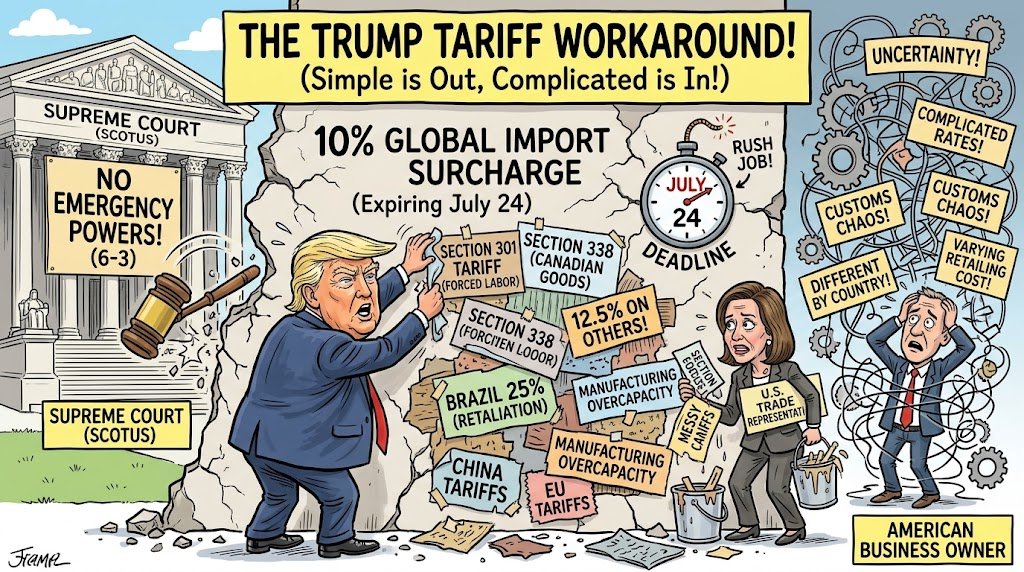
The administration is preparing duties on dozens of trading partners under alternative statutes after the Supreme Court rejected its earlier use of emergency powers.
A temporary ten percent United States import surcharge is due to expire on July 24, forcing President Donald Trump’s administration to replace a broad but time-limited measure if it intends to preserve tariffs across most international trade.
The approaching deadline is accelerating plans for a new collection of country-specific duties constructed under trade laws that provide narrower authority than the emergency statute used for Trump’s original reciprocal tariff program.
The existing surcharge took effect on February 24 and was authorized for 150 days under Section 122 of the Trade Act of 1974. That provision allows a president to impose temporary duties of as much as fifteen percent in response to serious international-payment problems, but it does not provide an indefinite foundation for a universal tariff.
A federal appeals court has allowed the government to continue collecting the charge while litigation over its legality proceeds.
Trump turned to Section 122 after the Supreme Court ruled in February that the International Emergency Economic Powers Act did not authorize the sweeping reciprocal and drug-trafficking tariffs imposed during 2025. The six-to-three decision did not eliminate presidential tariff authority.
It required the administration to rely on statutes in which Congress expressly delegated that power, each carrying its own evidentiary, procedural and temporal constraints.
The administration’s principal replacement mechanism is Section 301 of the Trade Act of 1974. It permits retaliation against foreign government practices judged unreasonable, discriminatory or harmful to United States commerce, but ordinarily requires an investigation, findings, consultation, public submissions and an opportunity for hearings before duties are finalized.
The Office of the United States Trade Representative has completed findings concerning 60 economies that it says fail to prohibit, or effectively prevent, the importation of goods made with forced labor.
Its proposed response would add tariffs of ten percent on imports from jurisdictions deemed to have some relevant restrictions and twelve and a half percent on goods from other affected economies.
The prospective targets encompass major partners, including China, Japan, Britain and members of the European Union, as well as numerous developing economies.
Public hearings on the forced-labor cases were held from July 7 through July 9. Foreign governments and affected industries disputed parts of the American assessment, with some arguing that they already maintain modern-slavery legislation or import controls.
The United States position is that having rules on paper is insufficient when enforcement allows products linked to forced labor to circulate through domestic markets and compete with American goods.
These proceedings allow Washington to present the tariffs as a response to identified commercial practices rather than a universal levy imposed solely because of bilateral trade deficits.
They also create a more defensible administrative record.
Section 301 actions can nevertheless be challenged in court, particularly if the duties appear disproportionate to the conduct documented in an investigation or if required procedures are abbreviated.
A second set of Section 301 investigations examines structural manufacturing overcapacity in 16 economies.
Those cases could eventually produce additional tariffs, although they remain distinct from the forced-labor proceedings and require separate findings.
Together, the investigations show how the administration is reconstructing its trade policy through multiple statutory channels instead of attempting to restore the invalidated emergency program in its original form.
Recent actions against individual partners illustrate that approach.
The administration has announced a twenty-five percent tariff on selected Brazilian imports following a yearlong Section 301 investigation, while exempting products considered important to American consumers or supply chains.
It has also invoked Section 338 of the Tariff Act of 1930 for additional duties on Canadian goods.
Existing national-security tariffs on metals and other products operate under still another authority and were not nullified by the Supreme Court ruling.
For importers, the result is a tariff system becoming less uniform but more intricate.
Rates may differ by country, product, statutory justification and exemption, complicating contracts, customs classifications and sourcing decisions.
Foreign governments must decide whether to negotiate, alter domestic enforcement or retaliate, while American businesses face uncertainty over which duties will replace the expiring surcharge and whether several levies may apply to the same shipment.
The administration argues that tariffs can counter unfair competition, strengthen domestic production and provide leverage in negotiations.
Critics contend that importers frequently pass at least part of the cost to manufacturers, retailers and consumers, creating particular exposure for businesses unable to change suppliers quickly.
The economic effect will depend on the final product coverage, available exemptions, foreign retaliation and whether the new duties supplement or replace the expiring ten percent charge.
With the temporary surcharge reaching its statutory limit, the next phase of Trump’s trade program will rest on completed investigations and targeted legal authorities.
The forced-labor hearings have concluded, and the trade representative can now determine which of the proposed duties on the 60 examined economies will be adopted.
The approaching deadline is accelerating plans for a new collection of country-specific duties constructed under trade laws that provide narrower authority than the emergency statute used for Trump’s original reciprocal tariff program.
The existing surcharge took effect on February 24 and was authorized for 150 days under Section 122 of the Trade Act of 1974. That provision allows a president to impose temporary duties of as much as fifteen percent in response to serious international-payment problems, but it does not provide an indefinite foundation for a universal tariff.
A federal appeals court has allowed the government to continue collecting the charge while litigation over its legality proceeds.
Trump turned to Section 122 after the Supreme Court ruled in February that the International Emergency Economic Powers Act did not authorize the sweeping reciprocal and drug-trafficking tariffs imposed during 2025. The six-to-three decision did not eliminate presidential tariff authority.
It required the administration to rely on statutes in which Congress expressly delegated that power, each carrying its own evidentiary, procedural and temporal constraints.
The administration’s principal replacement mechanism is Section 301 of the Trade Act of 1974. It permits retaliation against foreign government practices judged unreasonable, discriminatory or harmful to United States commerce, but ordinarily requires an investigation, findings, consultation, public submissions and an opportunity for hearings before duties are finalized.
The Office of the United States Trade Representative has completed findings concerning 60 economies that it says fail to prohibit, or effectively prevent, the importation of goods made with forced labor.
Its proposed response would add tariffs of ten percent on imports from jurisdictions deemed to have some relevant restrictions and twelve and a half percent on goods from other affected economies.
The prospective targets encompass major partners, including China, Japan, Britain and members of the European Union, as well as numerous developing economies.
Public hearings on the forced-labor cases were held from July 7 through July 9. Foreign governments and affected industries disputed parts of the American assessment, with some arguing that they already maintain modern-slavery legislation or import controls.
The United States position is that having rules on paper is insufficient when enforcement allows products linked to forced labor to circulate through domestic markets and compete with American goods.
These proceedings allow Washington to present the tariffs as a response to identified commercial practices rather than a universal levy imposed solely because of bilateral trade deficits.
They also create a more defensible administrative record.
Section 301 actions can nevertheless be challenged in court, particularly if the duties appear disproportionate to the conduct documented in an investigation or if required procedures are abbreviated.
A second set of Section 301 investigations examines structural manufacturing overcapacity in 16 economies.
Those cases could eventually produce additional tariffs, although they remain distinct from the forced-labor proceedings and require separate findings.
Together, the investigations show how the administration is reconstructing its trade policy through multiple statutory channels instead of attempting to restore the invalidated emergency program in its original form.
Recent actions against individual partners illustrate that approach.
The administration has announced a twenty-five percent tariff on selected Brazilian imports following a yearlong Section 301 investigation, while exempting products considered important to American consumers or supply chains.
It has also invoked Section 338 of the Tariff Act of 1930 for additional duties on Canadian goods.
Existing national-security tariffs on metals and other products operate under still another authority and were not nullified by the Supreme Court ruling.
For importers, the result is a tariff system becoming less uniform but more intricate.
Rates may differ by country, product, statutory justification and exemption, complicating contracts, customs classifications and sourcing decisions.
Foreign governments must decide whether to negotiate, alter domestic enforcement or retaliate, while American businesses face uncertainty over which duties will replace the expiring surcharge and whether several levies may apply to the same shipment.
The administration argues that tariffs can counter unfair competition, strengthen domestic production and provide leverage in negotiations.
Critics contend that importers frequently pass at least part of the cost to manufacturers, retailers and consumers, creating particular exposure for businesses unable to change suppliers quickly.
The economic effect will depend on the final product coverage, available exemptions, foreign retaliation and whether the new duties supplement or replace the expiring ten percent charge.
With the temporary surcharge reaching its statutory limit, the next phase of Trump’s trade program will rest on completed investigations and targeted legal authorities.
The forced-labor hearings have concluded, and the trade representative can now determine which of the proposed duties on the 60 examined economies will be adopted.
Regulators found that the Alibaba-owned marketplace failed to control systemic risks from illegal, counterfeit and unsafe goods, while AliExpress called the penalty disproportionate and prepared an appeal.
The European Commission has fined AliExpress €550 million for failing to assess and curb systemic risks arising from illegal, counterfeit and unsafe products sold through its marketplace.
The penalty is the largest imposed under the European Union’s Digital Services Act and places the Alibaba-owned platform at the centre of an intensifying campaign to make major online retailers accountable for what reaches European consumers.
The decision concerns shortcomings that continued until at least June 2025. Regulators found that counterfeit clothing, unsafe toys, dangerous cosmetics and other non-compliant goods circulated on AliExpress, sometimes remaining available for weeks after detection.
Products previously identified as illegal also reappeared, while sellers could circumvent safeguards by placing items in misleading categories.
The case is not based simply on the presence of individual prohibited listings.
The key issue is whether AliExpress established systems proportionate to the scale and foreseeable risks of its business.
Under the Digital Services Act, the largest platforms must identify dangers created by their services, introduce effective safeguards, test whether those measures work and correct persistent failures.
The Commission concluded that AliExpress had not met that standard.
Its investigation identified inadequate internal risk assessments, insufficient staffing for product checks and recommendation systems that continued promoting problematic listings.
Some reviewers were given only tens of seconds to determine whether an item complied with European rules, limiting the depth of scrutiny applied to a marketplace containing vast numbers of products.
AliExpress has about 193 million users in the European Union, making it one of the bloc’s largest online retail platforms.
That reach is central to the enforcement decision: a weakness in screening or seller oversight can expose consumers across 27 countries to unsafe merchandise at enormous scale.
Formal proceedings began in March 2024 and examined risk management, content moderation, trader traceability, advertising transparency, recommendation systems, complaint handling and access to data for researchers.
In June 2025, regulators issued preliminary findings that AliExpress had failed to assess and mitigate risks linked to illegal goods.
At the same time, the Commission accepted commitments from the company covering several other parts of the investigation.
Those undertakings, which became legally binding, addressed mechanisms for reporting unlawful listings, internal complaints, advertising and recommendation transparency, trader identification, researcher access and controls targeting hidden links, affiliate marketing and products that could endanger health or minors.
Breaching those commitments can itself trigger further enforcement.
The €550 million sanction reflects the Commission’s conclusion that the remaining failures were serious and systemic.
Digital Services Act penalties can reach 6% of a company’s worldwide annual turnover.
The fine is nevertheless less than 1% of the roughly €122 billion in revenue generated by Alibaba in its previous financial year.
Henna Virkkunen, the Commission’s executive vice-president responsible for technology sovereignty, security and democracy, said the circulation of counterfeit clothing, unsafe toys and dangerous cosmetics was not an unavoidable consequence of internet shopping.
She said scale did not excuse inadequate safeguards and that risks had to be identified and addressed systematically.
AliExpress rejected the scale of the penalty.
The company said it had invested substantial resources in risk assessment, product safety and consumer protection since the European rules took effect.
It described the fine as disproportionate, argued that the decision failed to recognise improvements already made and said it would appeal.
The ruling extends scrutiny across the fast-growing market for inexpensive goods shipped directly to European customers.
Temu previously received a €200 million Digital Services Act fine over similar product-safety failures, while other large marketplaces remain subject to investigations and tighter import controls.
The enforcement drive seeks to close the practical gap between laws governing goods sold in physical shops and the immense, rapidly changing inventories offered online.
AliExpress must now submit a corrective action plan by 20 October explaining how it will remedy its failures to assess and mitigate systemic risk.
Rejection of that plan or continued non-compliance could expose the company to additional sanctions, making implementation of stronger product controls the next binding stage of the case.
The penalty is the largest imposed under the European Union’s Digital Services Act and places the Alibaba-owned platform at the centre of an intensifying campaign to make major online retailers accountable for what reaches European consumers.
The decision concerns shortcomings that continued until at least June 2025. Regulators found that counterfeit clothing, unsafe toys, dangerous cosmetics and other non-compliant goods circulated on AliExpress, sometimes remaining available for weeks after detection.
Products previously identified as illegal also reappeared, while sellers could circumvent safeguards by placing items in misleading categories.
The case is not based simply on the presence of individual prohibited listings.
The key issue is whether AliExpress established systems proportionate to the scale and foreseeable risks of its business.
Under the Digital Services Act, the largest platforms must identify dangers created by their services, introduce effective safeguards, test whether those measures work and correct persistent failures.
The Commission concluded that AliExpress had not met that standard.
Its investigation identified inadequate internal risk assessments, insufficient staffing for product checks and recommendation systems that continued promoting problematic listings.
Some reviewers were given only tens of seconds to determine whether an item complied with European rules, limiting the depth of scrutiny applied to a marketplace containing vast numbers of products.
AliExpress has about 193 million users in the European Union, making it one of the bloc’s largest online retail platforms.
That reach is central to the enforcement decision: a weakness in screening or seller oversight can expose consumers across 27 countries to unsafe merchandise at enormous scale.
Formal proceedings began in March 2024 and examined risk management, content moderation, trader traceability, advertising transparency, recommendation systems, complaint handling and access to data for researchers.
In June 2025, regulators issued preliminary findings that AliExpress had failed to assess and mitigate risks linked to illegal goods.
At the same time, the Commission accepted commitments from the company covering several other parts of the investigation.
Those undertakings, which became legally binding, addressed mechanisms for reporting unlawful listings, internal complaints, advertising and recommendation transparency, trader identification, researcher access and controls targeting hidden links, affiliate marketing and products that could endanger health or minors.
Breaching those commitments can itself trigger further enforcement.
The €550 million sanction reflects the Commission’s conclusion that the remaining failures were serious and systemic.
Digital Services Act penalties can reach 6% of a company’s worldwide annual turnover.
The fine is nevertheless less than 1% of the roughly €122 billion in revenue generated by Alibaba in its previous financial year.
Henna Virkkunen, the Commission’s executive vice-president responsible for technology sovereignty, security and democracy, said the circulation of counterfeit clothing, unsafe toys and dangerous cosmetics was not an unavoidable consequence of internet shopping.
She said scale did not excuse inadequate safeguards and that risks had to be identified and addressed systematically.
AliExpress rejected the scale of the penalty.
The company said it had invested substantial resources in risk assessment, product safety and consumer protection since the European rules took effect.
It described the fine as disproportionate, argued that the decision failed to recognise improvements already made and said it would appeal.
The ruling extends scrutiny across the fast-growing market for inexpensive goods shipped directly to European customers.
Temu previously received a €200 million Digital Services Act fine over similar product-safety failures, while other large marketplaces remain subject to investigations and tighter import controls.
The enforcement drive seeks to close the practical gap between laws governing goods sold in physical shops and the immense, rapidly changing inventories offered online.
AliExpress must now submit a corrective action plan by 20 October explaining how it will remedy its failures to assess and mitigate systemic risk.
Rejection of that plan or continued non-compliance could expose the company to additional sanctions, making implementation of stronger product controls the next binding stage of the case.
Miliband Sets Climate and International Law at Centre of UK Diplomacy
Trump Readies New Tariffs as Temporary Global Levy Nears Expiry
EU Imposes Record €550 Million Digital Services Fine on AliExpress
Between Deliveries, Wang Jibing Wrote His Way to China’s Literary Heights
Morgan Stanley Builds a Wall Street Lead in AI Infrastructure Finance
High Prices Push Coffee Drinkers Toward Whole Beans and Home Brewing
Trump Draws Boos and Podium Scrutiny at Spain’s World Cup Triumph
Spain Defeats Argentina in Extra Time to Win Second World Cup
Police Block Cockroach Janta Party’s March to Parliament as Education Protests Intensify
Singapore Considers Lower Taxes for Fund Managers as Hong Kong Intensifies Talent Contest
Proposed U.S.-Saudi Nuclear Pact Could Permit Limited Uranium Enrichment Under International Safeguards
Why Kentucky Fried Chicken Became KFC—and Why the False Explanations Persist
Ukrainian Drones Strike Wildberries Warehouses Deep Inside Russia
Reported CIA Mission Helped Clear the UAE’s Path to Advanced US AI Chips
Artificial Intelligence Capital Fuels Markets While Governments and Regulators Face Mounting Strategic Tests
China’s Moonshot’s Kimi K3 Narrows the Gap With Anthropic Through Scale, Openness and Lower Cost
Gold and Cash Seizure Puts Indonesia’s Senior Anti-Corruption Prosecutor Under Investigation
The Ledger Will Not Trust on Faith
Ukraine’s Leadership Rift Spills Into the Streets as Protesters Target Army Chief
The Ten World Cup Finals That Defined Football History
Smartphones Are Getting More Expensive, Sales Are Collapsing, and Even Apple Admits: "Prices Will Rise"
Leadership Change and Strategic Rivalry Redraw the Political Map
The AI Race Enters Its Infrastructure Era
Britain Nationalises British Steel to Protect Scunthorpe Production and Strategic Supply
French National Assembly Overrides Senate to Pass Historic Assisted-Dying Legislation
Thomas Tuchel Faces Fierce Backlash After Tactical Retreat Costs England World Cup Final Berth
A Quiet Bastille Day: France Grapples with World Cup Heartbreak and Leftover Fireworks
Spain in Ecstasy: "We Feel Unbeatable, We Taught the Whole World a Lesson"
Harvard Astrophysicist to Lead U.S. Scientific Advisory on Unidentified Aerial Phenomena
Emergency Sirens Activated Across Bahrain as Interior Ministry Issues Shelter Directives
World Cup Visitors Turn American Big-Box Stores Into Souvenir Stops
Netflix Weighs Always-On Channels, Bundles and Short-Form Video
The AI Invoice Shock: Layoffs Didn't Save Managers Money — They Cost Them More
Concern: Sexually Transmitted Bacterium Among Men Develops Antibiotic Resistance
Following Massive Investor Demand: SK Hynix Raises 26.5 Billion Dollars on Nasdaq
Passenger Partially Pulled Out of Ryanair Jet After Cabin Window Fails Mid-Flight
Severe Heatwave Drives Dangerous Ground-Level Ozone Pollution Across Two Thirds of European Union
Flight Instructor Jumped to His Death — Student Landed the Plane: "You Know What You Need to Do"
The Physical and Electronic Barriers Disrupting Domestic Wireless Networks
France and Morocco Open World Cup Quarter-Finals as Collina Defends Refereeing
Tech Pulse: The Future of AI and Screen Culture
Global News Briefing: Escalating Geopolitical Tensions and Corporate Shakeups
Global News Brief: Escalating Conflicts, Public Health Crises, and World Cup Drama
Europe's Growing Struggle with Extreme Heat and Air Conditioning
Anthropic Reengineers Agentic Architecture to Shift Autonomous Workplace Automation to the Cloud
Apple Advances Late-Stage Operating Systems with Fourth Beta Deployments
Global Crisis Alert: Escalating Middle East Tensions and UK Political Upheaval
"A New Era of Testing": The Rare Launch of a Missile from a Chinese Nuclear Submarine - That Could Reach U.S. Soil
Japanese Technology Firm Fujitsu Launches Advanced Artificial Intelligence Tool for Corporate Disclosures
South Africa Officially Launches Nationwide Campaign for Highly Contested Local Government Elections