Agricultural agencies across Thailand, Vietnam and neighboring Mekong countries are introducing digital traceability systems and drought-resistant farming techniques to strengthen food security amid increasingly volatile weather.
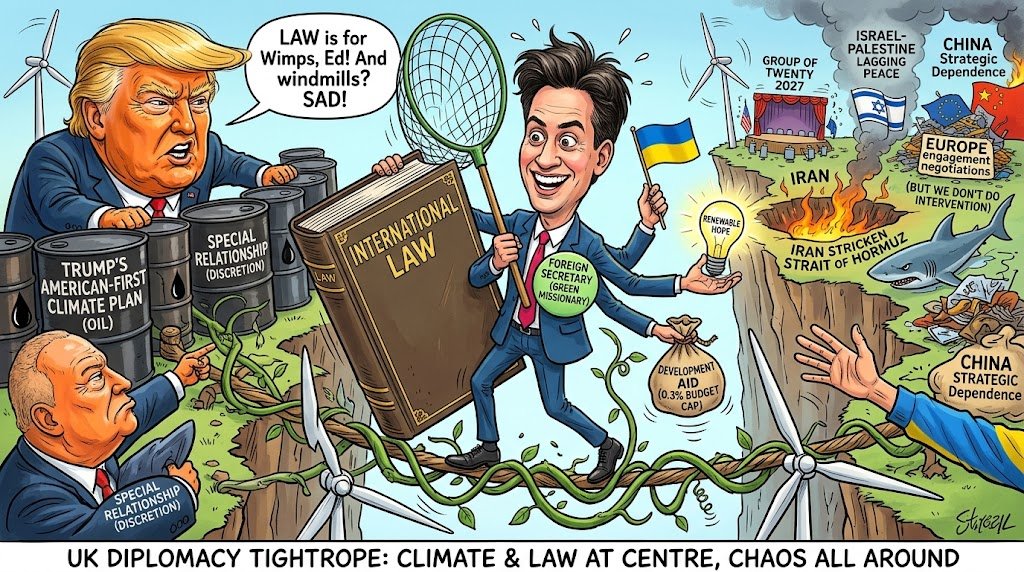
Britain’s new foreign secretary promises continuity on Ukraine and the American alliance while signalling greater emphasis on climate action, development and legal restraint.
Ed Miliband has taken control of British foreign policy with a promise to restore climate diplomacy, defend international law and maintain the country’s principal alliances, including its strategically indispensable but politically difficult relationship with the United States.
His appointment by Prime Minister Andy Burnham signals a change of emphasis more than an immediate rupture with the policies inherited from the previous government.
Miliband became foreign, commonwealth and development secretary on July 20 after two years overseeing energy security and the transition to net zero.
A former Labour leader and climate secretary, he arrives with greater cabinet experience and a more clearly defined ideological record than many newly appointed foreign ministers.
That record combines Atlanticism, European engagement, environmental activism and a longstanding reluctance to treat military intervention as the default response to international crises.
His initial commitments were deliberately broad.
He identified continued support for Ukraine, preservation of Britain’s special relationship with the United States, a sustainable peace between Israel and the Palestinians, and the reopening of the Strait of Hormuz as immediate priorities.
He also placed climate change and international development among the threats to justice and security that the Foreign Office must address.
The American relationship will provide the earliest test.
Britain depends on the United States for intelligence cooperation, nuclear deterrence, advanced defence technology and much of the military capacity underpinning the North Atlantic alliance.
Burnham has already spoken with President Donald Trump and indicated that he intends to engage candidly while preserving practical cooperation.
Miliband has promised to nurture that alliance despite substantial differences with the Trump administration.
Those disagreements encompass climate policy, North Sea drilling and aspects of the war with Iran.
Trump has criticised Britain’s restrictions on new offshore oil and gas development, while Miliband spent his tenure as energy secretary arguing that renewable power and reduced exposure to volatile fossil-fuel markets offer the more durable route to energy security.
The foreign secretary’s challenge will be to compartmentalise those disputes.
Britain can continue intelligence, defence and diplomatic coordination with Washington without adopting every American policy.
The more openly London invokes international law or questions military escalation, however, the more friction it may encounter with an administration that places greater weight on national discretion and coercive leverage.
Iran illustrates the tension.
Britain has a direct interest in restoring safe passage through the Strait of Hormuz, a crucial route for global oil and gas supplies.
It also has military facilities, citizens and commercial interests exposed to regional escalation.
Miliband is likely to support measures protecting navigation while applying a more exacting test to British participation in offensive operations, particularly where parliamentary authority, strategic objectives or the legal basis remain contested.
That caution reflects his political history.
As Labour leader in 2013, Miliband prevented the government from securing parliamentary approval for military action in Syria after a chemical-weapons attack.
Supporters viewed the decision as necessary scrutiny of an inadequately defined intervention; critics argued that it weakened deterrence.
The episode established his preference for explicit evidence, legal justification and a credible plan before Britain uses force.
Policy toward Ukraine is expected to remain substantially unchanged.
Miliband has reaffirmed support for Kyiv and characterised Russia’s invasion as a violation of international law.
Britain is therefore likely to continue military assistance, sanctions and diplomatic coordination with European and transatlantic partners, subject to the spending decisions of Burnham’s government.
Relations with Europe may acquire greater political energy.
Burnham inherited negotiations intended to reduce post-Brexit trade barriers, expand security cooperation and connect British and European climate policies.
Miliband’s multilateral instincts and familiarity with European energy institutions should support that reset, although the government has not proposed rejoining the European Union, its single market or its customs union.
The appointment of a dedicated minister for European relations strengthens that division of labour.
Practical negotiations will concentrate on food trade, emissions markets, security and youth mobility.
Progress will still require compromises over regulatory alignment, financial contributions and movement between Britain and the continent, matters that remain sensitive within domestic politics.
Climate policy is the clearest prospective departure.
Miliband treats global warming not as a specialist environmental portfolio but as a foreign-policy issue affecting migration, food security, debt, conflict and geopolitical influence.
He is expected to use diplomatic missions, development finance and trade relationships to promote emissions reduction, renewable investment and adaptation in countries most exposed to extreme weather.
That approach could restore climate diplomacy as a prominent component of British soft power.
It also creates difficult choices.
Britain wants affordable clean technologies and resilient supply chains, yet the global solar-panel, battery and critical-mineral industries depend heavily on China.
Miliband will have to balance decarbonisation against concerns about strategic dependence, subsidies, forced labour, industrial competition and human rights.
The tension cannot be resolved by treating China solely as either a partner or an adversary.
Cooperation is necessary for meaningful global emissions reductions, while economic security requires diversification and enforceable standards.
British policy is consequently likely to combine engagement on climate with greater scrutiny of investment, technology transfer and vulnerable supply chains.
The Middle East may produce more visible change.
Miliband is Jewish and the son of refugees from Nazi persecution, and he has consistently defended Israel’s right to security while criticising settlement expansion and military actions he considered disproportionate.
He supports Palestinian statehood, opposes boycotts of Israel and regards Hamas as a terrorist organisation.
As foreign secretary, he has committed himself to a sustainable peace for both Palestinians and Israelis.
His emphasis on the rule of law may lead to firmer public scrutiny of conduct by every party, including Israel, Iran and armed groups such as Hamas.
Yet decisions on recognition, sanctions, arms exports or diplomatic pressure belong to the government collectively, and no immediate policy reversal has been announced.
International development presents a more concrete constraint.
Britain is reducing official development assistance toward 0.3 percent of gross national income by the 2027–28 financial year, down from the earlier 0.5 percent level.
The reductions were designed partly to finance higher defence expenditure and include severe cuts to bilateral programmes in several fragile African states.
Miliband wants development restored as an instrument of foreign policy, but rhetoric cannot replace funding.
Reversing the scheduled reductions would require agreement from the Treasury and difficult choices elsewhere in the budget.
Without additional resources, he will have to concentrate spending, rely more heavily on multilateral institutions and pursue reforms that allow poorer countries to mobilise investment without expanding unsustainable debt.
Britain’s presidency of the Group of Twenty in 2027 will give him a platform for that agenda.
Climate finance, sovereign debt, development-bank reform, taxation and illicit financial flows could connect his environmental and development priorities with the interests of emerging economies.
Success will depend on persuading governments with sharply different strategic interests that British proposals offer material benefits rather than moral instruction.
The broad direction is now visible: closer European engagement, continuity on Ukraine, disciplined management of the American alliance and a stronger role for climate, development and international law.
The actual change will be measured through decisions on Iran, Israel, China, aid funding and the use of force.
Miliband’s first task is to convert those principles into policy while preserving the alliances on which Britain’s security still depends.
His appointment by Prime Minister Andy Burnham signals a change of emphasis more than an immediate rupture with the policies inherited from the previous government.
Miliband became foreign, commonwealth and development secretary on July 20 after two years overseeing energy security and the transition to net zero.
A former Labour leader and climate secretary, he arrives with greater cabinet experience and a more clearly defined ideological record than many newly appointed foreign ministers.
That record combines Atlanticism, European engagement, environmental activism and a longstanding reluctance to treat military intervention as the default response to international crises.
His initial commitments were deliberately broad.
He identified continued support for Ukraine, preservation of Britain’s special relationship with the United States, a sustainable peace between Israel and the Palestinians, and the reopening of the Strait of Hormuz as immediate priorities.
He also placed climate change and international development among the threats to justice and security that the Foreign Office must address.
The American relationship will provide the earliest test.
Britain depends on the United States for intelligence cooperation, nuclear deterrence, advanced defence technology and much of the military capacity underpinning the North Atlantic alliance.
Burnham has already spoken with President Donald Trump and indicated that he intends to engage candidly while preserving practical cooperation.
Miliband has promised to nurture that alliance despite substantial differences with the Trump administration.
Those disagreements encompass climate policy, North Sea drilling and aspects of the war with Iran.
Trump has criticised Britain’s restrictions on new offshore oil and gas development, while Miliband spent his tenure as energy secretary arguing that renewable power and reduced exposure to volatile fossil-fuel markets offer the more durable route to energy security.
The foreign secretary’s challenge will be to compartmentalise those disputes.
Britain can continue intelligence, defence and diplomatic coordination with Washington without adopting every American policy.
The more openly London invokes international law or questions military escalation, however, the more friction it may encounter with an administration that places greater weight on national discretion and coercive leverage.
Iran illustrates the tension.
Britain has a direct interest in restoring safe passage through the Strait of Hormuz, a crucial route for global oil and gas supplies.
It also has military facilities, citizens and commercial interests exposed to regional escalation.
Miliband is likely to support measures protecting navigation while applying a more exacting test to British participation in offensive operations, particularly where parliamentary authority, strategic objectives or the legal basis remain contested.
That caution reflects his political history.
As Labour leader in 2013, Miliband prevented the government from securing parliamentary approval for military action in Syria after a chemical-weapons attack.
Supporters viewed the decision as necessary scrutiny of an inadequately defined intervention; critics argued that it weakened deterrence.
The episode established his preference for explicit evidence, legal justification and a credible plan before Britain uses force.
Policy toward Ukraine is expected to remain substantially unchanged.
Miliband has reaffirmed support for Kyiv and characterised Russia’s invasion as a violation of international law.
Britain is therefore likely to continue military assistance, sanctions and diplomatic coordination with European and transatlantic partners, subject to the spending decisions of Burnham’s government.
Relations with Europe may acquire greater political energy.
Burnham inherited negotiations intended to reduce post-Brexit trade barriers, expand security cooperation and connect British and European climate policies.
Miliband’s multilateral instincts and familiarity with European energy institutions should support that reset, although the government has not proposed rejoining the European Union, its single market or its customs union.
The appointment of a dedicated minister for European relations strengthens that division of labour.
Practical negotiations will concentrate on food trade, emissions markets, security and youth mobility.
Progress will still require compromises over regulatory alignment, financial contributions and movement between Britain and the continent, matters that remain sensitive within domestic politics.
Climate policy is the clearest prospective departure.
Miliband treats global warming not as a specialist environmental portfolio but as a foreign-policy issue affecting migration, food security, debt, conflict and geopolitical influence.
He is expected to use diplomatic missions, development finance and trade relationships to promote emissions reduction, renewable investment and adaptation in countries most exposed to extreme weather.
That approach could restore climate diplomacy as a prominent component of British soft power.
It also creates difficult choices.
Britain wants affordable clean technologies and resilient supply chains, yet the global solar-panel, battery and critical-mineral industries depend heavily on China.
Miliband will have to balance decarbonisation against concerns about strategic dependence, subsidies, forced labour, industrial competition and human rights.
The tension cannot be resolved by treating China solely as either a partner or an adversary.
Cooperation is necessary for meaningful global emissions reductions, while economic security requires diversification and enforceable standards.
British policy is consequently likely to combine engagement on climate with greater scrutiny of investment, technology transfer and vulnerable supply chains.
The Middle East may produce more visible change.
Miliband is Jewish and the son of refugees from Nazi persecution, and he has consistently defended Israel’s right to security while criticising settlement expansion and military actions he considered disproportionate.
He supports Palestinian statehood, opposes boycotts of Israel and regards Hamas as a terrorist organisation.
As foreign secretary, he has committed himself to a sustainable peace for both Palestinians and Israelis.
His emphasis on the rule of law may lead to firmer public scrutiny of conduct by every party, including Israel, Iran and armed groups such as Hamas.
Yet decisions on recognition, sanctions, arms exports or diplomatic pressure belong to the government collectively, and no immediate policy reversal has been announced.
International development presents a more concrete constraint.
Britain is reducing official development assistance toward 0.3 percent of gross national income by the 2027–28 financial year, down from the earlier 0.5 percent level.
The reductions were designed partly to finance higher defence expenditure and include severe cuts to bilateral programmes in several fragile African states.
Miliband wants development restored as an instrument of foreign policy, but rhetoric cannot replace funding.
Reversing the scheduled reductions would require agreement from the Treasury and difficult choices elsewhere in the budget.
Without additional resources, he will have to concentrate spending, rely more heavily on multilateral institutions and pursue reforms that allow poorer countries to mobilise investment without expanding unsustainable debt.
Britain’s presidency of the Group of Twenty in 2027 will give him a platform for that agenda.
Climate finance, sovereign debt, development-bank reform, taxation and illicit financial flows could connect his environmental and development priorities with the interests of emerging economies.
Success will depend on persuading governments with sharply different strategic interests that British proposals offer material benefits rather than moral instruction.
The broad direction is now visible: closer European engagement, continuity on Ukraine, disciplined management of the American alliance and a stronger role for climate, development and international law.
The actual change will be measured through decisions on Iran, Israel, China, aid funding and the use of force.
Miliband’s first task is to convert those principles into policy while preserving the alliances on which Britain’s security still depends.
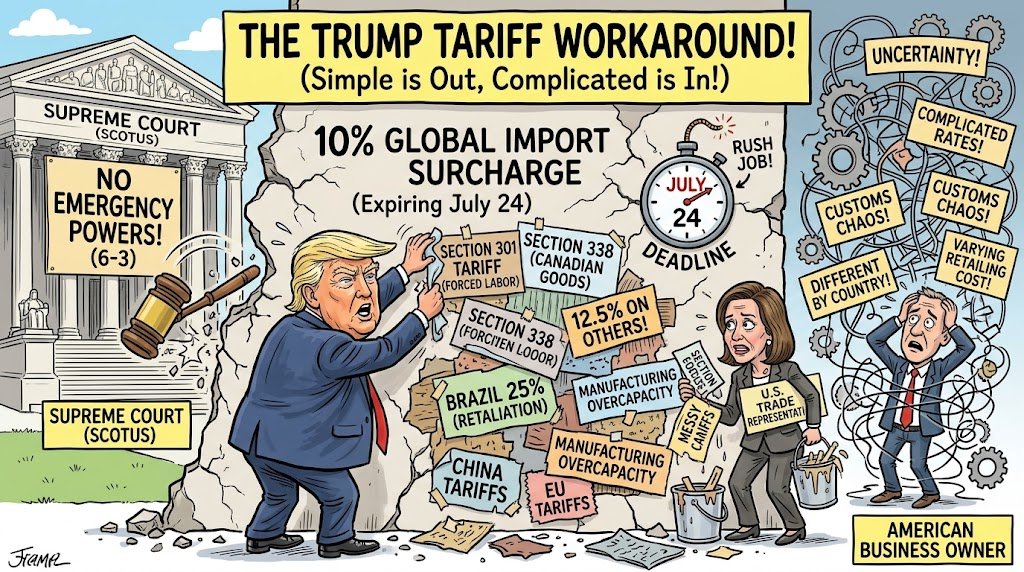
The administration is preparing duties on dozens of trading partners under alternative statutes after the Supreme Court rejected its earlier use of emergency powers.
A temporary ten percent United States import surcharge is due to expire on July 24, forcing President Donald Trump’s administration to replace a broad but time-limited measure if it intends to preserve tariffs across most international trade.
The approaching deadline is accelerating plans for a new collection of country-specific duties constructed under trade laws that provide narrower authority than the emergency statute used for Trump’s original reciprocal tariff program.
The existing surcharge took effect on February 24 and was authorized for 150 days under Section 122 of the Trade Act of 1974. That provision allows a president to impose temporary duties of as much as fifteen percent in response to serious international-payment problems, but it does not provide an indefinite foundation for a universal tariff.
A federal appeals court has allowed the government to continue collecting the charge while litigation over its legality proceeds.
Trump turned to Section 122 after the Supreme Court ruled in February that the International Emergency Economic Powers Act did not authorize the sweeping reciprocal and drug-trafficking tariffs imposed during 2025. The six-to-three decision did not eliminate presidential tariff authority.
It required the administration to rely on statutes in which Congress expressly delegated that power, each carrying its own evidentiary, procedural and temporal constraints.
The administration’s principal replacement mechanism is Section 301 of the Trade Act of 1974. It permits retaliation against foreign government practices judged unreasonable, discriminatory or harmful to United States commerce, but ordinarily requires an investigation, findings, consultation, public submissions and an opportunity for hearings before duties are finalized.
The Office of the United States Trade Representative has completed findings concerning 60 economies that it says fail to prohibit, or effectively prevent, the importation of goods made with forced labor.
Its proposed response would add tariffs of ten percent on imports from jurisdictions deemed to have some relevant restrictions and twelve and a half percent on goods from other affected economies.
The prospective targets encompass major partners, including China, Japan, Britain and members of the European Union, as well as numerous developing economies.
Public hearings on the forced-labor cases were held from July 7 through July 9. Foreign governments and affected industries disputed parts of the American assessment, with some arguing that they already maintain modern-slavery legislation or import controls.
The United States position is that having rules on paper is insufficient when enforcement allows products linked to forced labor to circulate through domestic markets and compete with American goods.
These proceedings allow Washington to present the tariffs as a response to identified commercial practices rather than a universal levy imposed solely because of bilateral trade deficits.
They also create a more defensible administrative record.
Section 301 actions can nevertheless be challenged in court, particularly if the duties appear disproportionate to the conduct documented in an investigation or if required procedures are abbreviated.
A second set of Section 301 investigations examines structural manufacturing overcapacity in 16 economies.
Those cases could eventually produce additional tariffs, although they remain distinct from the forced-labor proceedings and require separate findings.
Together, the investigations show how the administration is reconstructing its trade policy through multiple statutory channels instead of attempting to restore the invalidated emergency program in its original form.
Recent actions against individual partners illustrate that approach.
The administration has announced a twenty-five percent tariff on selected Brazilian imports following a yearlong Section 301 investigation, while exempting products considered important to American consumers or supply chains.
It has also invoked Section 338 of the Tariff Act of 1930 for additional duties on Canadian goods.
Existing national-security tariffs on metals and other products operate under still another authority and were not nullified by the Supreme Court ruling.
For importers, the result is a tariff system becoming less uniform but more intricate.
Rates may differ by country, product, statutory justification and exemption, complicating contracts, customs classifications and sourcing decisions.
Foreign governments must decide whether to negotiate, alter domestic enforcement or retaliate, while American businesses face uncertainty over which duties will replace the expiring surcharge and whether several levies may apply to the same shipment.
The administration argues that tariffs can counter unfair competition, strengthen domestic production and provide leverage in negotiations.
Critics contend that importers frequently pass at least part of the cost to manufacturers, retailers and consumers, creating particular exposure for businesses unable to change suppliers quickly.
The economic effect will depend on the final product coverage, available exemptions, foreign retaliation and whether the new duties supplement or replace the expiring ten percent charge.
With the temporary surcharge reaching its statutory limit, the next phase of Trump’s trade program will rest on completed investigations and targeted legal authorities.
The forced-labor hearings have concluded, and the trade representative can now determine which of the proposed duties on the 60 examined economies will be adopted.
The approaching deadline is accelerating plans for a new collection of country-specific duties constructed under trade laws that provide narrower authority than the emergency statute used for Trump’s original reciprocal tariff program.
The existing surcharge took effect on February 24 and was authorized for 150 days under Section 122 of the Trade Act of 1974. That provision allows a president to impose temporary duties of as much as fifteen percent in response to serious international-payment problems, but it does not provide an indefinite foundation for a universal tariff.
A federal appeals court has allowed the government to continue collecting the charge while litigation over its legality proceeds.
Trump turned to Section 122 after the Supreme Court ruled in February that the International Emergency Economic Powers Act did not authorize the sweeping reciprocal and drug-trafficking tariffs imposed during 2025. The six-to-three decision did not eliminate presidential tariff authority.
It required the administration to rely on statutes in which Congress expressly delegated that power, each carrying its own evidentiary, procedural and temporal constraints.
The administration’s principal replacement mechanism is Section 301 of the Trade Act of 1974. It permits retaliation against foreign government practices judged unreasonable, discriminatory or harmful to United States commerce, but ordinarily requires an investigation, findings, consultation, public submissions and an opportunity for hearings before duties are finalized.
The Office of the United States Trade Representative has completed findings concerning 60 economies that it says fail to prohibit, or effectively prevent, the importation of goods made with forced labor.
Its proposed response would add tariffs of ten percent on imports from jurisdictions deemed to have some relevant restrictions and twelve and a half percent on goods from other affected economies.
The prospective targets encompass major partners, including China, Japan, Britain and members of the European Union, as well as numerous developing economies.
Public hearings on the forced-labor cases were held from July 7 through July 9. Foreign governments and affected industries disputed parts of the American assessment, with some arguing that they already maintain modern-slavery legislation or import controls.
The United States position is that having rules on paper is insufficient when enforcement allows products linked to forced labor to circulate through domestic markets and compete with American goods.
These proceedings allow Washington to present the tariffs as a response to identified commercial practices rather than a universal levy imposed solely because of bilateral trade deficits.
They also create a more defensible administrative record.
Section 301 actions can nevertheless be challenged in court, particularly if the duties appear disproportionate to the conduct documented in an investigation or if required procedures are abbreviated.
A second set of Section 301 investigations examines structural manufacturing overcapacity in 16 economies.
Those cases could eventually produce additional tariffs, although they remain distinct from the forced-labor proceedings and require separate findings.
Together, the investigations show how the administration is reconstructing its trade policy through multiple statutory channels instead of attempting to restore the invalidated emergency program in its original form.
Recent actions against individual partners illustrate that approach.
The administration has announced a twenty-five percent tariff on selected Brazilian imports following a yearlong Section 301 investigation, while exempting products considered important to American consumers or supply chains.
It has also invoked Section 338 of the Tariff Act of 1930 for additional duties on Canadian goods.
Existing national-security tariffs on metals and other products operate under still another authority and were not nullified by the Supreme Court ruling.
For importers, the result is a tariff system becoming less uniform but more intricate.
Rates may differ by country, product, statutory justification and exemption, complicating contracts, customs classifications and sourcing decisions.
Foreign governments must decide whether to negotiate, alter domestic enforcement or retaliate, while American businesses face uncertainty over which duties will replace the expiring surcharge and whether several levies may apply to the same shipment.
The administration argues that tariffs can counter unfair competition, strengthen domestic production and provide leverage in negotiations.
Critics contend that importers frequently pass at least part of the cost to manufacturers, retailers and consumers, creating particular exposure for businesses unable to change suppliers quickly.
The economic effect will depend on the final product coverage, available exemptions, foreign retaliation and whether the new duties supplement or replace the expiring ten percent charge.
With the temporary surcharge reaching its statutory limit, the next phase of Trump’s trade program will rest on completed investigations and targeted legal authorities.
The forced-labor hearings have concluded, and the trade representative can now determine which of the proposed duties on the 60 examined economies will be adopted.
Regulators found that the Alibaba-owned marketplace failed to control systemic risks from illegal, counterfeit and unsafe goods, while AliExpress called the penalty disproportionate and prepared an appeal.
The European Commission has fined AliExpress €550 million for failing to assess and curb systemic risks arising from illegal, counterfeit and unsafe products sold through its marketplace.
The penalty is the largest imposed under the European Union’s Digital Services Act and places the Alibaba-owned platform at the centre of an intensifying campaign to make major online retailers accountable for what reaches European consumers.
The decision concerns shortcomings that continued until at least June 2025. Regulators found that counterfeit clothing, unsafe toys, dangerous cosmetics and other non-compliant goods circulated on AliExpress, sometimes remaining available for weeks after detection.
Products previously identified as illegal also reappeared, while sellers could circumvent safeguards by placing items in misleading categories.
The case is not based simply on the presence of individual prohibited listings.
The key issue is whether AliExpress established systems proportionate to the scale and foreseeable risks of its business.
Under the Digital Services Act, the largest platforms must identify dangers created by their services, introduce effective safeguards, test whether those measures work and correct persistent failures.
The Commission concluded that AliExpress had not met that standard.
Its investigation identified inadequate internal risk assessments, insufficient staffing for product checks and recommendation systems that continued promoting problematic listings.
Some reviewers were given only tens of seconds to determine whether an item complied with European rules, limiting the depth of scrutiny applied to a marketplace containing vast numbers of products.
AliExpress has about 193 million users in the European Union, making it one of the bloc’s largest online retail platforms.
That reach is central to the enforcement decision: a weakness in screening or seller oversight can expose consumers across 27 countries to unsafe merchandise at enormous scale.
Formal proceedings began in March 2024 and examined risk management, content moderation, trader traceability, advertising transparency, recommendation systems, complaint handling and access to data for researchers.
In June 2025, regulators issued preliminary findings that AliExpress had failed to assess and mitigate risks linked to illegal goods.
At the same time, the Commission accepted commitments from the company covering several other parts of the investigation.
Those undertakings, which became legally binding, addressed mechanisms for reporting unlawful listings, internal complaints, advertising and recommendation transparency, trader identification, researcher access and controls targeting hidden links, affiliate marketing and products that could endanger health or minors.
Breaching those commitments can itself trigger further enforcement.
The €550 million sanction reflects the Commission’s conclusion that the remaining failures were serious and systemic.
Digital Services Act penalties can reach 6% of a company’s worldwide annual turnover.
The fine is nevertheless less than 1% of the roughly €122 billion in revenue generated by Alibaba in its previous financial year.
Henna Virkkunen, the Commission’s executive vice-president responsible for technology sovereignty, security and democracy, said the circulation of counterfeit clothing, unsafe toys and dangerous cosmetics was not an unavoidable consequence of internet shopping.
She said scale did not excuse inadequate safeguards and that risks had to be identified and addressed systematically.
AliExpress rejected the scale of the penalty.
The company said it had invested substantial resources in risk assessment, product safety and consumer protection since the European rules took effect.
It described the fine as disproportionate, argued that the decision failed to recognise improvements already made and said it would appeal.
The ruling extends scrutiny across the fast-growing market for inexpensive goods shipped directly to European customers.
Temu previously received a €200 million Digital Services Act fine over similar product-safety failures, while other large marketplaces remain subject to investigations and tighter import controls.
The enforcement drive seeks to close the practical gap between laws governing goods sold in physical shops and the immense, rapidly changing inventories offered online.
AliExpress must now submit a corrective action plan by 20 October explaining how it will remedy its failures to assess and mitigate systemic risk.
Rejection of that plan or continued non-compliance could expose the company to additional sanctions, making implementation of stronger product controls the next binding stage of the case.
The penalty is the largest imposed under the European Union’s Digital Services Act and places the Alibaba-owned platform at the centre of an intensifying campaign to make major online retailers accountable for what reaches European consumers.
The decision concerns shortcomings that continued until at least June 2025. Regulators found that counterfeit clothing, unsafe toys, dangerous cosmetics and other non-compliant goods circulated on AliExpress, sometimes remaining available for weeks after detection.
Products previously identified as illegal also reappeared, while sellers could circumvent safeguards by placing items in misleading categories.
The case is not based simply on the presence of individual prohibited listings.
The key issue is whether AliExpress established systems proportionate to the scale and foreseeable risks of its business.
Under the Digital Services Act, the largest platforms must identify dangers created by their services, introduce effective safeguards, test whether those measures work and correct persistent failures.
The Commission concluded that AliExpress had not met that standard.
Its investigation identified inadequate internal risk assessments, insufficient staffing for product checks and recommendation systems that continued promoting problematic listings.
Some reviewers were given only tens of seconds to determine whether an item complied with European rules, limiting the depth of scrutiny applied to a marketplace containing vast numbers of products.
AliExpress has about 193 million users in the European Union, making it one of the bloc’s largest online retail platforms.
That reach is central to the enforcement decision: a weakness in screening or seller oversight can expose consumers across 27 countries to unsafe merchandise at enormous scale.
Formal proceedings began in March 2024 and examined risk management, content moderation, trader traceability, advertising transparency, recommendation systems, complaint handling and access to data for researchers.
In June 2025, regulators issued preliminary findings that AliExpress had failed to assess and mitigate risks linked to illegal goods.
At the same time, the Commission accepted commitments from the company covering several other parts of the investigation.
Those undertakings, which became legally binding, addressed mechanisms for reporting unlawful listings, internal complaints, advertising and recommendation transparency, trader identification, researcher access and controls targeting hidden links, affiliate marketing and products that could endanger health or minors.
Breaching those commitments can itself trigger further enforcement.
The €550 million sanction reflects the Commission’s conclusion that the remaining failures were serious and systemic.
Digital Services Act penalties can reach 6% of a company’s worldwide annual turnover.
The fine is nevertheless less than 1% of the roughly €122 billion in revenue generated by Alibaba in its previous financial year.
Henna Virkkunen, the Commission’s executive vice-president responsible for technology sovereignty, security and democracy, said the circulation of counterfeit clothing, unsafe toys and dangerous cosmetics was not an unavoidable consequence of internet shopping.
She said scale did not excuse inadequate safeguards and that risks had to be identified and addressed systematically.
AliExpress rejected the scale of the penalty.
The company said it had invested substantial resources in risk assessment, product safety and consumer protection since the European rules took effect.
It described the fine as disproportionate, argued that the decision failed to recognise improvements already made and said it would appeal.
The ruling extends scrutiny across the fast-growing market for inexpensive goods shipped directly to European customers.
Temu previously received a €200 million Digital Services Act fine over similar product-safety failures, while other large marketplaces remain subject to investigations and tighter import controls.
The enforcement drive seeks to close the practical gap between laws governing goods sold in physical shops and the immense, rapidly changing inventories offered online.
AliExpress must now submit a corrective action plan by 20 October explaining how it will remedy its failures to assess and mitigate systemic risk.
Rejection of that plan or continued non-compliance could expose the company to additional sanctions, making implementation of stronger product controls the next binding stage of the case.
The Thai government launched a 2.45 billion baht tourism package featuring hotel subsidies, domestic airfare discounts and incentives for international charter flights, with the aim of generating more than 56 billion baht in economic activity and strengthening Thailand's regional tourism competitiveness.
Foreign ministers from ASEAN and key dialogue partners including the United States, China, Russia and Australia gathered in Manila for the fifty-ninth ASEAN Foreign Ministers Meeting, with discussions focused on South China Sea negotiations, maritime security and the impact of Middle East energy disruptions on the region.
The food courier’s Lu Xun Literature Prize transforms a working life measured in deadlines and distances into a landmark moment for China’s growing literature of ordinary labor.
Wang Jibing spent years delivering other people’s orders through the streets of Kunshan; in the brief intervals that remained—outside restaurants, beside elevators, at traffic lights—he assembled a literature of his own.
On July 15, the 56-year-old courier won the poetry category of the ninth Lu Xun Literature Prize for Low Flight, a collection rooted in the hurried, precarious lives of China’s delivery workers.
The award is among the country’s most prestigious literary distinctions.
Organized by the China Writers Association and named for the foundational figure of modern Chinese literature, it recognizes work across seven categories, including fiction, poetry, literary reportage, criticism and translation.
The ninth edition covered books and writing first published between 2022 and 2025; 35 works were selected across the categories.
Wang is the first writer identified publicly as a food-delivery rider to receive the prize.
When the result arrived, his initial emotion was not triumph but release.
The attention generated by his nomination had left him anxious, and the announcement finally ended days of uncertainty.
He later insisted that the honor would not alter the rhythms or substance of his life.
“I was delivering food yesterday,” he said after winning.
Low Flight, first published in China in February 2024, is Wang’s third poetry collection.
Its title refuses the conventional assumption that flight is meaningful only when it reaches great altitude.
A life conducted close to the ground—among apartment entrances, restaurant counters, staircases and congested streets—still possesses motion, dignity and imaginative reach.
The book was not composed solely from personal recollection.
Wang interviewed more than 140 delivery riders and gathered written responses from over 60 others, approaching poetry with something resembling field research.
Their stories allowed him to move beyond a solitary worker’s testimony and construct a broader portrait of people whose labor is visible everywhere while their interior lives remain largely unseen.
Delivery platforms have become an essential layer of urban China.
Riders carry meals, groceries and household goods across cities at remarkable speed, but their work is governed by tight schedules, customer ratings, traffic conditions and algorithmic calculations.
A delayed restaurant order, an incorrect address or an elevator that stops on every floor can consume time for which the worker, rather than the system, may be penalized.
Wang knows this pressure intimately.
One of the experiences that sharpened his public voice occurred in 2019, when a customer supplied an incorrect address.
He searched several buildings, climbed 18 floors and was then berated for arriving late.
The encounter helped produce People in a Hurry, the poem that brought him widespread recognition.
Its compressed language turned the delivery rider’s contest with the clock into something bodily: wind, blades, fire and water forced from the same exhausted human frame.
By then, Wang had been writing for decades.
Born in November 1969 in Jiangsu province, he left school during his teenage years because his family could not afford to keep him there.
The decades that followed were filled with work that rarely enters literary biographies: construction, sand dredging, waste collection, street vending and other temporary jobs.
He began writing in 1988, without institutional training, financial security or a room reserved for creative work.
A large body of his early manuscripts was destroyed by his father, who regarded writing as an impractical distraction from earning a living.
Wang continued.
When proper paper was unavailable, he used discarded packaging, cigarette boxes, old newspapers, his telephone and even the palm of his hand.
Digital literary forums later became an informal workshop, allowing him to share drafts, study technique and revise poems in response to readers.
He became a delivery rider at about 50, one of the oldest workers at his station.
The job supplied both hardship and subject matter.
Over roughly 150,000 kilometers on the road, he has written more than 6,000 poems, although published accounts differ slightly on the total.
Several collections have followed, including People in a Hurry and Holding a Beam of Human Light.
His language is deliberately accessible.
Rather than disguising ordinary experience beneath elaborate literary machinery, Wang concentrates on the physical details through which economic pressure is felt: a printed order attached to packaging, a motorcycle wheel turning through rain, the shortening interval before a deadline, the customer waiting beyond a locked entrance.
The poems do not present riders merely as victims.
They record irritation, endurance, humor, tenderness and the private moral calculations that accompany public-facing work.
That directness has helped his poetry travel well beyond conventional literary circles.
It has also prompted debate among readers and writers who question whether personal authenticity and social significance necessarily amount to artistic distinction.
The criticism is part of a larger argument in contemporary Chinese culture over who is permitted to speak with literary authority and how work emerging outside universities, journals and professional associations should be judged.
Wang’s victory places that argument inside one of China’s highest literary institutions.
He belongs to a widening constellation of writers whose occupations have shaped their public identities: miners, domestic workers, market vendors, factory employees and couriers.
Their work is sometimes grouped under labels such as worker literature, grassroots writing or new popular literature.
The terminology can create its own enclosure, treating a writer’s occupation as both introduction and permanent category.
Wang’s prize complicates that separation.
Low Flight was honored not in a special division for workers, but in the national poetry category.
The award also arrives as China’s platform economy wrestles with the human consequences of speed.
Delivery riders embody the convenience of a system designed to make waiting disappear for customers.
Wang’s poems restore the missing minutes by showing who absorbs them: the worker running upstairs, searching for an address or calculating whether a red light can be obeyed without risking a penalty.
No current cash value for the prize has been publicly announced.
Its greater effect may be cultural.
Wang’s experience has moved from social-media curiosity to officially recognized literature, carrying the private vocabulary of delivery work into a national institution named after a writer who treated the lives of ordinary people as material worthy of enduring attention.
An English edition of Low Flight is scheduled for publication in the United States in December 2026. Its international readers will encounter a poet whose route to literary recognition did not bypass manual labor but passed directly through it—one order, one staircase and one salvaged fragment of paper at a time.
On July 15, the 56-year-old courier won the poetry category of the ninth Lu Xun Literature Prize for Low Flight, a collection rooted in the hurried, precarious lives of China’s delivery workers.
The award is among the country’s most prestigious literary distinctions.
Organized by the China Writers Association and named for the foundational figure of modern Chinese literature, it recognizes work across seven categories, including fiction, poetry, literary reportage, criticism and translation.
The ninth edition covered books and writing first published between 2022 and 2025; 35 works were selected across the categories.
Wang is the first writer identified publicly as a food-delivery rider to receive the prize.
When the result arrived, his initial emotion was not triumph but release.
The attention generated by his nomination had left him anxious, and the announcement finally ended days of uncertainty.
He later insisted that the honor would not alter the rhythms or substance of his life.
“I was delivering food yesterday,” he said after winning.
Low Flight, first published in China in February 2024, is Wang’s third poetry collection.
Its title refuses the conventional assumption that flight is meaningful only when it reaches great altitude.
A life conducted close to the ground—among apartment entrances, restaurant counters, staircases and congested streets—still possesses motion, dignity and imaginative reach.
The book was not composed solely from personal recollection.
Wang interviewed more than 140 delivery riders and gathered written responses from over 60 others, approaching poetry with something resembling field research.
Their stories allowed him to move beyond a solitary worker’s testimony and construct a broader portrait of people whose labor is visible everywhere while their interior lives remain largely unseen.
Delivery platforms have become an essential layer of urban China.
Riders carry meals, groceries and household goods across cities at remarkable speed, but their work is governed by tight schedules, customer ratings, traffic conditions and algorithmic calculations.
A delayed restaurant order, an incorrect address or an elevator that stops on every floor can consume time for which the worker, rather than the system, may be penalized.
Wang knows this pressure intimately.
One of the experiences that sharpened his public voice occurred in 2019, when a customer supplied an incorrect address.
He searched several buildings, climbed 18 floors and was then berated for arriving late.
The encounter helped produce People in a Hurry, the poem that brought him widespread recognition.
Its compressed language turned the delivery rider’s contest with the clock into something bodily: wind, blades, fire and water forced from the same exhausted human frame.
By then, Wang had been writing for decades.
Born in November 1969 in Jiangsu province, he left school during his teenage years because his family could not afford to keep him there.
The decades that followed were filled with work that rarely enters literary biographies: construction, sand dredging, waste collection, street vending and other temporary jobs.
He began writing in 1988, without institutional training, financial security or a room reserved for creative work.
A large body of his early manuscripts was destroyed by his father, who regarded writing as an impractical distraction from earning a living.
Wang continued.
When proper paper was unavailable, he used discarded packaging, cigarette boxes, old newspapers, his telephone and even the palm of his hand.
Digital literary forums later became an informal workshop, allowing him to share drafts, study technique and revise poems in response to readers.
He became a delivery rider at about 50, one of the oldest workers at his station.
The job supplied both hardship and subject matter.
Over roughly 150,000 kilometers on the road, he has written more than 6,000 poems, although published accounts differ slightly on the total.
Several collections have followed, including People in a Hurry and Holding a Beam of Human Light.
His language is deliberately accessible.
Rather than disguising ordinary experience beneath elaborate literary machinery, Wang concentrates on the physical details through which economic pressure is felt: a printed order attached to packaging, a motorcycle wheel turning through rain, the shortening interval before a deadline, the customer waiting beyond a locked entrance.
The poems do not present riders merely as victims.
They record irritation, endurance, humor, tenderness and the private moral calculations that accompany public-facing work.
That directness has helped his poetry travel well beyond conventional literary circles.
It has also prompted debate among readers and writers who question whether personal authenticity and social significance necessarily amount to artistic distinction.
The criticism is part of a larger argument in contemporary Chinese culture over who is permitted to speak with literary authority and how work emerging outside universities, journals and professional associations should be judged.
Wang’s victory places that argument inside one of China’s highest literary institutions.
He belongs to a widening constellation of writers whose occupations have shaped their public identities: miners, domestic workers, market vendors, factory employees and couriers.
Their work is sometimes grouped under labels such as worker literature, grassroots writing or new popular literature.
The terminology can create its own enclosure, treating a writer’s occupation as both introduction and permanent category.
Wang’s prize complicates that separation.
Low Flight was honored not in a special division for workers, but in the national poetry category.
The award also arrives as China’s platform economy wrestles with the human consequences of speed.
Delivery riders embody the convenience of a system designed to make waiting disappear for customers.
Wang’s poems restore the missing minutes by showing who absorbs them: the worker running upstairs, searching for an address or calculating whether a red light can be obeyed without risking a penalty.
No current cash value for the prize has been publicly announced.
Its greater effect may be cultural.
Wang’s experience has moved from social-media curiosity to officially recognized literature, carrying the private vocabulary of delivery work into a national institution named after a writer who treated the lives of ordinary people as material worthy of enduring attention.
An English edition of Low Flight is scheduled for publication in the United States in December 2026. Its international readers will encounter a poet whose route to literary recognition did not bypass manual labor but passed directly through it—one order, one staircase and one salvaged fragment of paper at a time.
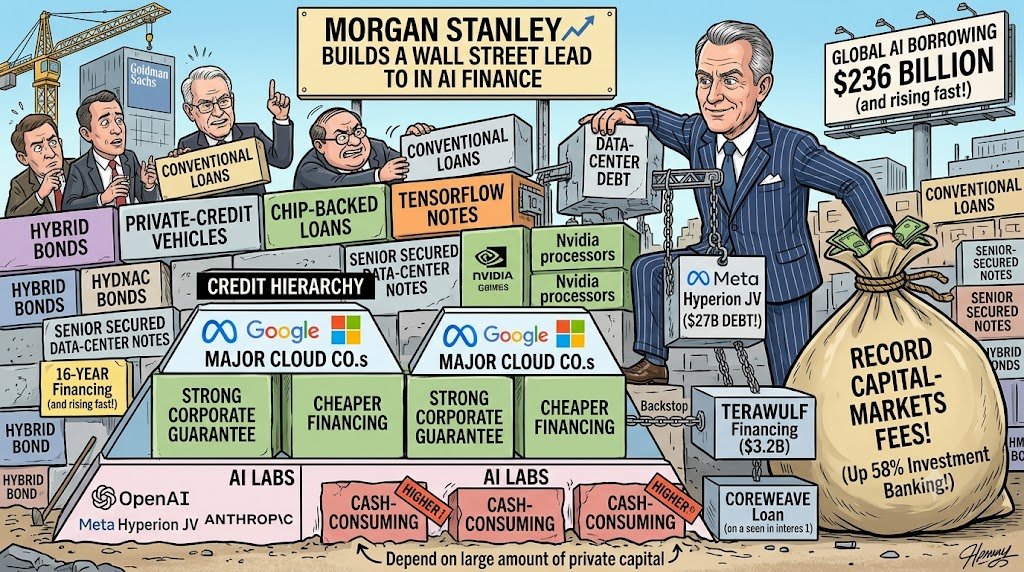
Hybrid bonds, private-credit vehicles and chip-backed loans have placed the bank at the center of a data-center investment cycle increasingly funded through debt.
Morgan Stanley has become a principal architect of the debt structures financing the artificial-intelligence infrastructure boom, connecting technology companies and data-center developers with insurers, pension funds, asset managers and private-credit investors.
Its bankers have arranged or advised on tens of billions of dollars in transactions spanning construction, computing chips and the vast facilities required to operate them.
The strategy addresses a central problem confronting the industry.
Artificial-intelligence systems require immense quantities of computing power, electricity and physical infrastructure, but even the largest technology groups cannot fund every project solely from current cash flow without constraining other spending.
Conventional project loans can also be slow, restrictive and difficult to scale to campuses costing tens of billions of dollars.
Morgan Stanley’s answer has been to combine elements of project finance, corporate credit and tradable securities.
Long-term data-center leases and commitments from large technology companies are used to strengthen the credit behind a project.
The resulting debt can then be sold to a broader group of institutional investors, widening the available pool of capital and reducing the amount banks must retain on their own balance sheets.
A $3.2 billion financing for data-center developer TeraWulf became an important template.
A subsidiary issued senior secured notes carrying a 7.75 percent coupon and maturing in 2030. The structure incorporated protections normally found in project lending while producing bonds that could be distributed widely.
Google supplied a financial backstop linked to the underlying computing agreements, giving investors exposure to stronger credit support than TeraWulf could have provided alone.
Most of the relevant capacity is intended to serve artificial-intelligence workloads through infrastructure provider Fluidstack, with Anthropic expected to be a major user.
The arrangement illustrates how several companies can occupy different layers of one financing: the developer supplies the site and power, an infrastructure operator contracts for capacity, an artificial-intelligence laboratory consumes the computing resources, and a large technology group supports the commercial obligations.
The stronger the corporate guarantee, the cheaper the financing can become.
Investors assessing a project backed by Google, Meta, Microsoft or another highly rated technology company are not relying exclusively on the balance sheet of a specialized developer.
Industry estimates indicate that a robust guarantee can reduce borrowing costs by roughly half compared with an otherwise similar transaction supported by a weaker counterparty.
Morgan Stanley also advised Meta on the financing of its Hyperion data-center campus in Louisiana, one of the largest private infrastructure transactions assembled for artificial intelligence.
The structure placed the project in a joint venture controlled 80 percent by funds managed by Blue Owl Capital, while Meta retained 20 percent.
More than $27 billion of debt and additional equity were raised through the arrangement, with Meta acting as developer, operator and long-term tenant.
That transaction allowed the project vehicle, rather than Meta itself, to incur the construction debt.
Meta nevertheless provided substantial support, including lease commitments and a conditional residual-value guarantee covering the first 16 years of operation.
The protections helped the private debt secure an investment-grade rating while transferring ownership and financing risk among Meta, Blue Owl and institutional bondholders.
The bank has extended the approach from buildings to the processors installed inside them.
It arranged an $8.5 billion financing for CoreWeave, a cloud provider specializing in graphics-processing capacity, supported by a contract with a large technology customer.
Morgan Stanley and Japanese lender MUFG subsequently assembled a $3.1 billion syndicated term loan to finance the purchase and installation of Nvidia processors.
Investor demand for the latter transaction reached approximately $20 billion.
The loan, however, carried a substantially larger premium over benchmark rates because its underlying customers were artificial-intelligence laboratories rather than technology groups with more established balance sheets.
The contrast exposes the credit hierarchy forming inside the sector: debt supported by major cloud companies is comparatively inexpensive, while financing dependent on cash-consuming laboratories commands higher returns.
Morgan Stanley has also advised Broadcom on a roughly $35 billion chip-financing transaction.
Taken together, the deals show how artificial intelligence is developing a specialized credit market encompassing property, power infrastructure, construction contracts, semiconductors and long-term computing leases.
The expansion has strengthened Morgan Stanley’s position in capital markets.
The bank generated $2.3 billion in debt and equity capital-markets fees during the first half of 2026, up from $1.4 billion in the same period a year earlier.
It rose from fourth to second globally in those fee rankings, behind JPMorgan Chase and ahead of Goldman Sachs.
Morgan Stanley reported record net revenue of $21.3 billion for the second quarter, compared with $16.8 billion a year earlier.
Investment-banking revenue increased 58 percent, although the bank does not separately disclose how much of that growth came directly from artificial-intelligence infrastructure transactions.
The financing boom carries risks alongside its fees.
Data centers face construction delays, power shortages and rapidly changing technology, while graphics processors can depreciate quickly as newer models enter the market.
Some projects ultimately depend on laboratories such as OpenAI and Anthropic, whose spending requirements remain high despite their ability to attract large amounts of private capital.
A downturn in demand, the failure of a tenant or a reduction in financial support from a major technology company could weaken several linked layers of debt.
The market is nevertheless expanding at exceptional speed.
Global borrowing associated with artificial intelligence had reached about $236 billion by the end of May 2026, roughly four times the amount recorded over the comparable period a year earlier, and Morgan Stanley projects issuance could approach $570 billion for the full year.
Having sold more than $40 billion of the emerging construction instruments, the bank is now working to extend the model into European and Asian markets.
Its bankers have arranged or advised on tens of billions of dollars in transactions spanning construction, computing chips and the vast facilities required to operate them.
The strategy addresses a central problem confronting the industry.
Artificial-intelligence systems require immense quantities of computing power, electricity and physical infrastructure, but even the largest technology groups cannot fund every project solely from current cash flow without constraining other spending.
Conventional project loans can also be slow, restrictive and difficult to scale to campuses costing tens of billions of dollars.
Morgan Stanley’s answer has been to combine elements of project finance, corporate credit and tradable securities.
Long-term data-center leases and commitments from large technology companies are used to strengthen the credit behind a project.
The resulting debt can then be sold to a broader group of institutional investors, widening the available pool of capital and reducing the amount banks must retain on their own balance sheets.
A $3.2 billion financing for data-center developer TeraWulf became an important template.
A subsidiary issued senior secured notes carrying a 7.75 percent coupon and maturing in 2030. The structure incorporated protections normally found in project lending while producing bonds that could be distributed widely.
Google supplied a financial backstop linked to the underlying computing agreements, giving investors exposure to stronger credit support than TeraWulf could have provided alone.
Most of the relevant capacity is intended to serve artificial-intelligence workloads through infrastructure provider Fluidstack, with Anthropic expected to be a major user.
The arrangement illustrates how several companies can occupy different layers of one financing: the developer supplies the site and power, an infrastructure operator contracts for capacity, an artificial-intelligence laboratory consumes the computing resources, and a large technology group supports the commercial obligations.
The stronger the corporate guarantee, the cheaper the financing can become.
Investors assessing a project backed by Google, Meta, Microsoft or another highly rated technology company are not relying exclusively on the balance sheet of a specialized developer.
Industry estimates indicate that a robust guarantee can reduce borrowing costs by roughly half compared with an otherwise similar transaction supported by a weaker counterparty.
Morgan Stanley also advised Meta on the financing of its Hyperion data-center campus in Louisiana, one of the largest private infrastructure transactions assembled for artificial intelligence.
The structure placed the project in a joint venture controlled 80 percent by funds managed by Blue Owl Capital, while Meta retained 20 percent.
More than $27 billion of debt and additional equity were raised through the arrangement, with Meta acting as developer, operator and long-term tenant.
That transaction allowed the project vehicle, rather than Meta itself, to incur the construction debt.
Meta nevertheless provided substantial support, including lease commitments and a conditional residual-value guarantee covering the first 16 years of operation.
The protections helped the private debt secure an investment-grade rating while transferring ownership and financing risk among Meta, Blue Owl and institutional bondholders.
The bank has extended the approach from buildings to the processors installed inside them.
It arranged an $8.5 billion financing for CoreWeave, a cloud provider specializing in graphics-processing capacity, supported by a contract with a large technology customer.
Morgan Stanley and Japanese lender MUFG subsequently assembled a $3.1 billion syndicated term loan to finance the purchase and installation of Nvidia processors.
Investor demand for the latter transaction reached approximately $20 billion.
The loan, however, carried a substantially larger premium over benchmark rates because its underlying customers were artificial-intelligence laboratories rather than technology groups with more established balance sheets.
The contrast exposes the credit hierarchy forming inside the sector: debt supported by major cloud companies is comparatively inexpensive, while financing dependent on cash-consuming laboratories commands higher returns.
Morgan Stanley has also advised Broadcom on a roughly $35 billion chip-financing transaction.
Taken together, the deals show how artificial intelligence is developing a specialized credit market encompassing property, power infrastructure, construction contracts, semiconductors and long-term computing leases.
The expansion has strengthened Morgan Stanley’s position in capital markets.
The bank generated $2.3 billion in debt and equity capital-markets fees during the first half of 2026, up from $1.4 billion in the same period a year earlier.
It rose from fourth to second globally in those fee rankings, behind JPMorgan Chase and ahead of Goldman Sachs.
Morgan Stanley reported record net revenue of $21.3 billion for the second quarter, compared with $16.8 billion a year earlier.
Investment-banking revenue increased 58 percent, although the bank does not separately disclose how much of that growth came directly from artificial-intelligence infrastructure transactions.
The financing boom carries risks alongside its fees.
Data centers face construction delays, power shortages and rapidly changing technology, while graphics processors can depreciate quickly as newer models enter the market.
Some projects ultimately depend on laboratories such as OpenAI and Anthropic, whose spending requirements remain high despite their ability to attract large amounts of private capital.
A downturn in demand, the failure of a tenant or a reduction in financial support from a major technology company could weaken several linked layers of debt.
The market is nevertheless expanding at exceptional speed.
Global borrowing associated with artificial intelligence had reached about $236 billion by the end of May 2026, roughly four times the amount recorded over the comparable period a year earlier, and Morgan Stanley projects issuance could approach $570 billion for the full year.
Having sold more than $40 billion of the emerging construction instruments, the bank is now working to extend the model into European and Asian markets.
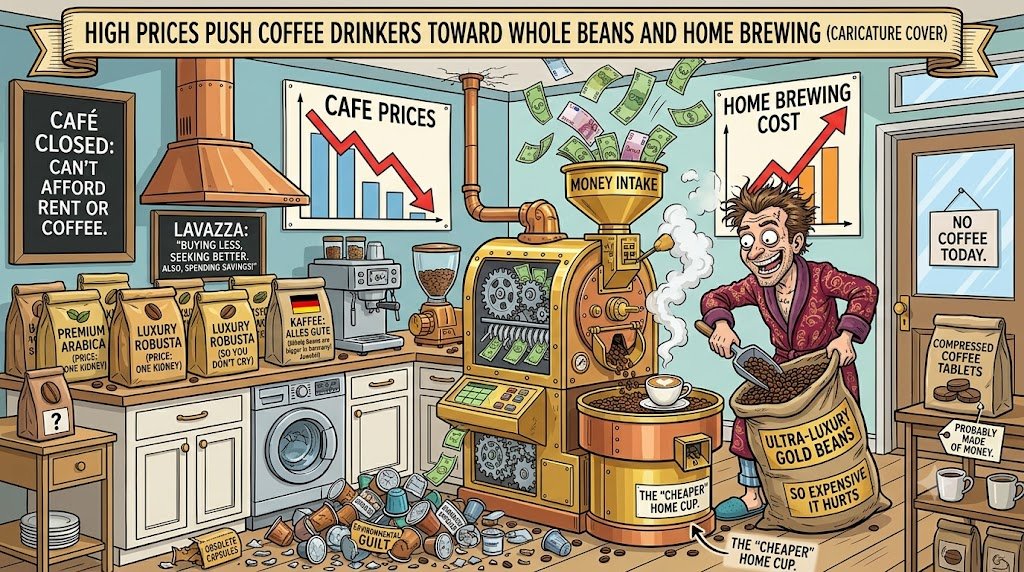
Lavazza says consumers are buying less but seeking better coffee, accelerating demand for whole beans and bean-to-cup machines across major European markets.
Four years of disruption in the global coffee market are reshaping what consumers brew at home.
After poor harvests and volatile commodity trading drove arabica and robusta prices to record levels in 2025, shoppers are increasingly choosing whole beans and equipment capable of producing café-style drinks rather than simply abandoning coffee altogether.
Lavazza chairman Giuseppe Lavazza described the migration toward beans as the industry’s most important consumer trend.
His assessment is that households are buying less but seeking better quality, investing in bean-to-cup machines to reproduce the experience of coffee shops in their kitchens.
The change is particularly pronounced in Britain.
Whole-bean sales rose 20.3 percent by volume in the year to May 2026, compared with growth of 2.8 percent across the broader market for coffee consumed at home.
The value of bean sales increased 36.8 percent, reflecting both higher demand and elevated retail prices.
Unit sales of bean-to-cup machines climbed 33.5 percent over the same period.
The figures suggest that higher prices are prompting a change in priorities rather than a uniform retreat from premium coffee.
Whole beans allow consumers to grind coffee immediately before brewing and adjust the strength, quantity and preparation method.
Modern automatic machines can also produce cappuccinos, flat whites and longer drinks with limited manual work, narrowing the practical difference between home preparation and a café purchase.
The pattern extends across continental Europe.
Whole-bean sales increased by value by 35 percent in France, 33 percent in Italy and 31.2 percent in Germany during the year to May. Germany, Europe’s largest coffee-consuming market, has advanced furthest: whole beans now constitute a larger segment than traditional pre-ground roasted coffee.
The change began before the latest price shock but accelerated during the coronavirus pandemic.
Café closures and widespread home working encouraged households to buy grinders, espresso makers and fully automatic machines.
Continued growth in both equipment and bean sales indicates that the habit persisted after offices and hospitality businesses reopened.
For roasters, the shift comes during an unusually difficult pricing cycle.
Adverse weather and disappointing crops in Brazil and Vietnam, the two largest producing countries, tightened supplies of arabica and robusta.
Because both varieties became expensive at the same time, manufacturers had less scope to reduce costs by substituting robusta, traditionally the cheaper component used in instant coffee and many espresso blends, for higher-priced arabica.
Commodity prices have since retreated from their 2025 peaks as supplies began to recover.
Arabica prices are projected to decline during 2026 after rising more than 40 percent in 2025, while robusta is also expected to fall.
Yet retail prices respond more slowly because roasters purchase beans in advance, carry inventories acquired at different costs and remain exposed to currency movements, shipping expenses and renewed weather disruption.
Lavazza therefore does not expect a rapid reduction in supermarket prices.
The company regards persistent volatility, rather than any single price level, as the market’s defining condition.
Heavy rain in Brazil could damage crops or delay harvesting, while a stronger El Niño weather pattern could disrupt production in other growing regions.
British prices for coffee consumed at home rose another 6.3 percent in the year to May. The simultaneous increase in bean volumes shows that at least part of the market is absorbing the pressure by concentrating spending on products perceived to deliver a better experience, even if consumers prepare fewer servings or reduce purchases elsewhere.
The upheaval has increased Lavazza’s revenue while also raising its costs.
The family-owned Italian group recorded revenue of €3.9 billion in 2025, an increase of 15.7 percent.
Core profit rose 8.8 percent to €340 million, with particularly strong growth in North America.
Higher selling prices contributed to the revenue increase, while weaker global volumes and expensive raw materials constrained the benefit to earnings.
Changing preferences are also challenging the capsule market.
Single-serve pods offer convenience, but their packaging has attracted environmental criticism, and demand has weakened in some markets as consumers adopt automatic bean machines.
Lavazza is responding with Tablì, a proprietary system that uses compressed tablets made entirely from coffee, without a plastic or aluminium capsule, individual wrapper, coating or binder.
The system, introduced first in Italy, is being expanded into the United States in 2026 as Lavazza’s largest investment in that market.
It requires a dedicated machine and is intended to preserve single-serving convenience while eliminating the conventional pod.
The launch places Lavazza behind two parallel bets: continued growth in whole-bean brewing and demand for a lower-packaging alternative among consumers who still prefer single-cup machines.
After poor harvests and volatile commodity trading drove arabica and robusta prices to record levels in 2025, shoppers are increasingly choosing whole beans and equipment capable of producing café-style drinks rather than simply abandoning coffee altogether.
Lavazza chairman Giuseppe Lavazza described the migration toward beans as the industry’s most important consumer trend.
His assessment is that households are buying less but seeking better quality, investing in bean-to-cup machines to reproduce the experience of coffee shops in their kitchens.
The change is particularly pronounced in Britain.
Whole-bean sales rose 20.3 percent by volume in the year to May 2026, compared with growth of 2.8 percent across the broader market for coffee consumed at home.
The value of bean sales increased 36.8 percent, reflecting both higher demand and elevated retail prices.
Unit sales of bean-to-cup machines climbed 33.5 percent over the same period.
The figures suggest that higher prices are prompting a change in priorities rather than a uniform retreat from premium coffee.
Whole beans allow consumers to grind coffee immediately before brewing and adjust the strength, quantity and preparation method.
Modern automatic machines can also produce cappuccinos, flat whites and longer drinks with limited manual work, narrowing the practical difference between home preparation and a café purchase.
The pattern extends across continental Europe.
Whole-bean sales increased by value by 35 percent in France, 33 percent in Italy and 31.2 percent in Germany during the year to May. Germany, Europe’s largest coffee-consuming market, has advanced furthest: whole beans now constitute a larger segment than traditional pre-ground roasted coffee.
The change began before the latest price shock but accelerated during the coronavirus pandemic.
Café closures and widespread home working encouraged households to buy grinders, espresso makers and fully automatic machines.
Continued growth in both equipment and bean sales indicates that the habit persisted after offices and hospitality businesses reopened.
For roasters, the shift comes during an unusually difficult pricing cycle.
Adverse weather and disappointing crops in Brazil and Vietnam, the two largest producing countries, tightened supplies of arabica and robusta.
Because both varieties became expensive at the same time, manufacturers had less scope to reduce costs by substituting robusta, traditionally the cheaper component used in instant coffee and many espresso blends, for higher-priced arabica.
Commodity prices have since retreated from their 2025 peaks as supplies began to recover.
Arabica prices are projected to decline during 2026 after rising more than 40 percent in 2025, while robusta is also expected to fall.
Yet retail prices respond more slowly because roasters purchase beans in advance, carry inventories acquired at different costs and remain exposed to currency movements, shipping expenses and renewed weather disruption.
Lavazza therefore does not expect a rapid reduction in supermarket prices.
The company regards persistent volatility, rather than any single price level, as the market’s defining condition.
Heavy rain in Brazil could damage crops or delay harvesting, while a stronger El Niño weather pattern could disrupt production in other growing regions.
British prices for coffee consumed at home rose another 6.3 percent in the year to May. The simultaneous increase in bean volumes shows that at least part of the market is absorbing the pressure by concentrating spending on products perceived to deliver a better experience, even if consumers prepare fewer servings or reduce purchases elsewhere.
The upheaval has increased Lavazza’s revenue while also raising its costs.
The family-owned Italian group recorded revenue of €3.9 billion in 2025, an increase of 15.7 percent.
Core profit rose 8.8 percent to €340 million, with particularly strong growth in North America.
Higher selling prices contributed to the revenue increase, while weaker global volumes and expensive raw materials constrained the benefit to earnings.
Changing preferences are also challenging the capsule market.
Single-serve pods offer convenience, but their packaging has attracted environmental criticism, and demand has weakened in some markets as consumers adopt automatic bean machines.
Lavazza is responding with Tablì, a proprietary system that uses compressed tablets made entirely from coffee, without a plastic or aluminium capsule, individual wrapper, coating or binder.
The system, introduced first in Italy, is being expanded into the United States in 2026 as Lavazza’s largest investment in that market.
It requires a dedicated machine and is intended to preserve single-serving convenience while eliminating the conventional pod.
The launch places Lavazza behind two parallel bets: continued growth in whole-bean brewing and demand for a lower-packaging alternative among consumers who still prefer single-cup machines.
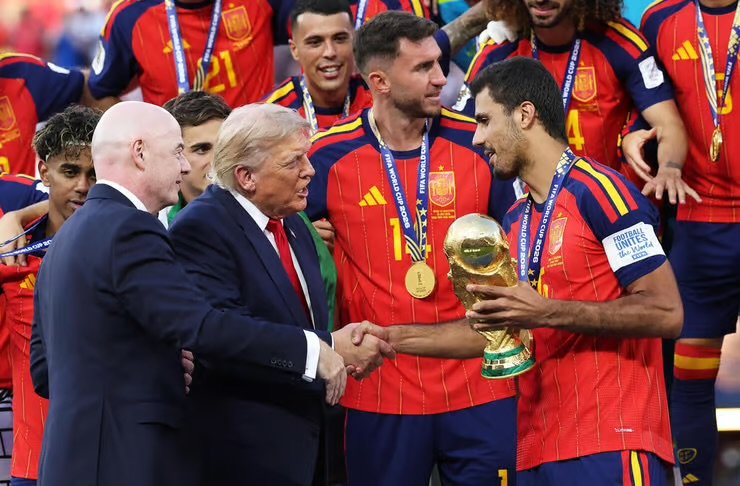
The United States president’s prominent role in the final ceremony produced audible hostility, disputed interpretations of a missed handshake and an awkward trophy celebration after Spain defeated Argentina in extra time.
President Donald Trump’s participation in the 2026 World Cup final became a conspicuous part of the closing ceremony after sections of the New Jersey crowd booed him and his prolonged appearance on the winners’ podium intruded briefly on Spain’s trophy celebration.
The observable events were unmistakable; some of the political interpretations attached to them were not.
Spain defeated defending champion Argentina 1-0 after extra time at New York New Jersey Stadium in East Rutherford on Sunday.
Substitute Ferran Torres scored the only goal in the 106th minute after Argentina had been reduced to 10 players by Enzo Fernández’s second yellow card.
The victory gave Spain its second men’s World Cup title, following its first in 2010, and added the global championship to the European title it won in 2024.
Trump arrived aboard Marine One and watched from a heavily secured executive suite alongside First Lady Melania Trump, FIFA President Gianni Infantino and an unusually concentrated group of political leaders.
The guests included Mexican President Claudia Sheinbaum, Canadian Prime Minister Mark Carney, Spanish Prime Minister Pedro Sánchez and King Felipe the Sixth and Queen Letizia of Spain.
The appearance made Trump the first sitting American president to attend a men’s World Cup final.
Bill Clinton did not attend the 1994 final in California, the only previous edition staged in the United States.
When Trump appeared on the stadium screens after the American national anthem, boos could be heard from portions of the crowd.
The reaction grew substantially louder when he entered the field with Infantino for the medal and trophy presentations.
It is not possible to establish from stadium audio how many spectators participated, so claims that all or most of the more than 80,000 people present were booing go beyond what the available evidence demonstrates.
Trump proceeded through the formal presentation line, greeting players from both teams.
He shook hands with Lionel Messi and other Argentine players as they received their runners-up medals following what may have been the 39-year-old captain’s final World Cup appearance.
Argentina defender Cristian Romero then passed through the line without shaking Trump’s hand.
Video shows Romero greeting Infantino and continuing toward the other dignitaries while bypassing the president.
The sequence circulated widely as an intentional political rebuff, but Romero has not publicly explained his conduct.
What is confirmed is that the handshake did not occur; the player’s motive has not been established.
Some footage also appeared to show Argentine defender Lisandro Martínez passing Trump without an exchange.
Medal ceremonies are congested, tightly choreographed and filled with overlapping introductions, making intent difficult to infer from a few seconds of video.
Describing either moment as a deliberate protest remains an interpretation rather than a verified fact.
The more visible protocol issue came during Spain’s celebration.
Trump and Infantino jointly presented the trophy to captain Rodri, who had also received the tournament’s Golden Ball as its best player.
After the formal handover, the president remained among the Spanish players as they gathered for the customary lift.
Trump raised his fists and joined the initial celebration before Infantino placed a hand near him and guided him away from the center of the group.
The intervention allowed the players to occupy the principal trophy image.
Trump left without any public confrontation.
Claims that he explicitly refused an instruction to leave the stage have not been substantiated.
The footage establishes that he stayed longer than customary and was subsequently directed aside, but no publicly available audio records what officials told him during the exchange.
The scene closely resembled the 2025 Club World Cup final at the same stadium.
After presenting Chelsea with that trophy, Trump remained beside the players during the lift even though the team had expected him to depart first.
Chelsea and Spain defender Marc Cucurella later said organizers had instructed the players to wait until the president left, only for Trump to tell them to lift the cup while he remained.
Cucurella described himself as extremely nervous and unwilling to challenge the president.
His comments concerned the 2025 ceremony, not Sunday’s World Cup presentation, although the recurrence gave the latest footage an immediate point of comparison.
Trump’s presence also carried diplomatic weight because several leaders seated near him represented governments with which Washington has had recent disputes.
Sheinbaum accepted his invitation after months of disagreements over trade and security, while Carney attended amid continuing tensions in the United States-Canada relationship.
The most pointed backdrop involved Spain.
Days before the final, Trump ordered a suspension of American trade with the country and described it as a “wasted cause” amid disputes with Sánchez over defense spending and Spain’s position on the war involving Iran.
Sánchez nevertheless attended the match, and the leaders temporarily shared the same ceremonial space as Spain claimed football’s most important prize.
That diplomatic conflict did not prevent Trump from congratulating Spain’s players or presenting the trophy.
Nor is there evidence that Romero’s missed handshake was connected to American policy toward Argentina, Spain or immigration, despite extensive speculation online.
Infantino’s decision to give Trump a central ceremonial role reflected the unusually close relationship between FIFA’s leadership and the government of the tournament’s largest host country.
The United States staged the competition with Canada and Mexico, requiring extensive federal involvement in security, visas, transportation and coordination among host cities.
Presidents and monarchs routinely attend major international finals, and host-country leaders often participate in trophy presentations.
The controversy arose less from Trump’s presence than from the amount of visual space he occupied after the formal duty had ended, at a moment traditionally reserved for the winning team.
That sequence should not obscure the sporting result.
Spain controlled the final, prevented Argentina from registering a shot on target and finally broke through after Fernández’s dismissal.
Argentine goalkeeper Emiliano Martínez delayed the defeat with a series of saves, but Torres’s extra-time finish ended Argentina’s attempt to become the first country since Brazil in 1962 to retain the men’s title.
Spain also collected the tournament’s principal individual honors: Rodri won the Golden Ball, Unai Simón received the Golden Glove and Pau Cubarsí was named the leading young player.
With the ceremony completed and the political guests removed from the stage, the Spanish squad lifted its second World Cup and began its reign as defending champion ahead of the 2030 tournament hosted by Spain, Portugal and Morocco.
The observable events were unmistakable; some of the political interpretations attached to them were not.
Spain defeated defending champion Argentina 1-0 after extra time at New York New Jersey Stadium in East Rutherford on Sunday.
Substitute Ferran Torres scored the only goal in the 106th minute after Argentina had been reduced to 10 players by Enzo Fernández’s second yellow card.
The victory gave Spain its second men’s World Cup title, following its first in 2010, and added the global championship to the European title it won in 2024.
Trump arrived aboard Marine One and watched from a heavily secured executive suite alongside First Lady Melania Trump, FIFA President Gianni Infantino and an unusually concentrated group of political leaders.
The guests included Mexican President Claudia Sheinbaum, Canadian Prime Minister Mark Carney, Spanish Prime Minister Pedro Sánchez and King Felipe the Sixth and Queen Letizia of Spain.
The appearance made Trump the first sitting American president to attend a men’s World Cup final.
Bill Clinton did not attend the 1994 final in California, the only previous edition staged in the United States.
When Trump appeared on the stadium screens after the American national anthem, boos could be heard from portions of the crowd.
The reaction grew substantially louder when he entered the field with Infantino for the medal and trophy presentations.
It is not possible to establish from stadium audio how many spectators participated, so claims that all or most of the more than 80,000 people present were booing go beyond what the available evidence demonstrates.
Trump proceeded through the formal presentation line, greeting players from both teams.
He shook hands with Lionel Messi and other Argentine players as they received their runners-up medals following what may have been the 39-year-old captain’s final World Cup appearance.
Argentina defender Cristian Romero then passed through the line without shaking Trump’s hand.
Video shows Romero greeting Infantino and continuing toward the other dignitaries while bypassing the president.
The sequence circulated widely as an intentional political rebuff, but Romero has not publicly explained his conduct.
What is confirmed is that the handshake did not occur; the player’s motive has not been established.
Some footage also appeared to show Argentine defender Lisandro Martínez passing Trump without an exchange.
Medal ceremonies are congested, tightly choreographed and filled with overlapping introductions, making intent difficult to infer from a few seconds of video.
Describing either moment as a deliberate protest remains an interpretation rather than a verified fact.
The more visible protocol issue came during Spain’s celebration.
Trump and Infantino jointly presented the trophy to captain Rodri, who had also received the tournament’s Golden Ball as its best player.
After the formal handover, the president remained among the Spanish players as they gathered for the customary lift.
Trump raised his fists and joined the initial celebration before Infantino placed a hand near him and guided him away from the center of the group.
The intervention allowed the players to occupy the principal trophy image.
Trump left without any public confrontation.
Claims that he explicitly refused an instruction to leave the stage have not been substantiated.
The footage establishes that he stayed longer than customary and was subsequently directed aside, but no publicly available audio records what officials told him during the exchange.
The scene closely resembled the 2025 Club World Cup final at the same stadium.
After presenting Chelsea with that trophy, Trump remained beside the players during the lift even though the team had expected him to depart first.
Chelsea and Spain defender Marc Cucurella later said organizers had instructed the players to wait until the president left, only for Trump to tell them to lift the cup while he remained.
Cucurella described himself as extremely nervous and unwilling to challenge the president.
His comments concerned the 2025 ceremony, not Sunday’s World Cup presentation, although the recurrence gave the latest footage an immediate point of comparison.
Trump’s presence also carried diplomatic weight because several leaders seated near him represented governments with which Washington has had recent disputes.
Sheinbaum accepted his invitation after months of disagreements over trade and security, while Carney attended amid continuing tensions in the United States-Canada relationship.
The most pointed backdrop involved Spain.
Days before the final, Trump ordered a suspension of American trade with the country and described it as a “wasted cause” amid disputes with Sánchez over defense spending and Spain’s position on the war involving Iran.
Sánchez nevertheless attended the match, and the leaders temporarily shared the same ceremonial space as Spain claimed football’s most important prize.
That diplomatic conflict did not prevent Trump from congratulating Spain’s players or presenting the trophy.
Nor is there evidence that Romero’s missed handshake was connected to American policy toward Argentina, Spain or immigration, despite extensive speculation online.
Infantino’s decision to give Trump a central ceremonial role reflected the unusually close relationship between FIFA’s leadership and the government of the tournament’s largest host country.
The United States staged the competition with Canada and Mexico, requiring extensive federal involvement in security, visas, transportation and coordination among host cities.
Presidents and monarchs routinely attend major international finals, and host-country leaders often participate in trophy presentations.
The controversy arose less from Trump’s presence than from the amount of visual space he occupied after the formal duty had ended, at a moment traditionally reserved for the winning team.
That sequence should not obscure the sporting result.
Spain controlled the final, prevented Argentina from registering a shot on target and finally broke through after Fernández’s dismissal.
Argentine goalkeeper Emiliano Martínez delayed the defeat with a series of saves, but Torres’s extra-time finish ended Argentina’s attempt to become the first country since Brazil in 1962 to retain the men’s title.
Spain also collected the tournament’s principal individual honors: Rodri won the Golden Ball, Unai Simón received the Golden Glove and Pau Cubarsí was named the leading young player.
With the ceremony completed and the political guests removed from the stage, the Spanish squad lifted its second World Cup and began its reign as defending champion ahead of the 2030 tournament hosted by Spain, Portugal and Morocco.
Ferran Torres scored in the one hundred and sixth minute as Spain beat the defending champions one-nil in New Jersey and reclaimed the title sixteen years after its first triumph.
Spain won the 2026 FIFA World Cup because its sustained control finally broke an Argentina side reduced to ten players, with Ferran Torres scoring the decisive goal in the one hundred and sixth minute of a tense final at New York New Jersey Stadium.
The one-nil victory delivered Spain its second men's world championship, sixteen years after the generation led by Andrés Iniesta claimed the country's first title in South Africa.
The final was goalless after ninety minutes, but the balance of play had already tilted sharply toward Spain.
Luis de la Fuente's team monopolized possession, compressed Argentina into its own half and generated repeated attempts against goalkeeper Emiliano Martínez.
Argentina offered little attacking threat during regulation time and relied heavily on defensive organization, tactical fouls and Martínez's interventions to remain level.
The pivotal disciplinary moment arrived late in normal time when midfielder Enzo Fernández received a second yellow card and was sent off.
Argentina entered extra time with ten players against a Spanish side already dictating the tempo, leaving the defending champions with even less capacity to press, counterattack or retain the ball.
Spain initially appeared to have found the breakthrough through Nico Williams, but the effort was disallowed following an infringement in the buildup.
The pressure continued.
Early in the second period of extra time, Williams helped create another opening, and Torres converted from inside the penalty area to place Spain ahead.
Argentina attempted a late response, including a rare effort from Lionel Messi, but could not force an equalizer.
The result ended Argentina's attempt to retain the trophy it won in Qatar in 2022. It also brought a painful conclusion to what may have been Messi's final World Cup appearance.
At thirty-nine, the Argentine captain was tightly contained for most of the match and struggled to influence a game in which his team spent long periods without meaningful possession or service in advanced areas.
For Spain, the championship completed a broader return to the summit of international football.
The team arrived as reigning European champion and advanced through the knockout rounds with a blend of territorial control, technical precision and defensive discipline.
Its triumph was not built around a single veteran core but around a younger generation capable of combining Spain's traditional possession game with greater directness and speed.
The final also underlined the depth of the Spanish squad.
Torres began outside the central narrative surrounding the tournament's biggest stars, yet became the player who settled its most important match.
Williams provided penetration from the flank, while Spain's midfield restricted Argentina's routes into the final third and repeatedly recovered possession before counterattacks could develop.
Argentina's defeat was severe in competitive terms but did not erase the achievements of the previous four years.
The team entered the final as defending world champion after a cycle that included continental success and a sustained period near the top of the international game.
In New Jersey, however, its strategy became increasingly dependent on survival rather than creation, and Fernández's dismissal made that approach harder to sustain.
The match concluded the first forty-eight-team men's World Cup, staged across the United States, Canada and Mexico.
Spain received the trophy after a final defined less by open exchanges than by accumulated pressure, defensive resistance and one clinical extra-time finish.
What is confirmed is that Spain has returned to the top of world football with a second title, while Argentina's reign ended after four years.
Torres's extra-time goal now joins Iniesta's winner in 2010 as the strike that secured a World Cup for Spain.
The one-nil victory delivered Spain its second men's world championship, sixteen years after the generation led by Andrés Iniesta claimed the country's first title in South Africa.
The final was goalless after ninety minutes, but the balance of play had already tilted sharply toward Spain.
Luis de la Fuente's team monopolized possession, compressed Argentina into its own half and generated repeated attempts against goalkeeper Emiliano Martínez.
Argentina offered little attacking threat during regulation time and relied heavily on defensive organization, tactical fouls and Martínez's interventions to remain level.
The pivotal disciplinary moment arrived late in normal time when midfielder Enzo Fernández received a second yellow card and was sent off.
Argentina entered extra time with ten players against a Spanish side already dictating the tempo, leaving the defending champions with even less capacity to press, counterattack or retain the ball.
Spain initially appeared to have found the breakthrough through Nico Williams, but the effort was disallowed following an infringement in the buildup.
The pressure continued.
Early in the second period of extra time, Williams helped create another opening, and Torres converted from inside the penalty area to place Spain ahead.
Argentina attempted a late response, including a rare effort from Lionel Messi, but could not force an equalizer.
The result ended Argentina's attempt to retain the trophy it won in Qatar in 2022. It also brought a painful conclusion to what may have been Messi's final World Cup appearance.
At thirty-nine, the Argentine captain was tightly contained for most of the match and struggled to influence a game in which his team spent long periods without meaningful possession or service in advanced areas.
For Spain, the championship completed a broader return to the summit of international football.
The team arrived as reigning European champion and advanced through the knockout rounds with a blend of territorial control, technical precision and defensive discipline.
Its triumph was not built around a single veteran core but around a younger generation capable of combining Spain's traditional possession game with greater directness and speed.
The final also underlined the depth of the Spanish squad.
Torres began outside the central narrative surrounding the tournament's biggest stars, yet became the player who settled its most important match.
Williams provided penetration from the flank, while Spain's midfield restricted Argentina's routes into the final third and repeatedly recovered possession before counterattacks could develop.
Argentina's defeat was severe in competitive terms but did not erase the achievements of the previous four years.
The team entered the final as defending world champion after a cycle that included continental success and a sustained period near the top of the international game.
In New Jersey, however, its strategy became increasingly dependent on survival rather than creation, and Fernández's dismissal made that approach harder to sustain.
The match concluded the first forty-eight-team men's World Cup, staged across the United States, Canada and Mexico.
Spain received the trophy after a final defined less by open exchanges than by accumulated pressure, defensive resistance and one clinical extra-time finish.
What is confirmed is that Spain has returned to the top of world football with a second title, while Argentina's reign ended after four years.
Torres's extra-time goal now joins Iniesta's winner in 2010 as the strike that secured a World Cup for Spain.
Miliband Sets Climate and International Law at Centre of UK Diplomacy
Trump Readies New Tariffs as Temporary Global Levy Nears Expiry
EU Imposes Record €550 Million Digital Services Fine on AliExpress
Between Deliveries, Wang Jibing Wrote His Way to China’s Literary Heights
Morgan Stanley Builds a Wall Street Lead in AI Infrastructure Finance
High Prices Push Coffee Drinkers Toward Whole Beans and Home Brewing
Trump Draws Boos and Podium Scrutiny at Spain’s World Cup Triumph
Spain Defeats Argentina in Extra Time to Win Second World Cup
Police Block Cockroach Janta Party’s March to Parliament as Education Protests Intensify
Singapore Considers Lower Taxes for Fund Managers as Hong Kong Intensifies Talent Contest
Proposed U.S.-Saudi Nuclear Pact Could Permit Limited Uranium Enrichment Under International Safeguards
Why Kentucky Fried Chicken Became KFC—and Why the False Explanations Persist
Ukrainian Drones Strike Wildberries Warehouses Deep Inside Russia
Reported CIA Mission Helped Clear the UAE’s Path to Advanced US AI Chips
Artificial Intelligence Capital Fuels Markets While Governments and Regulators Face Mounting Strategic Tests
China’s Moonshot’s Kimi K3 Narrows the Gap With Anthropic Through Scale, Openness and Lower Cost
Gold and Cash Seizure Puts Indonesia’s Senior Anti-Corruption Prosecutor Under Investigation
The Ledger Will Not Trust on Faith
Ukraine’s Leadership Rift Spills Into the Streets as Protesters Target Army Chief
The Ten World Cup Finals That Defined Football History
Smartphones Are Getting More Expensive, Sales Are Collapsing, and Even Apple Admits: "Prices Will Rise"
Leadership Change and Strategic Rivalry Redraw the Political Map
The AI Race Enters Its Infrastructure Era
Britain Nationalises British Steel to Protect Scunthorpe Production and Strategic Supply
French National Assembly Overrides Senate to Pass Historic Assisted-Dying Legislation
Thomas Tuchel Faces Fierce Backlash After Tactical Retreat Costs England World Cup Final Berth
A Quiet Bastille Day: France Grapples with World Cup Heartbreak and Leftover Fireworks
Spain in Ecstasy: "We Feel Unbeatable, We Taught the Whole World a Lesson"
Harvard Astrophysicist to Lead U.S. Scientific Advisory on Unidentified Aerial Phenomena
Emergency Sirens Activated Across Bahrain as Interior Ministry Issues Shelter Directives
World Cup Visitors Turn American Big-Box Stores Into Souvenir Stops
Netflix Weighs Always-On Channels, Bundles and Short-Form Video
The AI Invoice Shock: Layoffs Didn't Save Managers Money — They Cost Them More
Concern: Sexually Transmitted Bacterium Among Men Develops Antibiotic Resistance
Following Massive Investor Demand: SK Hynix Raises 26.5 Billion Dollars on Nasdaq
Passenger Partially Pulled Out of Ryanair Jet After Cabin Window Fails Mid-Flight
Severe Heatwave Drives Dangerous Ground-Level Ozone Pollution Across Two Thirds of European Union
Flight Instructor Jumped to His Death — Student Landed the Plane: "You Know What You Need to Do"
The Physical and Electronic Barriers Disrupting Domestic Wireless Networks
France and Morocco Open World Cup Quarter-Finals as Collina Defends Refereeing
Tech Pulse: The Future of AI and Screen Culture
Global News Briefing: Escalating Geopolitical Tensions and Corporate Shakeups
Global News Brief: Escalating Conflicts, Public Health Crises, and World Cup Drama
Europe's Growing Struggle with Extreme Heat and Air Conditioning
Anthropic Reengineers Agentic Architecture to Shift Autonomous Workplace Automation to the Cloud
Apple Advances Late-Stage Operating Systems with Fourth Beta Deployments
Global Crisis Alert: Escalating Middle East Tensions and UK Political Upheaval
"A New Era of Testing": The Rare Launch of a Missile from a Chinese Nuclear Submarine - That Could Reach U.S. Soil
Japanese Technology Firm Fujitsu Launches Advanced Artificial Intelligence Tool for Corporate Disclosures
South Africa Officially Launches Nationwide Campaign for Highly Contested Local Government Elections