Chancellor announces £1bn package mostly for hospitality and leisure firms but refuses to revive furlough

Rishi Sunak has been accused of failing to do enough to help embattled hospitality businesses through the Omicron wave after refusing to bring back furlough for the hardest-hit firms.

Succumbing to intense pressure to offer financial support amid a collapse in pre-Christmas trade for pubs, restaurants and hotels, the chancellor announced a £1bn bailout package on Tuesday consisting of business grants and help with sick pay.

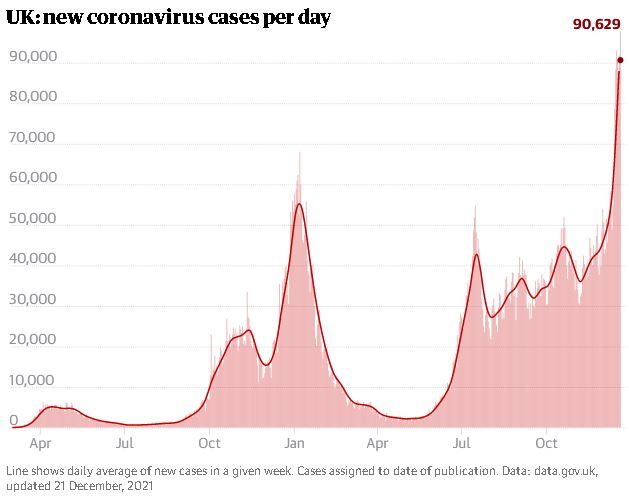
However, it drew an angry response from bosses who told Sunak he was failing to grasp the severity of the Omicron shock to the economy and that a lack of clarity from the government over the need for further pandemic restrictions was making matters worse.

Comparing the plan to a “dud cracker on Christmas Day”, Tim Rumney, the chief executive of the Best Western hotel chain, which employs 10,000 staff in the UK, said a return to furlough was vital if the current Covid wave continues.

“It’s just so disappointing and underwhelming in every sense. It doesn’t go far enough in our opinion, it doesn’t go deep enough and it’s too little too late,” he said.

Michael Kill, the chief executive of the Night Time Industries Association, said a stuttering open/close approach to government restrictions was “crucifying business” during a pivotal period for trading before Christmas.

“Every pound of help is much needed. But this package is far too little and borders on the insulting,” he said.

Sunak said the government was intervening because “the spread of the Omicron variant means businesses in the hospitality and leisure sectors are facing huge uncertainty, at a crucial time”.

The bailout package comprises four elements:

*  Grants for hospitality and leisure businesses in England, worth up to £6,000 per premise. The Treasury has set aside £683m for these payments, which will be administered through local authorities and will be available in the coming weeks.

*  Further grants for businesses in England, worth £102m, intended to help businesses most in need, and again administered through local authorities.

*  The resumption of the statutory sick pay rebate scheme, which will reimburse employers in the UK with fewer than 250 workers for the cost of paying statutory sick pay for Covid-related absences for up to two weeks.

*  An extra £30m for arts organisations , paid through the culture recovery fund.

In addition, the Scottish government will receive £150m, the Welsh government £50m and the Northern Ireland executive £25m under the Barnett formula to offset the England-only spending.

Britain’s biggest business lobby groups broadly welcomed the plan hammered out after meetings with Treasury officials over recent days, although several other trade groups, large firms, Labour and unions criticised the lack of substance.

It follows pressure on the chancellor to reboot the multibillion-pound furlough job support scheme to cushion the financial blow for firms and to help workers amid a worsening economic outlook and a cost of living squeeze.

Frances O’Grady, the general secretary of the Trades Union Congress (TUC), said the measures announced by the chancellor amounted to “abandoning” workers ahead of Christmas and as the pandemic worsened.

“The economic support measures announced today are not conditional on employers keeping workers on and covering their wages. And they do nothing to fix the gaping holes in our sick pay system,” she said.

The Treasury’s statutory sick pay rebate scheme covers employers’ costs, rather than supporting an employee directly, and does not boost the amount available. The TUC estimates 238,000 hospitality workers – about one in six of the workforce – do not qualify for statutory sick pay.

“Millions of workers will go into Christmas worrying for their jobs and anxious about what they will do if asked to self-isolate. The chancellor must go back to the drawing board,” O’Grady said.

No firm has been legally required to close under plan B, which was announced by Boris Johnson for England earlier this month and which extended the use of face masks, required Covid passes for some venues and encouraged working from home.

But the move to plan B was quickly followed by advice from Prof Chris Whitty, the chief medical officer for England, that people should limit their socialising over Christmas to people and events that “really matter” and this, combined with a surge in Covid cases, led to dramatic falls in the number of people going to pubs, restaurants and shows.

The measures announced by the Treasury on Tuesday are intended to compensate for the loss of earnings that businesses are already suffering.

Ministers have not ruled out imposing further restrictions on socialising after Christmas, which could lead to calls for a further bailout for hospitality.

When Sunak was asked in an interview if businesses would be offered more support if the rules tightened again in the coming days, he gave a non-committal answer.

He said he would always respond “proportionately and appropriately”, but he said the business grants he was announcing were “comparable to the grants that we provided for hospitality businesses when they were completely closed earlier this year”, and said other help for business was already in place until the spring.

Shevaun Haviland, the director general of the British Chambers of Commerce, said the measures were “a positive starting point” that would provide “some welcome respite” to firms hardest hit by the latest Covid wave.

But she urged the Treasury to ensure grants were paid out quickly, and said more help may be needed. “If restrictions persist or are tightened further, then we would need to see a wider support package, equal to the scale of any new measures, put in place,” she said.

Vietnam beat Thailand 2-0 in the first leg of the ASEAN Cup final in Hanoi, giving Vietnam a significant advantage ahead of the second leg and setting up a closely watched regional finale.
A political amnesty law has taken effect in Thailand while excluding people charged with lese-majeste offenses, a decision that reflects continuing political tensions within the governing coalition.
Major Thai developers, including Land & Houses, are redirecting investment toward senior rental communities and other recurring-revenue properties as traditional residential sales weaken and demographic patterns change.
Thai trade representatives are seeking to expand bilateral commerce with New Zealand by promoting Thailand's logistics infrastructure and central position in ASEAN as a distribution gateway for agricultural and manufactured goods.
Malaysia's Transport Ministry says the planned Rapid Transit System Link station at Bukit Chagar will connect directly with KTM trains, local buses and taxis, improving connections for commuters traveling between Johor and Singapore.
The Tourism Authority of Thailand is shifting marketing efforts toward Taiwan and selected South Korean visitor groups after arrivals from South Korea fell 42 percent, seeking to sustain tourism demand and support the hospitality sector.
Samart Corporation has secured a two billion baht contract to develop and upgrade power transmission networks, supporting efforts to strengthen Thailand's electricity grid as industrial and digital energy demand rises.
Thailand's Securities and Exchange Commission has introduced stricter corporate shareholding rules as part of efforts to strengthen transparency, curb illicit funds and protect the integrity of the country's capital markets.
Organizers of the Singapore Formula One night race and other major outdoor events are activating air-quality contingency measures as forest fires in neighboring Indonesia raise the risk of worsening regional haze.
Thailand's prime minister has ordered emergency teams to speed up infrastructure repairs and provide financial assistance after severe flash flooding in Nan province, with authorities prioritizing the restoration of local economic activity.
More than 50 bombings, arson attacks on government offices and tire burnings across three southern Thai provinces have injured at least two people, prompting Malaysia to strengthen surveillance along the shared border.
Thai automotive and manufacturing executives are urging the government to require greater domestic sourcing from foreign electric vehicle investors, seeking more technology transfer and stronger links between incoming Chinese capital and local suppliers.
Thailand is hosting the twenty-ninth ASEAN Labor Ministers Meeting, where governments are working on a regional framework for digital skills training and a new ASEAN Digital Skills Passport intended to improve worker mobility and access to talent across Southeast Asia.
Thailand's digital economy regulators are drafting national rules for data centers and cloud infrastructure as interest from global hyperscalers grows, with the government seeking to strengthen the country's role as a regional digital hub.
Malaysia and Indonesia are coordinating cross-border cloud seeding operations as dry conditions and worsening air quality intensify, with the measures aimed at suppressing peatland fires ahead of Malaysia's National Day celebrations.
Philippine authorities have begun evacuations and stepped up emergency preparations as Typhoon Saudel enters the country's area of responsibility, with meteorologists warning that the system could intensify into a super typhoon.
Heavy rainfall from Typhoon Narra has caused flooding and landslides across northern Vietnam, displacing thousands of households, damaging rice crops and disrupting tourism and transport, including around Ha Long Bay.
Authorities in Indonesia say 91 people have died after a magnitude 7.7 earthquake struck East Nusa Tenggara, with military transport aircraft deployed to deliver specialized assistance to vulnerable women and children across the affected islands.
Indonesian authorities have arrested 72 people accused of starting forest and peatland fires across Borneo and Sumatra, as widespread haze affects neighboring countries, prompts school closures in Malaysia and drives urgent regional cooperation.
Thailand recorded a 37 percent year-on-year increase in foreign direct investment to 219 billion baht, as multinational companies expand manufacturing and technology operations in the country amid intensifying global trade friction.
Indonesian authorities arrested 72 people accused of using illegal fires to clear land across Borneo and Sumatra as a worsening dry season generated heavy transboundary haze and contributed to the closure of nearly 600 schools in neighboring Malaysian states.
Prime Minister Anutin Charnvirakul convened senior military and intelligence officials after more than 50 bombings and arson attacks targeted infrastructure in Narathiwat, Pattani and Yala, prompting an urgent review of security measures amid fears of renewed insurgent violence.
Prime Minister Lawrence Wong announced that every Singaporean child will receive about 70,000 Singapore dollars in financial support through cash payments and grants by age seventeen, as the government steps up efforts to address the country’s declining fertility rate.
Thailand has begun enforcing updated electric vehicle requirements that oblige foreign automakers to produce two vehicles locally for every one imported this year, alongside new battery sourcing rules intended to deepen domestic supply chains in the Eastern Economic Corridor.
Singapore’s Ministry of Trade and Industry upgraded its annual economic growth forecast to as much as 5.5 percent, citing robust global electronics demand and a sharp increase in the adoption of agentic artificial intelligence among local businesses.
President Prabowo Subianto inaugurated Indonesia’s national electric motorcycle initiative in West Java, backed by state financing and designed to build domestic capacity in electric vehicle and battery manufacturing while positioning Indonesia as a global production hub.
Thailand received investment applications worth 1.4 trillion baht, or about 43.6 billion US dollars, in the first half of the year, a 37 percent increase from a year earlier as global technology companies expanded data centers, cloud infrastructure and advanced electronics manufacturing.
An Indonesian court convicted twenty-six-year-old Luzian Andrin Zgraggen of blasphemy after he breached strict holiday restrictions and posted an explicit video from an empty beach.
An Indonesian court on the island of Bali has sentenced twenty-six-year-old Swiss national Luzian Andrin Zgraggen to one year in prison for publicly insulting Nyepi, the sacred Balinese Hindu Day of Silence.

The verdict follows Zgraggen's arrest in March after he recorded and published a social media video that violated island-wide religious restrictions and sparked widespread public outrage.

During Nyepi, Bali enforces strict, mandatory observances requiring residents and tourists alike to remain indoors, extinguish lights, cease travel, and refrain from loud noises or public activities.

The island's international airport suspends operations and commercial internet connectivity is largely restricted for twenty-four hours to maintain complete silence.

Zgraggen violated the curfew by walking onto a deserted beach, filming the empty surroundings, and sharing the footage online alongside captions containing expletives.

Presiding judges ruled that Zgraggen's deliberate breach and subsequent social media broadcast caused profound offense to the Balinese population and desecrated religious customs.

In court, Zgraggen expressed remorse and offered a public apology, testifying that he had failed to comprehend the scope and religious gravity of the annual holiday before violating the rules.

The prison sentence reflects an intensifying campaign by Indonesian authorities to enforce local laws and religious standards amid record post-pandemic tourism volumes.

While immigration officials have historically deported or briefly detained foreign visitors who violated local ordinances, local prosecutors have increasingly sought formal custodial sentences for deliberate acts of public blasphemy and disruptive behavior at cultural and religious sites across the province.
Japanese police intervened after the child was discovered abandoned for hours in rainy, foggy conditions at 2,000 meters while his father continued hiking toward the peak.
Japanese police have castigated a forty-eight-year-old father who abandoned his seven-year-old son on Mount Fuji in poor weather conditions to continue climbing toward the summit with his older child.

Mountain hut staff discovered the boy sitting alone on a bench near the trail's sixth station at an altitude exceeding two thousand meters, prompting an emergency call to local law enforcement.

The boy, left behind with only a soft drink and a snack after complaining of fatigue, was found waiting in dense fog and rain.

Police officers located the father hours later between the seventh and eighth stations, approximately a three-hour hike further up the mountain.

By the time authorities brought the father back down to reunite with his son, the child had been left unsupervised for approximately eight hours.

Police reprimanded the father upon his return, emphasizing that abandoning a young child on the mountain under adverse weather was entirely unacceptable, regardless of climbing ambitions.

The father apologized for what he described as a rash decision.

The incident occurred along the popular Fujinomiya route, which begins at the fifth station and typically requires an eight-hour round trip to reach the 3,776-meter summit.

The mountain, an active volcano and designated UNESCO World Heritage site that attracts roughly two hundred thousand hikers annually, has experienced a series of safety incidents and overcrowding issues, leading local authorities to enforce stricter route management and daily visitor caps.
Malaysian policymakers are examining expanded social care arrangements after federal welfare spending reached seven hundred twenty-eight million ringgit, warning that responsibility for elderly and social care cannot rest entirely with families.
Philippine security forces arrested a wanted bombing suspect and a Lanao del Sur vice mayor facing murder charges in separate operations in Mindanao, strengthening the government’s efforts to combat crime in the volatile southern region.
Gold industry representatives are preparing talks with Thai ministers to oppose proposed taxation measures, warning that the changes could disrupt one of Southeast Asia’s most active physical gold markets.
Indonesian police arrested one hundred ninety-seven people, including Singaporean nationals, in a raid on an illegal gambling network in Batam and seized hundreds of thousands of dollars in cash and other assets.
Thai authorities have widened investigations into three companies in Pattaya as part of a broader crackdown on nominee arrangements allegedly used to circumvent restrictions on foreign ownership of property.
Executive Secretary Ralph Recto has rejected claims of a systemic garbage crisis while blaming improper waste disposal for clogging waterways and worsening severe flooding across Metro Manila.
Thai transport authorities are assessing a seventy-four-kilometer rail expansion intended to connect with existing national infrastructure, reduce logistics costs and improve urban and regional connectivity.
Cambodian policymakers are channeling workforce-development funding into electric vehicles and agricultural processing to build industrial skills and attract higher-value manufacturing activity.
Prime Minister Anutin Charnvirakul has ordered faster humanitarian relief as severe flooding affects Nan and eight other northern provinces, with authorities also strengthening early-warning systems to protect communities and agricultural production.
Private-sector executives are calling for greater technology adoption, knowledge sharing and access to finance to unlock the potential of Thailand’s three point three million small and medium-sized enterprises amid a volatile global economy.
Chinese luxury companies in jewelry, watches and premium wine are increasingly targeting Southeast Asia’s affluent consumers as a testing ground for international expansion, intensifying competition across the region’s high-end retail market.
Thai policymakers are examining new frameworks to strengthen trade and logistics links with New Zealand, as Bangkok seeks to diversify international commercial partnerships and expand its role as a regional distribution hub.
The ASEAN Observer Team has inspected parts of Banteay Meanchey province after Cambodia protested the deployment of shipping containers by Thai forces, highlighting continued tensions over territorial demarcation.
Vietnam has deployed thousands of emergency personnel after Storm Narra brought extreme rainfall to northern and central provinces, triggering landslides, damaging infrastructure and disrupting local supply chains.
Strong public registration for the new TH-AI Passport and growing interest in digital asset tokenization point to accelerating adoption of advanced digital financial technologies in Thailand.
A series of coordinated arson and bomb attacks in Pattani, Yala and Narathiwat led to the suspension of State Railway of Thailand services and prompted Malaysia to advise citizens to postpone non-essential travel to the border region.
The Armed Forces of the Philippines has rejected demands from China’s embassy to remove the grounded naval vessel from Ayungin Shoal, reaffirming Manila’s position on its territorial claims in the South China Sea.
President Prabowo Subianto has ordered a major emergency response to forest and land fires in Kalimantan and traveled to the region to oversee containment efforts, while authorities pledged tougher enforcement against environmental violations.
Prime Minister Lawrence Wong used his National Day Rally to warn that intensifying US-China tensions and fragmented supply chains are creating a more uncertain global environment, urging Singapore to deepen partnerships that protect its position as an international hub.
Swiss Tourist Sentenced to One Year in Prison for Insulting Bali's Sacred Day of Silence
Father Reprimanded After Leaving Seven-Year-Old Son Alone on Mount Fuji During Summit Climb
Google Launches Pixel 11 With Gemini AI at the Center of Its Hardware Strategy
China’s Kimi Launches AI-Focused Credit Card With Agricultural Bank of China and American Express
Success: Nvidia Turned Gaming Chips Into the Engine of the AI Boom
AI’s Next Bottleneck Is Power, Not Just Nvidia Chips
Meta Raises AI Spending Target to as Much as $145bn Despite Pressure Over Returns
Joe Biden’s Cancer Has Spread Beyond His Bones, Hunter Biden Says
Why 2027 Could Be a Strong Year for Stocks—and Why the Forecast Is Fragile
Why Markets May Look Quiet in August After Big Tech Earnings
UFO: Pentagon Releases Video of Unidentified Object Tracked Over Middle East
Ukraine Tells Senate Republicans Its Drone War Offers a Blueprint for America
Weight-Loss Drug Boom Tests the Limits of Prescription Advertising Rules
Taiwan’s President Joins Wartime Command Drill as China Pressure Grows
Lightning Strike Kills Yala FC Player During Match in Southern Thailand
AI Is Remaking the US Economy, From GDP Growth to iPhone Prices
Indonesia’s Free School Meals Plan Has Been Hit by Poisoning, Corruption and Cuts
US and Japan Step In to Support the Yen in Rare Joint Intervention
FIFA’s Retreat Leaves a Larger Question Over Who Guards the Game
Valued at $109 Million: F-35B Fighter Jet Crashes in Southern California
US Says It Has Carried Out Heavy Strikes on Iran After Attempted Attacks on Its Forces
Over 24 Hours in the Air: Qantas Airbus Completes Record-Breaking Test Flight
Nvidia Reportedly Takes Vast Texas Data-Centre Lease to Underwrite AI Expansion
FIFA’s Private-Investment Plan for World Cup Rights Draws European Revolt
Following OpenAI's Cyberattack: 'Most Companies Still Do Not Understand What Is Coming'
OpenAI Sued After ChatGPT Allegedly Discouraged Emergency Care Before Near-Fatal Embolism
Miliband Sets Climate and International Law at Centre of UK Diplomacy
Trump Readies New Tariffs as Temporary Global Levy Nears Expiry
EU Imposes Record €550 Million Digital Services Fine on AliExpress
Between Deliveries, Wang Jibing Wrote His Way to China’s Literary Heights
Morgan Stanley Builds a Wall Street Lead in AI Infrastructure Finance
High Prices Push Coffee Drinkers Toward Whole Beans and Home Brewing
Trump Draws Boos and Podium Scrutiny at Spain’s World Cup Triumph
Spain Defeats Argentina in Extra Time to Win Second World Cup
Police Block Cockroach Janta Party’s March to Parliament as Education Protests Intensify
Singapore Considers Lower Taxes for Fund Managers as Hong Kong Intensifies Talent Contest
Proposed U.S.-Saudi Nuclear Pact Could Permit Limited Uranium Enrichment Under International Safeguards
Why Kentucky Fried Chicken Became KFC—and Why the False Explanations Persist
Ukrainian Drones Strike Wildberries Warehouses Deep Inside Russia
Reported CIA Mission Helped Clear the UAE’s Path to Advanced US AI Chips
Artificial Intelligence Capital Fuels Markets While Governments and Regulators Face Mounting Strategic Tests
China’s Moonshot’s Kimi K3 Narrows the Gap With Anthropic Through Scale, Openness and Lower Cost
Gold and Cash Seizure Puts Indonesia’s Senior Anti-Corruption Prosecutor Under Investigation
The Ledger Will Not Trust on Faith
Ukraine’s Leadership Rift Spills Into the Streets as Protesters Target Army Chief
The Ten World Cup Finals That Defined Football History
Smartphones Are Getting More Expensive, Sales Are Collapsing, and Even Apple Admits: "Prices Will Rise"
Leadership Change and Strategic Rivalry Redraw the Political Map
The AI Race Enters Its Infrastructure Era
Britain Nationalises British Steel to Protect Scunthorpe Production and Strategic Supply