The L’OFFICIEL March 2021 digital coverstar speaks about her new novel in which she details her life after a near-death experience and inspirations today.

Throughout the COVID-19 pandemic, the magic of technology has for better or worse allowed glimpses inside one another’s homes and lives. If one was intimate enough with Sharon Stone to peer into her Beverly Hills home, the scene may have, according to the actress, resembled a frat house. This is in part thanks to her strapping three boys, Roan, 20, Laird, 15, and Quinn, 14, who are all prone to picking up their mother and carrying her around. The trio reside with Stone and her own mother, 88-year-old Dorothy, or, as the actress affectionately calls her, Dot, while two French bulldogs add to the family’s raucous energy. In the midst of this bustle and the unknown of the world around her, the mother of the house found quiet and solitude in her room where she wrote a book.

She was penning The Beauty of Living Twice, her first book, which debuted earlier this month. But the release isn’t a typical Hollywood tell-all, nor does Stone dole out the usual autobiography with an obvious chronological sequence of her life. It's rich with details and at times infers more than divulges specifics. Moreso, the book describes an emotional journey of discovery, forgiveness, acceptance, and healing while avoiding the tropes of becoming a sappy self-help tome. "Writing is such a singular, solitary journey and that is hard for everyone else to grasp," Stone tells L’OFFICIEL. "When you reveal yourself to the rest of the world, you feel like a vampire that has been stuck in a box for 200 years, coming out saying ‘Sunlight!’”



As its name suggests, The Beauty of Living Twice begins with the severe 2001 accident that left Stone with a near-fatal brain hemorrhage. In her book’s personal pages, the author describes how she felt as if she was struck by lightning, causing her to go reeling over furniture and falling head-first onto the floor. She wouldn’t realize that she had suffered a stroke until days later; the cause of the impactful fall wasn’t detected until Stone felt numbness in her legs and her body temperature started precariously dropping. Stranger still was the exploratory brain surgery that almost happened without her consent and a press-patsy doctor who leaked details of her condition to People magazine. (Misdiagnosed too, as she reveals in the book.) Stone’s determination and what could only be called a touch of divine intervention prevented the procedure, which was ultimately replaced with a gentler method: a camera sent through the femoral artery to locate the source of the bleeding. More complicated was the discovery that blood had pooled on one side of her head, a result of Stone sleeping on her side while recovering from the removal of two benign breast tumors. For the iconic actress once known for making turtlenecks sexy and the ultimate seductive crotch shot, this ungraceful fall from glamour-laid up in a hospital bed while floating in and out of consciousness-was a far cry from this previous life. Fighting for your life has a way of shoving things like exterior qualities and personal style pretty far down the totem pole.

Glamour, in Stone’s eyes, was always something of a put-on; a job requirement both on and off the screen. She explains this by quoting Arthurian enchantress Morgan le Fay. “I always like those fantastic Knights of the Round Table tales,” recalls Stone. “What was it she said? ‘Glamour wasn’t something that you are. Glamour was part of a magic spell. It wasn’t a thing or object or a style per se but an air of magic.’ I think that is more true than anything, an attitude versus what you are wearing.”



For most actors, in fact, style lives in two camps: on-screen through a role or off-screen at a Hollywood function. But Stone doesn't take much personal ownership for the styles her characters have worn over the decades, whether it was the gorgeous villain Ginger McKenna, a con-artist who hustles her way into the heart of Robert De Niro’s character, Ace, in Casino, or Catherine Tramell, who was equal parts femme fatale and psycho killer in Basic Instinct. Instead, Stone lays the accolades for the flashy 1970s, and ‘80s wardrobe of the former and ‘90s minimalism of the latter, on the hard-working costume designers of those films, Rita Ryack and Ellen Mirojnick, respectively. "It isn't about me relating [to the wardrobe] ever. It's about me fulfilling the character that I agreed to play; Nothing to do with me personally." These days she yearns for topics a bit deeper than clothing and sex appeal.

Stone appreciates the finer things, but opts out of retail therapy at this time in her life in favor of writing, a process which proved therapeutic. While she wasn’t quite prepared for other peoples' reactions, she hopes the frankness with which she discusses the details about her life proves to be helpful to others. "That was a conscious decision,” says Stone. “Particularly with my mom because I read the first draft to her, voice-memo recorded her thoughts into the book, and dedicated it to her.” The two had long had a strained relationship, and the actress confesses healing that was an unexpected outcome. Writing The Beauty of Living Twice helped her better understand their relationship.

Discovering her mother's life in greater detail, in fact, was eye-opening. In the book, the actress explains that she didn't really know her mother in her childhood, and even hated her for her efficient yet aloof manner of parenting. Through the course of writing, Stone discovered that the reason her mother grew up with another family wasn’t due to financial circumstances, but rather because her mom had been beaten by her own father (Sharon’s maternal grandfather) since she was five. It was a secret Dot kept from Stone and perhaps even her late husband her entire life.

Stone recalls her family's struggle with poverty, too. Especially one tale involving her paternal grandmother, who was once well-to-do, but wasn't allowed to inherit her husband's company and adjacent wealth after his passing due to her sex. As a single mother, she sank into poverty. Stone also speaks of an aunt who got “lucky” as a child to go to work with her mother in an “insane asylum” instead of following her brothers to work on farms or join the navy. "I have grown to understand [more] about poverty in America and the way we don't address it,” she says. “We keep backing away; we aren't going to give a 15 dollar minimum wage. It really strikes a profound chord with me.” The Beauty of Living Twice reveals other dark experiences for Stone as well. Like when she and her younger sister, Kelly, experienced “glee and relief” at the passing of their maternal grandfather, Clarence. Stone was both a witness of and victim to his pedophillic acts. The two blamed their mother for leaving them alone with this man and his wife, who was beaten into complicity.
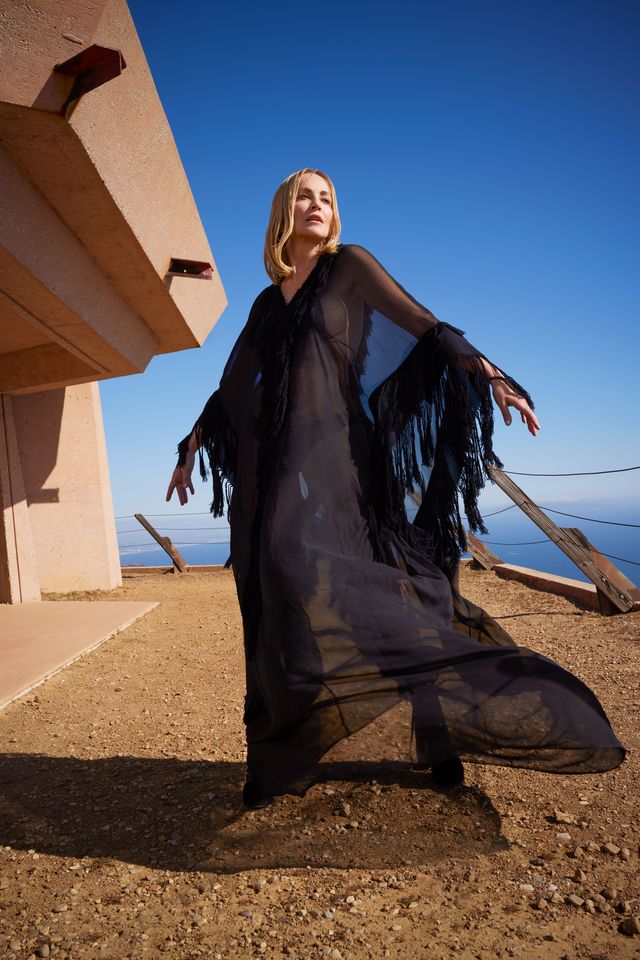


This childhood trauma likely informed Stone's path to becoming an advocate for those who can't do so for themselves or need more support. Her fundraising abilities for amfAR are legendary, and her AIDS advocacy is award-winning. In November 2020, Stone was given a Lifetime Achievement Award from the Treatment Action Group alongside Dr. Anthony Fauci. Her devotion to service has earned her several other awards in the past, including the 2013 Peace Summit Award. The COVID-19 pandemic sparked the same outrage in Stone that the AIDS crisis did. "It was like seeing the AIDS crisis in high-speed," she recalls. "It had the same disenfranchisement, denial, and lies." Stone says the ability to proceed with scientific fact or governmental care on top of lies the public was fed definitely rang a bell. "AIDS was not just a gay disease,” she says referring to an early description of the illness, “it went on to become the number one killer of women in their reproductive years.”



When pressed, Stone doesn't want to dawdle discussing feminism's storied history, but devotes a chapter of The Beauty of Living Twice to #MeToo, in which she discusses the dicey Hollywood encounters she managed to escape, like the director who expected her to sit in his lap to take direction. "Sex has long been expected in my business," she confirms in the book, adding, "I certainly didn't sleep my way into or around the business. But that didn't stop me from being sexually abused throughout my life by people I knew and did not know." Instead, she reveals going to programs for incest survivors and using tools like A Course in Miracles, the so-called New Age Bible that inspired spiritual thought leader, political activist, and most recent presidential candidate Marianne Williamson's teachings.

Still, Stone sees this moment as bigger than just allowing her to speak about her own experience, and has a clear picture of what it will take to stop the abuse. Beyond real legislation and the creation of safe spaces, Stone says it's going to take a global sisterhood of women to put an end to sexual harassment and abuse. She advocates for frank, open discussion to normalize conversations around taboo subjects. She speaks of this with a similar passion that she has for global warming. “If COVID wasn't a warning for people to get your mind straight, the planet itself will straighten you out,” she says. “Nature itself is a very big teacher.”
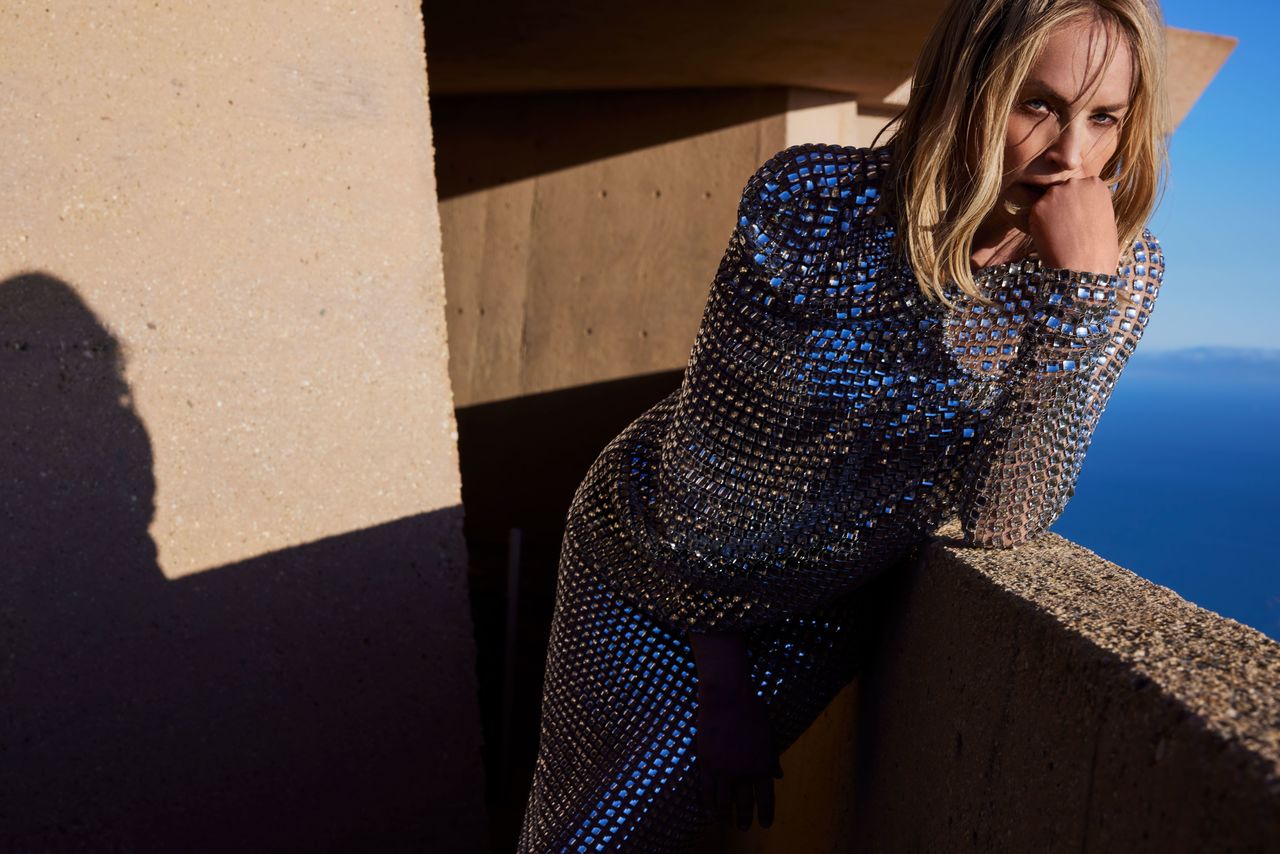


In fact, Stone speaks to nature, literally. The habit is likely tied to the experience she had filming King Solomon Mines with Richard Chamberlain during a drought in Zimbabwe in the 1980s. Six weeks after arriving, the rain came for months, and the locals bestowed the title Rain King and Queen on the two actors in a ceremony. "When real African countrymen believe you brought the rain and laud you for it, you feel a sense of real relationship with the rain, and if they believe I can talk to rain, then I will meditate and do my very best to talk to nature," notes Stone. It also inspired her other pandemic-induced pastime: painting. On display in her home office is an impressively large watercolor entitled “Mother Nature.” The actress picked up some adult paint-by-number kits to “push the paint” around, and pleasantly found herself painting more and more. She tends to admire other artists more than emulate them, naming her cats after Jasper Johns and Robert Rauschenberg. Still, the actress is pleased with the result. “I’ve never painted like this in my life,” she says.



Her artistic nature was in full force in her 40s when she landed a Dior Beauty contract in 2005. Facing her own financial struggles post-accident, Stone describes the opportunity as a godsend. But as grateful as Stone was to work with the French fashion house, she couldn't help but feel the approach was old school. Much to the luxury company’s annoyance initially, she brought in a team to amend the aesthetic beyond just the “airbrushing into the blur” look, hiring Jean-Baptiste Mondino and even updating the copy to reflect a more modern vision. She takes credit for the company's overall sales increase of 28-32 percent during this period as well as claims to have helped steer Dior’s largest scandal to date—when former creative director John Galliano used racial slurs against diners at Café Flore in Paris. "John might do the drawings, but the seamstresses, the secretaries, even the janitors were all making the clothes,” she says. “Bring the seamstresses out on the runway! You have to look at what makes a company."



As the descriptives of Stone continue to expand-actress, activist, mother, daughter, model, artist, and now author-it begs the question: What is next? It’s clear Stone has shifted into a new phase of life, while continuing to practice her craft. She recently starred in Netflix’s Ratched and is still landing modeling gigs. Stone also hinted at an upcoming philanthropic project.

She doesn’t let on, saying “I’ll stay in my lane.” Though perhaps the real beauty of living twice, is graciously changing lanes as Sharon Stone does so masterfully.

Vietnam beat Thailand 2-0 in the first leg of the ASEAN Cup final in Hanoi, giving Vietnam a significant advantage ahead of the second leg and setting up a closely watched regional finale.
A political amnesty law has taken effect in Thailand while excluding people charged with lese-majeste offenses, a decision that reflects continuing political tensions within the governing coalition.
Major Thai developers, including Land & Houses, are redirecting investment toward senior rental communities and other recurring-revenue properties as traditional residential sales weaken and demographic patterns change.
Thai trade representatives are seeking to expand bilateral commerce with New Zealand by promoting Thailand's logistics infrastructure and central position in ASEAN as a distribution gateway for agricultural and manufactured goods.
Malaysia's Transport Ministry says the planned Rapid Transit System Link station at Bukit Chagar will connect directly with KTM trains, local buses and taxis, improving connections for commuters traveling between Johor and Singapore.
The Tourism Authority of Thailand is shifting marketing efforts toward Taiwan and selected South Korean visitor groups after arrivals from South Korea fell 42 percent, seeking to sustain tourism demand and support the hospitality sector.
Samart Corporation has secured a two billion baht contract to develop and upgrade power transmission networks, supporting efforts to strengthen Thailand's electricity grid as industrial and digital energy demand rises.
Thailand's Securities and Exchange Commission has introduced stricter corporate shareholding rules as part of efforts to strengthen transparency, curb illicit funds and protect the integrity of the country's capital markets.
Organizers of the Singapore Formula One night race and other major outdoor events are activating air-quality contingency measures as forest fires in neighboring Indonesia raise the risk of worsening regional haze.
Thailand's prime minister has ordered emergency teams to speed up infrastructure repairs and provide financial assistance after severe flash flooding in Nan province, with authorities prioritizing the restoration of local economic activity.
More than 50 bombings, arson attacks on government offices and tire burnings across three southern Thai provinces have injured at least two people, prompting Malaysia to strengthen surveillance along the shared border.
Thai automotive and manufacturing executives are urging the government to require greater domestic sourcing from foreign electric vehicle investors, seeking more technology transfer and stronger links between incoming Chinese capital and local suppliers.
Thailand is hosting the twenty-ninth ASEAN Labor Ministers Meeting, where governments are working on a regional framework for digital skills training and a new ASEAN Digital Skills Passport intended to improve worker mobility and access to talent across Southeast Asia.
Thailand's digital economy regulators are drafting national rules for data centers and cloud infrastructure as interest from global hyperscalers grows, with the government seeking to strengthen the country's role as a regional digital hub.
Malaysia and Indonesia are coordinating cross-border cloud seeding operations as dry conditions and worsening air quality intensify, with the measures aimed at suppressing peatland fires ahead of Malaysia's National Day celebrations.
Philippine authorities have begun evacuations and stepped up emergency preparations as Typhoon Saudel enters the country's area of responsibility, with meteorologists warning that the system could intensify into a super typhoon.
Heavy rainfall from Typhoon Narra has caused flooding and landslides across northern Vietnam, displacing thousands of households, damaging rice crops and disrupting tourism and transport, including around Ha Long Bay.
Authorities in Indonesia say 91 people have died after a magnitude 7.7 earthquake struck East Nusa Tenggara, with military transport aircraft deployed to deliver specialized assistance to vulnerable women and children across the affected islands.
Indonesian authorities have arrested 72 people accused of starting forest and peatland fires across Borneo and Sumatra, as widespread haze affects neighboring countries, prompts school closures in Malaysia and drives urgent regional cooperation.
Thailand recorded a 37 percent year-on-year increase in foreign direct investment to 219 billion baht, as multinational companies expand manufacturing and technology operations in the country amid intensifying global trade friction.
Indonesian authorities arrested 72 people accused of using illegal fires to clear land across Borneo and Sumatra as a worsening dry season generated heavy transboundary haze and contributed to the closure of nearly 600 schools in neighboring Malaysian states.
Prime Minister Anutin Charnvirakul convened senior military and intelligence officials after more than 50 bombings and arson attacks targeted infrastructure in Narathiwat, Pattani and Yala, prompting an urgent review of security measures amid fears of renewed insurgent violence.
Prime Minister Lawrence Wong announced that every Singaporean child will receive about 70,000 Singapore dollars in financial support through cash payments and grants by age seventeen, as the government steps up efforts to address the country’s declining fertility rate.
Thailand has begun enforcing updated electric vehicle requirements that oblige foreign automakers to produce two vehicles locally for every one imported this year, alongside new battery sourcing rules intended to deepen domestic supply chains in the Eastern Economic Corridor.
Singapore’s Ministry of Trade and Industry upgraded its annual economic growth forecast to as much as 5.5 percent, citing robust global electronics demand and a sharp increase in the adoption of agentic artificial intelligence among local businesses.
President Prabowo Subianto inaugurated Indonesia’s national electric motorcycle initiative in West Java, backed by state financing and designed to build domestic capacity in electric vehicle and battery manufacturing while positioning Indonesia as a global production hub.
Thailand received investment applications worth 1.4 trillion baht, or about 43.6 billion US dollars, in the first half of the year, a 37 percent increase from a year earlier as global technology companies expanded data centers, cloud infrastructure and advanced electronics manufacturing.
An Indonesian court convicted twenty-six-year-old Luzian Andrin Zgraggen of blasphemy after he breached strict holiday restrictions and posted an explicit video from an empty beach.
An Indonesian court on the island of Bali has sentenced twenty-six-year-old Swiss national Luzian Andrin Zgraggen to one year in prison for publicly insulting Nyepi, the sacred Balinese Hindu Day of Silence.

The verdict follows Zgraggen's arrest in March after he recorded and published a social media video that violated island-wide religious restrictions and sparked widespread public outrage.

During Nyepi, Bali enforces strict, mandatory observances requiring residents and tourists alike to remain indoors, extinguish lights, cease travel, and refrain from loud noises or public activities.

The island's international airport suspends operations and commercial internet connectivity is largely restricted for twenty-four hours to maintain complete silence.

Zgraggen violated the curfew by walking onto a deserted beach, filming the empty surroundings, and sharing the footage online alongside captions containing expletives.

Presiding judges ruled that Zgraggen's deliberate breach and subsequent social media broadcast caused profound offense to the Balinese population and desecrated religious customs.

In court, Zgraggen expressed remorse and offered a public apology, testifying that he had failed to comprehend the scope and religious gravity of the annual holiday before violating the rules.

The prison sentence reflects an intensifying campaign by Indonesian authorities to enforce local laws and religious standards amid record post-pandemic tourism volumes.

While immigration officials have historically deported or briefly detained foreign visitors who violated local ordinances, local prosecutors have increasingly sought formal custodial sentences for deliberate acts of public blasphemy and disruptive behavior at cultural and religious sites across the province.
Japanese police intervened after the child was discovered abandoned for hours in rainy, foggy conditions at 2,000 meters while his father continued hiking toward the peak.
Japanese police have castigated a forty-eight-year-old father who abandoned his seven-year-old son on Mount Fuji in poor weather conditions to continue climbing toward the summit with his older child.

Mountain hut staff discovered the boy sitting alone on a bench near the trail's sixth station at an altitude exceeding two thousand meters, prompting an emergency call to local law enforcement.

The boy, left behind with only a soft drink and a snack after complaining of fatigue, was found waiting in dense fog and rain.

Police officers located the father hours later between the seventh and eighth stations, approximately a three-hour hike further up the mountain.

By the time authorities brought the father back down to reunite with his son, the child had been left unsupervised for approximately eight hours.

Police reprimanded the father upon his return, emphasizing that abandoning a young child on the mountain under adverse weather was entirely unacceptable, regardless of climbing ambitions.

The father apologized for what he described as a rash decision.

The incident occurred along the popular Fujinomiya route, which begins at the fifth station and typically requires an eight-hour round trip to reach the 3,776-meter summit.

The mountain, an active volcano and designated UNESCO World Heritage site that attracts roughly two hundred thousand hikers annually, has experienced a series of safety incidents and overcrowding issues, leading local authorities to enforce stricter route management and daily visitor caps.
Malaysian policymakers are examining expanded social care arrangements after federal welfare spending reached seven hundred twenty-eight million ringgit, warning that responsibility for elderly and social care cannot rest entirely with families.
Philippine security forces arrested a wanted bombing suspect and a Lanao del Sur vice mayor facing murder charges in separate operations in Mindanao, strengthening the government’s efforts to combat crime in the volatile southern region.
Gold industry representatives are preparing talks with Thai ministers to oppose proposed taxation measures, warning that the changes could disrupt one of Southeast Asia’s most active physical gold markets.
Indonesian police arrested one hundred ninety-seven people, including Singaporean nationals, in a raid on an illegal gambling network in Batam and seized hundreds of thousands of dollars in cash and other assets.
Thai authorities have widened investigations into three companies in Pattaya as part of a broader crackdown on nominee arrangements allegedly used to circumvent restrictions on foreign ownership of property.
Executive Secretary Ralph Recto has rejected claims of a systemic garbage crisis while blaming improper waste disposal for clogging waterways and worsening severe flooding across Metro Manila.
Thai transport authorities are assessing a seventy-four-kilometer rail expansion intended to connect with existing national infrastructure, reduce logistics costs and improve urban and regional connectivity.
Cambodian policymakers are channeling workforce-development funding into electric vehicles and agricultural processing to build industrial skills and attract higher-value manufacturing activity.
Prime Minister Anutin Charnvirakul has ordered faster humanitarian relief as severe flooding affects Nan and eight other northern provinces, with authorities also strengthening early-warning systems to protect communities and agricultural production.
Private-sector executives are calling for greater technology adoption, knowledge sharing and access to finance to unlock the potential of Thailand’s three point three million small and medium-sized enterprises amid a volatile global economy.
Chinese luxury companies in jewelry, watches and premium wine are increasingly targeting Southeast Asia’s affluent consumers as a testing ground for international expansion, intensifying competition across the region’s high-end retail market.
Thai policymakers are examining new frameworks to strengthen trade and logistics links with New Zealand, as Bangkok seeks to diversify international commercial partnerships and expand its role as a regional distribution hub.
The ASEAN Observer Team has inspected parts of Banteay Meanchey province after Cambodia protested the deployment of shipping containers by Thai forces, highlighting continued tensions over territorial demarcation.
Vietnam has deployed thousands of emergency personnel after Storm Narra brought extreme rainfall to northern and central provinces, triggering landslides, damaging infrastructure and disrupting local supply chains.
Strong public registration for the new TH-AI Passport and growing interest in digital asset tokenization point to accelerating adoption of advanced digital financial technologies in Thailand.
A series of coordinated arson and bomb attacks in Pattani, Yala and Narathiwat led to the suspension of State Railway of Thailand services and prompted Malaysia to advise citizens to postpone non-essential travel to the border region.
The Armed Forces of the Philippines has rejected demands from China’s embassy to remove the grounded naval vessel from Ayungin Shoal, reaffirming Manila’s position on its territorial claims in the South China Sea.
President Prabowo Subianto has ordered a major emergency response to forest and land fires in Kalimantan and traveled to the region to oversee containment efforts, while authorities pledged tougher enforcement against environmental violations.
Prime Minister Lawrence Wong used his National Day Rally to warn that intensifying US-China tensions and fragmented supply chains are creating a more uncertain global environment, urging Singapore to deepen partnerships that protect its position as an international hub.
Swiss Tourist Sentenced to One Year in Prison for Insulting Bali's Sacred Day of Silence
Father Reprimanded After Leaving Seven-Year-Old Son Alone on Mount Fuji During Summit Climb
Google Launches Pixel 11 With Gemini AI at the Center of Its Hardware Strategy
China’s Kimi Launches AI-Focused Credit Card With Agricultural Bank of China and American Express
Success: Nvidia Turned Gaming Chips Into the Engine of the AI Boom
AI’s Next Bottleneck Is Power, Not Just Nvidia Chips
Meta Raises AI Spending Target to as Much as $145bn Despite Pressure Over Returns
Joe Biden’s Cancer Has Spread Beyond His Bones, Hunter Biden Says
Why 2027 Could Be a Strong Year for Stocks—and Why the Forecast Is Fragile
Why Markets May Look Quiet in August After Big Tech Earnings
UFO: Pentagon Releases Video of Unidentified Object Tracked Over Middle East
Ukraine Tells Senate Republicans Its Drone War Offers a Blueprint for America
Weight-Loss Drug Boom Tests the Limits of Prescription Advertising Rules
Taiwan’s President Joins Wartime Command Drill as China Pressure Grows
Lightning Strike Kills Yala FC Player During Match in Southern Thailand
AI Is Remaking the US Economy, From GDP Growth to iPhone Prices
Indonesia’s Free School Meals Plan Has Been Hit by Poisoning, Corruption and Cuts
US and Japan Step In to Support the Yen in Rare Joint Intervention
FIFA’s Retreat Leaves a Larger Question Over Who Guards the Game
Valued at $109 Million: F-35B Fighter Jet Crashes in Southern California
US Says It Has Carried Out Heavy Strikes on Iran After Attempted Attacks on Its Forces
Over 24 Hours in the Air: Qantas Airbus Completes Record-Breaking Test Flight
Nvidia Reportedly Takes Vast Texas Data-Centre Lease to Underwrite AI Expansion
FIFA’s Private-Investment Plan for World Cup Rights Draws European Revolt
Following OpenAI's Cyberattack: 'Most Companies Still Do Not Understand What Is Coming'
OpenAI Sued After ChatGPT Allegedly Discouraged Emergency Care Before Near-Fatal Embolism
Miliband Sets Climate and International Law at Centre of UK Diplomacy
Trump Readies New Tariffs as Temporary Global Levy Nears Expiry
EU Imposes Record €550 Million Digital Services Fine on AliExpress
Between Deliveries, Wang Jibing Wrote His Way to China’s Literary Heights
Morgan Stanley Builds a Wall Street Lead in AI Infrastructure Finance
High Prices Push Coffee Drinkers Toward Whole Beans and Home Brewing
Trump Draws Boos and Podium Scrutiny at Spain’s World Cup Triumph
Spain Defeats Argentina in Extra Time to Win Second World Cup
Police Block Cockroach Janta Party’s March to Parliament as Education Protests Intensify
Singapore Considers Lower Taxes for Fund Managers as Hong Kong Intensifies Talent Contest
Proposed U.S.-Saudi Nuclear Pact Could Permit Limited Uranium Enrichment Under International Safeguards
Why Kentucky Fried Chicken Became KFC—and Why the False Explanations Persist
Ukrainian Drones Strike Wildberries Warehouses Deep Inside Russia
Reported CIA Mission Helped Clear the UAE’s Path to Advanced US AI Chips
Artificial Intelligence Capital Fuels Markets While Governments and Regulators Face Mounting Strategic Tests
China’s Moonshot’s Kimi K3 Narrows the Gap With Anthropic Through Scale, Openness and Lower Cost
Gold and Cash Seizure Puts Indonesia’s Senior Anti-Corruption Prosecutor Under Investigation
The Ledger Will Not Trust on Faith
Ukraine’s Leadership Rift Spills Into the Streets as Protesters Target Army Chief
The Ten World Cup Finals That Defined Football History
Smartphones Are Getting More Expensive, Sales Are Collapsing, and Even Apple Admits: "Prices Will Rise"
Leadership Change and Strategic Rivalry Redraw the Political Map
The AI Race Enters Its Infrastructure Era
Britain Nationalises British Steel to Protect Scunthorpe Production and Strategic Supply