
Art object or machine for living in Architect William Massie’s personal prefab project takes the mass out of mass customization to create a one-of-a-kind wonder.


William Massie relaxes inside the utterly unique interior of his America House 08.



The kitchen is a long sleek space.


Milling technologies at various scales helped give the house its unique textures and spaces. The result is as much a demonstration piece of domestic construction techniques as it is a place to live.

William Massie always longed to live, work, and build in the same place. For most of his career, the charismatic architect, known for championing the latest design technologies, had to travel long distances in order to construct his experimental homes.

Then, in 2005, after becoming head of the architecture department at the Cranbrook Academy of Art in Bloomfield Hills, Michigan, Massie had less time to do even that. Shortly after relocating for the job, he came across a former tool-and-die factory that was for sale in nearby Pontiac. At 10,000 square feet, it was large enough to erect a house in. Massie snapped it up. Finally, he could work on his residential designs close to home and in his own time.

Last summer, the architect completed the first home to come off of his factory’s highly idiosyncratic production line. An all-white, superbly elegant, 2,500-square-foot modernist box, the steel-framed house, which was built in sections, is easily recognizable for its roof line that parabolically plunges at one point to form a dimple.

The house, which Massie dubbed the American House 08, was built to move: No sooner was it completed than the architect jumped behind the wheel of his dual-axle GMC truck and towed many of its components five miles along Woodward Avenue to Cranbrook. The house was reassembled on a lawn outside the art museum, next to a towering sculpture by Mark DiSuvero. After the addition of cork flooring and newly plastered ceilings, the house, part of an exhibition on Massie’s work, was opened to the public. But the 08 still faces a much longer and yet to be determined journey: to its eventual client.

For Massie, creating this "transportable" house proved inspirational. "It is the culmination of everything—the digital technology, the prefabrication techniques, and more formal architecture—that I have brought to my designs," he states. Walking inside, it is clear why. Massie’s grasp of domestic space, honed by a reverence for early modernists like Richard Neutra and Rudolf Schindler—he once lived in a Neutra house in Bozeman, Montana—has been enhanced by the freedom that designing inside his factory allows.

At first, all he did was erect the steel frame. Abandoning the standard practice of deciding a house’s layout before construction, Massie spent hours walking around inside to figure out, from the occupant’s point of view, what it would be like to live there. "There was never a need to finalize beforehand where the bathroom wall should be or where the front door had to be placed," he recalls. For the first time in his career, Massie found himself free of demanding clients. "They are not good coconspirators," this obsessive experimenter confesses. And experiment he did. Sometimes his search for different materials meant roaming up and down the aisles of Lowe’s and Home Depot, both equidistant from his factory, on his Segway. At other times, he would simply sit in a chair and see that a certain window could be higher. "I was able to play constantly," the 46-year-old exults.

The result of this approach (Massie refers to it as "subtly improvisational") is an interior that responds immediately, albeit quietly, to an occupant’s needs. Massie lowered the ceiling, creating space between the ceiling and the roof and making the house feel less like a solid block. He then made sure that the views from the master bedroom both to the living area and to the outside spoke directly to the choices offered by the house: Is it time to go outside to the lawn or return to the main space?

Some decisions were straightforward. In keeping with modernist tradition, skylights and floor-to-ceiling windows in the living room invite natural light inside; the question for Massie, as he wandered around inside his frame of a house, was simply how to use that light. He soon decided that shade, even darkness, would make the master suite feel more separate, so he inserted a 34-foot-long panel to bisect the wall of glass. The darkened room thus feels apart from the rest of the house and, appropriately to Massie’s original idea, more private.

When Massie attended Columbia University back in the late 1980s, he and his classmates believed that the computer would revolutionize design. For many, that ended up meaning greater dexterity with programs like AutoCAD. Massie, however, was determined to use this new technology in the construction process itself, not merely as a design tool.

For over a decade, attaching his computer to a laser cutter, he learned how to draw intricate shapes—such as jigsaw patterns for wood paneling—and have the machine cut them out seamlessly. He then bought his own computer numerically controlled (CNC) milling machine, which could drill down into a material to create molds. He was thus able to redefine how standard materials such as concrete, wood, and even rubber were used. They no longer had to be flat or rectangular—they could become sculptural forms.

As soon as one steps inside the 08, the results of these battle-tested skills are evident. Two sculpted pods dominate the living room. One is the reverse of the roof dimple while the other houses a large stand-alone bath and shower. Both are made from the same structural insulated panels (SIPs) that in-fill the exterior, but, thanks to the laser cutter, these panels were sliced into even smaller pieces and pushed into dramatic shapes.

Massie’s computer-design wizardry is not confined to grandiose gestures. The cabinets—which look like thin sponges—are simply whiteboard sculpted out by the laser cutter according to a pattern set up on the computer (when viewed at the right vantage point the varying ellipses all condense to form perfect circles). In the master suite, two small rectangular sections of the walls have been filled with translucent rubber cubes also cut on this machine. "They allow light through as well as some exciting shadowy movement," Massie says.

Sometimes there seems no end to these flourishes. Orange rubber molds fill in the elliptical recesses on the house’s solid end walls; from certain angles the torqued shapes flatten out to form perfect circles. The bathroom sinks are made from the same colorful material. Surprisingly, though, the house does not feel self-conscious. "I don’t like design to be fetishized," he says flatly.

The 08 seems to amplify Massie’s own freewheeling spirit. During my visit he invited friends and family in for drinks. A built-in projector shone an episode of Twin Peaks onto the wall of the sculptured shower pod. LEDs in the floor beamed different colors onto each side of the dimple. With the rest of the living room subtly lit, it became a New York cocktail lounge. Those inside soon forgot, if they ever knew that what they were sitting in had been prefabricated in sections, transported to the site, and then bolted one to the other. Of course, this is the way Massie wants it. This architect came to the idea of transportability to satisfy his own design ambitions, not because he was obsessed with prefab.

When the house is moved again, some interior surfaces, such as the plaster ceilings, will, in Massie’s words, "have to be sacrificed." Redoing them, and reinstalling the floor, will cost about $20,000. The total transport cost, apart from any work to connect the house to the site, will be nearly $45,000. The cost of the house itself? $750,000. But the new owner will be getting something unlike any other prefab: a one-of-a-kind house by William Massie.

The architect is asking the buyer to view the 08 as a work of art. To that end, he has contemplated putting it up for auction on eBay. Like many of Massie’s ideas, this seems outlandish. Then again, so did buying an abandoned factory in suburban Detroit. The architect would have it no other way.



Seen from the outside, angular slits offer tantalizing glimpses of the home's interior.



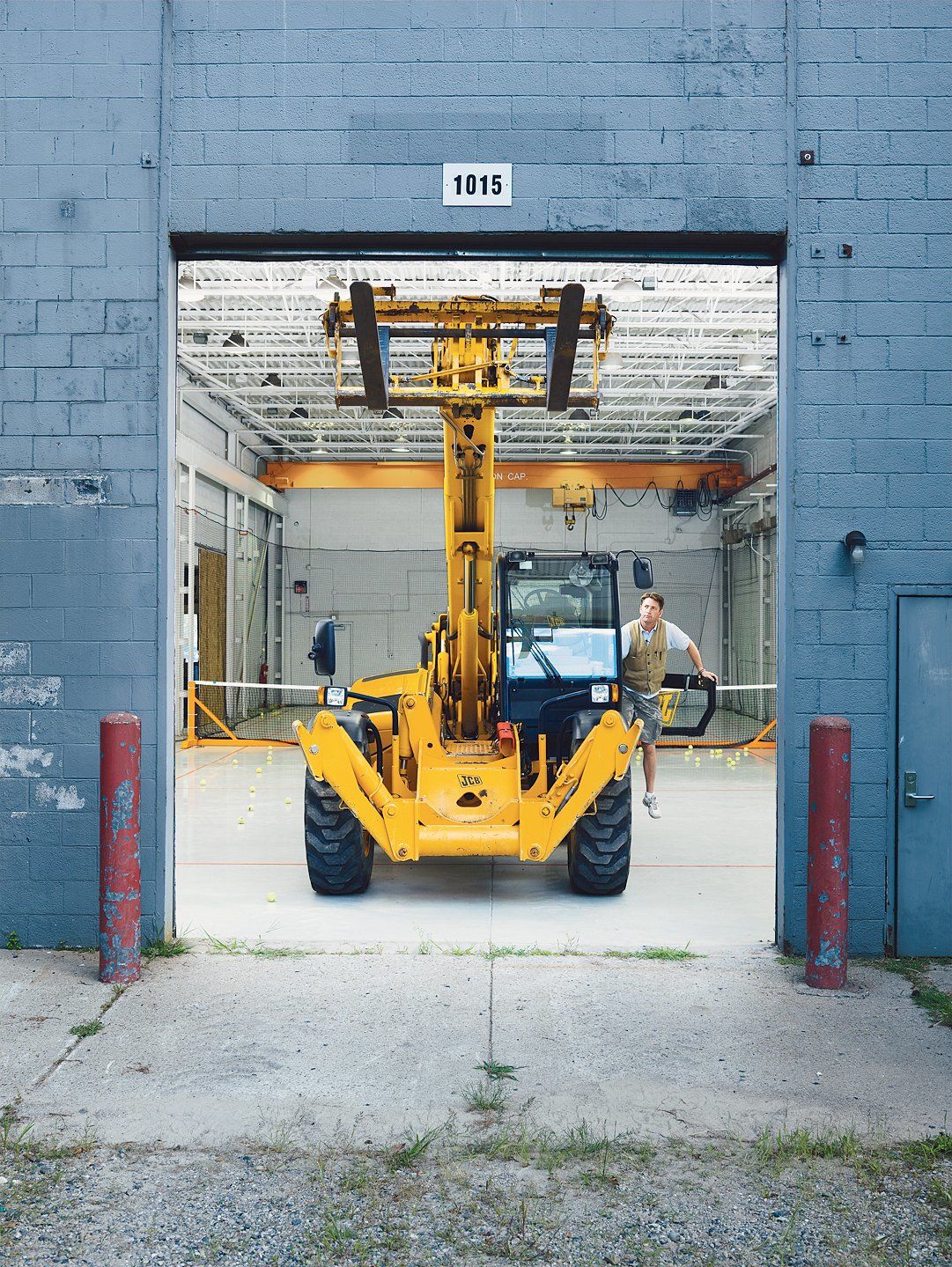
William Massie's factory was itself a spatial influence on the 08 project. The two main doors to the warehouse had originally been designed to allow a standard trailer to back inside. Thus, no section of the house could be wider than the trailer (12 feet). Although each section was designed with these dimensions in mind, getting them out proved tricky. In the end, Massie came with with a solution after building a test model.



Irregular milled perforations form intriguing light wells in the skin of the house.



The curving, bulbous walls of the bath and shower reveal an unexpected secondary role as a screen for film projections, giving the house a sci-fi glow.



The inner dimple, not far from the front door, separates the entrance from the living space.



Up close the dimple forms a voluptuous hallway.



The curving exterior of the podlike bath and shower cuts an elegant form at the other end of the room.



The bedroom is a comfortable show of geometric regularity.

The Indonesian national football squad secured a historic tournament championship following a late equalizer, sparking nationwide celebrations and boosting the profile of regional sports.
A new industry analysis shows that the expanding ASEAN aviation sector supports over 23 million jobs, highlighting the importance of major airport infrastructure projects in hubs like Bangkok.
The administration of Anwar Ibrahim is working to balance essential cost-of-living relief for households against the need for subsidy reforms to maintain long-term national fiscal health.
The board of directors has dismissed the airline's chief executive following public backlash over the mishandling of passenger communications and baggage logistics during severe regional floods.
Following extreme weather that has caused dozens of deaths in Thailand since mid-September, urban development experts are calling for urgent civil engineering projects to protect the capital's economic core.
Lawmakers have implemented strict bans on the digital distribution of unsafe personal mobility vehicles to address urban pedestrian safety concerns and domestic fire hazards.
Authorities in southern Malaysia have shuttered educational institutions due to deteriorating air quality, while Indonesian courts face negligence complaints regarding agricultural fires driving the regional crisis.
In a move to deepen defense ties, Polish leadership is in the Philippines to negotiate military aviation contracts and align strategic interests regarding regional sovereignty.
National and municipal authorities are directing significant capital into seapert and multimodal transport infrastructure to transform the Hai Phong area into a competitive international maritime hub.
The Thai Ministry of Public Health has backed a proposed arrival fee for international visitors to fund an insurance pool intended to cover unpaid hospital bills and maintain care standards.
Authorities in Jakarta have committed to ending the conversion of pristine forests into rice paddies as part of a shift toward more sustainable agricultural intensification and food security.
Diplomatic and labor delegations from both nations are working to finalize a new regulatory agreement by year-end to resolve exploitation issues and secure the flow of essential labor into Malaysia.
President Ferdinand Marcos has arrived in Singapore for a five-day working visit aimed at attracting foreign direct investment into the Philippines' domestic technology and infrastructure sectors.
Energy ministers from across Southeast Asia have inaugurated a new institutional body designed to harmonize utility frameworks and facilitate multi-billion dollar investments into an interconnected regional electricity grid.
Foreign Affairs Minister Vivian Balakrishnan stated that Singapore will use its upcoming leadership of the regional bloc to push for deeper economic integration and stronger trade partnerships to navigate global volatility.
The Laotian government has introduced new resource nationalism policies requiring all extracted minerals to be processed domestically before export to capture higher industrial value and increase national revenue.
Domestic financial institutions across Vietnam are seeking massive capital injections from international and regional investors to expand lending capacity and support the country's rapid industrialization.
Malaysian infrastructure and technology authorities have commenced development of a large-scale technological hub aimed at attracting global semiconductor manufacturing and artificial intelligence data centers to compete with Singapore.
Thai Prime Minister Anutin Charnvirakul confirmed that negotiators are drafting the final stages of a sweeping trade pact designed to strengthen Thailand’s position within global manufacturing and technology supply chains.
Cambodian and Lao energy authorities agreed to strengthen high-voltage grid connections, supporting larger flows of hydropower between the two countries and neighboring regional markets.
Norwegian shipbuilder VARD inaugurated a marine engineering and vessel design center in Ho Chi Minh City to support growing shipbuilding demand across Southeast Asia.
Malaysian sovereign funds, venture capital networks and technology agencies are allocating capital to local chip design and advanced packaging companies to strengthen the country’s electronics industry.
Chinese technology companies are increasing spending on regional data centers and cloud services as businesses across ASEAN adopt more artificial intelligence tools and digital financial platforms.
Indonesian authorities and Danantara are preparing several major state-owned companies for potential listings in 2027 as part of efforts to deepen the Jakarta capital market and attract institutional investors.
Bangkok authorities are rolling out electric river boats, additional skywalks and cycling lanes under the Car Free 2026 initiative to reduce congestion and emissions across the capital.
Large projects including the 20 billion baht Songklanagarind Phuket Advanced Medical Center are helping broaden Phuket’s economy into healthcare, residential development and retail alongside its traditional tourism base.
The Tourism Authority of Thailand signed a letter of intent with aviation and tourism partners to turn passenger stopovers at Bangkok airports into curated travel experiences aimed at increasing visitor spending.
Blockchain analytics data showed Vietnam processed more than $122 billion in digital asset transactions over a 12-month period, ranking second in Southeast Asia behind Singapore.
Analysts expect the Bangko Sentral ng Pilipinas to conclude its monetary tightening cycle in October as imported inflation pressures ease and policymakers weigh the need to support domestic spending.
Philippine equities dropped to their lowest levels of the year amid foreign fund outflows, a weaker peso and concerns that high borrowing costs could weigh on domestic growth.
Singaporean officials are preparing for the country’s 2027 ASEAN chairmanship with a focus on deeper economic integration, digital trade standards and stronger regional security cooperation.
Thai economic officials outlined a three-part plan to reduce exposure to expensive fossil-fuel imports by increasing domestic renewable generation and allowing households to sell surplus electricity back to the grid.
German chipmaker Infineon Technologies inaugurated an expanded facility in Thailand that is expected to increase local engineering capacity toward 1,000 specialized jobs and deepen the country’s role in semiconductor supply chains.
Malaysia’s Johor chief minister called for urgent regional talks as smoke from agricultural fires in Sumatra and Borneo affected parts of Malaysia, Singapore and Indonesia, increasing pressure for coordinated firefighting and enforcement.
Vietnam’s consumer price index rose to 5.08% in September as higher construction material and food costs pushed inflation to its highest level in a decade.
Severe monsoonal flooding across northern and central Thailand has damaged farms, disrupted food supply chains and pushed estimated national economic losses above 69 billion baht.
A World Bank assessment found that Malaysia and Vietnam are capturing strong demand for artificial intelligence hardware and electrical equipment, while Indonesia faces greater difficulty attracting advanced digital manufacturing investment.
The ASEAN+3 Macroeconomic Research Office said weaker global demand for artificial intelligence hardware could significantly slow regional growth by 2027, exposing economies increasingly reliant on semiconductor and electronics exports.
The World Bank lifted Vietnam’s 2026 GDP growth forecast by 1.1 percentage points to 7.4%, citing surging exports of computers, servers and other high-tech products tied to global artificial intelligence infrastructure demand.
International law enforcement agencies seized 521 kilograms of crystal methamphetamine from a private aircraft at a Laotian airport and arrested a Singaporean pilot in a major operation linked to the Golden Triangle drug trade. :chatgpt-content-reference{index="19"}
Thai developer Siam Piwat has announced IconPhuket, a large retail and entertainment project aimed at capturing growing demand from affluent international visitors to the southern island. :chatgpt-content-reference{index="18"}
Malaysia’s election commission has scheduled the Melaka state poll for mid-November, creating a significant political test for Prime Minister Anwar Ibrahim and public support for his government’s economic reforms. :chatgpt-content-reference{index="17"}
Thailand recorded 7.5 billion baht in revenue from international film and television productions, supported by tax incentives and growing use of Thai locations and production talent. :chatgpt-content-reference{index="16"}
Singapore is urging ASEAN governments to expand cross-border intelligence sharing as criminal networks increasingly use advanced artificial intelligence tools to conduct sophisticated financial fraud. :chatgpt-content-reference{index="15"}
Thailand’s Board of Investment says its 10-year Long-Term Resident visa program has attracted more than 12,000 wealthy individuals, executives and digital professionals, supporting foreign spending and investment in the domestic economy. :chatgpt-content-reference{index="14"}
Malaysia has begun high-level discussions with visiting Myanmar officials over the return of undocumented Myanmar nationals as planned repatriations draw warnings from United Nations human rights monitors. :chatgpt-content-reference{index="13"}
Thailand has climbed to 38th place in the World Economic Forum’s Travel and Tourism Development Index, reflecting improvements in aviation connectivity and efforts to attract higher-value international visitors. :chatgpt-content-reference{index="12"}
Singapore is promoting deeper regional electricity integration and shared energy infrastructure as it prepares to chair ASEAN, seeking to reduce Southeast Asia’s exposure to volatile global fossil fuel markets. :chatgpt-content-reference{index="11"}
Glacier Collapse, Not Earthquake, Triggered Deadly Nepal-Tibet Flood
Swiss Tourist Sentenced to One Year in Prison for Insulting Bali's Sacred Day of Silence
Father Reprimanded After Leaving Seven-Year-Old Son Alone on Mount Fuji During Summit Climb
Google Launches Pixel 11 With Gemini AI at the Center of Its Hardware Strategy
China’s Kimi Launches AI-Focused Credit Card With Agricultural Bank of China and American Express
Success: Nvidia Turned Gaming Chips Into the Engine of the AI Boom
AI’s Next Bottleneck Is Power, Not Just Nvidia Chips
Meta Raises AI Spending Target to as Much as $145bn Despite Pressure Over Returns
Joe Biden’s Cancer Has Spread Beyond His Bones, Hunter Biden Says
Why 2027 Could Be a Strong Year for Stocks—and Why the Forecast Is Fragile
Why Markets May Look Quiet in August After Big Tech Earnings
UFO: Pentagon Releases Video of Unidentified Object Tracked Over Middle East
Ukraine Tells Senate Republicans Its Drone War Offers a Blueprint for America
Weight-Loss Drug Boom Tests the Limits of Prescription Advertising Rules
Taiwan’s President Joins Wartime Command Drill as China Pressure Grows
Lightning Strike Kills Yala FC Player During Match in Southern Thailand
AI Is Remaking the US Economy, From GDP Growth to iPhone Prices
Indonesia’s Free School Meals Plan Has Been Hit by Poisoning, Corruption and Cuts
US and Japan Step In to Support the Yen in Rare Joint Intervention
FIFA’s Retreat Leaves a Larger Question Over Who Guards the Game
Valued at $109 Million: F-35B Fighter Jet Crashes in Southern California
US Says It Has Carried Out Heavy Strikes on Iran After Attempted Attacks on Its Forces
Over 24 Hours in the Air: Qantas Airbus Completes Record-Breaking Test Flight
Nvidia Reportedly Takes Vast Texas Data-Centre Lease to Underwrite AI Expansion
FIFA’s Private-Investment Plan for World Cup Rights Draws European Revolt
Following OpenAI's Cyberattack: 'Most Companies Still Do Not Understand What Is Coming'
OpenAI Sued After ChatGPT Allegedly Discouraged Emergency Care Before Near-Fatal Embolism
Miliband Sets Climate and International Law at Centre of UK Diplomacy
Trump Readies New Tariffs as Temporary Global Levy Nears Expiry
EU Imposes Record €550 Million Digital Services Fine on AliExpress
Between Deliveries, Wang Jibing Wrote His Way to China’s Literary Heights
Morgan Stanley Builds a Wall Street Lead in AI Infrastructure Finance
High Prices Push Coffee Drinkers Toward Whole Beans and Home Brewing
Trump Draws Boos and Podium Scrutiny at Spain’s World Cup Triumph
Spain Defeats Argentina in Extra Time to Win Second World Cup
Police Block Cockroach Janta Party’s March to Parliament as Education Protests Intensify
Singapore Considers Lower Taxes for Fund Managers as Hong Kong Intensifies Talent Contest
Proposed U.S.-Saudi Nuclear Pact Could Permit Limited Uranium Enrichment Under International Safeguards
Why Kentucky Fried Chicken Became KFC—and Why the False Explanations Persist
Ukrainian Drones Strike Wildberries Warehouses Deep Inside Russia
Reported CIA Mission Helped Clear the UAE’s Path to Advanced US AI Chips
Artificial Intelligence Capital Fuels Markets While Governments and Regulators Face Mounting Strategic Tests
China’s Moonshot’s Kimi K3 Narrows the Gap With Anthropic Through Scale, Openness and Lower Cost
Gold and Cash Seizure Puts Indonesia’s Senior Anti-Corruption Prosecutor Under Investigation
The Ledger Will Not Trust on Faith
Ukraine’s Leadership Rift Spills Into the Streets as Protesters Target Army Chief
The Ten World Cup Finals That Defined Football History
Smartphones Are Getting More Expensive, Sales Are Collapsing, and Even Apple Admits: "Prices Will Rise"
Leadership Change and Strategic Rivalry Redraw the Political Map
The AI Race Enters Its Infrastructure Era