The designer is redefining American luxury for the boundary-less, genderless now.

Jerry Lorenzo, the reserved designer of Los Angeles–based cult label Fear of God, is known for his defiantly understated clothes, which disregard fashion seasons and inhabit a different register from the loud, status-conscious glamour of many of his contemporaries. Lorenzo’s low-key, luxe looks, based on his personal style and created ostensibly for men but beloved by women, offer an almost muffled rebuke to the din of the fashion circus.



But despite his efforts to exist outside the fleeting nature of fashion, Lorenzo, who started his label in 2012, now finds himself very much of the moment. The hosannas for Fear of God’s seventh collection—a study in languid luxury two years in the making and unveiled in August—presaged the “all sweats all the time, but make it cute” orthodoxy of our new lives, and all but anointed him the savior of American fashion.

At a time when fashion is seeking salvation, from the social and racist sins of its past and the commercial and psychic battering of the pandemic, the 43-year-old has gone from self-taught newbie to Covid-era critical darling, an agenda-setting second coming of Ralph Lauren. Once a name known primarily among the cliquish, primarily male-dominated streetwear scene, Lorenzo’s latest collection welcomes a broader range of shoppers.

The die-hard streetwear collector will find something, to be sure, but so will the woman who still longs for the luxurious simplicity of Phoebe Philoera Celine.

“It’s pretty crazy, man,” says Lorenzo, speaking over Zoom from his studio in the Arts District of Downtown L.A. “I’d be lying if I said I knew exactly why the label is resonating the way it is now, but I’d like to think it’s partly because we’ve always approached fashion in an honest way, providing honest solutions.”



If Lorenzo, who previously worked as a well-known party promoter and a design consultant for Kanye West, sounds more like a tech entrepreneur than the newly minted exemplar of youthful American sophistication, he certainly doesn’t dress the part. He is wearing a cropped gray waffle-weave hoodie (a generously cut prototype from a coming collection that he refers to as “comfortable and considered”) and taupe-and-champagne-colored glasses from a collaboration with Barton Perreira. His hair is braided and worn in a bun. “I usually just have it out and pull it back,” he says, “but figured I’d rock a new hairdo.”

"Luxury is being comfortable in your own skin and able to move at your own pace."


Lately, Lorenzo has been experimenting. Spurred by a collaboration with Ermenegildo Zegna, which had him traveling to Italy six times last year and introduced him to new ateliers and factories, he has expanded Fear of God beyond cozy sweats and denim, and into high-end tailoring, suiting, knitwear, and accessories. Gone are the streetwear-inflected motocross pants and rock T-shirts in favor of Italian virgin wool coats.

“Now that we have better resources, we’re able to tell a better story,” he says. “We’re saying the same thing but with new words. I put as much love into the cut and drape of a pair of sweatpants as I do trousers. So it’s really just the same point of view living through new pieces.”

It’s an attention to detail bordering on fastidiousness that he shares with his erstwhile boss. “Kanye saw my first collection, and he held up a blank T-shirt and said, ‘Man, I can see all the thought that went into this one T-shirt,’ ” Lorenzo recalls.
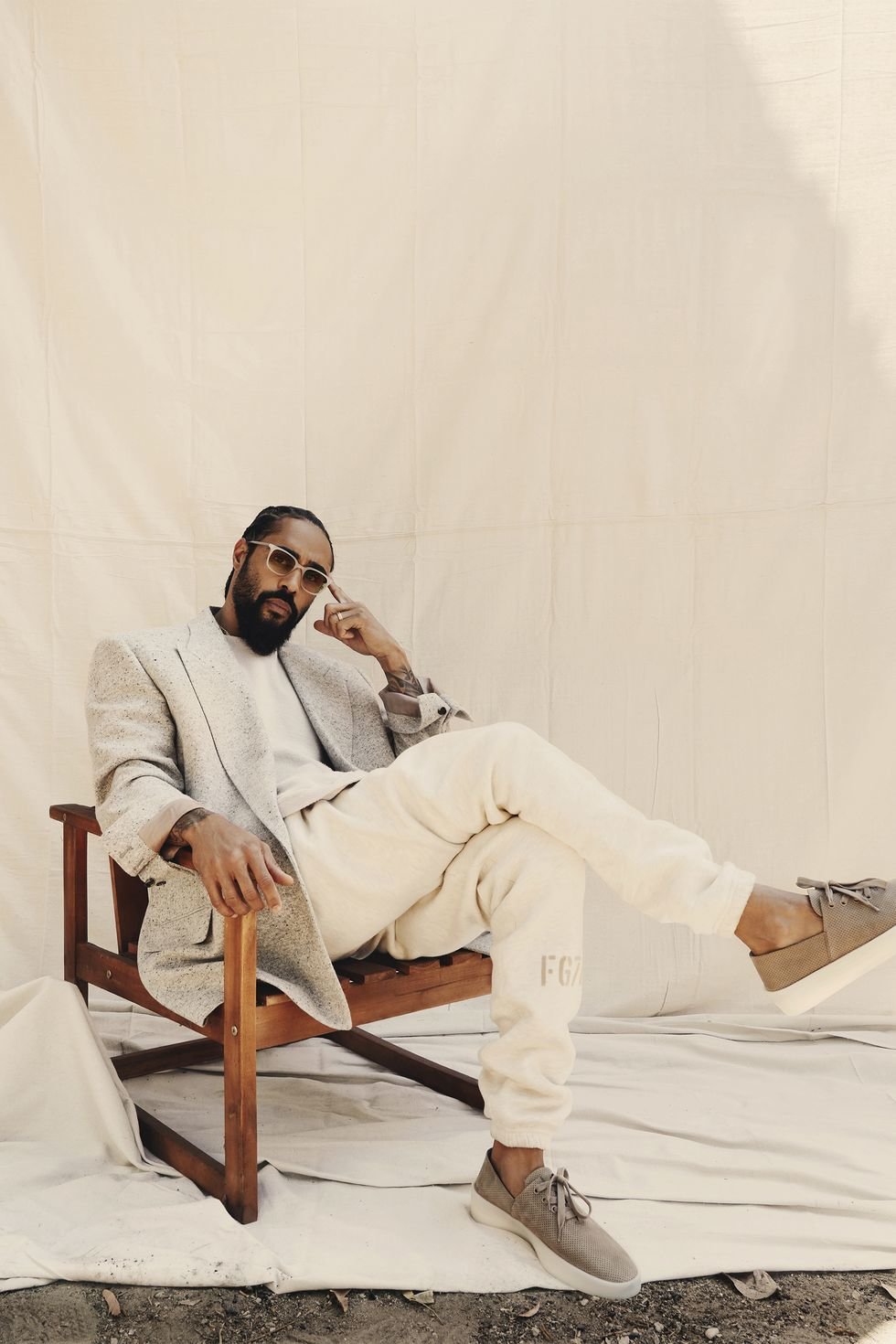


For Lorenzo, the essence of style remains being able to feel at home in any room. “Luxury is being comfortable in your own skin and able to move at your own pace,” he notes, not oblivious to the fact that the pace of the world has dramatically stalled.

“So many times, though, when someone dresses up for an occasion, they step into a silhouette that’s a lot different from how they look the rest of the week. They don’t feel comfortable, and it shows. So with Fear of God, we’re trying to blend all of these life moments together in one wardrobe that offers comfort and functionality at the same time as elegance and sophistication.”

"I put as much love into the cut and drape of a pair of sweatpants as I do trousers."


According to the singer John Mayer, a friend and longtime customer, it’s a balancing act that the designer adroitly pulls off. “Jerry’s discipline is so good from season to season that it makes you want to buy into it because you don’t feel like you’re going to get whiplash,” says Mayer, an inveterate collector of watches and sneakers who rates Lorenzo’s Nike Air Fear of God 1 as the most important men’s shoe of this generation.

“Like a great band, you can take any one of their songs from any record and put it on a playlist and it sounds complete. You could take stuff from Fear of God Season 6 and mash it up with the stuff that’s coming out from him now, and with the Zegna stuff, and it’s going to look like a really coherent statement.”

Adds celebrity stylist Karla Welch, who worked with Lorenzo when he made custom looks for Justin Bieber’s Purpose tour: “His clothes don’t scream fashion, and suggest more of a feeling than a trend, but like all great visionaries, Jerry is able to capture a moment right before it happens. His references are vast but also very uniquely his.”



True to form, Lorenzo explains that the latest collection was inspired by Julia Roberts in any chunky knit (especially in The Pelican Brief), Princess Diana’s boulder-shoulder blazers, a young Tom Cruise, and basketball players like Michael Jordan on their travel days, with their oversize blazers and T-shirts tucked into jeans. As evinced by his broad influences, Lorenzo envisions all genders in his clothing, even if his label is still considered menswear on paper.

“He recognizes that luxury and the way people spend money are changing,” says friend and booster, the screenwriter and producer Lena Waithe. “He is saying that rather than just going to a traditional fashion house when we feel like getting fancy, you can buy something by someone who has the same values as you, who looks like you and understands you.”

Plus, Waithe adds, “He doesn’t treat women differently, and he makes them feel every bit as strong and bold as men. We’re all fighting the same fight; we’re in the trenches together, so why not wear the same uniform?”

While he is mindful of Fear of God’s popularity among women and continues to feature women in his campaigns, Lorenzo is wary of trying to be all things to all people. “I think there’s something incredibly sexy about a woman in a man’s proportions,” he says. “And I’m always considering, when my wife goes to steal [something] from my closet, how is it going to look on her?

But I’m not trying to land the plane in between. If you’re trying to fit a man’s body and a woman’s body equally, you land in this weird shape that doesn’t necessarily suit either.”

Besides, Lorenzo points out, in addition to his signature Fear of God collection, the Essentials offshoot label, and the ongoing Zegna project, he has enough on his plate right now. “Dude, I have three kids,” he says, referring to the twin daughters, Liv and Mercy, and son, Jerry Lorenzo Manuel III, he has with his wife, Desiree. “They take up all my extra time, especially now with homeschool. That’s the extent of my bandwidth."

Cambodian and Lao energy authorities agreed to strengthen high-voltage grid connections, supporting larger flows of hydropower between the two countries and neighboring regional markets.
Norwegian shipbuilder VARD inaugurated a marine engineering and vessel design center in Ho Chi Minh City to support growing shipbuilding demand across Southeast Asia.
Malaysian sovereign funds, venture capital networks and technology agencies are allocating capital to local chip design and advanced packaging companies to strengthen the country’s electronics industry.
Chinese technology companies are increasing spending on regional data centers and cloud services as businesses across ASEAN adopt more artificial intelligence tools and digital financial platforms.
Indonesian authorities and Danantara are preparing several major state-owned companies for potential listings in 2027 as part of efforts to deepen the Jakarta capital market and attract institutional investors.
Bangkok authorities are rolling out electric river boats, additional skywalks and cycling lanes under the Car Free 2026 initiative to reduce congestion and emissions across the capital.
Large projects including the 20 billion baht Songklanagarind Phuket Advanced Medical Center are helping broaden Phuket’s economy into healthcare, residential development and retail alongside its traditional tourism base.
The Tourism Authority of Thailand signed a letter of intent with aviation and tourism partners to turn passenger stopovers at Bangkok airports into curated travel experiences aimed at increasing visitor spending.
Blockchain analytics data showed Vietnam processed more than $122 billion in digital asset transactions over a 12-month period, ranking second in Southeast Asia behind Singapore.
Analysts expect the Bangko Sentral ng Pilipinas to conclude its monetary tightening cycle in October as imported inflation pressures ease and policymakers weigh the need to support domestic spending.
Philippine equities dropped to their lowest levels of the year amid foreign fund outflows, a weaker peso and concerns that high borrowing costs could weigh on domestic growth.
Singaporean officials are preparing for the country’s 2027 ASEAN chairmanship with a focus on deeper economic integration, digital trade standards and stronger regional security cooperation.
Thai economic officials outlined a three-part plan to reduce exposure to expensive fossil-fuel imports by increasing domestic renewable generation and allowing households to sell surplus electricity back to the grid.
German chipmaker Infineon Technologies inaugurated an expanded facility in Thailand that is expected to increase local engineering capacity toward 1,000 specialized jobs and deepen the country’s role in semiconductor supply chains.
Malaysia’s Johor chief minister called for urgent regional talks as smoke from agricultural fires in Sumatra and Borneo affected parts of Malaysia, Singapore and Indonesia, increasing pressure for coordinated firefighting and enforcement.
Vietnam’s consumer price index rose to 5.08% in September as higher construction material and food costs pushed inflation to its highest level in a decade.
Severe monsoonal flooding across northern and central Thailand has damaged farms, disrupted food supply chains and pushed estimated national economic losses above 69 billion baht.
A World Bank assessment found that Malaysia and Vietnam are capturing strong demand for artificial intelligence hardware and electrical equipment, while Indonesia faces greater difficulty attracting advanced digital manufacturing investment.
The ASEAN+3 Macroeconomic Research Office said weaker global demand for artificial intelligence hardware could significantly slow regional growth by 2027, exposing economies increasingly reliant on semiconductor and electronics exports.
The World Bank lifted Vietnam’s 2026 GDP growth forecast by 1.1 percentage points to 7.4%, citing surging exports of computers, servers and other high-tech products tied to global artificial intelligence infrastructure demand.
International law enforcement agencies seized 521 kilograms of crystal methamphetamine from a private aircraft at a Laotian airport and arrested a Singaporean pilot in a major operation linked to the Golden Triangle drug trade. :chatgpt-content-reference{index="19"}
Thai developer Siam Piwat has announced IconPhuket, a large retail and entertainment project aimed at capturing growing demand from affluent international visitors to the southern island. :chatgpt-content-reference{index="18"}
Malaysia’s election commission has scheduled the Melaka state poll for mid-November, creating a significant political test for Prime Minister Anwar Ibrahim and public support for his government’s economic reforms. :chatgpt-content-reference{index="17"}
Thailand recorded 7.5 billion baht in revenue from international film and television productions, supported by tax incentives and growing use of Thai locations and production talent. :chatgpt-content-reference{index="16"}
Singapore is urging ASEAN governments to expand cross-border intelligence sharing as criminal networks increasingly use advanced artificial intelligence tools to conduct sophisticated financial fraud. :chatgpt-content-reference{index="15"}
Thailand’s Board of Investment says its 10-year Long-Term Resident visa program has attracted more than 12,000 wealthy individuals, executives and digital professionals, supporting foreign spending and investment in the domestic economy. :chatgpt-content-reference{index="14"}
Malaysia has begun high-level discussions with visiting Myanmar officials over the return of undocumented Myanmar nationals as planned repatriations draw warnings from United Nations human rights monitors. :chatgpt-content-reference{index="13"}
Thailand has climbed to 38th place in the World Economic Forum’s Travel and Tourism Development Index, reflecting improvements in aviation connectivity and efforts to attract higher-value international visitors. :chatgpt-content-reference{index="12"}
Singapore is promoting deeper regional electricity integration and shared energy infrastructure as it prepares to chair ASEAN, seeking to reduce Southeast Asia’s exposure to volatile global fossil fuel markets. :chatgpt-content-reference{index="11"}
The Thai and Cambodian prime ministers met during the ASEAN summit in the Philippines to discuss cross-border trade resilience and joint resource management amid wider regional supply concerns. :chatgpt-content-reference{index="10"}
Indonesia is considering Chinese backing for a major railway across Borneo while policymakers weigh financing risks following cost overruns on previous high-speed rail cooperation with Beijing. :chatgpt-content-reference{index="9"}
Philippine President Ferdinand Marcos Jr. secured agreements on sovereign investment and civil nuclear technology during a state visit to Singapore as Manila seeks to modernize its energy infrastructure. :chatgpt-content-reference{index="8"}
Agricultural economists are warning that Middle East shipping disruptions could restrict fertilizer supplies to ASEAN economies, threatening crop yields and increasing food-price pressures across the region. :chatgpt-content-reference{index="7"}
European Union and Philippine negotiators have finalized key parts of a bilateral free trade agreement, strengthening Europe’s economic presence in the Indo-Pacific and reviving expectations for broader trade engagement with ASEAN. :chatgpt-content-reference{index="6"}
Thailand is responding to Bangkok’s worst seasonal flooding in 15 years, with major logistics disruption in the capital and relief registration opened across 65 provinces. :chatgpt-content-reference{index="5"}
Energy regulators in Malaysia and Thailand are reassessing data center expansion plans as the electricity demands of new cloud and artificial intelligence facilities put growing pressure on national power networks. :chatgpt-content-reference{index="4"}
Chinese and ASEAN logistics companies have begun using the 130-kilometer Pinglu Canal, which links China’s southwestern industrial regions to the Gulf of Tonkin and is expected to reduce shipping times and freight costs. :chatgpt-content-reference{index="3"}
Indonesian President Prabowo Subianto has elevated economic technocrats to key cabinet posts in a reshuffle aimed at reassuring investors and improving implementation of the government’s development agenda. :chatgpt-content-reference{index="2"}
The Trump administration is urging Thailand to conclude a major trade and tariff agreement before November as Washington seeks closer supply-chain alignment ahead of upcoming Indo-Pacific summits. :chatgpt-content-reference{index="1"}
Southeast Asian leaders are negotiating emergency fuel- and food-sharing arrangements at the ASEAN summit in Cebu as Middle East shipping disruptions raise concerns over prolonged supply shortages across the region. :chatgpt-content-reference{index="0"}
Cambodian leaders used meetings in Vientiane to promote the country’s improving logistics infrastructure and deeper regional supply-chain links as they seek additional manufacturing investment from neighboring economies.
Aircraft leasing company TrueNoord and technology firm EVIO agreed to establish a Singapore innovation center focused on modernizing short-haul aviation fleets across the Asia-Pacific region.
Thai industrial group Energy Absolute announced a restructuring focused on specialty chemicals and advanced materials as it seeks to reduce exposure to volatility in renewable energy markets and global supply chains.
Thailand’s Department of International Trade Promotion launched a campaign to promote Thai film and entertainment at major Asian content markets as the government seeks to increase overseas revenue from the creative sector.
Malaysia’s foreign direct investment position rose above 1.1 trillion ringgit, supported by capital from Singapore and Hong Kong flowing into services, technology and manufacturing.
Indonesia’s national police and Densus 88 counter-terrorism unit arrested 12 people in coordinated operations across six provinces as authorities moved against a domestic extremist network.
The Bangkok Metropolitan Administration introduced an urban climate investment framework identifying nearly 150 million baht in immediate funding needs for projects aimed at improving resilience to extreme heat and flooding.
Thailand’s Commerce Ministry refined its annual inflation forecast to 2% despite volatility in energy markets and agricultural disruption from seasonal flooding.
Glacier Collapse, Not Earthquake, Triggered Deadly Nepal-Tibet Flood
Swiss Tourist Sentenced to One Year in Prison for Insulting Bali's Sacred Day of Silence
Father Reprimanded After Leaving Seven-Year-Old Son Alone on Mount Fuji During Summit Climb
Google Launches Pixel 11 With Gemini AI at the Center of Its Hardware Strategy
China’s Kimi Launches AI-Focused Credit Card With Agricultural Bank of China and American Express
Success: Nvidia Turned Gaming Chips Into the Engine of the AI Boom
AI’s Next Bottleneck Is Power, Not Just Nvidia Chips
Meta Raises AI Spending Target to as Much as $145bn Despite Pressure Over Returns
Joe Biden’s Cancer Has Spread Beyond His Bones, Hunter Biden Says
Why 2027 Could Be a Strong Year for Stocks—and Why the Forecast Is Fragile
Why Markets May Look Quiet in August After Big Tech Earnings
UFO: Pentagon Releases Video of Unidentified Object Tracked Over Middle East
Ukraine Tells Senate Republicans Its Drone War Offers a Blueprint for America
Weight-Loss Drug Boom Tests the Limits of Prescription Advertising Rules
Taiwan’s President Joins Wartime Command Drill as China Pressure Grows
Lightning Strike Kills Yala FC Player During Match in Southern Thailand
AI Is Remaking the US Economy, From GDP Growth to iPhone Prices
Indonesia’s Free School Meals Plan Has Been Hit by Poisoning, Corruption and Cuts
US and Japan Step In to Support the Yen in Rare Joint Intervention
FIFA’s Retreat Leaves a Larger Question Over Who Guards the Game
Valued at $109 Million: F-35B Fighter Jet Crashes in Southern California
US Says It Has Carried Out Heavy Strikes on Iran After Attempted Attacks on Its Forces
Over 24 Hours in the Air: Qantas Airbus Completes Record-Breaking Test Flight
Nvidia Reportedly Takes Vast Texas Data-Centre Lease to Underwrite AI Expansion
FIFA’s Private-Investment Plan for World Cup Rights Draws European Revolt
Following OpenAI's Cyberattack: 'Most Companies Still Do Not Understand What Is Coming'
OpenAI Sued After ChatGPT Allegedly Discouraged Emergency Care Before Near-Fatal Embolism
Miliband Sets Climate and International Law at Centre of UK Diplomacy
Trump Readies New Tariffs as Temporary Global Levy Nears Expiry
EU Imposes Record €550 Million Digital Services Fine on AliExpress
Between Deliveries, Wang Jibing Wrote His Way to China’s Literary Heights
Morgan Stanley Builds a Wall Street Lead in AI Infrastructure Finance
High Prices Push Coffee Drinkers Toward Whole Beans and Home Brewing
Trump Draws Boos and Podium Scrutiny at Spain’s World Cup Triumph
Spain Defeats Argentina in Extra Time to Win Second World Cup
Police Block Cockroach Janta Party’s March to Parliament as Education Protests Intensify
Singapore Considers Lower Taxes for Fund Managers as Hong Kong Intensifies Talent Contest
Proposed U.S.-Saudi Nuclear Pact Could Permit Limited Uranium Enrichment Under International Safeguards
Why Kentucky Fried Chicken Became KFC—and Why the False Explanations Persist
Ukrainian Drones Strike Wildberries Warehouses Deep Inside Russia
Reported CIA Mission Helped Clear the UAE’s Path to Advanced US AI Chips
Artificial Intelligence Capital Fuels Markets While Governments and Regulators Face Mounting Strategic Tests
China’s Moonshot’s Kimi K3 Narrows the Gap With Anthropic Through Scale, Openness and Lower Cost
Gold and Cash Seizure Puts Indonesia’s Senior Anti-Corruption Prosecutor Under Investigation
The Ledger Will Not Trust on Faith
Ukraine’s Leadership Rift Spills Into the Streets as Protesters Target Army Chief
The Ten World Cup Finals That Defined Football History
Smartphones Are Getting More Expensive, Sales Are Collapsing, and Even Apple Admits: "Prices Will Rise"
Leadership Change and Strategic Rivalry Redraw the Political Map
The AI Race Enters Its Infrastructure Era