Oliver M. Furth rolled with the pandemic punches to give a young family their ultimate urban oasis.

It was pre-pandemic when the Los Angeles–based interior designer Oliver M. Furth’s clients approached him about updating their new home in the coveted flats of Beverly Hills. The couple had recently relocated from New York City hoping to capture the same urban charm but in a less chaotic environment.

“The husband and wife are both from California,” Furth says. “And after living in Manhattan for two decades, they felt it was time to come home.”

The couple rented for a while before stumbling upon the two-story Georgian-style property set on nearly half an acre in the heart of the 90210 zip code. “Beverly Hills is a garden city, but the flats are really urban—you’re only four blocks from all the shops, so everything is really walkable,” he adds. “They consider themselves New Yorkers, so incorporating that urban feel into the design was important to them.”

A view of the pool on the half-acre property in Beverly Hills.


The home was built in 1929; its original style was still somewhat evident, but it had been remodeled a number of times over the years, and many of the period details had been covered up or removed entirely. Still, it had great bones and plenty of heart. “Oliver was very eager to keep what we loved—its charm, which reminded us of our apartment in New York City—and make it livable and current,” the homeowners explain.

“We were looking at a sort of Paul Williams aesthetic,” says Furth, referring to the famed Los Angeles architect who once designed homes for Frank Sinatra, Barbara Stanwyck, and Lucille Ball. “So I used [that era] as a point of reference for restoring some architectural gravitas to the home.”

But even the best-laid plans can go somewhat awry: During the 10 months Furth spent renovating and outfitting the home, the world changed. “Initially, there was a very structured foundation for the design, but, as we began the installation, we decided to be a bit more playful based on the current state of events,” he says. The result is a colorful, functional, and family-friendly retreat from the uncertainty gripping the world. “It has enough space that we can all find our own area and not be on top of one another,” the homeowners add. “But the elements meant to draw us together—like the den downstairs with the giant pink sofa—are never far away.”

Entry Hall
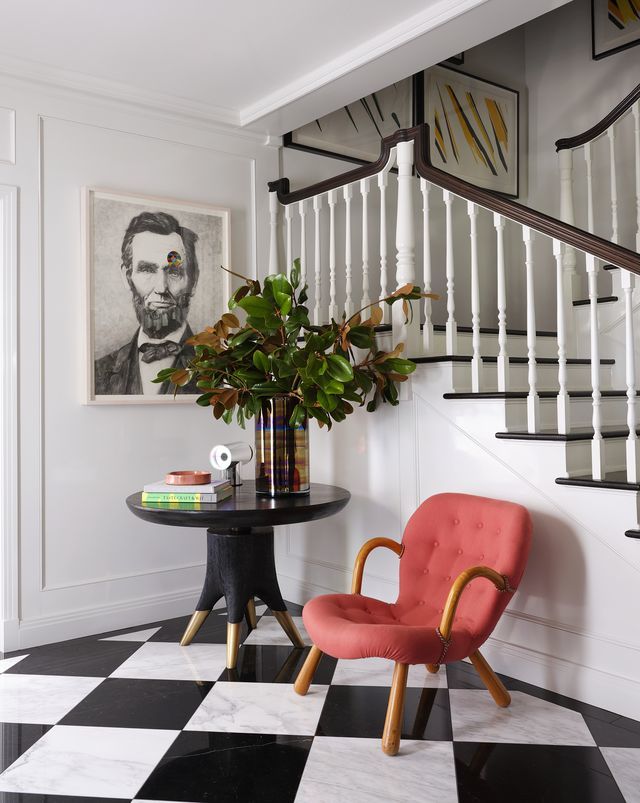
Designer Oliver M. Furth mixed modern and contemporary pieces in the entry hall, including the vintage Philip Arctander Clam chair from J.F. Chen, a BCW Adjustable Mushroom table from Blackman Cruz, and artwork such as Mark Reigelman’s My American Cousin.


Furth began with a nod to old Hollywood by laying the Carrara and Nero Marquina marble checkerboard flooring, which extends throughout much of the main level. The staircase—one of the home’s original elements—was given more prominence when Furth chose to ebonize the steps, adding to the graphic quality of the space. “We uncovered the balustrade and banister, which were both original, then custom-built all the paneling on the walls to highlight staircase,” he says.

Sitting Room
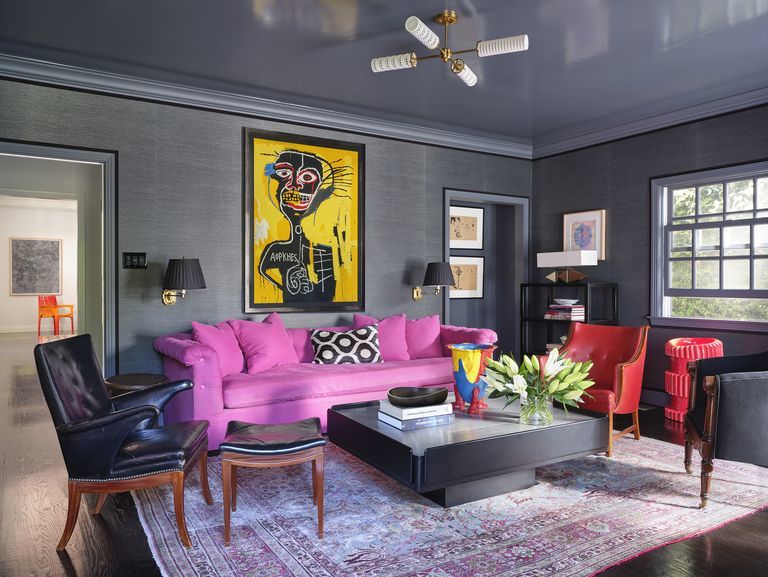
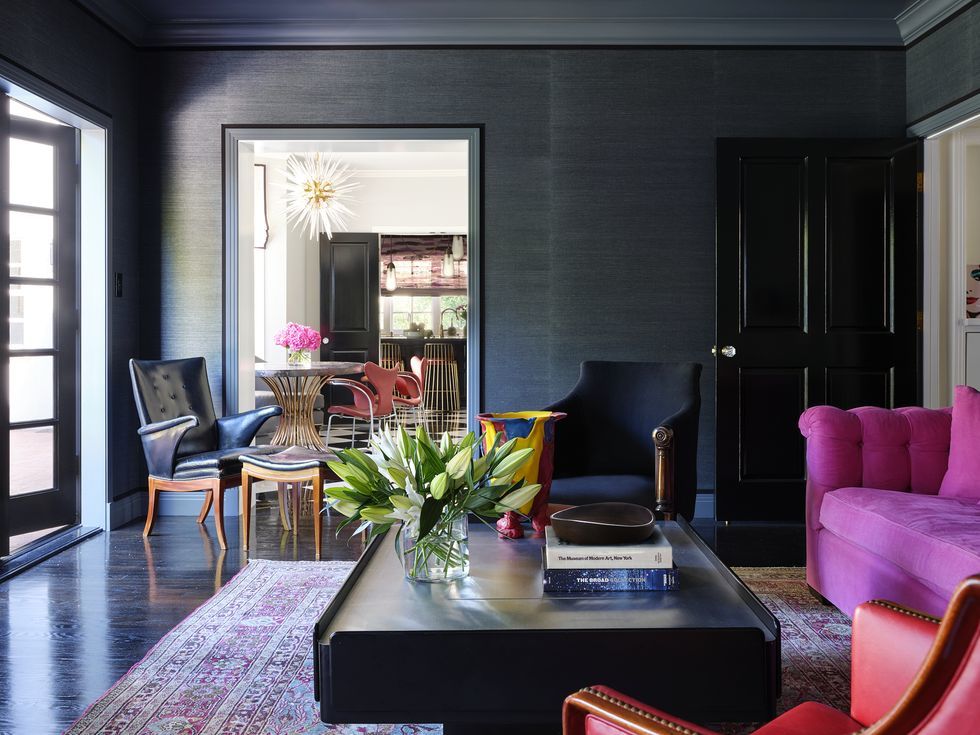
Furth selected several antique Fritz Henningsen pieces, including a black chair and ottoman and a red leather chair (circa 1930), along with an antique William IV mahogany and leather chair, all from J.F. Chen. He also sourced a vintage Vico Magistretti chrome-and-ebonized cocktail table to anchor the space.


Playing with contrasts of color and textures, Furth created the ultimate lounge space worthy of a Fifth Avenue penthouse. “I gave the walls this beautiful Manila Hemp grass cloth from Phillip Jeffries—with its ‘Triscuit’ texture—and set it off by lacquering the ceiling in Pratt & Lambert’s high-gloss lacquer in Gun Powder.” He then juxtaposed the custom upholstered “lipstick pink” Romo Linara linen sofa against the antique Mashad rug to accentuate the New York vibe the homeowners wanted.

The homeowner’s collection of objects and artwork—including a Jean-Michel Basquiat Cabeza screen print—creates the final, personal layer. “The ceramic Love light fixture by Ryan Mennealy was a gift from the husband to his wife—the cutouts are made up of dots and dashes that spell the word love in Morse code,” Furth says.

Kitchen
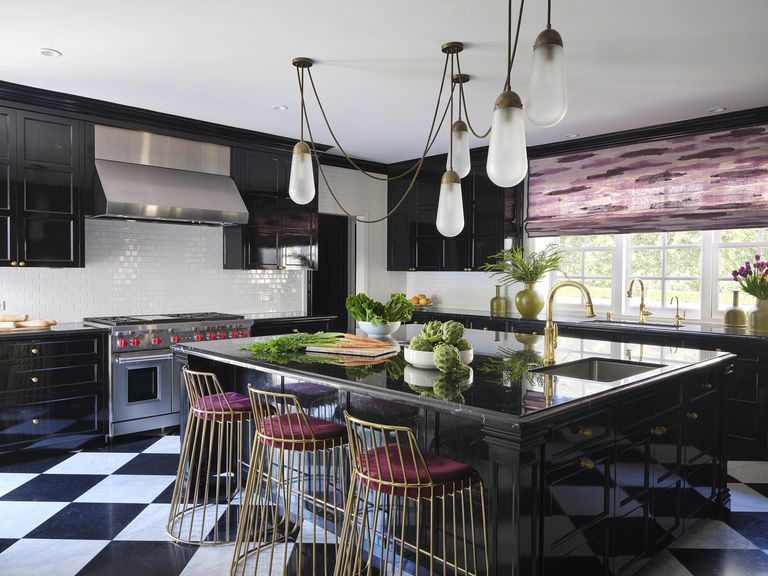
With its enlarged footprint, the kitchen is a favorite spot for the family to come together. The checkerboard floor is a perfect complement to the custom cabinets in Benjamin Moore’s Black Satin high gloss and the white subway tiles. The hand-painted Roman shade is from Porter Teleo, the seats are vintage Bride’s Veil counter stools from Galerie Twentieth, the Lariat pendant is from Apparatus, and the appliances are Wolf.


What was originally five rooms and a service staircase is now a place where the family can hang out and entertain. “The existing country-style kitchen had been redone in the ’80s, complete with hand-painted tiles depicting farm animals,” Furth adds with a laugh. “It was the joke of the project because it’s definitely not a country house.”

The designer extended the marble checkerboard flooring into the space and clad the walls in white subway tile. “Thanks to Oliver, our kitchen is the hub of our home and also the sexiest and chicest room,” the homeowners say. “Not a person comes into our home who doesn’t comment on it—it’s not often you see a black lacquer kitchen, especially in L.A.”

Breakfast Nook
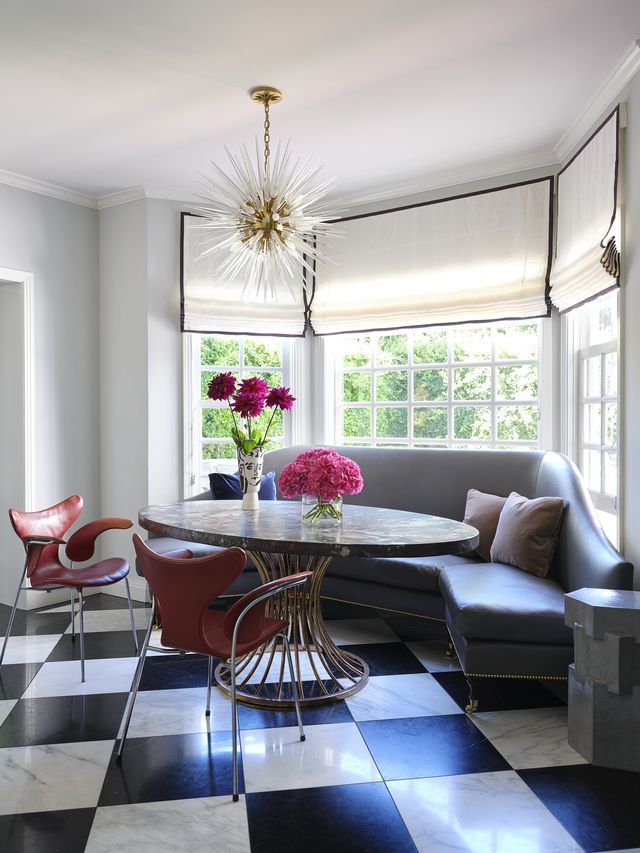
Arne Jacobsen Lily armchairs from the 1970s add a pop of color. A Quincy chandelier from Circa Lighting hangs overhead, and the custom shades were designed with World Linen fabric and Samuel & Sons grosgrain trim. The Devil Head vase by Luke Edward Hall was acquired from the Future Perfect.


“This is a casual place for the family to gather,” Furth says of this light-filled breakfast area. “There’s a big banquette to hangout on, a bulletproof concrete table, a television—so between kids, dogs, food, and red wine, everything can happen in here.”

Furth had the vintage table updated with a custom top by Concrete Cat and upholstered the custom banquette with faux leather and had it put on casters. “I always think about what might happen a decade from now, so if you remove the banquette the room could serve an entirely new purpose,” the designer notes.

Dining Room
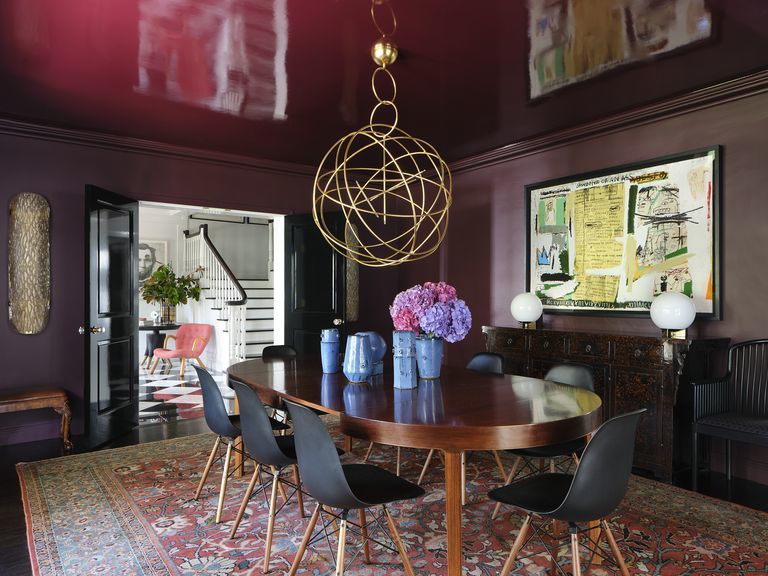
The vintage Ole Wanscher rosewood dining table is from J.F. Chen, and the molded plastic side chairs are from Design Within Reach. The chandelier from Hubert LeHall was one of Furth’s first purchases for the project. An antique Chinese sideboard and Davis Allen for Knoll Exeter spindle chairs add to the room’s glamour. Another of the homeowner’s statement-making Basquiat screen prints is flanked by a pair of contemporary Cross Globe table lamps from CB2.


“It’s pretty glam in here, but it’s a realistic glamour,” Furth says of the home’s dining room. “There’s an antique table and rug, sconces we found in Paris, and an Astrolabe chandelier, but the chairs are Eames—they’re plastic and can take a spill. I didn’t want anything to feel too precious or fussy. We wanted people to feel comfortable, not only physically, but emotionally.” For the wall color he chose Farrow & Ball’s Brinjal and had a matching custom high-gloss lacquer made for the ceiling.

Living Room
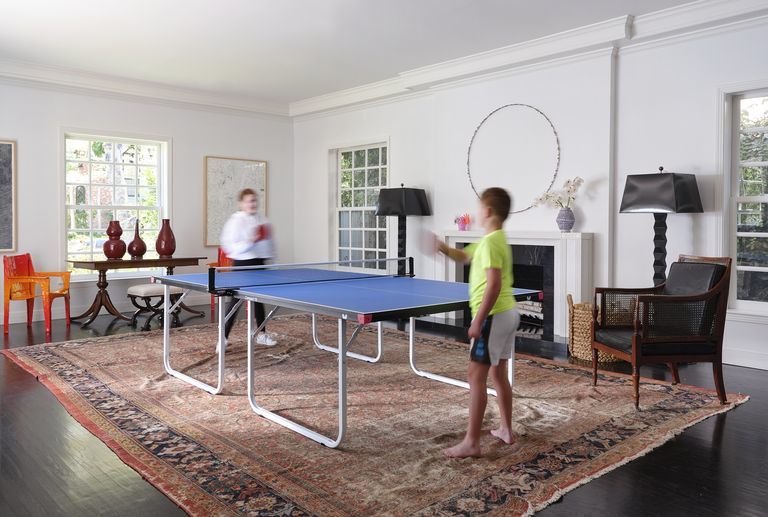
The family’s Ping-Pong table sits atop a vintage Mahal rug from Lawrence of La Brea. Seating includes an antique 19th-century Regency bergère from J.F. Chen and Wonky dining chairs by Matthew Day Jackson from the Future Perfect. Artworks by Mark Fox, Mark Reigelman, and Marilyn Minter are hung throughout.


“This space was heading in one direction—we had plans for beautiful hand-painted silverleaf wallpaper and fancy curtains—but the pandemic was in full swing and we switched gears,” the designer recalls. For this family, the change in direction meant setting up their Ping-Pong table in the center of the room, but the utilitarian room is also perfect for large dinner parties.

In contrast to the some of the more colorful rooms, Furth chose a combination of Farrow & Ball’s All White flat and high gloss for the walls and ceiling. “This room is flooded with light from three different directions all day, so we embraced it,” he says.

Formal Powder Room
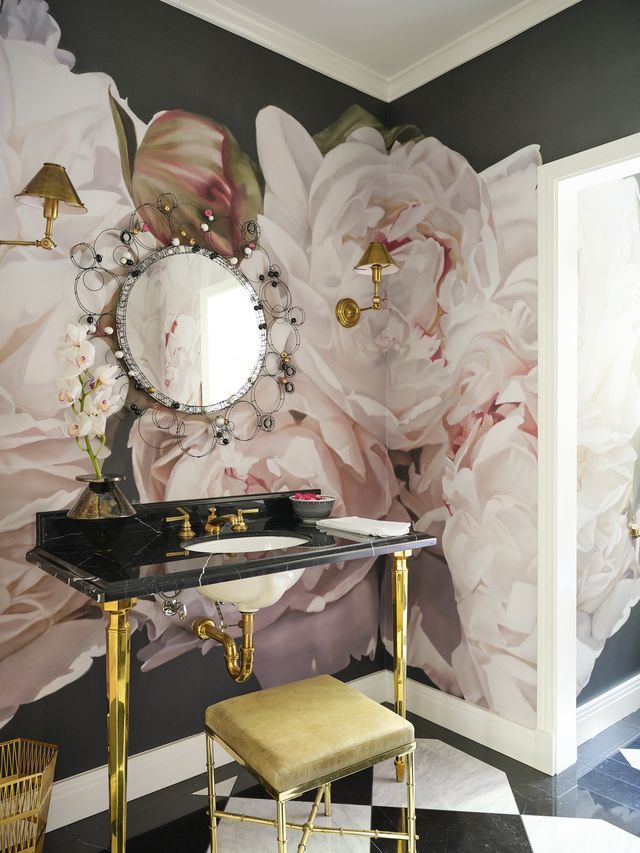
The White Peonies wallpaper is by Design Alliance, the Anette swing-arm sconces are from Circa Lighting, and the antique faux bamboo Italian ottoman is from J.F. Chen.


Furth outfitted this space, which serves as the main powder room for guests, with gilt brass and gold fixtures and accessories in homage to 1930s glamour. “The client’s favorite flowers are peonies, so we blew up this pattern,” he says of the dramatic wallcovering. The custom circular wire mirror, with handmade ceramic beads by Marie Christophe, was commissioned by the husband as a gift for his wife.

Primary Bathroom

A paneled tub from Carter Hardware creates a spa-like elegance in the space. The Ann Sacks marble herringbone tile floor is the perfect contrast to the cabinetry painted in Pratt & Lambert’s Gun Powder. Next to the tub is a Double Tier Cloud side table handmade in Los Angeles from B Zippy.


“This was another little warren of rooms that we busted open to put a tub right in the center,” the designer says of his client’s dream bathroom. “There’s a tight language to this home that’s repeated throughout, with all the marble, shiny lacquered cabinets and walls, the very clean ivory linen window shades, and gilt brass and gold fixtures.”

See More of This Sophisticated Beverly Hills Home
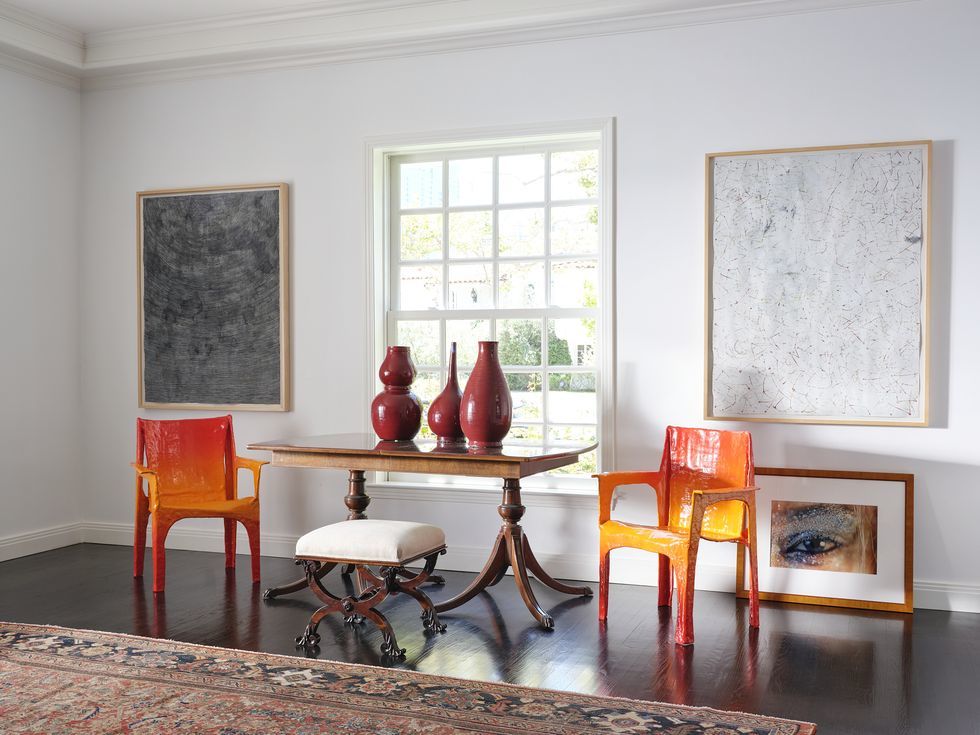
Living Room : In addition to the Ping-Pong table, two orange chairs by multidisciplinary artist Matthew Day Jackson bring another moment of levity to the living room. The English table and stool are both antiques, as is the carpet. The two artworks on the wall are by Mark Fox, while the photograph on the floor is by Marilyn Minter.
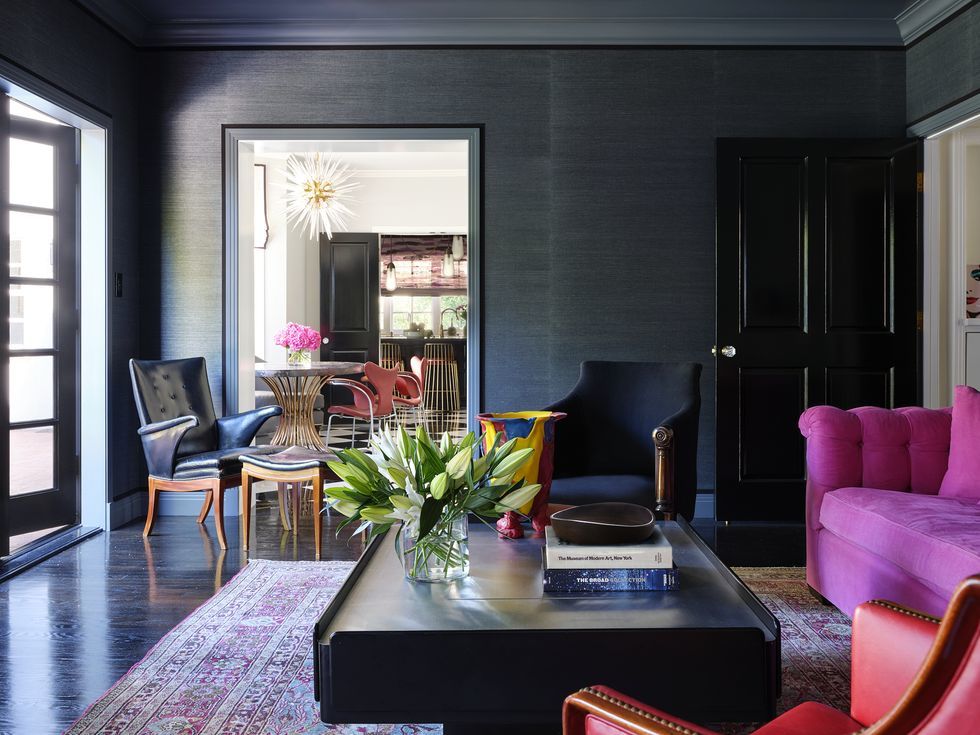

Sitting Room : This room exudes the New York atmosphere the clients sought. Furth selected several antique Fritz Henningsen pieces, including a black chair and ottoman and a red leather chair (circa 1930), along with an antique William IV mahogany and leather chair, all from J.F. Chen. He also sourced a vintage Vico Magistretti chrome-and-ebonized cocktail table to anchor the space.


Kitchen : With its enlarged footprint, the kitchen is a favorite spot for the family to come together. The checkerboard floor is a perfect complement to the custom cabinets and the white subway tiles from Daltile.
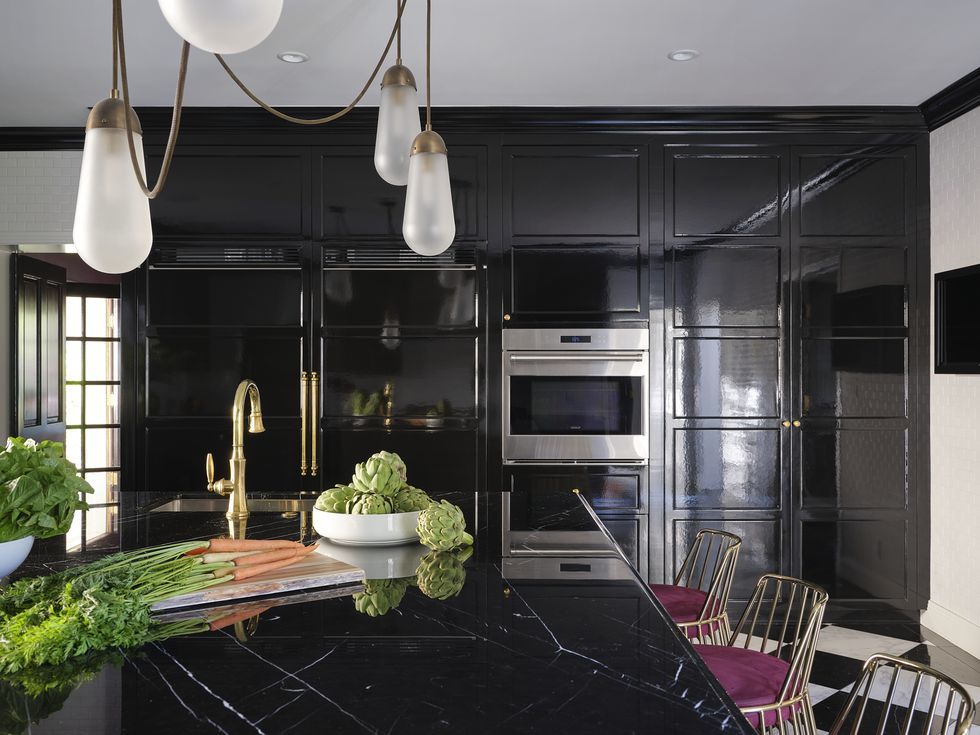

Kitchen : The custom cabinets are in Benjamin Moore’s Black Satin high gloss. The seats are vintage Bride’s Veil counter stools from Galerie Twentieth, the Lariat pendant is from Apparatus, and the appliances are by Wolf.


Secondary Powder Room : Adjacent to the kitchen, the half-bath is a seamless extension of the larger room’s design. “As a variation of the black-and-white marble flooring, we did stripes in here,” Furth says. The Carrara and Nero Marquina rectangular tiles are from Walker Zanger, and the cabinetry is painted in the same Benjamin Moore Black Satin high gloss found in the kitchen. Illuminating the space are Mercer wall sconces from Circa Lighting.


Stairwell : An Agnes 10-Bulb Chandelier from Lindsey Adelman is as much a work of art as the homeowner’s 19th-century Japanese woodblock prints that Furth had framed to line the walls. The white paint throughout is a combination of All White High Gloss and Flat #2005 from Farrow & Ball.

The July launch links credit-card spending and rewards to Kimi memberships and AI computing benefits, although some claims about conversational banking functions go beyond what the companies’ official materials currently confirm.
Chinese artificial-intelligence company Moonshot AI has launched a Kimi-branded credit card with Agricultural Bank of China and American Express, bringing AI subscriptions and computing-related rewards directly into a mainstream banking product.

The card became available in mainland China on July 10, 2026, after opening for reservations in June.

Kimi and some reports have described it as the world’s first “AI-native” credit card, although that designation is a marketing description rather than an independently established industry category.

:contentReference[oaicite:0]{index=0}

The most significant verified feature is not that artificial intelligence replaces the bank’s conventional credit-card infrastructure.

Instead, Kimi services are built into the card’s membership and rewards proposition.

Kimi’s own explanation says an AI-native credit card embeds Kimi membership, credits and related benefits into card opening and points-based spending, while also offering AI-oriented activities such as prompt courses and sharing sessions.

Agricultural Bank of China remains responsible for the credit-card account and associated banking functions.

:contentReference[oaicite:1]{index=1}

The card is offered in standard and premium platinum versions tied to different Kimi membership levels.

Published product information says the standard card corresponds to Kimi’s Andante membership tier and carries a main-card annual fee of 580 yuan, with the first year waived and subsequent annual fees waived after ten qualifying transactions.

The premium platinum version corresponds to the higher Allegretto tier and carries an annual fee of 880 yuan, which can be offset with 200,000 qualifying points.

Cardholders can obtain Kimi-related benefits including memberships and access to AI resources such as Agent and Kimi Code usage, alongside opportunities connected to new Kimi models.

:contentReference[oaicite:2]{index=2}

Agricultural Bank of China is also using introductory incentives to attract customers.

During a campaign running from July 10 through September 30, first-time applicants for the premium platinum card who spend at least 5,888 yuan within the qualifying period can receive a Kimi-branded NFC accessory and two monthly Allegretto memberships.

A separate promotion for eligible new Agricultural Bank of China credit-card customers offers Kimi-related rewards after three purchases of at least 18 yuan each.

The card is currently available only in mainland China.

:contentReference[oaicite:3]{index=3}

Some descriptions of the product have gone considerably further, portraying the card as a conversational financial assistant capable of examining transaction histories, answering natural-language questions about spending, planning repayments, blocking purchases when budgets are exceeded and identifying suspicious transactions before authorization.

Those functions have appeared in secondary coverage of the launch.

However, the official Kimi and Agricultural Bank of China materials reviewed for the product do not clearly establish that these capabilities are currently integrated into the live credit-card account.

The verified launch is therefore better understood as a credit card deeply tied to Kimi’s AI ecosystem and digital benefits rather than, on the available evidence, an autonomous AI system managing a customer’s credit account.

:contentReference[oaicite:4]{index=4}

The distinction matters because it changes the privacy implications.

A card that merely awards AI subscriptions or computing credits creates a different data relationship from one that gives a large language model direct access to a customer’s full transaction history, credit profile and repayment behavior.

Official campaign terms show that some personal information is shared where necessary to deliver Kimi memberships and promotional rewards, but they do not establish that Moonshot AI routinely receives complete card transaction histories for conversational analysis.

Claims about AI-driven lending decisions, personalized credit scoring or continuous surveillance of cardholder spending therefore remain unconfirmed for this product.

:contentReference[oaicite:5]{index=5}

The launch nevertheless reflects a broader shift in China’s financial sector.

Several Chinese banks have recently introduced cards or banking products that exchange ordinary spending activity for access to AI models, cloud-computing resources or tokens.

China Merchants Bank, Ping An Bank, Shanghai Pudong Development Bank and MYbank have all been associated with similar initiatives involving technology companies or cloud providers.

The emerging competition is aimed particularly at developers, technology workers and heavy users of generative AI, turning computing resources into a new category of credit-card reward.

:contentReference[oaicite:6]{index=6}

For Moonshot AI, the card gives Kimi another distribution channel beyond conventional AI subscriptions.

For Agricultural Bank of China, it offers a way to attract technology-oriented customers in a Chinese credit-card market that has been contracting.

American Express contributes the card-network component to the three-party product.

The experiment could become more consequential if future versions connect conversational AI securely to banking data and account controls.

For now, however, the clearest innovation is more modest and more concrete: spending on a conventional bank-issued credit card can generate benefits that consumers use inside an AI platform.

The next test will be whether that model appeals beyond developers and intensive AI users strongly enough to become a lasting category of financial product rather than a specialized co-branded rewards card.
New cultural directives and security measures targeting minority communities in Indonesia have drawn criticism from international rights groups, while the developments are raising concerns among multinational companies about the country’s social environment.
Malaysia is seeking diplomatic solutions after a change in British regulations disrupted practice pathways for Malaysian medical students studying at international campuses, raising concerns over the country’s investment in overseas medical education and its future healthcare workforce.
Prime Minister Anwar Ibrahim has defended the government’s economic reform agenda during a parliamentary dispute over management of the Tabung Haji pilgrimage fund, as opposition tensions expose divisions over strategic state investment.
Manufacturers across Southeast Asia are preparing for possible changes in US bilateral trade policy that could redirect more Chinese industrial goods into regional markets while encouraging companies to shift investment toward ASEAN production bases.
Thailand’s tourism authorities are shifting greater attention toward high-spending and long-stay international visitors as localised tensions along the Cambodian border complicate some cross-border tourism flows.
Thailand plans to use the influx of international delegates for the World Bank meetings to promote geographical indication products, premium jasmine rice, and heritage textiles, combining economic diplomacy with cultural promotion.
Merck is upgrading its Singapore operations with an advanced biosafety testing laboratory, strengthening the city-state’s role as a regional research and biomanufacturing centre serving healthcare and biotechnology markets across Asia-Pacific.
The use of an artificial intelligence-generated video in Singapore’s national day celebrations has prompted debate over human filmmaking, intellectual property, and the role of AI in the city-state’s creative economy.
Vietnamese automaker VinFast is rapidly adding authorised dealerships and service centres across Indonesia, intensifying competition with established Japanese manufacturers and Chinese electric vehicle brands in one of Southeast Asia’s largest markets.
Vietnam is preparing new tax incentives for high-tech foreign manufacturers that maintain at least thirty percent domestic equity and transfer core technologies to local partners as the government seeks to move higher up the manufacturing value chain.
Vietnamese satellite startup VinSpace has secured a dedicated launch arrangement with SpaceX as Hanoi seeks to strengthen its domestic space industry and expand its role in regional satellite communications.
Singapore is accelerating agreements to import renewable electricity from neighboring ASEAN countries as rapidly expanding data centers and artificial intelligence infrastructure increase energy demand and put pressure on the city-state’s carbon reduction goals.
Severe monsoon rains have displaced more than five hundred thousand people across Manila and thirty-three provinces, prompting the Philippine government to redirect funding from its Build Better More infrastructure programme toward disaster recovery and economic support.
US defense officials have called for greater domestic defense spending during high-level consultations with the Philippines, signalling a more pragmatic approach to regional security partnerships as maritime tensions rise in the South China Sea.
Thailand’s Finance Ministry says timely approval of the national budget will allow funding for major infrastructure projects to continue without interruption, supporting public investment and development across the Eastern Economic Corridor.
Southeast Asian economic ministers are advancing plans for digital payments, cross-border data flows, and more unified supply-chain rules as the region seeks greater economic resilience amid rising global trade tensions and tariff risks.
Bangkok is preparing to host more than fifteen thousand delegates for the October IMF and World Bank annual meetings while promoting the Bangkok Blueprint, a policy framework focused on digital public infrastructure and climate finance.
DHL Express has introduced a daily Boeing 767 freighter service linking Shanghai directly with Bangkok as cross-border trade and manufacturing activity between China, Thailand, and mainland Southeast Asia continues to expand.
Foreign investment in Thailand reached one hundred eighty-seven billion baht in the first half of the year, prompting the Finance Ministry to raise its growth outlook as advanced technology and manufacturing projects benefit from the Thailand FastPass investment scheme.
Deputy Prime Minister Sihasak Phuangketkeow has travelled to Moscow to finalise a new strategic consultation plan and expand trade with Eurasia, reinforcing Thailand’s effort to maintain active neutrality while deepening ties with major global powers.
The Republic of Singapore Air Force has carried out a helicopter medical evacuation of an ill crew member from a commercial vessel, highlighting Singapore’s role in maritime emergency response along some of the world’s busiest shipping routes.
The ASEAN Secretariat has launched a regional workshop aimed at accelerating the clearance of legacy landmines and unexploded ordnance in affected member states, with the goal of making land available for agriculture and infrastructure development.
Singaporean health and technology experts are advocating regulations that would require social media companies to modify how algorithms deliver content to young users, moving beyond simple limits on overall screen time.
Search and rescue operations in Baguio City following deadly monsoon-triggered landslides have renewed calls for stronger infrastructure and more comprehensive geological risk assessments as the Philippines prepares for increasingly challenging annual monsoon seasons.
Indonesian authorities have raised coastal flooding alerts across six districts in Bali as extreme weather and rising sea levels increase risks to tourism infrastructure and property in one of Southeast Asia’s most important destinations.
ASEAN Secretary-General Kao Kim Hourn has held talks with European diplomatic officials in Jakarta on maintaining economic links and regulatory cooperation between Southeast Asia and the European Union as trade disputes and geopolitical tensions disrupt global supply chains.
Southeast Asian diplomats have reaffirmed the ASEAN Five-Point Consensus as the bloc’s framework for addressing the Myanmar crisis, including efforts to manage refugee movements and limit wider regional instability.
Thai tourism and finance authorities are finalizing a fee for international visitors that would help fund tourism infrastructure while also supporting domestic travel subsidies designed to spread tourism spending beyond major metropolitan areas.
Indonesia has nominated Senior Deputy Governor Destry Damayanti as the sole candidate for a leadership role at the central bank, offering policy continuity as investors monitor the rupiah and the country’s monetary policy.
An Israeli software security company has secured sixty million dollars in funding to establish operations in Singapore, targeting cybersecurity risks associated with the expansion of artificial intelligence systems and corporate cloud infrastructure across Southeast Asia.
Singapore’s tax authorities have recovered a twenty-four percent capital gains tax from a foreign holding company after determining that the entity lacked genuine commercial purpose in the Southeast Asian market, signaling closer scrutiny of cross-border corporate structures.
Vietnamese electric mobility operators are developing a high-speed charging network in Indonesia’s capital, seeking to expand across Southeast Asia’s largest consumer market as the region moves toward wider adoption of electric vehicles.
Malaysia’s leadership is urging faster progress on intra-regional trade agreements and more unified economic policies as the country prepares for its upcoming regional chairmanship and seeks to capitalize on Southeast Asia’s growing middle class and working-age population.
Thailand’s business and industry groups are calling for stricter local-content requirements in foreign electric vehicle projects so that domestic manufacturers capture a larger share of the value created by the sector’s rapid expansion.
Chinese technology and manufacturing companies are shifting away from traditional direct-distribution models toward deeper local operations in Singapore, Thailand and Vietnam as governments tighten digital tax verification, labor protections and customs enforcement.
Thailand’s Cabinet has activated new regulations intended to streamline the deportation of foreign nationals who violate immigration laws or unauthorized business rules, as the government seeks to strengthen border enforcement while managing diplomatic concerns over undocumented migration.
South Korea’s Hanwha Group has made a one point two billion dollar bid for shipbuilder Austal, a move that could expand South Korean involvement in naval manufacturing and defense supply chains across Southeast Asia and the wider Indo-Pacific.
Indonesia has started domestic construction of advanced attack submarines under a technology transfer agreement, marking a significant step in the country’s naval modernization as Jakarta strengthens its ability to secure its extensive maritime territory.
Thailand’s Board of Investment has approved nearly two hundred electric vehicle projects covering batteries, intelligent software and charging networks, strengthening the country’s position as a major Southeast Asian hub for next-generation automotive manufacturing.
Thailand’s Joint Standing Committee on Commerce, Industry and Banking has raised its annual export growth forecast to ten percent, citing a surge in advanced technology shipments that now account for more than a quarter of export value as global demand for artificial intelligence products grows.
Mangosteen growers in Thailand’s southern border provinces are benefiting from the highest prices in two decades, driven by strong regional demand for premium fruit and improved export quality.
Torrential monsoon rains have triggered severe landslides in northern Philippine provinces including Baguio City, killing at least 12 people and disrupting agricultural supply chains and critical infrastructure as military and rescue teams respond.
Wildfires have burned more than 550 hectares of vegetation in Indonesia’s Mount Bromo national park, prompting authorities to close the popular tourist destination indefinitely as emergency crews battle the expanding fires.
Five Thai ministries have introduced nationwide school security and mental health measures following a shooting in Nonthaburi province that killed nine people, including stronger anti-bullying policies and wider use of the HERO OBEC Care psychological support system.
Malaysia is advancing a regional strategy focused on digital trade and supply-chain integration as it prepares to chair ASEAN, with the government seeking to develop the 10-member bloc into the world’s fourth-largest economy by 2030.
Thailand’s PTT Global Chemical posted a net profit of 12.2 billion baht for the second quarter of 2026, marking a sharp turnaround from the previous year and pointing to resilient industrial demand despite broader global economic pressures.
Indonesia is maintaining existing automotive policies rather than adding new hybrid subsidies, a decision aimed at protecting current manufacturing investments as hybrid vehicle sales expand rapidly in the domestic market.
China’s Kimi Launches AI-Focused Credit Card With Agricultural Bank of China and American Express
Success: Nvidia Turned Gaming Chips Into the Engine of the AI Boom
AI’s Next Bottleneck Is Power, Not Just Nvidia Chips
Meta Raises AI Spending Target to as Much as $145bn Despite Pressure Over Returns
Joe Biden’s Cancer Has Spread Beyond His Bones, Hunter Biden Says
Why 2027 Could Be a Strong Year for Stocks—and Why the Forecast Is Fragile
Why Markets May Look Quiet in August After Big Tech Earnings
UFO: Pentagon Releases Video of Unidentified Object Tracked Over Middle East
Ukraine Tells Senate Republicans Its Drone War Offers a Blueprint for America
Weight-Loss Drug Boom Tests the Limits of Prescription Advertising Rules
Taiwan’s President Joins Wartime Command Drill as China Pressure Grows
Lightning Strike Kills Yala FC Player During Match in Southern Thailand
AI Is Remaking the US Economy, From GDP Growth to iPhone Prices
Indonesia’s Free School Meals Plan Has Been Hit by Poisoning, Corruption and Cuts
US and Japan Step In to Support the Yen in Rare Joint Intervention
FIFA’s Retreat Leaves a Larger Question Over Who Guards the Game
Valued at $109 Million: F-35B Fighter Jet Crashes in Southern California
US Says It Has Carried Out Heavy Strikes on Iran After Attempted Attacks on Its Forces
Over 24 Hours in the Air: Qantas Airbus Completes Record-Breaking Test Flight
Nvidia Reportedly Takes Vast Texas Data-Centre Lease to Underwrite AI Expansion
FIFA’s Private-Investment Plan for World Cup Rights Draws European Revolt
Following OpenAI's Cyberattack: 'Most Companies Still Do Not Understand What Is Coming'
OpenAI Sued After ChatGPT Allegedly Discouraged Emergency Care Before Near-Fatal Embolism
Miliband Sets Climate and International Law at Centre of UK Diplomacy
Trump Readies New Tariffs as Temporary Global Levy Nears Expiry
EU Imposes Record €550 Million Digital Services Fine on AliExpress
Between Deliveries, Wang Jibing Wrote His Way to China’s Literary Heights
Morgan Stanley Builds a Wall Street Lead in AI Infrastructure Finance
High Prices Push Coffee Drinkers Toward Whole Beans and Home Brewing
Trump Draws Boos and Podium Scrutiny at Spain’s World Cup Triumph
Spain Defeats Argentina in Extra Time to Win Second World Cup
Police Block Cockroach Janta Party’s March to Parliament as Education Protests Intensify
Singapore Considers Lower Taxes for Fund Managers as Hong Kong Intensifies Talent Contest
Proposed U.S.-Saudi Nuclear Pact Could Permit Limited Uranium Enrichment Under International Safeguards
Why Kentucky Fried Chicken Became KFC—and Why the False Explanations Persist
Ukrainian Drones Strike Wildberries Warehouses Deep Inside Russia
Reported CIA Mission Helped Clear the UAE’s Path to Advanced US AI Chips
Artificial Intelligence Capital Fuels Markets While Governments and Regulators Face Mounting Strategic Tests
China’s Moonshot’s Kimi K3 Narrows the Gap With Anthropic Through Scale, Openness and Lower Cost
Gold and Cash Seizure Puts Indonesia’s Senior Anti-Corruption Prosecutor Under Investigation
The Ledger Will Not Trust on Faith
Ukraine’s Leadership Rift Spills Into the Streets as Protesters Target Army Chief
The Ten World Cup Finals That Defined Football History
Smartphones Are Getting More Expensive, Sales Are Collapsing, and Even Apple Admits: "Prices Will Rise"
Leadership Change and Strategic Rivalry Redraw the Political Map
The AI Race Enters Its Infrastructure Era
Britain Nationalises British Steel to Protect Scunthorpe Production and Strategic Supply
French National Assembly Overrides Senate to Pass Historic Assisted-Dying Legislation
Thomas Tuchel Faces Fierce Backlash After Tactical Retreat Costs England World Cup Final Berth
A Quiet Bastille Day: France Grapples with World Cup Heartbreak and Leftover Fireworks