Chancellor Rishi Sunak has set out a £1bn fund to help businesses hit by the rise in Covid cases, including the leisure and hospitality sector.

Hospitality businesses like pubs and restaurants will be able to apply for cash grants of up to £6,000 per premises.

The government would also help some firms with the cost of sick pay for Covid-related absences, Mr Sunak said.

And he announced an extra £30m to help theatres and museums.

Many hospitality and leisure firms have been hit by a collapse in bookings and reduced footfall due to people's fears over the spread of the Omicron variant.

Mr Sunak said the new support was "generous" and recognised the situation facing businesses in the run-up to Christmas.

Some industry figures have welcomed what they described as "unprecedented" support, but others said the measures do not go far enough.

Businesses other than hospitality and leisure can apply for some of the funding.

However, the chancellor would not be drawn on whether more help would come should further restrictions be announced, as ministers come under pressure to tackle the rapid rise of Omicron.

Tough new rules have been brought in in Scotland, with a limit on the number of people allowed to attend large events and Edinburgh's Hogmanay street party being cancelled.

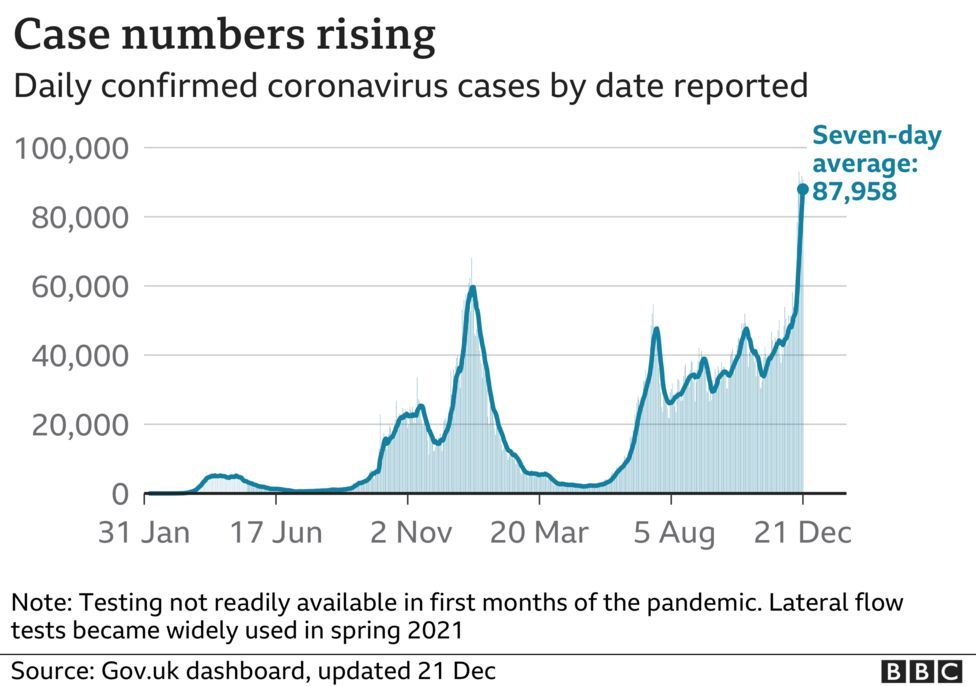
Another 90,629 new Covid cases were reported across the UK on Tuesday - slightly down on the all-time highs announced last week.

The announcement on Tuesday means:

*  Restaurants, bars, cinemas and theatres can apply for a grant of up to £6,000 for each of their premises. The Treasury is setting aside £683m for these grants and it will be provided under existing council-run schemes

*  Other struggling businesses outside leisure and hospitality can apply to local councils for a different grant under the Additional Restrictions Grant, which has been topped up with £102m

*  The Statutory Sick Pay Rebate Scheme is being reintroduced, meaning business with fewer than 250 employees can claim money to cover sick pay for employees who are affected by Covid

*  An extra £30m for arts organisations through the existing Culture Recovery Fund.

Asked if more support would be offered, the chancellor said he would "always respond proportionately and appropriately to the situation we face".

But he added that he thought the new measures announced were comparable to the grants that were on offer when businesses were fully closed earlier this year.

The UK's devolved administrations are also receiving £154m of funding to cover all three schemes, with around £80m for Scotland, £50m for Wales and £25m for Northern Ireland. This money is part of a fund announced earlier this week.

Challenged on whether he could rule out any more restrictions before the new year, Mr Sunak said he understood people's frustrations but the UK faced a very uncertain situation over Omicron.

He echoed the prime minister's comments on Monday, saying ministers were keeping the situation under review and monitoring the data "day-by-day, hour by hour" but ruling nothing out.

However, Labour's shadow Treasury minister Pat McFadden described Mr Sunak's announcement as "a holding package from a government caught in a holding position".

Mr McFadden said the support was "welcome" but that it should have been announced last week when MPs voted to pass the government's Plan B measures.

Support as good as it gets for now

In the past, government support has been extended when government policy has restricted businesses ability to trade - so this is an important recognition that consumer caution can be almost as damaging as mandatory closure.

The question then is - is this it?

The chancellor said that the government has always responded when necessary but he was also at pains to point out that this level of grant funding was similar in generosity to those given during lockdown.

A hint perhaps that this is as good as it gets - for grant funding at least.

Business groups have welcomed today's move, but are clear that plenty of hardship lies ahead in the next year when business rates bills (albeit discounted) come due and the VAT discount wears off on 1 April.

The British Chambers of Commerce and others would like to see a sector specific furlough scheme if firms are forced to close their doors.

Perhaps most crushing of all for business confidence is the ongoing uncertainty, and with Covid-19 that is something over which the chancellor has little control.

The reaction from businesses has been mixed.

Shevaun Haviland, director general of the British Chambers of Commerce, said the new support would provide "welcome respite" to many firms affected by Covid measures, but warned that more could be needed if restrictions persist or are tightened.

And Kate Nicholls, chief executive of UK Hospitality, welcomed the "unprecedented support" announced by Mr Sunak.

But Michael Kill, chief executive of the Night Time Industries Association, said "mixed" government messaging and further restrictions had had a "catastrophic impact" on nightclubs and other late-night venues over the past two weeks.

He described the chancellor's support package as "far too little" and said it bordered "on the insulting" in the face of failing businesses, lost livelihoods, and a "crippled" industry.

A pub owner from Stoke-on-Trent has said he expects to receive just under £2,700 in support, rather than the headline £6,000 - as the system is based on business rates, so larger chains will be the ones to benefit from the top end of support.

Rob Ledgar told BBC Radio 4's PM programme he was around 40 to 60% down on his normal festive turnover and the funding only represents "about seven to 10 days worth of trade over Christmas".

Meanwhile, other business owners have urged the government to provide certainty about the Covid situation, rather than handouts.

Nathan Godley, from restaurant supply firm Premier Seafoods in Grimsby, Lincolnshire, said that while he did not qualify for or want government support, he wanted certainty so he could plan orders in advance and avoid losing money or stock.
He told BBC Radio 4's World at One there had been a drop in orders from restaurants in the last week as people cancelled bookings and that he would have to make "contingency plans" to preserve and freeze the fish until it could be sold in the new year.

Meanwhile, the UK's devolved nations have already announced extra measures to combat the surge of the Omicron variant:

*  In Scotland, from Boxing Day all outdoor events will be limited to just 500 people and the numbers at indoor events will also be cut to 200 if seated and 100 if standing. The rules will be in place for at least three weeks

*  In Wales, spectators will be banned from all sports events from 26 December, nightclubs will close from 27 December and social distancing will return in shops and workplaces after Christmas

*  In Northern Ireland, there is a limit of 30 on people mixing from different households in homes, face coverings are compulsory in shops and other venues and a Covid passport is needed to enter nightclubs, bars and cinemas

Last week, Mr Johnson advised people to "think carefully before you go" out to socialise. England's chief medical officer Prof Chris Whitty also urged people not to "mix with people you don't have to".


Watch Rishi Sunak discuss the government's stance on any potential Covid restrictions this Christmas


Thailand’s tourism authorities have introduced an international campaign linking traditional textile design with global fashion as the government seeks to expand the country’s cultural profile and creative industries.
Authorities in Quang Tri are investing in deeper fishing ports and stronger storm shelters to protect coastal communities and support Vietnam’s fishing fleet in strategically sensitive waters.
National surveys show improving economic sentiment among Filipinos as targeted subsidies and faster infrastructure spending help offset persistent inflation pressures.
Malaysian legal and trade representatives are intensifying efforts in Europe to defend the country’s sustainable palm oil certification framework as exporters face stricter European Union deforestation requirements.
SingHealth has been designated an anchor centre by the International Atomic Energy Agency, giving Singapore a larger role in training and technology development for nuclear medicine across Southeast Asia.
Singapore’s Ministry of Home Affairs denied international media reports that capital punishment was discussed during a recent visit by Israeli security officials, stressing the government’s control over domestic judicial policy.
Prime Minister Anwar Ibrahim’s government increased the annual sales threshold for mandatory electronic invoicing to 3 million ringgit, giving smaller companies more regulatory breathing room during Malaysia’s digital tax transition.
The value of condominium transfers to foreign buyers in Thailand increased 20% in the second quarter, according to the Real Estate Information Center, reflecting renewed demand from expatriates and overseas investors.
Prime Minister Anutin Charnvirakul directed the State Railway of Thailand to overhaul operations on Bangkok’s Airport Rail Link as authorities seek to protect reliable transport between Suvarnabhumi Airport and the capital.
Indonesia’s disaster authorities are urging maritime operators and coastal residents to keep their distance from Anak Krakatau as sustained seismic activity raises concerns about further volcanic unrest.
Vietnam is stepping up domestic drone manufacturing with plans to integrate artificial intelligence and locally produced semiconductors into unmanned systems for surveillance and emerging logistics applications.
Thai and Malaysian officials agreed to accelerate new border fencing and transport corridors aimed at improving security in southern Thailand while strengthening bilateral trade and supply-chain links.
Singapore has launched a new 200-megawatt capacity allocation for energy-efficient data centres, selectively easing earlier restrictions as it seeks to retain its position as a regional base for global cloud and technology companies.
Telecommunications companies are accelerating new submarine cable links connecting Thailand, Malaysia and Indonesia directly with Western markets as demand grows for more resilient regional digital infrastructure.
Indonesia has welcomed operational support from Malaysia to fight forest fires in Sumatra and Kalimantan as authorities seek to prevent a wider transboundary haze crisis.
Thailand will reduce visa-exempt stays for citizens of 60 countries to 30 days from the temporary 60-day allowance introduced in 2024, tightening immigration oversight while maintaining broad access for international tourists.
The Marcos administration has publicly urged Vice President Sara Duterte to respond to emerging legal cases and impeachment proceedings as the political alliance between the Philippines’ two most powerful families continues to unravel.
Rapid expansion of hyperscale data centres in Thailand, Malaysia, Singapore and Indonesia is expected to lift regional liquefied natural gas demand by 16% over the next decade as power grids seek reliable round-the-clock generation.
Thailand’s Board of Investment approved almost 1 trillion baht in new projects, including a $25 billion infrastructure expansion by TikTok and major data centre investments in the Eastern Economic Corridor.
Vietnam has doubled its land area on Barque Canada Reef and militarized 21 features in the South China Sea as Chinese Coast Guard activity around Scarborough Shoal intensifies, adding to tensions in contested waters.
Businessman Haji Isam is reportedly pursuing a significant holding in coal producer Bayan Resources, pointing to further consolidation of Indonesia’s energy assets among major domestic investors.
Thailand is rolling out new creative and cultural promotion agencies under its “One Family, One Soft Power” initiative, seeking to turn food, entertainment, fashion and local expertise into higher-value international exports.
Prime Minister Lawrence Wong has announced an adjustment to Singapore’s ministerial pay framework, lifting the entry-level benchmark to S$1.8 million a year as the government seeks to remain competitive with private-sector compensation.
Thai transport authorities are speeding terminal and runway upgrades at major airports including Suvarnabhumi and Don Mueang as passenger volumes rise and Bangkok seeks to preserve its role as a leading regional aviation hub.
Thailand is leading Southeast Asia’s tourism recovery as expanded air links and visa-free agreements, particularly with China and India, support renewed growth in hospitality and retail activity.
The Philippines recorded a recovery in merchandise exports during the third quarter, led by stronger demand for electronic components as Manila seeks more semiconductor assembly and testing investment.
Industrial parks across northern and southern Vietnam are operating close to capacity as electronics, textile and metals companies increase investment in alternative manufacturing bases outside mainland China.
Malaysia’s economy expanded by 6% in the second quarter, supported by household consumption and foreign investment in Johor data centres as the country increases its focus on high-technology industries.
Singapore’s family offices and private banks are receiving billions in new regional wealth as political uncertainty in Indonesia and broader Asian market volatility drive capital toward the city-state.
Severe drought and agricultural land clearing have pushed Indonesia’s wildfire carbon emissions to the highest levels globally, raising renewed concerns over transboundary haze affecting Singapore and Malaysia.
Central banks across Southeast Asia are reassessing the scope for monetary easing as higher crude prices risk reviving inflation and adding pressure to currencies including the Indonesian rupiah and Philippine peso.
Hundreds of Indonesian students have fallen ill after eating contaminated food supplied through President Prabowo Subianto’s $45 billion national nutrition programme, raising questions over oversight and implementation.
Myanmar military leader Min Aung Hlaing is pursuing state visits and bilateral ties with neighbouring Thailand and Laos as his government seeks economic links and diplomatic engagement despite continuing ASEAN restrictions following the 2021 coup.
Thailand has temporarily halted 166 data centre applications while authorities develop new standards covering electricity demand, water use, grid stability and clean energy integration for the fast-growing cloud infrastructure sector.
Economic growth across Southeast Asia is being led by technology exporters, with Vietnam and Malaysia expanding by more than 8% and 6% respectively as global manufacturers continue shifting production away from mainland China.
Thailand’s Department of Business Development has launched an inter-agency investigation into suspected nominee structures used by foreign investors to circumvent ownership restrictions in property and industrial assets.
Indonesia’s billionaire Hartono family has shifted more than $1 billion into Singaporean and European entities as investors reassess President Prabowo Subianto’s fiscal policies, sovereign wealth fund changes and cabinet restructuring.
Prime Minister Anwar Ibrahim’s government is considering Huawei Ascend chips for a nearly RM4 billion sovereign artificial intelligence initiative despite US warnings over the Chinese company’s technology.
Prime Minister Paetongtarn Shinawatra has outlined 10 priorities including household debt restructuring, electric vehicle development and major transport projects aimed at strengthening Thailand’s economy and regional logistics role.
Governments across Vietnam, Thailand and Laos are mounting major recovery operations after Typhoon Yagi caused an estimated $1.6 billion in damage in Vietnam, disrupted agricultural supply chains and left millions of children vulnerable across the Mekong region.
Cambodia’s Tourism Ministry and telecom operator Metfone launched a digital marketing campaign using mobile-network infrastructure to attract more international visitors.
Prime Minister Lawrence Wong defended planned increases in public-sector compensation as a way to narrow pay gaps and retain senior government talent amid public scrutiny of political salaries.
Timor-Leste announced measures aimed at attracting foreign investment into sustainable tourism and agriculture as the government seeks to diversify the economy away from heavy reliance on petroleum.
Severe monsoon flooding has temporarily stopped work on the 75%-completed Dawei airport expansion, delaying a project intended to accommodate larger cargo aircraft and support cross-border freight.
Bangkok authorities are piloting reflective roofing and heat shelters in the Phasi Charoen district through a German-funded climate adaptation project aimed at protecting vulnerable communities from extreme heat.
Ho Chi Minh City is linking hospital-based training with community health stations in a pilot programme designed to decentralise care and reduce pressure on metropolitan hospitals.
Heavy rain caused widespread flooding and traffic disruption across Pattaya and Chonburi, putting renewed attention on drainage and water-management capacity ahead of the tourism high season.
Vietnam imported more than $4 billion of meat and fishery products during the first eight months of the year, with Indian suppliers accounting for a large share as consumption outpaces domestic production.
Glacier Collapse, Not Earthquake, Triggered Deadly Nepal-Tibet Flood
Swiss Tourist Sentenced to One Year in Prison for Insulting Bali's Sacred Day of Silence
Father Reprimanded After Leaving Seven-Year-Old Son Alone on Mount Fuji During Summit Climb
Google Launches Pixel 11 With Gemini AI at the Center of Its Hardware Strategy
China’s Kimi Launches AI-Focused Credit Card With Agricultural Bank of China and American Express
Success: Nvidia Turned Gaming Chips Into the Engine of the AI Boom
AI’s Next Bottleneck Is Power, Not Just Nvidia Chips
Meta Raises AI Spending Target to as Much as $145bn Despite Pressure Over Returns
Joe Biden’s Cancer Has Spread Beyond His Bones, Hunter Biden Says
Why 2027 Could Be a Strong Year for Stocks—and Why the Forecast Is Fragile
Why Markets May Look Quiet in August After Big Tech Earnings
UFO: Pentagon Releases Video of Unidentified Object Tracked Over Middle East
Ukraine Tells Senate Republicans Its Drone War Offers a Blueprint for America
Weight-Loss Drug Boom Tests the Limits of Prescription Advertising Rules
Taiwan’s President Joins Wartime Command Drill as China Pressure Grows
Lightning Strike Kills Yala FC Player During Match in Southern Thailand
AI Is Remaking the US Economy, From GDP Growth to iPhone Prices
Indonesia’s Free School Meals Plan Has Been Hit by Poisoning, Corruption and Cuts
US and Japan Step In to Support the Yen in Rare Joint Intervention
FIFA’s Retreat Leaves a Larger Question Over Who Guards the Game
Valued at $109 Million: F-35B Fighter Jet Crashes in Southern California
US Says It Has Carried Out Heavy Strikes on Iran After Attempted Attacks on Its Forces
Over 24 Hours in the Air: Qantas Airbus Completes Record-Breaking Test Flight
Nvidia Reportedly Takes Vast Texas Data-Centre Lease to Underwrite AI Expansion
FIFA’s Private-Investment Plan for World Cup Rights Draws European Revolt
Following OpenAI's Cyberattack: 'Most Companies Still Do Not Understand What Is Coming'
OpenAI Sued After ChatGPT Allegedly Discouraged Emergency Care Before Near-Fatal Embolism
Miliband Sets Climate and International Law at Centre of UK Diplomacy
Trump Readies New Tariffs as Temporary Global Levy Nears Expiry
EU Imposes Record €550 Million Digital Services Fine on AliExpress
Between Deliveries, Wang Jibing Wrote His Way to China’s Literary Heights
Morgan Stanley Builds a Wall Street Lead in AI Infrastructure Finance
High Prices Push Coffee Drinkers Toward Whole Beans and Home Brewing
Trump Draws Boos and Podium Scrutiny at Spain’s World Cup Triumph
Spain Defeats Argentina in Extra Time to Win Second World Cup
Police Block Cockroach Janta Party’s March to Parliament as Education Protests Intensify
Singapore Considers Lower Taxes for Fund Managers as Hong Kong Intensifies Talent Contest
Proposed U.S.-Saudi Nuclear Pact Could Permit Limited Uranium Enrichment Under International Safeguards
Why Kentucky Fried Chicken Became KFC—and Why the False Explanations Persist
Ukrainian Drones Strike Wildberries Warehouses Deep Inside Russia
Reported CIA Mission Helped Clear the UAE’s Path to Advanced US AI Chips
Artificial Intelligence Capital Fuels Markets While Governments and Regulators Face Mounting Strategic Tests
China’s Moonshot’s Kimi K3 Narrows the Gap With Anthropic Through Scale, Openness and Lower Cost
Gold and Cash Seizure Puts Indonesia’s Senior Anti-Corruption Prosecutor Under Investigation
The Ledger Will Not Trust on Faith
Ukraine’s Leadership Rift Spills Into the Streets as Protesters Target Army Chief
The Ten World Cup Finals That Defined Football History
Smartphones Are Getting More Expensive, Sales Are Collapsing, and Even Apple Admits: "Prices Will Rise"
Leadership Change and Strategic Rivalry Redraw the Political Map
The AI Race Enters Its Infrastructure Era