The government needs to "reserve the possibility" of bringing in new Covid rules in England as cases of the Omicron variant surge before Christmas, the prime minister has said.

Boris Johnson did not announce any new measures but said ministers were "looking at all kinds of things".

The PM said the data was being reviewed "hour by hour" and there were still "some things that we need to be clearer about before we decide to go further".

He urged people to exercise caution.

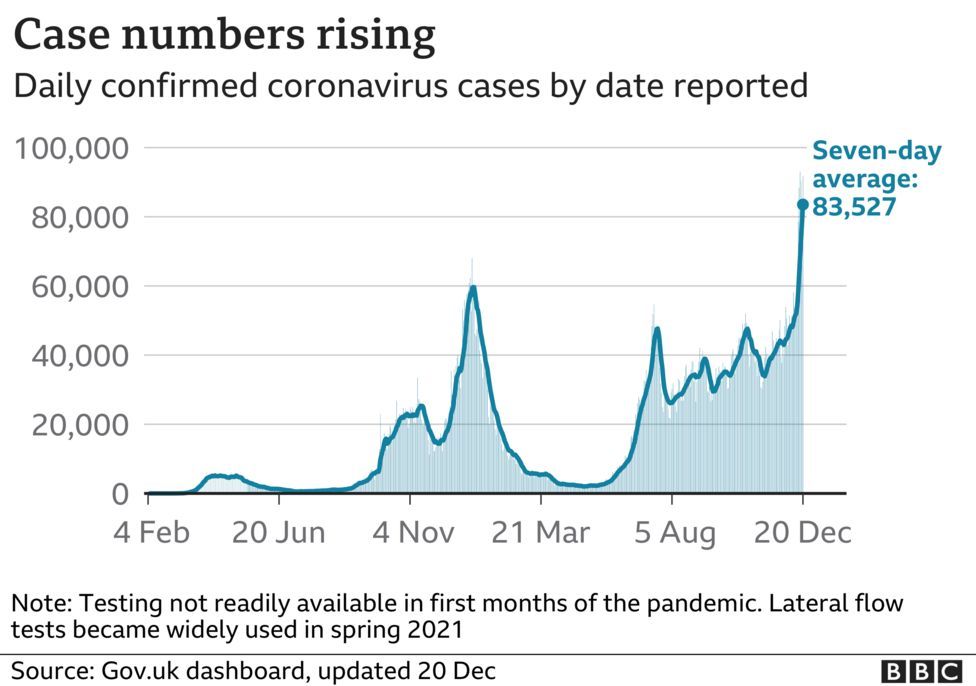
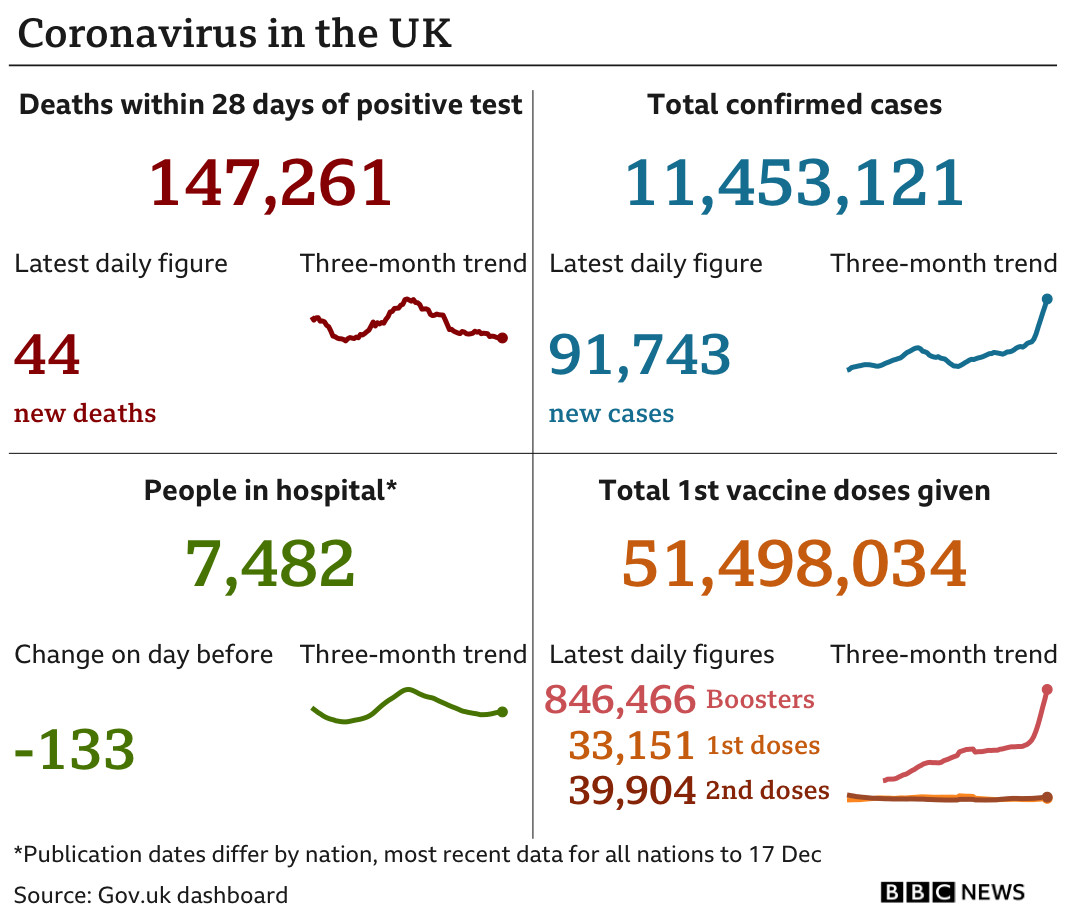
A further 91,743 Covid cases were reported across the UK on Monday, the second highest daily total on record.

The government's scientific advisers say new restrictions may be required very soon - and have suggested reducing the size of groups that can meet and closing venues where there is a high risk of transmission.

But Mr Johnson faces opposition to new restrictions from within his party. Nearly 100 Tory MPs voted against the government's decision to bring in Covid passes last week, while Brexit minister Lord Frost resigned from government at the weekend over "coercive measures" to tackle Covid.

Speaking after a two-hour cabinet meeting, Mr Johnson said the arguments for taking action were "very, very finely balanced".

He added: "Unfortunately I must say to people that we will have to reserve the possibility of taking further action to protect the public, to protect public health, to protect our NHS. And we won't hesitate to take that action."

Asked about the prospect of further restrictions before or after Christmas, Mr Johnson said: "We are looking at all kinds of things to keep Omicron under control and we will rule nothing out.

"But at the moment, what I think we want people to focus on is exercising caution - so ventilation, masks in the appropriate places, all the usual stuff about washing hands, but remember how contagious Omicron really is."

The prime minister said "what really matters is for everybody to get vaccinated and get boosted".

He also acknowledged the impact that recent behavioural changes by some people, such as cancelling bookings, were having on businesses in the hospitality sector, saying the economic impacts would be kept "under constant review".

London Mayor Sadiq Khan urged the government to provide "immediate support" to businesses in the hospitality, retail and culture sector to prevent jobs being lost, saying in a tweet that "time is running out".


Analysis

By Damian Grammaticas, political correspondent

The PM had been urged to give clarity. The nation was waiting to hear if there would be more restrictions coming - and if so, what and when?

Boris Johnson and his cabinet had spent more than two hours deliberating. But what Mr Johnson told us didn't answer those questions.

On how serious things are, he said there were still "uncertainties" and "we should keep the data under review".

On what possible action might come, he said: "We are looking at all kinds of things."

Could it still happen before Christmas? "We will rule nothing out," he replied.

So this was a decision by the PM not to do more right now, despite the fact he said cases were "surging".

Was that because of doubts around the cabinet table? Or because the PM - as he pointed out - believes people are already adapting their behaviour and he wants more time to see if that's enough to control the spread of Omicron?

Perhaps, but it perpetuates the uncertainty. And, as the scientists have said, delay has consequences in itself, because cases continue to rise.

Leaked notes from the Scientific Advisory Group for Emergencies (Sage) suggest that, without intervention beyond current Plan B rules in England, hospital admissions could reach 3,000 a day.

And the BBC has been told that civil servants have produced three options for future Covid measures, ranging in severity from low to medium and high.

Deputy PM Dominic Raab earlier refused to guarantee that no new rules - such as a circuit-breaker lockdown - would be brought in, saying: "We've said we can't make hard, fast guarantees... it depends on the severity of the Omicron cases."

Shadow health secretary Wes Streeting accused Mr Johnson of having "absolutely nothing new to say, no plan whatsoever".

He told Radio 4's PM programme: "Boris Johnson is paralysed by weakness because of fear of his own backbenchers... no-one wants to bite the bullet and level with the public this side of Christmas."

And Liberal Democrat leader Sir Ed Davey criticised Boris Johnson's "indecision", arguing he was providing "more chaos and confusion" at a time people "urgently need clarity and reassurance".

The current rules for England - known as Plan B - include Covid passes for certain events, face masks in more places and people being urged to work from home if they can.

Other nations of the UK have similar rules, though Scotland has gone further by asking people to limit social contact to three households at a time in the run-up to Christmas.

However, First Minister Nicola Sturgeon confirmed on Monday that people in Scotland would not face fresh restrictions on Christmas Day gatherings.

Wales has also ordered nightclubs to close from 27 December.

Matthew Taylor, chief executive of the NHS Confederation, said health experts were not calling for further restrictions as they know they "can be very damaging to people's health and wellbeing", but added officials feel it is "now a question of when rather than if" they will be needed.

He said: "If the Plan B measures and boosters prove not to be enough, [experts] expect the government to respond quickly and pre-emptively in the national interest to the range of advice and modelling it has."

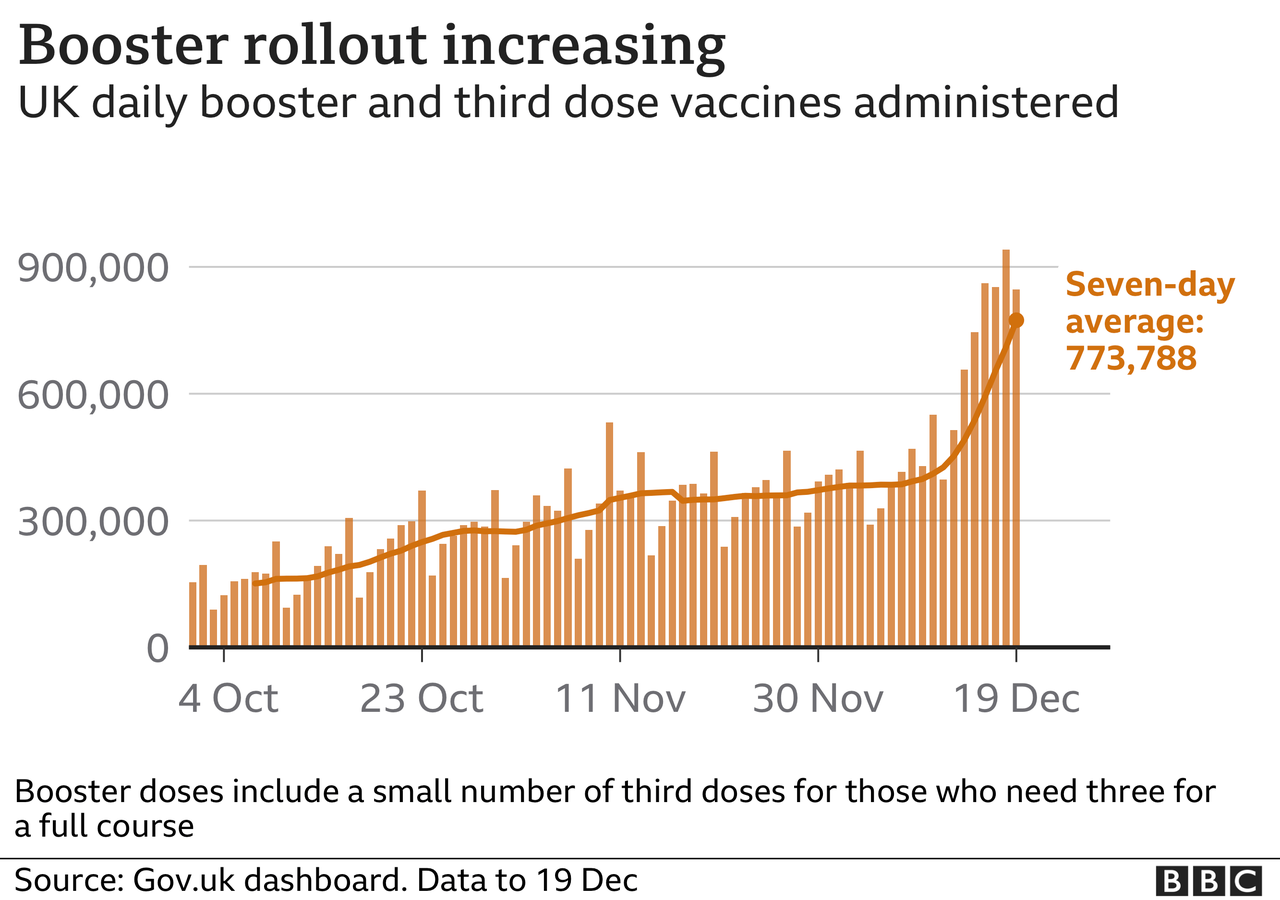
There were 1,024,833 people given a Covid-19 vaccine dose on Saturday - the highest single daily jab figure on record - more than 940,606 of which were booster or third doses.

Vaccinations dropped to 919,521 on Sunday, which is still the fourth highest total on record - beaten only by the number of doses administered on Thursday and Friday.

The news means 50.4% of the UK population - nearly 29 million people - have had a booster dose, with 81.8% having had two jabs and 89.5% one dose.


Boris Johnson: "We will have to reserve the possibility of taking further action to protect the public"

Nicola Sturgeon says she wants "people to have clarity about what we are expecting of them" ahead of Christmas Day


Marina Bay Sands is preparing to host around 29,000 technology executives at a late-September summit focused on cloud infrastructure, cybersecurity, data centers and enterprise artificial intelligence investment.
Thailand’s Eastern Economic Corridor Office has held investment forums with Chinese technology and manufacturing companies from the Yangtze River Delta to attract digital infrastructure and industrial capital into eastern Thailand.
Cambodian Defense Minister Tea Seiha led a military delegation to HMAS Kuttabul in Sydney, reflecting Phnom Penh’s effort to broaden defense relationships beyond its existing ties with China.
NXP Semiconductors is expanding automotive and radar chip design capabilities across Southeast Asia while using European Chips Act support to connect regional engineering talent with European vehicle manufacturers.
Thailand’s ambassador to Cambodia has denied reports that Thai diplomats pressured other countries to limit discussion of the bilateral border dispute at the upcoming Francophonie Summit.
Dutch payments company Adyen reported strong transaction-volume growth among Asia-Pacific enterprise clients as it uses its Singapore headquarters to expand across the region’s increasingly digital payments market.
Bursa Malaysia recorded more than 342,000 new central depository accounts in the first half of the year, driven largely by younger investors and prompting stronger regulatory efforts on financial literacy and fraud prevention.
The Singapore dollar gained against the US currency following a decline in long-term Treasury yields and an expansion of Washington’s bond buyback program.
Benchmark palm oil futures have risen toward 5,000 ringgit per tonne as traders assess the risk of supply disruption from agricultural and peatland fires across Indonesia.
Thai corporate executives and the Bank of Thailand have urged the government to establish a 100 billion baht university innovation fund alongside a five-layer sovereign artificial intelligence strategy.
The Eastern Economic Corridor Office has opened the next phase of consultations for the EECiti project, seeking 72 billion baht in public-private investment for a net-zero smart city and tourism hub in Chon Buri.
Myanmar military leader Min Aung Hlaing is set to visit Phnom Penh for bilateral talks, continuing direct engagement with mainland Southeast Asian governments despite his exclusion from official ASEAN summits.
Philippine Defense Secretary Gilberto Teodoro has warned that Beijing could use reductions in US-South Korean military exercises to expand its strategic presence in the disputed South China Sea.
Thailand’s Interior Ministry has reduced visa-free stays from 60 days to 30 days for passport holders from 93 countries, adjusting the policy as the government balances tourism growth with immigration and security concerns.
Cambodia has approved a $1.22 billion fiscal stabilization program to offset higher fuel costs and global trade volatility after international tourist arrivals fell 46% from a year earlier.
A 25-hour eruption of Anak Krakatau prompted Indonesian aviation authorities to ground flights at Soekarno-Hatta International Airport, stranding an estimated 150,000 passengers and disrupting logistics around the capital.
Monetary Authority of Singapore forecasters have lifted the city-state’s growth estimate to 5%, citing strong capital inflows and rising global spending on artificial intelligence hardware and infrastructure.
Vietnam’s economy grew 8.4% in the second quarter, outperforming expectations as foreign investment, manufacturing and export demand continued to support the country’s rise as an alternative production base to China.
Thailand’s Board of Investment has attracted $30.5 billion in semiconductor packaging, printed circuit boards and artificial intelligence hardware projects since 2023, strengthening the country’s position in Southeast Asia’s advanced manufacturing supply chain.
Large peatland and forest fires in Borneo and Sumatra are worsening air quality across Indonesia, Singapore, Malaysia and the Philippines, forcing school closures and increasing public-health and diplomatic pressures across the region.
Representatives of Singapore and Hong Kong have played down direct rivalry between the two financial centres and called for greater cooperation even as both introduce incentives to attract ultra-high-net-worth family offices.
The US aircraft carrier USS Abraham Lincoln has departed Pattaya after a logistical and diplomatic visit that highlighted defence cooperation between Washington and Bangkok.
Indonesia has begun developing plans for a nationwide battery-recycling system to manage future industrial waste and support more sustainable supply chains in its growing electric-vehicle and critical-minerals industries.
Malaysia is introducing education initiatives and corporate incentives to retain semiconductor specialists as increased foreign investment intensifies demand for engineers in the country’s chip industry.
Singapore authorities have searched the offices of commodities trader Radiant World over allegations involving invalid invoices and false documentation, alongside related investigations by US authorities.
Southeast Asian digital policymakers are considering a regional regulatory framework requiring global technology companies to strengthen protections against digital fraud, harassment and child exploitation.
Vietnamese policymakers are urging domestic manufacturers to adopt artificial intelligence and advanced data systems after exports reached $374 billion in the first eight months of the year.
The Monetary Authority of Singapore has launched a three-year financial technology programme worth $220 million to promote adoption of artificial intelligence, distributed-ledger technology and quantum computing across the financial sector.
China has begun deploying command vessels for the planned opening of the Pinglu Canal, a $10 billion waterway intended to give inland factories a more direct shipping route to markets including Vietnam and Thailand.
PLDT, Globe Telecom and Converge ICT have allocated a combined $2.2 billion for network investment, including underground conduits, the National Fiber Backbone and infrastructure supporting artificial intelligence.
Thai Airways has temporarily halted passenger and cargo services to Jakarta because of hazardous volcanic activity in Indonesia, disrupting a major regional aviation route.
Chinese automaker BYD has opened its first Southeast Asian production facility in West Java, with annual capacity of 150,000 vehicles as Indonesia expands its role in the regional automotive supply chain.
Authorities in Sarawak have closed schools and activated emergency measures after smoke from Indonesian agricultural fires pushed air pollution to hazardous levels and renewed regional tensions over transboundary haze.
Prime Ministers Lawrence Wong and Anutin Charnvirakul concluded their first leaders’ retreat in Bangkok with commitments to deepen cooperation in digital economies, civil-service exchanges and regional supply chains.
China and ASEAN trade officials concluded another round of negotiations focused on reducing non-tariff barriers, expanding digital-economy integration and strengthening critical supply chains.
Thailand has temporarily halted approvals and construction for 166 data centre projects while the government develops rules covering clean-energy use, cybersecurity and economic benefits for the domestic technology sector.
Investment applications in Thailand rose 37% in the first half of the year as capital flowed into digital infrastructure, data centres and advanced manufacturing.
Japan is negotiating transfers of decommissioned naval vessels to the Philippines and Indonesia in an effort to strengthen regional maritime capabilities without requiring explicit alignment against China.
Vietnam has formally objected to Chinese infrastructure development in the disputed Paracel Islands, adding to South China Sea tensions ahead of an upcoming ASEAN summit.
Beijing has indicated it could build permanent facilities at Scarborough Shoal if Manila continues challenging Chinese maritime enforcement, prompting security discussions among the Philippines, the United States and Japan.
PwC estimates that worldwide spending on artificial intelligence data centers could exceed $31 trillion by 2050, with Southeast Asia positioned to capture a substantial share of new infrastructure investment.
The Philippine government plans significant increases in teacher compensation, annual allowances and professional development funding under the proposed 2027 budget as it seeks to strengthen retention in the public education system.
Veteran political activist Sondhi Limthongkul has indicated that he may organize new demonstrations, raising the prospect of renewed street mobilization amid continuing political realignment in Thailand.
Singapore’s Ministry of Home Affairs is investigating racist online commentary surrounding Singapore Airlines’ integration with Air India, reiterating the government’s stance against xenophobia in the multiracial city-state.
Vietnam is developing Phu Quoc as a higher-end international tourism hub, with Sun PhuQuoc Airways taking delivery of Airbus A321LR aircraft to expand the island’s international connectivity.
Technology companies and financial institutions in Singapore are sharply increasing compensation for artificial intelligence developers, reinforcing the city-state’s position as a leading regional market for advanced technology talent.
The Philippine Department of Public Works and Highways has begun technical work on a national flood-management master plan using advanced modeling to protect major urban centers and critical infrastructure.
Vietnamese financial authorities urged ASEAN governments to accelerate development of a more unified fintech ecosystem, with closer digital banking and cross-border financial integration across Southeast Asia.
Glacier Collapse, Not Earthquake, Triggered Deadly Nepal-Tibet Flood
Swiss Tourist Sentenced to One Year in Prison for Insulting Bali's Sacred Day of Silence
Father Reprimanded After Leaving Seven-Year-Old Son Alone on Mount Fuji During Summit Climb
Google Launches Pixel 11 With Gemini AI at the Center of Its Hardware Strategy
China’s Kimi Launches AI-Focused Credit Card With Agricultural Bank of China and American Express
Success: Nvidia Turned Gaming Chips Into the Engine of the AI Boom
AI’s Next Bottleneck Is Power, Not Just Nvidia Chips
Meta Raises AI Spending Target to as Much as $145bn Despite Pressure Over Returns
Joe Biden’s Cancer Has Spread Beyond His Bones, Hunter Biden Says
Why 2027 Could Be a Strong Year for Stocks—and Why the Forecast Is Fragile
Why Markets May Look Quiet in August After Big Tech Earnings
UFO: Pentagon Releases Video of Unidentified Object Tracked Over Middle East
Ukraine Tells Senate Republicans Its Drone War Offers a Blueprint for America
Weight-Loss Drug Boom Tests the Limits of Prescription Advertising Rules
Taiwan’s President Joins Wartime Command Drill as China Pressure Grows
Lightning Strike Kills Yala FC Player During Match in Southern Thailand
AI Is Remaking the US Economy, From GDP Growth to iPhone Prices
Indonesia’s Free School Meals Plan Has Been Hit by Poisoning, Corruption and Cuts
US and Japan Step In to Support the Yen in Rare Joint Intervention
FIFA’s Retreat Leaves a Larger Question Over Who Guards the Game
Valued at $109 Million: F-35B Fighter Jet Crashes in Southern California
US Says It Has Carried Out Heavy Strikes on Iran After Attempted Attacks on Its Forces
Over 24 Hours in the Air: Qantas Airbus Completes Record-Breaking Test Flight
Nvidia Reportedly Takes Vast Texas Data-Centre Lease to Underwrite AI Expansion
FIFA’s Private-Investment Plan for World Cup Rights Draws European Revolt
Following OpenAI's Cyberattack: 'Most Companies Still Do Not Understand What Is Coming'
OpenAI Sued After ChatGPT Allegedly Discouraged Emergency Care Before Near-Fatal Embolism
Miliband Sets Climate and International Law at Centre of UK Diplomacy
Trump Readies New Tariffs as Temporary Global Levy Nears Expiry
EU Imposes Record €550 Million Digital Services Fine on AliExpress
Between Deliveries, Wang Jibing Wrote His Way to China’s Literary Heights
Morgan Stanley Builds a Wall Street Lead in AI Infrastructure Finance
High Prices Push Coffee Drinkers Toward Whole Beans and Home Brewing
Trump Draws Boos and Podium Scrutiny at Spain’s World Cup Triumph
Spain Defeats Argentina in Extra Time to Win Second World Cup
Police Block Cockroach Janta Party’s March to Parliament as Education Protests Intensify
Singapore Considers Lower Taxes for Fund Managers as Hong Kong Intensifies Talent Contest
Proposed U.S.-Saudi Nuclear Pact Could Permit Limited Uranium Enrichment Under International Safeguards
Why Kentucky Fried Chicken Became KFC—and Why the False Explanations Persist
Ukrainian Drones Strike Wildberries Warehouses Deep Inside Russia
Reported CIA Mission Helped Clear the UAE’s Path to Advanced US AI Chips
Artificial Intelligence Capital Fuels Markets While Governments and Regulators Face Mounting Strategic Tests
China’s Moonshot’s Kimi K3 Narrows the Gap With Anthropic Through Scale, Openness and Lower Cost
Gold and Cash Seizure Puts Indonesia’s Senior Anti-Corruption Prosecutor Under Investigation
The Ledger Will Not Trust on Faith
Ukraine’s Leadership Rift Spills Into the Streets as Protesters Target Army Chief
The Ten World Cup Finals That Defined Football History
Smartphones Are Getting More Expensive, Sales Are Collapsing, and Even Apple Admits: "Prices Will Rise"
Leadership Change and Strategic Rivalry Redraw the Political Map
The AI Race Enters Its Infrastructure Era