A vast trove of Cambodia's Angkorian crown jewellery, some dating back to the 7th Century, resurfaced in London last summer, it has been revealed.

The stolen items belonged to British antiquities smuggler Douglas Latchford.

Experts say they have never seen most of the jewellery before and are stunned by its existence.

The collection has been secretly returned to Cambodia's capital, Phnom Penh, and is due to go on display there in the country's national museum.

Latchford died in 2020 while awaiting trial in the US. His family promised to return his stolen collection to Cambodia after he died, but the authorities did not know what exactly would be handed over or how it would happen.

Brad Gordon, the head of Cambodia's investigative team, became the first representative of the nation to see the jewellery when he visited London last summer. He told the BBC: "I was driven by a representative of the Latchford family to an undisclosed location. In the parking lot was a vehicle with four boxes inside.

"I felt like crying. I just thought - wow - the crown jewels of ancient Cambodian civilization packed into four boxes in the back of a car."

When it was all unwrapped, the resurfaced collection was found to contain 77 pieces of gold and jewel-encrusted jewellery, including crowns, belts and earrings. A large bowl is thought to date to the 11th Century and although it has yet to be tested, appears to be made of solid gold. Experts believe it could have been used as a rice bowl for Angkorian royalty.
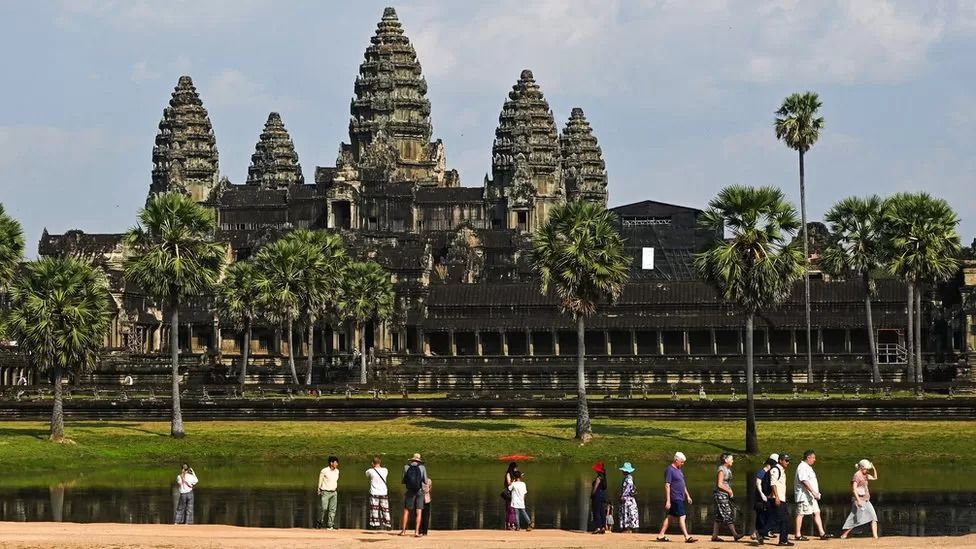
It's possible some of the jewellery was looted from temples such as Angkor Wat

One of the crowns appears to be from the pre-Angkorian period, experts believe, and could have been made by artisans in the 7th Century. Other items, including a small sculpted flower, pose a mystery. Experts simply don't know why it was made or how it was used.

It's still unclear exactly how and when the jewellery was stolen and how it made its way to London. Many of the items can be matched to stone carvings in the walls of Angkor Wat, a Unesco World Heritage Site. The largest religious monument in the world, its construction began in 1122 as a dedication to the Hindu god Vishnu, though it transitioned into a Buddhist temple decades later.

Angkor Wat was heavily looted during the French colonial period. However, many of Cambodia's other temples were looted during the Khmer Rouge era in the 1970s, and the turmoil that continued for decades.

Archaeologist Sonetra Seng studied Angkorian jewellery for years by examining temple carvings. Finally, she can hold the real thing.

"The jewellery proves what was on the carvings and what was rumoured is really true. Cambodia was really, really rich in the past," she says. "Still, I can't believe it, especially that it's from one single collection found abroad."
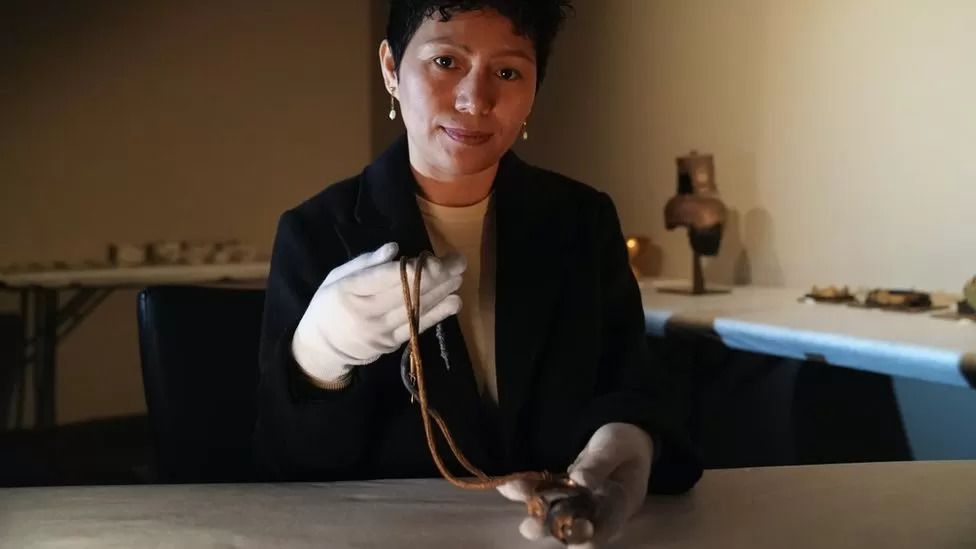
Archaeologist Sonetra Seng recognised some of the jewellery from temple carvings

Some of the jewellery had surfaced before; Douglas Latchford included five items from the collection in a book titled Khmer Gold that he co-wrote with his collaborator, Emma Bunker, in 2008. Khmer antiquities expert Ashley Thompson describes this book and two others as elaborate sales brochures, giving private collectors a taste of what was being sold illegally behind the scenes.

"Publishing these materials, inviting other scholars to contribute and comparing the items to museum pieces was a way of validating them and associating them with known materials already in museums and effectively enhancing their value," she explained.

Ms Thompson, a professor in South East Asian art at SOAS University of London, says it will take a long time for experts to piece together where the newly discovered jewellery really came from because the book contains so many half-truths.

"You certainly can't take for granted anything that is said about the provenance or the current ownership," she explained, as she flipped through the book and pointed to the way in which Latchford and Bunker described the ownership of the different pieces of jewellery. "Private Thai collection, private London collection, private New York collection, private Japanese collection etc. You have to be very wary."
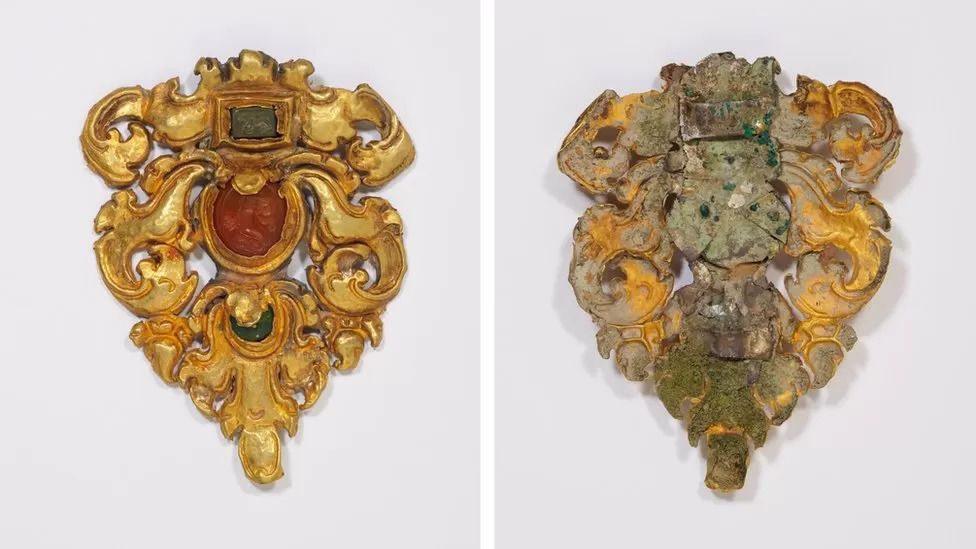
There were 77 items recovered, some made of solid gold and some encrusted with jewels


The Cambodian authorities believe that more Angkorian jewellery is yet to be found. The Cambodians have evidence from Latchford's email correspondence that he was attempting to secretly sell the collection from a north London warehouse as late as 2019.

We asked London's Metropolitan Police if Latchford's UK associates are also being investigated. They declined to comment - noting they do not identify anyone under investigation prior to being charged with a criminal offence.

Last year, the BBC travelled to Cambodia to meet looters turned government witnesses who identified items they say they stole from temples and sold to Latchford. Some of those items have been matched by investigators to museum pieces that are now in respected UK institutions like the British Museum and the V&A.

One of the women the BBC interviewed then - nicknamed Iron Princess - will also work to help identify some of the jewellery.

For now, the collection's return will be welcomed by the country's autocratic leader, Hun Sen. An election is coming up in July, and since his ruling party has effectively dismantled the opposition, this development will be painted as something Hun Sen has done to benefit his people.

Politics aside, ordinary Cambodians want all the looted items back. After decades hidden inside dusty boxes, they will soon go on public display in Phnom Penh, allowing this jewellery to shine once again.

Regional governments are advancing digital trade and cross-border connectivity while building stronger cooperation against cyber fraud and transnational financial crime.
Major Southeast Asian tourism destinations are placing greater emphasis on higher-spending travelers, stricter visa enforcement and infrastructure upgrades as governments seek more sustainable economic returns from tourism.
Countries across mainland and maritime Southeast Asia are expanding semiconductor packaging and electric vehicle manufacturing capacity, increasing their integration into global technology and automotive supply chains.
Global cloud and technology companies are concentrating more capital in Thailand and Malaysia as they compete for suitable land, electricity and renewable energy supplies for large-scale regional data centers.
International hospitality companies announced new high-end resorts in Phuket, Chiang Mai and coastal Vietnam as demand from affluent travelers continues to support premium tourism investment.
Brunei’s economic development authorities introduced new incentives for technology and specialized manufacturing investment as the country seeks to reduce its long-standing dependence on hydrocarbons.
Timorese delegations continued legal and institutional harmonization talks with the ASEAN Coordinating Council as the country works through requirements for full integration into the regional bloc.
Bank of Thailand indicators showed continued growth in spending across hotels, restaurants and retail during late summer, supported by government stimulus measures, long-holiday demand and strong international tourist arrivals.
Cambodian leaders and the ASEAN secretary-general launched construction of the Phnom Penh Logistics Complex, a multimodal freight hub intended to reduce transport costs and improve trade flows across the Mekong region.
The Laos-China Railway recorded its highest cargo tonnage between Vientiane and Kunming, supported by stronger Chinese demand for Southeast Asian agricultural products and processed minerals.
Indonesia is advancing public-private investment in its new capital, prioritizing autonomous public transport, green building standards, renewable power and high-speed fiber infrastructure.
Malaysian transport authorities approved major investment in Port Klang terminal capacity as shifting supply chains and growing intra-ASEAN manufacturing trade increase regional container volumes.
Bangko Sentral ng Pilipinas kept key policy rates unchanged, citing stabilizing food prices and resilient domestic consumption as inflation moves closer to target levels.
The ASEAN+3 Macroeconomic Research Office said regional economies maintained positive revenue growth, supported in part by corporate earnings tied to the semiconductor and artificial intelligence upcycle despite persistent energy-price pressures.
Industrial planners in Indonesia and Vietnam advanced coordination on battery minerals and electric vehicle assembly standards as global automakers and clean-energy companies increase investment across Southeast Asia.
Naval and coast guard forces from ASEAN claimant states increased cooperative maritime surveillance aimed at protecting commercial shipping lanes and supporting adherence to international law in contested waters.
Malaysia and Singapore completed major legal and tax frameworks for the Johor-Singapore Special Economic Zone, paving the way for closer talent mobility, joint industrial development and integrated financial services.
Authorities in northern Vietnam announced fresh commitments from global semiconductor testing and packaging companies, strengthening the country’s position in advanced electronics manufacturing and regional technology supply chains.
Telecommunications ministers, regulators and industry leaders meeting at the GSMA M360 ASEAN summit in Kuala Lumpur moved to establish a regional intelligence exchange aimed at combating increasingly sophisticated cross-border digital financial scams.
The Thai government introduced a 30-day limit for visa-free visitors from 60 countries, replacing the previous 60-day allowance and restricting land-border visa runs as authorities seek to curb misuse and strengthen immigration oversight.
Thailand’s exports reached $34.8 billion in July, rising 21.6% as overseas demand strengthened for computers, integrated circuits and electronic components across US and European markets.
Thailand’s Board of Investment added nine projects worth 52 billion baht to its FastPass program while advancing direct renewable power purchase frameworks designed to secure clean electricity for incoming hyperscale technology investments.
Cushman & Wakefield projects Thailand will attract about 570 billion baht in data center investment between 2026 and 2030, driven by limited existing capacity and a ninefold increase in pre-leasing activity.
Thailand’s Board of Investment approved six major projects worth 958 billion baht, led by investments from TikTok System and Dubai-based DAMAC Group’s Skyline Data Center, accelerating the country’s push to become a major Southeast Asian cloud and digital infrastructure hub.
Singapore Health Minister Ong Ye Kung told business and labor leaders that artificial intelligence is increasingly automating repetitive tasks while more often augmenting, rather than entirely replacing, human occupations.
Agoda ranked Bangkok behind Tokyo as Asia’s second-most revisited urban destination for a second consecutive year, highlighting the Thai capital’s continued appeal to regional and international travelers.
Delegates from across Southeast Asia met in Yangon for the 23rd regional Red Cross and Red Crescent leadership meeting to develop stronger cross-border disaster-response and humanitarian assistance frameworks.
Chinese and Lao military medical units began humanitarian assistance and disaster-response exercises under the Peace Train framework, strengthening bilateral emergency cooperation in the Mekong region.
Cambodian logistics companies are expanding automated cargo-clearance and port digitalization systems to reduce supply-chain friction and increase manufacturing exports under the Regional Comprehensive Economic Partnership.
Vietnam and Russia signed agreements covering digital farming, precision agriculture and automated crop management as Hanoi seeks to improve agricultural productivity and export competitiveness.
Economic planners in Laos said commerce in Luang Prabang and northern logistics centers expanded by nearly 4% in the first half, supported by tourism and freight flows along the Laos-China railway.
Authorities in Chiang Rai activated emergency barriers and mobile warning systems after heavy upstream rainfall pushed the Mae Sai River close to the underside of the Thai-Myanmar Friendship Bridge.
The Philippine Agriculture Department opened additional outlets selling subsidized rice at 20 pesos per kilogram as authorities seek to cushion lower-income households from persistent food-price pressures.
Thailand’s Fuel Fund Management Committee changed diesel and gasohol compensation mechanisms to protect the fund’s long-term liquidity while limiting the impact of international crude-price volatility on consumers.
Bangkok Governor Chadchart Sittipunt and Thailand’s Digital Economy and Society Ministry launched reviews of central-city data centers following questions over planning compliance and pressure on municipal electricity capacity.
Malaysia ranked joint third in Southeast Asia for planned European corporate expansion in an EU-ASEAN Business Council survey, supported by its semiconductor manufacturing base and clean-energy policies.
Thailand’s State Enterprise Policy Office said state-owned enterprises exceeded annual targets with more than 197 billion baht in treasury remittances, supported by higher dividends from the Vayuakij Fund and major energy companies including PTT.
ASEAN Secretary-General Kao Kim Hourn joined a Hong Kong forum focused on regional interoperability, cross-border digital trade and trusted financial infrastructure as the bloc targets a $2 trillion digital economy by 2030.
Thailand’s Securities and Exchange Commission imposed multimillion-baht penalties and multi-year executive bans on 18 individuals found responsible for false trading volumes and share-price manipulation.
Indonesian aviation authorities said volcanic ash from Mount Anak Krakatau disrupted travel for more than 300,000 passengers, forcing regional airlines including Singapore Airlines to cancel or reschedule connecting flights.
Indonesia’s Finance Ministry said sufficient public funds are available to meet upcoming debt obligations for the Whoosh high-speed railway ahead of a scheduled mid-September transfer of operational ownership.
Deputy Prime Minister and Finance Minister Ekniti Nitithanprapas outlined a growth plan centered on public-private coordination, World Bank alignment, artificial intelligence and higher productivity as Thailand prepares for its upcoming ASEAN chairmanship.
The Thai Meteorological Department warned of heavy to very heavy monsoon rain across Bangkok, surrounding areas and northern provinces through Sept. 13, prompting disaster-response teams to activate flood defenses.
Thailand will reduce visa-free stays from 60 days to 30 days for travelers from 60 countries and territories starting Sept. 15, tightening immigration oversight while keeping the program open to international tourists.
Brunei is introducing trade measures aimed at diversifying exports beyond oil and gas, with a focus on specialized chemical products and certified halal consumer goods for Asian markets.
Ho Chi Minh City equities posted strong weekly gains as foreign institutional investors increased exposure to major Vietnamese banks and digital-infrastructure companies.
Timor-Leste is working with regional bodies to complete legal harmonization and customs-alignment requirements ahead of its planned integration into the ASEAN economic community.
Singapore Airlines and other regional carriers are adjusting flight paths to avoid unstable Middle Eastern airspace, balancing passenger safety with additional fuel use and travel time.
Glacier Collapse, Not Earthquake, Triggered Deadly Nepal-Tibet Flood
Swiss Tourist Sentenced to One Year in Prison for Insulting Bali's Sacred Day of Silence
Father Reprimanded After Leaving Seven-Year-Old Son Alone on Mount Fuji During Summit Climb
Google Launches Pixel 11 With Gemini AI at the Center of Its Hardware Strategy
China’s Kimi Launches AI-Focused Credit Card With Agricultural Bank of China and American Express
Success: Nvidia Turned Gaming Chips Into the Engine of the AI Boom
AI’s Next Bottleneck Is Power, Not Just Nvidia Chips
Meta Raises AI Spending Target to as Much as $145bn Despite Pressure Over Returns
Joe Biden’s Cancer Has Spread Beyond His Bones, Hunter Biden Says
Why 2027 Could Be a Strong Year for Stocks—and Why the Forecast Is Fragile
Why Markets May Look Quiet in August After Big Tech Earnings
UFO: Pentagon Releases Video of Unidentified Object Tracked Over Middle East
Ukraine Tells Senate Republicans Its Drone War Offers a Blueprint for America
Weight-Loss Drug Boom Tests the Limits of Prescription Advertising Rules
Taiwan’s President Joins Wartime Command Drill as China Pressure Grows
Lightning Strike Kills Yala FC Player During Match in Southern Thailand
AI Is Remaking the US Economy, From GDP Growth to iPhone Prices
Indonesia’s Free School Meals Plan Has Been Hit by Poisoning, Corruption and Cuts
US and Japan Step In to Support the Yen in Rare Joint Intervention
FIFA’s Retreat Leaves a Larger Question Over Who Guards the Game
Valued at $109 Million: F-35B Fighter Jet Crashes in Southern California
US Says It Has Carried Out Heavy Strikes on Iran After Attempted Attacks on Its Forces
Over 24 Hours in the Air: Qantas Airbus Completes Record-Breaking Test Flight
Nvidia Reportedly Takes Vast Texas Data-Centre Lease to Underwrite AI Expansion
FIFA’s Private-Investment Plan for World Cup Rights Draws European Revolt
Following OpenAI's Cyberattack: 'Most Companies Still Do Not Understand What Is Coming'
OpenAI Sued After ChatGPT Allegedly Discouraged Emergency Care Before Near-Fatal Embolism
Miliband Sets Climate and International Law at Centre of UK Diplomacy
Trump Readies New Tariffs as Temporary Global Levy Nears Expiry
EU Imposes Record €550 Million Digital Services Fine on AliExpress
Between Deliveries, Wang Jibing Wrote His Way to China’s Literary Heights
Morgan Stanley Builds a Wall Street Lead in AI Infrastructure Finance
High Prices Push Coffee Drinkers Toward Whole Beans and Home Brewing
Trump Draws Boos and Podium Scrutiny at Spain’s World Cup Triumph
Spain Defeats Argentina in Extra Time to Win Second World Cup
Police Block Cockroach Janta Party’s March to Parliament as Education Protests Intensify
Singapore Considers Lower Taxes for Fund Managers as Hong Kong Intensifies Talent Contest
Proposed U.S.-Saudi Nuclear Pact Could Permit Limited Uranium Enrichment Under International Safeguards
Why Kentucky Fried Chicken Became KFC—and Why the False Explanations Persist
Ukrainian Drones Strike Wildberries Warehouses Deep Inside Russia
Reported CIA Mission Helped Clear the UAE’s Path to Advanced US AI Chips
Artificial Intelligence Capital Fuels Markets While Governments and Regulators Face Mounting Strategic Tests
China’s Moonshot’s Kimi K3 Narrows the Gap With Anthropic Through Scale, Openness and Lower Cost
Gold and Cash Seizure Puts Indonesia’s Senior Anti-Corruption Prosecutor Under Investigation
The Ledger Will Not Trust on Faith
Ukraine’s Leadership Rift Spills Into the Streets as Protesters Target Army Chief
The Ten World Cup Finals That Defined Football History
Smartphones Are Getting More Expensive, Sales Are Collapsing, and Even Apple Admits: "Prices Will Rise"
Leadership Change and Strategic Rivalry Redraw the Political Map
The AI Race Enters Its Infrastructure Era