The Asian Development Bank trimmed its 2026 growth forecast for developing Southeast Asia to four point six percent, citing geopolitical uncertainty, higher energy costs and continuing supply chain disruptions linked to conflicts in the Middle East.
Regulators found that the Alibaba-owned marketplace failed to control systemic risks from illegal, counterfeit and unsafe goods, while AliExpress called the penalty disproportionate and prepared an appeal.
The European Commission has fined AliExpress €550 million for failing to assess and curb systemic risks arising from illegal, counterfeit and unsafe products sold through its marketplace.
The penalty is the largest imposed under the European Union’s Digital Services Act and places the Alibaba-owned platform at the centre of an intensifying campaign to make major online retailers accountable for what reaches European consumers.
The decision concerns shortcomings that continued until at least June 2025. Regulators found that counterfeit clothing, unsafe toys, dangerous cosmetics and other non-compliant goods circulated on AliExpress, sometimes remaining available for weeks after detection.
Products previously identified as illegal also reappeared, while sellers could circumvent safeguards by placing items in misleading categories.
The case is not based simply on the presence of individual prohibited listings.
The key issue is whether AliExpress established systems proportionate to the scale and foreseeable risks of its business.
Under the Digital Services Act, the largest platforms must identify dangers created by their services, introduce effective safeguards, test whether those measures work and correct persistent failures.
The Commission concluded that AliExpress had not met that standard.
Its investigation identified inadequate internal risk assessments, insufficient staffing for product checks and recommendation systems that continued promoting problematic listings.
Some reviewers were given only tens of seconds to determine whether an item complied with European rules, limiting the depth of scrutiny applied to a marketplace containing vast numbers of products.
AliExpress has about 193 million users in the European Union, making it one of the bloc’s largest online retail platforms.
That reach is central to the enforcement decision: a weakness in screening or seller oversight can expose consumers across 27 countries to unsafe merchandise at enormous scale.
Formal proceedings began in March 2024 and examined risk management, content moderation, trader traceability, advertising transparency, recommendation systems, complaint handling and access to data for researchers.
In June 2025, regulators issued preliminary findings that AliExpress had failed to assess and mitigate risks linked to illegal goods.
At the same time, the Commission accepted commitments from the company covering several other parts of the investigation.
Those undertakings, which became legally binding, addressed mechanisms for reporting unlawful listings, internal complaints, advertising and recommendation transparency, trader identification, researcher access and controls targeting hidden links, affiliate marketing and products that could endanger health or minors.
Breaching those commitments can itself trigger further enforcement.
The €550 million sanction reflects the Commission’s conclusion that the remaining failures were serious and systemic.
Digital Services Act penalties can reach 6% of a company’s worldwide annual turnover.
The fine is nevertheless less than 1% of the roughly €122 billion in revenue generated by Alibaba in its previous financial year.
Henna Virkkunen, the Commission’s executive vice-president responsible for technology sovereignty, security and democracy, said the circulation of counterfeit clothing, unsafe toys and dangerous cosmetics was not an unavoidable consequence of internet shopping.
She said scale did not excuse inadequate safeguards and that risks had to be identified and addressed systematically.
AliExpress rejected the scale of the penalty.
The company said it had invested substantial resources in risk assessment, product safety and consumer protection since the European rules took effect.
It described the fine as disproportionate, argued that the decision failed to recognise improvements already made and said it would appeal.
The ruling extends scrutiny across the fast-growing market for inexpensive goods shipped directly to European customers.
Temu previously received a €200 million Digital Services Act fine over similar product-safety failures, while other large marketplaces remain subject to investigations and tighter import controls.
The enforcement drive seeks to close the practical gap between laws governing goods sold in physical shops and the immense, rapidly changing inventories offered online.
AliExpress must now submit a corrective action plan by 20 October explaining how it will remedy its failures to assess and mitigate systemic risk.
Rejection of that plan or continued non-compliance could expose the company to additional sanctions, making implementation of stronger product controls the next binding stage of the case.
The penalty is the largest imposed under the European Union’s Digital Services Act and places the Alibaba-owned platform at the centre of an intensifying campaign to make major online retailers accountable for what reaches European consumers.
The decision concerns shortcomings that continued until at least June 2025. Regulators found that counterfeit clothing, unsafe toys, dangerous cosmetics and other non-compliant goods circulated on AliExpress, sometimes remaining available for weeks after detection.
Products previously identified as illegal also reappeared, while sellers could circumvent safeguards by placing items in misleading categories.
The case is not based simply on the presence of individual prohibited listings.
The key issue is whether AliExpress established systems proportionate to the scale and foreseeable risks of its business.
Under the Digital Services Act, the largest platforms must identify dangers created by their services, introduce effective safeguards, test whether those measures work and correct persistent failures.
The Commission concluded that AliExpress had not met that standard.
Its investigation identified inadequate internal risk assessments, insufficient staffing for product checks and recommendation systems that continued promoting problematic listings.
Some reviewers were given only tens of seconds to determine whether an item complied with European rules, limiting the depth of scrutiny applied to a marketplace containing vast numbers of products.
AliExpress has about 193 million users in the European Union, making it one of the bloc’s largest online retail platforms.
That reach is central to the enforcement decision: a weakness in screening or seller oversight can expose consumers across 27 countries to unsafe merchandise at enormous scale.
Formal proceedings began in March 2024 and examined risk management, content moderation, trader traceability, advertising transparency, recommendation systems, complaint handling and access to data for researchers.
In June 2025, regulators issued preliminary findings that AliExpress had failed to assess and mitigate risks linked to illegal goods.
At the same time, the Commission accepted commitments from the company covering several other parts of the investigation.
Those undertakings, which became legally binding, addressed mechanisms for reporting unlawful listings, internal complaints, advertising and recommendation transparency, trader identification, researcher access and controls targeting hidden links, affiliate marketing and products that could endanger health or minors.
Breaching those commitments can itself trigger further enforcement.
The €550 million sanction reflects the Commission’s conclusion that the remaining failures were serious and systemic.
Digital Services Act penalties can reach 6% of a company’s worldwide annual turnover.
The fine is nevertheless less than 1% of the roughly €122 billion in revenue generated by Alibaba in its previous financial year.
Henna Virkkunen, the Commission’s executive vice-president responsible for technology sovereignty, security and democracy, said the circulation of counterfeit clothing, unsafe toys and dangerous cosmetics was not an unavoidable consequence of internet shopping.
She said scale did not excuse inadequate safeguards and that risks had to be identified and addressed systematically.
AliExpress rejected the scale of the penalty.
The company said it had invested substantial resources in risk assessment, product safety and consumer protection since the European rules took effect.
It described the fine as disproportionate, argued that the decision failed to recognise improvements already made and said it would appeal.
The ruling extends scrutiny across the fast-growing market for inexpensive goods shipped directly to European customers.
Temu previously received a €200 million Digital Services Act fine over similar product-safety failures, while other large marketplaces remain subject to investigations and tighter import controls.
The enforcement drive seeks to close the practical gap between laws governing goods sold in physical shops and the immense, rapidly changing inventories offered online.
AliExpress must now submit a corrective action plan by 20 October explaining how it will remedy its failures to assess and mitigate systemic risk.
Rejection of that plan or continued non-compliance could expose the company to additional sanctions, making implementation of stronger product controls the next binding stage of the case.
The Thai government launched a 2.45 billion baht tourism package featuring hotel subsidies, domestic airfare discounts and incentives for international charter flights, with the aim of generating more than 56 billion baht in economic activity and strengthening Thailand's regional tourism competitiveness.
Foreign ministers from ASEAN and key dialogue partners including the United States, China, Russia and Australia gathered in Manila for the fifty-ninth ASEAN Foreign Ministers Meeting, with discussions focused on South China Sea negotiations, maritime security and the impact of Middle East energy disruptions on the region.
The food courier’s Lu Xun Literature Prize transforms a working life measured in deadlines and distances into a landmark moment for China’s growing literature of ordinary labor.
Wang Jibing spent years delivering other people’s orders through the streets of Kunshan; in the brief intervals that remained—outside restaurants, beside elevators, at traffic lights—he assembled a literature of his own.
On July 15, the 56-year-old courier won the poetry category of the ninth Lu Xun Literature Prize for Low Flight, a collection rooted in the hurried, precarious lives of China’s delivery workers.
The award is among the country’s most prestigious literary distinctions.
Organized by the China Writers Association and named for the foundational figure of modern Chinese literature, it recognizes work across seven categories, including fiction, poetry, literary reportage, criticism and translation.
The ninth edition covered books and writing first published between 2022 and 2025; 35 works were selected across the categories.
Wang is the first writer identified publicly as a food-delivery rider to receive the prize.
When the result arrived, his initial emotion was not triumph but release.
The attention generated by his nomination had left him anxious, and the announcement finally ended days of uncertainty.
He later insisted that the honor would not alter the rhythms or substance of his life.
“I was delivering food yesterday,” he said after winning.
Low Flight, first published in China in February 2024, is Wang’s third poetry collection.
Its title refuses the conventional assumption that flight is meaningful only when it reaches great altitude.
A life conducted close to the ground—among apartment entrances, restaurant counters, staircases and congested streets—still possesses motion, dignity and imaginative reach.
The book was not composed solely from personal recollection.
Wang interviewed more than 140 delivery riders and gathered written responses from over 60 others, approaching poetry with something resembling field research.
Their stories allowed him to move beyond a solitary worker’s testimony and construct a broader portrait of people whose labor is visible everywhere while their interior lives remain largely unseen.
Delivery platforms have become an essential layer of urban China.
Riders carry meals, groceries and household goods across cities at remarkable speed, but their work is governed by tight schedules, customer ratings, traffic conditions and algorithmic calculations.
A delayed restaurant order, an incorrect address or an elevator that stops on every floor can consume time for which the worker, rather than the system, may be penalized.
Wang knows this pressure intimately.
One of the experiences that sharpened his public voice occurred in 2019, when a customer supplied an incorrect address.
He searched several buildings, climbed 18 floors and was then berated for arriving late.
The encounter helped produce People in a Hurry, the poem that brought him widespread recognition.
Its compressed language turned the delivery rider’s contest with the clock into something bodily: wind, blades, fire and water forced from the same exhausted human frame.
By then, Wang had been writing for decades.
Born in November 1969 in Jiangsu province, he left school during his teenage years because his family could not afford to keep him there.
The decades that followed were filled with work that rarely enters literary biographies: construction, sand dredging, waste collection, street vending and other temporary jobs.
He began writing in 1988, without institutional training, financial security or a room reserved for creative work.
A large body of his early manuscripts was destroyed by his father, who regarded writing as an impractical distraction from earning a living.
Wang continued.
When proper paper was unavailable, he used discarded packaging, cigarette boxes, old newspapers, his telephone and even the palm of his hand.
Digital literary forums later became an informal workshop, allowing him to share drafts, study technique and revise poems in response to readers.
He became a delivery rider at about 50, one of the oldest workers at his station.
The job supplied both hardship and subject matter.
Over roughly 150,000 kilometers on the road, he has written more than 6,000 poems, although published accounts differ slightly on the total.
Several collections have followed, including People in a Hurry and Holding a Beam of Human Light.
His language is deliberately accessible.
Rather than disguising ordinary experience beneath elaborate literary machinery, Wang concentrates on the physical details through which economic pressure is felt: a printed order attached to packaging, a motorcycle wheel turning through rain, the shortening interval before a deadline, the customer waiting beyond a locked entrance.
The poems do not present riders merely as victims.
They record irritation, endurance, humor, tenderness and the private moral calculations that accompany public-facing work.
That directness has helped his poetry travel well beyond conventional literary circles.
It has also prompted debate among readers and writers who question whether personal authenticity and social significance necessarily amount to artistic distinction.
The criticism is part of a larger argument in contemporary Chinese culture over who is permitted to speak with literary authority and how work emerging outside universities, journals and professional associations should be judged.
Wang’s victory places that argument inside one of China’s highest literary institutions.
He belongs to a widening constellation of writers whose occupations have shaped their public identities: miners, domestic workers, market vendors, factory employees and couriers.
Their work is sometimes grouped under labels such as worker literature, grassroots writing or new popular literature.
The terminology can create its own enclosure, treating a writer’s occupation as both introduction and permanent category.
Wang’s prize complicates that separation.
Low Flight was honored not in a special division for workers, but in the national poetry category.
The award also arrives as China’s platform economy wrestles with the human consequences of speed.
Delivery riders embody the convenience of a system designed to make waiting disappear for customers.
Wang’s poems restore the missing minutes by showing who absorbs them: the worker running upstairs, searching for an address or calculating whether a red light can be obeyed without risking a penalty.
No current cash value for the prize has been publicly announced.
Its greater effect may be cultural.
Wang’s experience has moved from social-media curiosity to officially recognized literature, carrying the private vocabulary of delivery work into a national institution named after a writer who treated the lives of ordinary people as material worthy of enduring attention.
An English edition of Low Flight is scheduled for publication in the United States in December 2026. Its international readers will encounter a poet whose route to literary recognition did not bypass manual labor but passed directly through it—one order, one staircase and one salvaged fragment of paper at a time.
On July 15, the 56-year-old courier won the poetry category of the ninth Lu Xun Literature Prize for Low Flight, a collection rooted in the hurried, precarious lives of China’s delivery workers.
The award is among the country’s most prestigious literary distinctions.
Organized by the China Writers Association and named for the foundational figure of modern Chinese literature, it recognizes work across seven categories, including fiction, poetry, literary reportage, criticism and translation.
The ninth edition covered books and writing first published between 2022 and 2025; 35 works were selected across the categories.
Wang is the first writer identified publicly as a food-delivery rider to receive the prize.
When the result arrived, his initial emotion was not triumph but release.
The attention generated by his nomination had left him anxious, and the announcement finally ended days of uncertainty.
He later insisted that the honor would not alter the rhythms or substance of his life.
“I was delivering food yesterday,” he said after winning.
Low Flight, first published in China in February 2024, is Wang’s third poetry collection.
Its title refuses the conventional assumption that flight is meaningful only when it reaches great altitude.
A life conducted close to the ground—among apartment entrances, restaurant counters, staircases and congested streets—still possesses motion, dignity and imaginative reach.
The book was not composed solely from personal recollection.
Wang interviewed more than 140 delivery riders and gathered written responses from over 60 others, approaching poetry with something resembling field research.
Their stories allowed him to move beyond a solitary worker’s testimony and construct a broader portrait of people whose labor is visible everywhere while their interior lives remain largely unseen.
Delivery platforms have become an essential layer of urban China.
Riders carry meals, groceries and household goods across cities at remarkable speed, but their work is governed by tight schedules, customer ratings, traffic conditions and algorithmic calculations.
A delayed restaurant order, an incorrect address or an elevator that stops on every floor can consume time for which the worker, rather than the system, may be penalized.
Wang knows this pressure intimately.
One of the experiences that sharpened his public voice occurred in 2019, when a customer supplied an incorrect address.
He searched several buildings, climbed 18 floors and was then berated for arriving late.
The encounter helped produce People in a Hurry, the poem that brought him widespread recognition.
Its compressed language turned the delivery rider’s contest with the clock into something bodily: wind, blades, fire and water forced from the same exhausted human frame.
By then, Wang had been writing for decades.
Born in November 1969 in Jiangsu province, he left school during his teenage years because his family could not afford to keep him there.
The decades that followed were filled with work that rarely enters literary biographies: construction, sand dredging, waste collection, street vending and other temporary jobs.
He began writing in 1988, without institutional training, financial security or a room reserved for creative work.
A large body of his early manuscripts was destroyed by his father, who regarded writing as an impractical distraction from earning a living.
Wang continued.
When proper paper was unavailable, he used discarded packaging, cigarette boxes, old newspapers, his telephone and even the palm of his hand.
Digital literary forums later became an informal workshop, allowing him to share drafts, study technique and revise poems in response to readers.
He became a delivery rider at about 50, one of the oldest workers at his station.
The job supplied both hardship and subject matter.
Over roughly 150,000 kilometers on the road, he has written more than 6,000 poems, although published accounts differ slightly on the total.
Several collections have followed, including People in a Hurry and Holding a Beam of Human Light.
His language is deliberately accessible.
Rather than disguising ordinary experience beneath elaborate literary machinery, Wang concentrates on the physical details through which economic pressure is felt: a printed order attached to packaging, a motorcycle wheel turning through rain, the shortening interval before a deadline, the customer waiting beyond a locked entrance.
The poems do not present riders merely as victims.
They record irritation, endurance, humor, tenderness and the private moral calculations that accompany public-facing work.
That directness has helped his poetry travel well beyond conventional literary circles.
It has also prompted debate among readers and writers who question whether personal authenticity and social significance necessarily amount to artistic distinction.
The criticism is part of a larger argument in contemporary Chinese culture over who is permitted to speak with literary authority and how work emerging outside universities, journals and professional associations should be judged.
Wang’s victory places that argument inside one of China’s highest literary institutions.
He belongs to a widening constellation of writers whose occupations have shaped their public identities: miners, domestic workers, market vendors, factory employees and couriers.
Their work is sometimes grouped under labels such as worker literature, grassroots writing or new popular literature.
The terminology can create its own enclosure, treating a writer’s occupation as both introduction and permanent category.
Wang’s prize complicates that separation.
Low Flight was honored not in a special division for workers, but in the national poetry category.
The award also arrives as China’s platform economy wrestles with the human consequences of speed.
Delivery riders embody the convenience of a system designed to make waiting disappear for customers.
Wang’s poems restore the missing minutes by showing who absorbs them: the worker running upstairs, searching for an address or calculating whether a red light can be obeyed without risking a penalty.
No current cash value for the prize has been publicly announced.
Its greater effect may be cultural.
Wang’s experience has moved from social-media curiosity to officially recognized literature, carrying the private vocabulary of delivery work into a national institution named after a writer who treated the lives of ordinary people as material worthy of enduring attention.
An English edition of Low Flight is scheduled for publication in the United States in December 2026. Its international readers will encounter a poet whose route to literary recognition did not bypass manual labor but passed directly through it—one order, one staircase and one salvaged fragment of paper at a time.
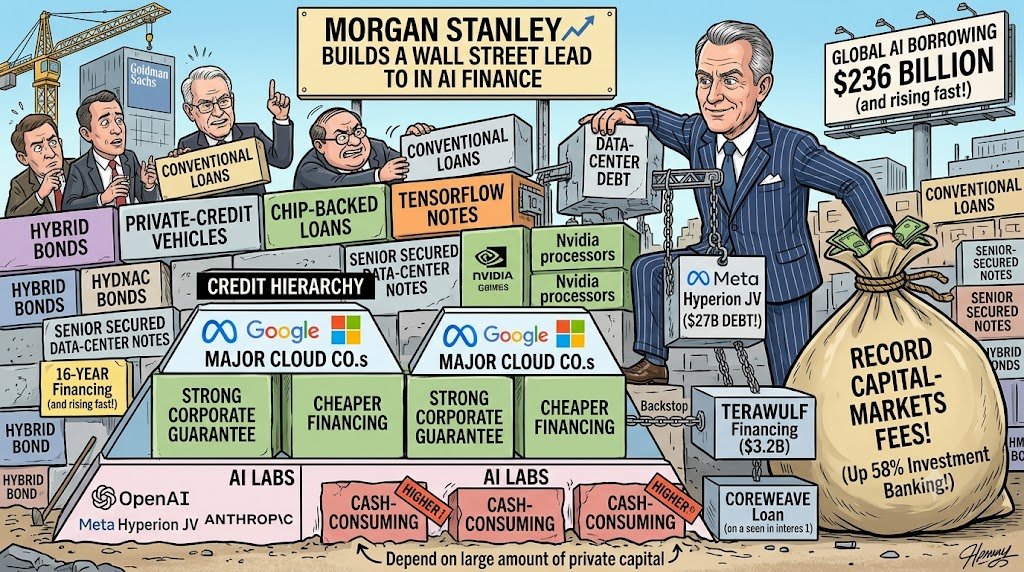
Hybrid bonds, private-credit vehicles and chip-backed loans have placed the bank at the center of a data-center investment cycle increasingly funded through debt.
Morgan Stanley has become a principal architect of the debt structures financing the artificial-intelligence infrastructure boom, connecting technology companies and data-center developers with insurers, pension funds, asset managers and private-credit investors.
Its bankers have arranged or advised on tens of billions of dollars in transactions spanning construction, computing chips and the vast facilities required to operate them.
The strategy addresses a central problem confronting the industry.
Artificial-intelligence systems require immense quantities of computing power, electricity and physical infrastructure, but even the largest technology groups cannot fund every project solely from current cash flow without constraining other spending.
Conventional project loans can also be slow, restrictive and difficult to scale to campuses costing tens of billions of dollars.
Morgan Stanley’s answer has been to combine elements of project finance, corporate credit and tradable securities.
Long-term data-center leases and commitments from large technology companies are used to strengthen the credit behind a project.
The resulting debt can then be sold to a broader group of institutional investors, widening the available pool of capital and reducing the amount banks must retain on their own balance sheets.
A $3.2 billion financing for data-center developer TeraWulf became an important template.
A subsidiary issued senior secured notes carrying a 7.75 percent coupon and maturing in 2030. The structure incorporated protections normally found in project lending while producing bonds that could be distributed widely.
Google supplied a financial backstop linked to the underlying computing agreements, giving investors exposure to stronger credit support than TeraWulf could have provided alone.
Most of the relevant capacity is intended to serve artificial-intelligence workloads through infrastructure provider Fluidstack, with Anthropic expected to be a major user.
The arrangement illustrates how several companies can occupy different layers of one financing: the developer supplies the site and power, an infrastructure operator contracts for capacity, an artificial-intelligence laboratory consumes the computing resources, and a large technology group supports the commercial obligations.
The stronger the corporate guarantee, the cheaper the financing can become.
Investors assessing a project backed by Google, Meta, Microsoft or another highly rated technology company are not relying exclusively on the balance sheet of a specialized developer.
Industry estimates indicate that a robust guarantee can reduce borrowing costs by roughly half compared with an otherwise similar transaction supported by a weaker counterparty.
Morgan Stanley also advised Meta on the financing of its Hyperion data-center campus in Louisiana, one of the largest private infrastructure transactions assembled for artificial intelligence.
The structure placed the project in a joint venture controlled 80 percent by funds managed by Blue Owl Capital, while Meta retained 20 percent.
More than $27 billion of debt and additional equity were raised through the arrangement, with Meta acting as developer, operator and long-term tenant.
That transaction allowed the project vehicle, rather than Meta itself, to incur the construction debt.
Meta nevertheless provided substantial support, including lease commitments and a conditional residual-value guarantee covering the first 16 years of operation.
The protections helped the private debt secure an investment-grade rating while transferring ownership and financing risk among Meta, Blue Owl and institutional bondholders.
The bank has extended the approach from buildings to the processors installed inside them.
It arranged an $8.5 billion financing for CoreWeave, a cloud provider specializing in graphics-processing capacity, supported by a contract with a large technology customer.
Morgan Stanley and Japanese lender MUFG subsequently assembled a $3.1 billion syndicated term loan to finance the purchase and installation of Nvidia processors.
Investor demand for the latter transaction reached approximately $20 billion.
The loan, however, carried a substantially larger premium over benchmark rates because its underlying customers were artificial-intelligence laboratories rather than technology groups with more established balance sheets.
The contrast exposes the credit hierarchy forming inside the sector: debt supported by major cloud companies is comparatively inexpensive, while financing dependent on cash-consuming laboratories commands higher returns.
Morgan Stanley has also advised Broadcom on a roughly $35 billion chip-financing transaction.
Taken together, the deals show how artificial intelligence is developing a specialized credit market encompassing property, power infrastructure, construction contracts, semiconductors and long-term computing leases.
The expansion has strengthened Morgan Stanley’s position in capital markets.
The bank generated $2.3 billion in debt and equity capital-markets fees during the first half of 2026, up from $1.4 billion in the same period a year earlier.
It rose from fourth to second globally in those fee rankings, behind JPMorgan Chase and ahead of Goldman Sachs.
Morgan Stanley reported record net revenue of $21.3 billion for the second quarter, compared with $16.8 billion a year earlier.
Investment-banking revenue increased 58 percent, although the bank does not separately disclose how much of that growth came directly from artificial-intelligence infrastructure transactions.
The financing boom carries risks alongside its fees.
Data centers face construction delays, power shortages and rapidly changing technology, while graphics processors can depreciate quickly as newer models enter the market.
Some projects ultimately depend on laboratories such as OpenAI and Anthropic, whose spending requirements remain high despite their ability to attract large amounts of private capital.
A downturn in demand, the failure of a tenant or a reduction in financial support from a major technology company could weaken several linked layers of debt.
The market is nevertheless expanding at exceptional speed.
Global borrowing associated with artificial intelligence had reached about $236 billion by the end of May 2026, roughly four times the amount recorded over the comparable period a year earlier, and Morgan Stanley projects issuance could approach $570 billion for the full year.
Having sold more than $40 billion of the emerging construction instruments, the bank is now working to extend the model into European and Asian markets.
Its bankers have arranged or advised on tens of billions of dollars in transactions spanning construction, computing chips and the vast facilities required to operate them.
The strategy addresses a central problem confronting the industry.
Artificial-intelligence systems require immense quantities of computing power, electricity and physical infrastructure, but even the largest technology groups cannot fund every project solely from current cash flow without constraining other spending.
Conventional project loans can also be slow, restrictive and difficult to scale to campuses costing tens of billions of dollars.
Morgan Stanley’s answer has been to combine elements of project finance, corporate credit and tradable securities.
Long-term data-center leases and commitments from large technology companies are used to strengthen the credit behind a project.
The resulting debt can then be sold to a broader group of institutional investors, widening the available pool of capital and reducing the amount banks must retain on their own balance sheets.
A $3.2 billion financing for data-center developer TeraWulf became an important template.
A subsidiary issued senior secured notes carrying a 7.75 percent coupon and maturing in 2030. The structure incorporated protections normally found in project lending while producing bonds that could be distributed widely.
Google supplied a financial backstop linked to the underlying computing agreements, giving investors exposure to stronger credit support than TeraWulf could have provided alone.
Most of the relevant capacity is intended to serve artificial-intelligence workloads through infrastructure provider Fluidstack, with Anthropic expected to be a major user.
The arrangement illustrates how several companies can occupy different layers of one financing: the developer supplies the site and power, an infrastructure operator contracts for capacity, an artificial-intelligence laboratory consumes the computing resources, and a large technology group supports the commercial obligations.
The stronger the corporate guarantee, the cheaper the financing can become.
Investors assessing a project backed by Google, Meta, Microsoft or another highly rated technology company are not relying exclusively on the balance sheet of a specialized developer.
Industry estimates indicate that a robust guarantee can reduce borrowing costs by roughly half compared with an otherwise similar transaction supported by a weaker counterparty.
Morgan Stanley also advised Meta on the financing of its Hyperion data-center campus in Louisiana, one of the largest private infrastructure transactions assembled for artificial intelligence.
The structure placed the project in a joint venture controlled 80 percent by funds managed by Blue Owl Capital, while Meta retained 20 percent.
More than $27 billion of debt and additional equity were raised through the arrangement, with Meta acting as developer, operator and long-term tenant.
That transaction allowed the project vehicle, rather than Meta itself, to incur the construction debt.
Meta nevertheless provided substantial support, including lease commitments and a conditional residual-value guarantee covering the first 16 years of operation.
The protections helped the private debt secure an investment-grade rating while transferring ownership and financing risk among Meta, Blue Owl and institutional bondholders.
The bank has extended the approach from buildings to the processors installed inside them.
It arranged an $8.5 billion financing for CoreWeave, a cloud provider specializing in graphics-processing capacity, supported by a contract with a large technology customer.
Morgan Stanley and Japanese lender MUFG subsequently assembled a $3.1 billion syndicated term loan to finance the purchase and installation of Nvidia processors.
Investor demand for the latter transaction reached approximately $20 billion.
The loan, however, carried a substantially larger premium over benchmark rates because its underlying customers were artificial-intelligence laboratories rather than technology groups with more established balance sheets.
The contrast exposes the credit hierarchy forming inside the sector: debt supported by major cloud companies is comparatively inexpensive, while financing dependent on cash-consuming laboratories commands higher returns.
Morgan Stanley has also advised Broadcom on a roughly $35 billion chip-financing transaction.
Taken together, the deals show how artificial intelligence is developing a specialized credit market encompassing property, power infrastructure, construction contracts, semiconductors and long-term computing leases.
The expansion has strengthened Morgan Stanley’s position in capital markets.
The bank generated $2.3 billion in debt and equity capital-markets fees during the first half of 2026, up from $1.4 billion in the same period a year earlier.
It rose from fourth to second globally in those fee rankings, behind JPMorgan Chase and ahead of Goldman Sachs.
Morgan Stanley reported record net revenue of $21.3 billion for the second quarter, compared with $16.8 billion a year earlier.
Investment-banking revenue increased 58 percent, although the bank does not separately disclose how much of that growth came directly from artificial-intelligence infrastructure transactions.
The financing boom carries risks alongside its fees.
Data centers face construction delays, power shortages and rapidly changing technology, while graphics processors can depreciate quickly as newer models enter the market.
Some projects ultimately depend on laboratories such as OpenAI and Anthropic, whose spending requirements remain high despite their ability to attract large amounts of private capital.
A downturn in demand, the failure of a tenant or a reduction in financial support from a major technology company could weaken several linked layers of debt.
The market is nevertheless expanding at exceptional speed.
Global borrowing associated with artificial intelligence had reached about $236 billion by the end of May 2026, roughly four times the amount recorded over the comparable period a year earlier, and Morgan Stanley projects issuance could approach $570 billion for the full year.
Having sold more than $40 billion of the emerging construction instruments, the bank is now working to extend the model into European and Asian markets.
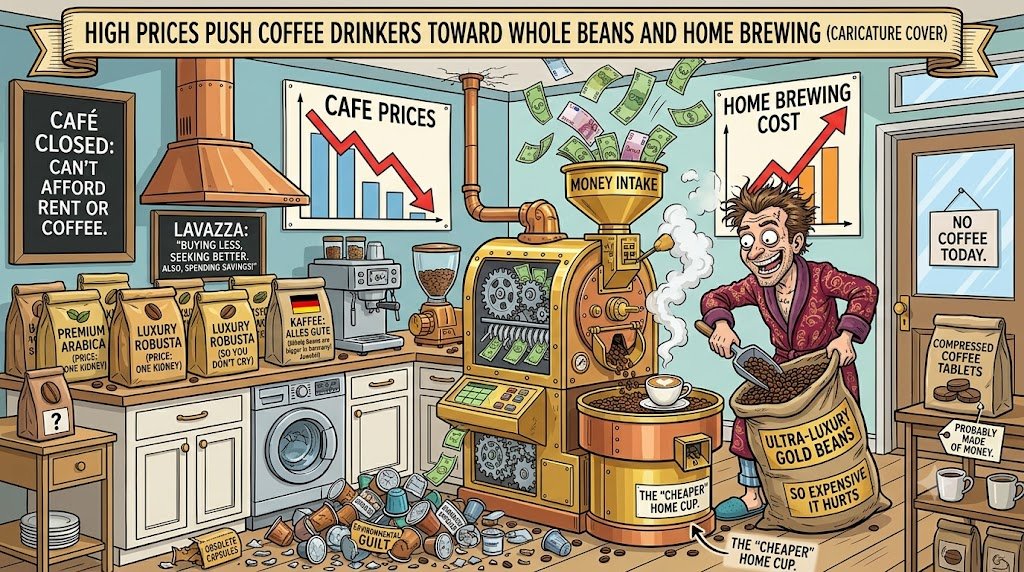
Lavazza says consumers are buying less but seeking better coffee, accelerating demand for whole beans and bean-to-cup machines across major European markets.
Four years of disruption in the global coffee market are reshaping what consumers brew at home.
After poor harvests and volatile commodity trading drove arabica and robusta prices to record levels in 2025, shoppers are increasingly choosing whole beans and equipment capable of producing café-style drinks rather than simply abandoning coffee altogether.
Lavazza chairman Giuseppe Lavazza described the migration toward beans as the industry’s most important consumer trend.
His assessment is that households are buying less but seeking better quality, investing in bean-to-cup machines to reproduce the experience of coffee shops in their kitchens.
The change is particularly pronounced in Britain.
Whole-bean sales rose 20.3 percent by volume in the year to May 2026, compared with growth of 2.8 percent across the broader market for coffee consumed at home.
The value of bean sales increased 36.8 percent, reflecting both higher demand and elevated retail prices.
Unit sales of bean-to-cup machines climbed 33.5 percent over the same period.
The figures suggest that higher prices are prompting a change in priorities rather than a uniform retreat from premium coffee.
Whole beans allow consumers to grind coffee immediately before brewing and adjust the strength, quantity and preparation method.
Modern automatic machines can also produce cappuccinos, flat whites and longer drinks with limited manual work, narrowing the practical difference between home preparation and a café purchase.
The pattern extends across continental Europe.
Whole-bean sales increased by value by 35 percent in France, 33 percent in Italy and 31.2 percent in Germany during the year to May. Germany, Europe’s largest coffee-consuming market, has advanced furthest: whole beans now constitute a larger segment than traditional pre-ground roasted coffee.
The change began before the latest price shock but accelerated during the coronavirus pandemic.
Café closures and widespread home working encouraged households to buy grinders, espresso makers and fully automatic machines.
Continued growth in both equipment and bean sales indicates that the habit persisted after offices and hospitality businesses reopened.
For roasters, the shift comes during an unusually difficult pricing cycle.
Adverse weather and disappointing crops in Brazil and Vietnam, the two largest producing countries, tightened supplies of arabica and robusta.
Because both varieties became expensive at the same time, manufacturers had less scope to reduce costs by substituting robusta, traditionally the cheaper component used in instant coffee and many espresso blends, for higher-priced arabica.
Commodity prices have since retreated from their 2025 peaks as supplies began to recover.
Arabica prices are projected to decline during 2026 after rising more than 40 percent in 2025, while robusta is also expected to fall.
Yet retail prices respond more slowly because roasters purchase beans in advance, carry inventories acquired at different costs and remain exposed to currency movements, shipping expenses and renewed weather disruption.
Lavazza therefore does not expect a rapid reduction in supermarket prices.
The company regards persistent volatility, rather than any single price level, as the market’s defining condition.
Heavy rain in Brazil could damage crops or delay harvesting, while a stronger El Niño weather pattern could disrupt production in other growing regions.
British prices for coffee consumed at home rose another 6.3 percent in the year to May. The simultaneous increase in bean volumes shows that at least part of the market is absorbing the pressure by concentrating spending on products perceived to deliver a better experience, even if consumers prepare fewer servings or reduce purchases elsewhere.
The upheaval has increased Lavazza’s revenue while also raising its costs.
The family-owned Italian group recorded revenue of €3.9 billion in 2025, an increase of 15.7 percent.
Core profit rose 8.8 percent to €340 million, with particularly strong growth in North America.
Higher selling prices contributed to the revenue increase, while weaker global volumes and expensive raw materials constrained the benefit to earnings.
Changing preferences are also challenging the capsule market.
Single-serve pods offer convenience, but their packaging has attracted environmental criticism, and demand has weakened in some markets as consumers adopt automatic bean machines.
Lavazza is responding with Tablì, a proprietary system that uses compressed tablets made entirely from coffee, without a plastic or aluminium capsule, individual wrapper, coating or binder.
The system, introduced first in Italy, is being expanded into the United States in 2026 as Lavazza’s largest investment in that market.
It requires a dedicated machine and is intended to preserve single-serving convenience while eliminating the conventional pod.
The launch places Lavazza behind two parallel bets: continued growth in whole-bean brewing and demand for a lower-packaging alternative among consumers who still prefer single-cup machines.
After poor harvests and volatile commodity trading drove arabica and robusta prices to record levels in 2025, shoppers are increasingly choosing whole beans and equipment capable of producing café-style drinks rather than simply abandoning coffee altogether.
Lavazza chairman Giuseppe Lavazza described the migration toward beans as the industry’s most important consumer trend.
His assessment is that households are buying less but seeking better quality, investing in bean-to-cup machines to reproduce the experience of coffee shops in their kitchens.
The change is particularly pronounced in Britain.
Whole-bean sales rose 20.3 percent by volume in the year to May 2026, compared with growth of 2.8 percent across the broader market for coffee consumed at home.
The value of bean sales increased 36.8 percent, reflecting both higher demand and elevated retail prices.
Unit sales of bean-to-cup machines climbed 33.5 percent over the same period.
The figures suggest that higher prices are prompting a change in priorities rather than a uniform retreat from premium coffee.
Whole beans allow consumers to grind coffee immediately before brewing and adjust the strength, quantity and preparation method.
Modern automatic machines can also produce cappuccinos, flat whites and longer drinks with limited manual work, narrowing the practical difference between home preparation and a café purchase.
The pattern extends across continental Europe.
Whole-bean sales increased by value by 35 percent in France, 33 percent in Italy and 31.2 percent in Germany during the year to May. Germany, Europe’s largest coffee-consuming market, has advanced furthest: whole beans now constitute a larger segment than traditional pre-ground roasted coffee.
The change began before the latest price shock but accelerated during the coronavirus pandemic.
Café closures and widespread home working encouraged households to buy grinders, espresso makers and fully automatic machines.
Continued growth in both equipment and bean sales indicates that the habit persisted after offices and hospitality businesses reopened.
For roasters, the shift comes during an unusually difficult pricing cycle.
Adverse weather and disappointing crops in Brazil and Vietnam, the two largest producing countries, tightened supplies of arabica and robusta.
Because both varieties became expensive at the same time, manufacturers had less scope to reduce costs by substituting robusta, traditionally the cheaper component used in instant coffee and many espresso blends, for higher-priced arabica.
Commodity prices have since retreated from their 2025 peaks as supplies began to recover.
Arabica prices are projected to decline during 2026 after rising more than 40 percent in 2025, while robusta is also expected to fall.
Yet retail prices respond more slowly because roasters purchase beans in advance, carry inventories acquired at different costs and remain exposed to currency movements, shipping expenses and renewed weather disruption.
Lavazza therefore does not expect a rapid reduction in supermarket prices.
The company regards persistent volatility, rather than any single price level, as the market’s defining condition.
Heavy rain in Brazil could damage crops or delay harvesting, while a stronger El Niño weather pattern could disrupt production in other growing regions.
British prices for coffee consumed at home rose another 6.3 percent in the year to May. The simultaneous increase in bean volumes shows that at least part of the market is absorbing the pressure by concentrating spending on products perceived to deliver a better experience, even if consumers prepare fewer servings or reduce purchases elsewhere.
The upheaval has increased Lavazza’s revenue while also raising its costs.
The family-owned Italian group recorded revenue of €3.9 billion in 2025, an increase of 15.7 percent.
Core profit rose 8.8 percent to €340 million, with particularly strong growth in North America.
Higher selling prices contributed to the revenue increase, while weaker global volumes and expensive raw materials constrained the benefit to earnings.
Changing preferences are also challenging the capsule market.
Single-serve pods offer convenience, but their packaging has attracted environmental criticism, and demand has weakened in some markets as consumers adopt automatic bean machines.
Lavazza is responding with Tablì, a proprietary system that uses compressed tablets made entirely from coffee, without a plastic or aluminium capsule, individual wrapper, coating or binder.
The system, introduced first in Italy, is being expanded into the United States in 2026 as Lavazza’s largest investment in that market.
It requires a dedicated machine and is intended to preserve single-serving convenience while eliminating the conventional pod.
The launch places Lavazza behind two parallel bets: continued growth in whole-bean brewing and demand for a lower-packaging alternative among consumers who still prefer single-cup machines.
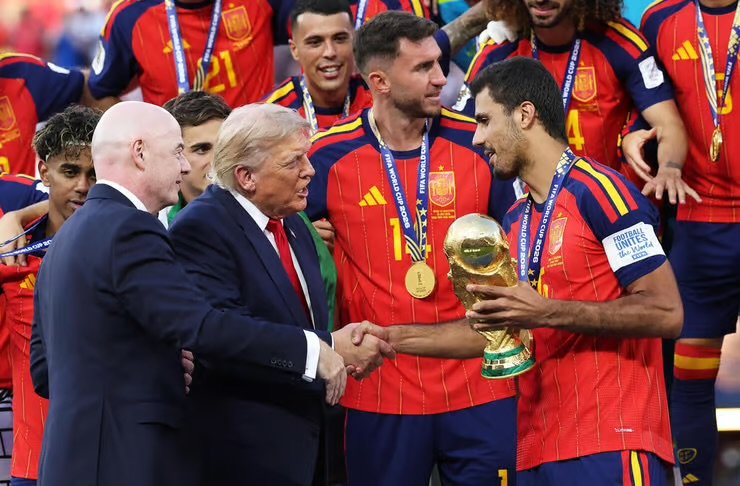
The United States president’s prominent role in the final ceremony produced audible hostility, disputed interpretations of a missed handshake and an awkward trophy celebration after Spain defeated Argentina in extra time.
President Donald Trump’s participation in the 2026 World Cup final became a conspicuous part of the closing ceremony after sections of the New Jersey crowd booed him and his prolonged appearance on the winners’ podium intruded briefly on Spain’s trophy celebration.
The observable events were unmistakable; some of the political interpretations attached to them were not.
Spain defeated defending champion Argentina 1-0 after extra time at New York New Jersey Stadium in East Rutherford on Sunday.
Substitute Ferran Torres scored the only goal in the 106th minute after Argentina had been reduced to 10 players by Enzo Fernández’s second yellow card.
The victory gave Spain its second men’s World Cup title, following its first in 2010, and added the global championship to the European title it won in 2024.
Trump arrived aboard Marine One and watched from a heavily secured executive suite alongside First Lady Melania Trump, FIFA President Gianni Infantino and an unusually concentrated group of political leaders.
The guests included Mexican President Claudia Sheinbaum, Canadian Prime Minister Mark Carney, Spanish Prime Minister Pedro Sánchez and King Felipe the Sixth and Queen Letizia of Spain.
The appearance made Trump the first sitting American president to attend a men’s World Cup final.
Bill Clinton did not attend the 1994 final in California, the only previous edition staged in the United States.
When Trump appeared on the stadium screens after the American national anthem, boos could be heard from portions of the crowd.
The reaction grew substantially louder when he entered the field with Infantino for the medal and trophy presentations.
It is not possible to establish from stadium audio how many spectators participated, so claims that all or most of the more than 80,000 people present were booing go beyond what the available evidence demonstrates.
Trump proceeded through the formal presentation line, greeting players from both teams.
He shook hands with Lionel Messi and other Argentine players as they received their runners-up medals following what may have been the 39-year-old captain’s final World Cup appearance.
Argentina defender Cristian Romero then passed through the line without shaking Trump’s hand.
Video shows Romero greeting Infantino and continuing toward the other dignitaries while bypassing the president.
The sequence circulated widely as an intentional political rebuff, but Romero has not publicly explained his conduct.
What is confirmed is that the handshake did not occur; the player’s motive has not been established.
Some footage also appeared to show Argentine defender Lisandro Martínez passing Trump without an exchange.
Medal ceremonies are congested, tightly choreographed and filled with overlapping introductions, making intent difficult to infer from a few seconds of video.
Describing either moment as a deliberate protest remains an interpretation rather than a verified fact.
The more visible protocol issue came during Spain’s celebration.
Trump and Infantino jointly presented the trophy to captain Rodri, who had also received the tournament’s Golden Ball as its best player.
After the formal handover, the president remained among the Spanish players as they gathered for the customary lift.
Trump raised his fists and joined the initial celebration before Infantino placed a hand near him and guided him away from the center of the group.
The intervention allowed the players to occupy the principal trophy image.
Trump left without any public confrontation.
Claims that he explicitly refused an instruction to leave the stage have not been substantiated.
The footage establishes that he stayed longer than customary and was subsequently directed aside, but no publicly available audio records what officials told him during the exchange.
The scene closely resembled the 2025 Club World Cup final at the same stadium.
After presenting Chelsea with that trophy, Trump remained beside the players during the lift even though the team had expected him to depart first.
Chelsea and Spain defender Marc Cucurella later said organizers had instructed the players to wait until the president left, only for Trump to tell them to lift the cup while he remained.
Cucurella described himself as extremely nervous and unwilling to challenge the president.
His comments concerned the 2025 ceremony, not Sunday’s World Cup presentation, although the recurrence gave the latest footage an immediate point of comparison.
Trump’s presence also carried diplomatic weight because several leaders seated near him represented governments with which Washington has had recent disputes.
Sheinbaum accepted his invitation after months of disagreements over trade and security, while Carney attended amid continuing tensions in the United States-Canada relationship.
The most pointed backdrop involved Spain.
Days before the final, Trump ordered a suspension of American trade with the country and described it as a “wasted cause” amid disputes with Sánchez over defense spending and Spain’s position on the war involving Iran.
Sánchez nevertheless attended the match, and the leaders temporarily shared the same ceremonial space as Spain claimed football’s most important prize.
That diplomatic conflict did not prevent Trump from congratulating Spain’s players or presenting the trophy.
Nor is there evidence that Romero’s missed handshake was connected to American policy toward Argentina, Spain or immigration, despite extensive speculation online.
Infantino’s decision to give Trump a central ceremonial role reflected the unusually close relationship between FIFA’s leadership and the government of the tournament’s largest host country.
The United States staged the competition with Canada and Mexico, requiring extensive federal involvement in security, visas, transportation and coordination among host cities.
Presidents and monarchs routinely attend major international finals, and host-country leaders often participate in trophy presentations.
The controversy arose less from Trump’s presence than from the amount of visual space he occupied after the formal duty had ended, at a moment traditionally reserved for the winning team.
That sequence should not obscure the sporting result.
Spain controlled the final, prevented Argentina from registering a shot on target and finally broke through after Fernández’s dismissal.
Argentine goalkeeper Emiliano Martínez delayed the defeat with a series of saves, but Torres’s extra-time finish ended Argentina’s attempt to become the first country since Brazil in 1962 to retain the men’s title.
Spain also collected the tournament’s principal individual honors: Rodri won the Golden Ball, Unai Simón received the Golden Glove and Pau Cubarsí was named the leading young player.
With the ceremony completed and the political guests removed from the stage, the Spanish squad lifted its second World Cup and began its reign as defending champion ahead of the 2030 tournament hosted by Spain, Portugal and Morocco.
The observable events were unmistakable; some of the political interpretations attached to them were not.
Spain defeated defending champion Argentina 1-0 after extra time at New York New Jersey Stadium in East Rutherford on Sunday.
Substitute Ferran Torres scored the only goal in the 106th minute after Argentina had been reduced to 10 players by Enzo Fernández’s second yellow card.
The victory gave Spain its second men’s World Cup title, following its first in 2010, and added the global championship to the European title it won in 2024.
Trump arrived aboard Marine One and watched from a heavily secured executive suite alongside First Lady Melania Trump, FIFA President Gianni Infantino and an unusually concentrated group of political leaders.
The guests included Mexican President Claudia Sheinbaum, Canadian Prime Minister Mark Carney, Spanish Prime Minister Pedro Sánchez and King Felipe the Sixth and Queen Letizia of Spain.
The appearance made Trump the first sitting American president to attend a men’s World Cup final.
Bill Clinton did not attend the 1994 final in California, the only previous edition staged in the United States.
When Trump appeared on the stadium screens after the American national anthem, boos could be heard from portions of the crowd.
The reaction grew substantially louder when he entered the field with Infantino for the medal and trophy presentations.
It is not possible to establish from stadium audio how many spectators participated, so claims that all or most of the more than 80,000 people present were booing go beyond what the available evidence demonstrates.
Trump proceeded through the formal presentation line, greeting players from both teams.
He shook hands with Lionel Messi and other Argentine players as they received their runners-up medals following what may have been the 39-year-old captain’s final World Cup appearance.
Argentina defender Cristian Romero then passed through the line without shaking Trump’s hand.
Video shows Romero greeting Infantino and continuing toward the other dignitaries while bypassing the president.
The sequence circulated widely as an intentional political rebuff, but Romero has not publicly explained his conduct.
What is confirmed is that the handshake did not occur; the player’s motive has not been established.
Some footage also appeared to show Argentine defender Lisandro Martínez passing Trump without an exchange.
Medal ceremonies are congested, tightly choreographed and filled with overlapping introductions, making intent difficult to infer from a few seconds of video.
Describing either moment as a deliberate protest remains an interpretation rather than a verified fact.
The more visible protocol issue came during Spain’s celebration.
Trump and Infantino jointly presented the trophy to captain Rodri, who had also received the tournament’s Golden Ball as its best player.
After the formal handover, the president remained among the Spanish players as they gathered for the customary lift.
Trump raised his fists and joined the initial celebration before Infantino placed a hand near him and guided him away from the center of the group.
The intervention allowed the players to occupy the principal trophy image.
Trump left without any public confrontation.
Claims that he explicitly refused an instruction to leave the stage have not been substantiated.
The footage establishes that he stayed longer than customary and was subsequently directed aside, but no publicly available audio records what officials told him during the exchange.
The scene closely resembled the 2025 Club World Cup final at the same stadium.
After presenting Chelsea with that trophy, Trump remained beside the players during the lift even though the team had expected him to depart first.
Chelsea and Spain defender Marc Cucurella later said organizers had instructed the players to wait until the president left, only for Trump to tell them to lift the cup while he remained.
Cucurella described himself as extremely nervous and unwilling to challenge the president.
His comments concerned the 2025 ceremony, not Sunday’s World Cup presentation, although the recurrence gave the latest footage an immediate point of comparison.
Trump’s presence also carried diplomatic weight because several leaders seated near him represented governments with which Washington has had recent disputes.
Sheinbaum accepted his invitation after months of disagreements over trade and security, while Carney attended amid continuing tensions in the United States-Canada relationship.
The most pointed backdrop involved Spain.
Days before the final, Trump ordered a suspension of American trade with the country and described it as a “wasted cause” amid disputes with Sánchez over defense spending and Spain’s position on the war involving Iran.
Sánchez nevertheless attended the match, and the leaders temporarily shared the same ceremonial space as Spain claimed football’s most important prize.
That diplomatic conflict did not prevent Trump from congratulating Spain’s players or presenting the trophy.
Nor is there evidence that Romero’s missed handshake was connected to American policy toward Argentina, Spain or immigration, despite extensive speculation online.
Infantino’s decision to give Trump a central ceremonial role reflected the unusually close relationship between FIFA’s leadership and the government of the tournament’s largest host country.
The United States staged the competition with Canada and Mexico, requiring extensive federal involvement in security, visas, transportation and coordination among host cities.
Presidents and monarchs routinely attend major international finals, and host-country leaders often participate in trophy presentations.
The controversy arose less from Trump’s presence than from the amount of visual space he occupied after the formal duty had ended, at a moment traditionally reserved for the winning team.
That sequence should not obscure the sporting result.
Spain controlled the final, prevented Argentina from registering a shot on target and finally broke through after Fernández’s dismissal.
Argentine goalkeeper Emiliano Martínez delayed the defeat with a series of saves, but Torres’s extra-time finish ended Argentina’s attempt to become the first country since Brazil in 1962 to retain the men’s title.
Spain also collected the tournament’s principal individual honors: Rodri won the Golden Ball, Unai Simón received the Golden Glove and Pau Cubarsí was named the leading young player.
With the ceremony completed and the political guests removed from the stage, the Spanish squad lifted its second World Cup and began its reign as defending champion ahead of the 2030 tournament hosted by Spain, Portugal and Morocco.
Ferran Torres scored in the one hundred and sixth minute as Spain beat the defending champions one-nil in New Jersey and reclaimed the title sixteen years after its first triumph.
Spain won the 2026 FIFA World Cup because its sustained control finally broke an Argentina side reduced to ten players, with Ferran Torres scoring the decisive goal in the one hundred and sixth minute of a tense final at New York New Jersey Stadium.
The one-nil victory delivered Spain its second men's world championship, sixteen years after the generation led by Andrés Iniesta claimed the country's first title in South Africa.
The final was goalless after ninety minutes, but the balance of play had already tilted sharply toward Spain.
Luis de la Fuente's team monopolized possession, compressed Argentina into its own half and generated repeated attempts against goalkeeper Emiliano Martínez.
Argentina offered little attacking threat during regulation time and relied heavily on defensive organization, tactical fouls and Martínez's interventions to remain level.
The pivotal disciplinary moment arrived late in normal time when midfielder Enzo Fernández received a second yellow card and was sent off.
Argentina entered extra time with ten players against a Spanish side already dictating the tempo, leaving the defending champions with even less capacity to press, counterattack or retain the ball.
Spain initially appeared to have found the breakthrough through Nico Williams, but the effort was disallowed following an infringement in the buildup.
The pressure continued.
Early in the second period of extra time, Williams helped create another opening, and Torres converted from inside the penalty area to place Spain ahead.
Argentina attempted a late response, including a rare effort from Lionel Messi, but could not force an equalizer.
The result ended Argentina's attempt to retain the trophy it won in Qatar in 2022. It also brought a painful conclusion to what may have been Messi's final World Cup appearance.
At thirty-nine, the Argentine captain was tightly contained for most of the match and struggled to influence a game in which his team spent long periods without meaningful possession or service in advanced areas.
For Spain, the championship completed a broader return to the summit of international football.
The team arrived as reigning European champion and advanced through the knockout rounds with a blend of territorial control, technical precision and defensive discipline.
Its triumph was not built around a single veteran core but around a younger generation capable of combining Spain's traditional possession game with greater directness and speed.
The final also underlined the depth of the Spanish squad.
Torres began outside the central narrative surrounding the tournament's biggest stars, yet became the player who settled its most important match.
Williams provided penetration from the flank, while Spain's midfield restricted Argentina's routes into the final third and repeatedly recovered possession before counterattacks could develop.
Argentina's defeat was severe in competitive terms but did not erase the achievements of the previous four years.
The team entered the final as defending world champion after a cycle that included continental success and a sustained period near the top of the international game.
In New Jersey, however, its strategy became increasingly dependent on survival rather than creation, and Fernández's dismissal made that approach harder to sustain.
The match concluded the first forty-eight-team men's World Cup, staged across the United States, Canada and Mexico.
Spain received the trophy after a final defined less by open exchanges than by accumulated pressure, defensive resistance and one clinical extra-time finish.
What is confirmed is that Spain has returned to the top of world football with a second title, while Argentina's reign ended after four years.
Torres's extra-time goal now joins Iniesta's winner in 2010 as the strike that secured a World Cup for Spain.
The one-nil victory delivered Spain its second men's world championship, sixteen years after the generation led by Andrés Iniesta claimed the country's first title in South Africa.
The final was goalless after ninety minutes, but the balance of play had already tilted sharply toward Spain.
Luis de la Fuente's team monopolized possession, compressed Argentina into its own half and generated repeated attempts against goalkeeper Emiliano Martínez.
Argentina offered little attacking threat during regulation time and relied heavily on defensive organization, tactical fouls and Martínez's interventions to remain level.
The pivotal disciplinary moment arrived late in normal time when midfielder Enzo Fernández received a second yellow card and was sent off.
Argentina entered extra time with ten players against a Spanish side already dictating the tempo, leaving the defending champions with even less capacity to press, counterattack or retain the ball.
Spain initially appeared to have found the breakthrough through Nico Williams, but the effort was disallowed following an infringement in the buildup.
The pressure continued.
Early in the second period of extra time, Williams helped create another opening, and Torres converted from inside the penalty area to place Spain ahead.
Argentina attempted a late response, including a rare effort from Lionel Messi, but could not force an equalizer.
The result ended Argentina's attempt to retain the trophy it won in Qatar in 2022. It also brought a painful conclusion to what may have been Messi's final World Cup appearance.
At thirty-nine, the Argentine captain was tightly contained for most of the match and struggled to influence a game in which his team spent long periods without meaningful possession or service in advanced areas.
For Spain, the championship completed a broader return to the summit of international football.
The team arrived as reigning European champion and advanced through the knockout rounds with a blend of territorial control, technical precision and defensive discipline.
Its triumph was not built around a single veteran core but around a younger generation capable of combining Spain's traditional possession game with greater directness and speed.
The final also underlined the depth of the Spanish squad.
Torres began outside the central narrative surrounding the tournament's biggest stars, yet became the player who settled its most important match.
Williams provided penetration from the flank, while Spain's midfield restricted Argentina's routes into the final third and repeatedly recovered possession before counterattacks could develop.
Argentina's defeat was severe in competitive terms but did not erase the achievements of the previous four years.
The team entered the final as defending world champion after a cycle that included continental success and a sustained period near the top of the international game.
In New Jersey, however, its strategy became increasingly dependent on survival rather than creation, and Fernández's dismissal made that approach harder to sustain.
The match concluded the first forty-eight-team men's World Cup, staged across the United States, Canada and Mexico.
Spain received the trophy after a final defined less by open exchanges than by accumulated pressure, defensive resistance and one clinical extra-time finish.
What is confirmed is that Spain has returned to the top of world football with a second title, while Argentina's reign ended after four years.
Torres's extra-time goal now joins Iniesta's winner in 2010 as the strike that secured a World Cup for Spain.

Hundreds of demonstrators gathered in central New Delhi demanding accountability for examination failures, but police enforced prohibitory orders and began removing supporters before the unauthorized procession could reach Parliament.
Delhi Police blocked the Cockroach Janta Party’s planned march from Jantar Mantar to Parliament on Monday, July 20, deploying thousands of officers, barricades, riot-control vehicles and water cannons across central New Delhi.
Police began removing supporters from the designated protest area before the procession could advance, citing prohibitory orders and the absence of official permission.
The demonstration coincided with the opening of Parliament’s monsoon session.
Section 163 of the Bharatiya Nagarik Suraksha Sanhita was in force throughout the New Delhi district, restricting unauthorized processions, demonstrations and assemblies of five or more people outside approved locations.
Police said no application for the march had been submitted or approved and warned that participants in an unauthorized procession could face legal action.
Hundreds of students, parents, activists and political supporters assembled at Jantar Mantar despite heavy rain and extensive security restrictions.
Protesters waved Indian flags, carried copies of the Constitution and held plastic roses intended to signal peaceful intent.
Organizers claimed that substantially larger numbers had gathered in the surrounding area but were prevented from reaching the site.
The Cockroach Janta Party is not a conventional registered political party.
It began in May as a satirical, youth-led online movement founded by political communications strategist Abhijeet Dipke.
Its provocative name emerged after remarks by India’s chief justice comparing some unemployed protesters with “cockroaches” and “parasites,” language that young critics of the political and education systems adopted as a symbol of endurance and collective resistance.
The movement rapidly converted online attention into street demonstrations focused on examination integrity, graduate unemployment and political accountability.
Its immediate demand is the resignation of Education Minister Dharmendra Pradhan over repeated examination irregularities and the leak of a national medical entrance paper.
The central controversy concerns the 2026 National Eligibility cum Entrance Test for undergraduate medical admissions, commonly known as NEET-UG. Nearly 2.28 million candidates sat the examination on May 3. The National Testing Agency cancelled it on May 12 after investigators established that question papers had circulated before the test.
A nationwide re-examination was held under heightened security on June 21 for more than two million candidates.
The Indian Air Force transported confidential paper packets to some examination centers, while people involved in preparing and translating the questions were isolated at a secure location.
Results were released on July 16, but the successful retest did not extinguish anger over the disruption, financial costs and psychological pressure placed on candidates and their families.
Investigators have made arrests in connection with the leak.
One accused candidate allegedly received question papers through Telegram and sold access for one million rupees.
His retest score was withheld despite a court permitting him to sit the replacement examination.
The criminal allegations remain subject to judicial proceedings.
Protest organizers say more than 20 students died by suicide during the period of uncertainty surrounding the cancelled examination and retest.
Families have attributed those deaths to examination pressure and the disruption, but no single official finding has established that every case resulted directly from the leak.
The movement has also raised complaints about school-leaving examinations, university admissions and government recruitment tests.
Its proposed reforms include stronger security for examination papers, transparent investigations, fixed accountability when tests are compromised and compensation or practical support for affected candidates.
Pradhan has rejected the movement’s characterization of his conduct and called the group the “B team of disruptive elements.” He has argued that its supporters are attempting to create confusion and undermine confidence in India’s progress.
The government has investigated the medical-test leak and implemented tighter safeguards for the retest, but it has not accepted the protesters’ demand for the minister’s resignation.
Tensions escalated after police transferred engineer, educator and environmental activist Sonam Wangchuk from Jantar Mantar to Safdarjung Hospital on Saturday.
Wangchuk had entered the twenty-first day of an indefinite hunger strike and had lost approximately nine kilograms while consuming salt, water and electrolyte fluids.
Police said his health had deteriorated and that the transfer followed medical advice and judicial directions requiring authorities to protect his life.
Protesters described the removal as coercive.
Wangchuk’s wife, Gitanjali Angmo, sought permission to move him to a private hospital, but the Delhi High Court declined to intervene immediately, finding that hospitalization was not arbitrary.
It ordered continued medical supervision and a fresh health report within three days, with another hearing scheduled for July 24.
Wangchuk remained medically stable but weak under continuous observation on Monday and continued his fast.
He said he would stop if the government accepted responsibility for recent examination failures, if movement representatives reached Parliament and received assurances that lawmakers would raise the issue, or if political leaders visited him and made the same commitment.
Dipke began his own indefinite fast after Wangchuk’s hospitalization and insisted that the march would remain peaceful.
Protesters also expanded their demands to include Prime Minister Narendra Modi’s resignation following the police intervention, although the movement’s original and principal demand concerned Pradhan.
Parallel demonstrations have taken place in Mumbai, Bengaluru, Hyderabad and Pune, showing that discontent extends beyond the Jantar Mantar encampment.
Opposition politicians, public figures and student organizations have joined or endorsed parts of the campaign, while the government maintains that examination reform must proceed without unauthorized disruption around Parliament.
Monday’s police operation prevented the planned procession from reaching the parliamentary complex, but it did not end the campaign.
Wangchuk remains under hospital supervision, Dipke’s fast continues, and organizers are pressing lawmakers to place examination accountability before Parliament during the monsoon session.
Police began removing supporters from the designated protest area before the procession could advance, citing prohibitory orders and the absence of official permission.
The demonstration coincided with the opening of Parliament’s monsoon session.
Section 163 of the Bharatiya Nagarik Suraksha Sanhita was in force throughout the New Delhi district, restricting unauthorized processions, demonstrations and assemblies of five or more people outside approved locations.
Police said no application for the march had been submitted or approved and warned that participants in an unauthorized procession could face legal action.
Hundreds of students, parents, activists and political supporters assembled at Jantar Mantar despite heavy rain and extensive security restrictions.
Protesters waved Indian flags, carried copies of the Constitution and held plastic roses intended to signal peaceful intent.
Organizers claimed that substantially larger numbers had gathered in the surrounding area but were prevented from reaching the site.
The Cockroach Janta Party is not a conventional registered political party.
It began in May as a satirical, youth-led online movement founded by political communications strategist Abhijeet Dipke.
Its provocative name emerged after remarks by India’s chief justice comparing some unemployed protesters with “cockroaches” and “parasites,” language that young critics of the political and education systems adopted as a symbol of endurance and collective resistance.
The movement rapidly converted online attention into street demonstrations focused on examination integrity, graduate unemployment and political accountability.
Its immediate demand is the resignation of Education Minister Dharmendra Pradhan over repeated examination irregularities and the leak of a national medical entrance paper.
The central controversy concerns the 2026 National Eligibility cum Entrance Test for undergraduate medical admissions, commonly known as NEET-UG. Nearly 2.28 million candidates sat the examination on May 3. The National Testing Agency cancelled it on May 12 after investigators established that question papers had circulated before the test.
A nationwide re-examination was held under heightened security on June 21 for more than two million candidates.
The Indian Air Force transported confidential paper packets to some examination centers, while people involved in preparing and translating the questions were isolated at a secure location.
Results were released on July 16, but the successful retest did not extinguish anger over the disruption, financial costs and psychological pressure placed on candidates and their families.
Investigators have made arrests in connection with the leak.
One accused candidate allegedly received question papers through Telegram and sold access for one million rupees.
His retest score was withheld despite a court permitting him to sit the replacement examination.
The criminal allegations remain subject to judicial proceedings.
Protest organizers say more than 20 students died by suicide during the period of uncertainty surrounding the cancelled examination and retest.
Families have attributed those deaths to examination pressure and the disruption, but no single official finding has established that every case resulted directly from the leak.
The movement has also raised complaints about school-leaving examinations, university admissions and government recruitment tests.
Its proposed reforms include stronger security for examination papers, transparent investigations, fixed accountability when tests are compromised and compensation or practical support for affected candidates.
Pradhan has rejected the movement’s characterization of his conduct and called the group the “B team of disruptive elements.” He has argued that its supporters are attempting to create confusion and undermine confidence in India’s progress.
The government has investigated the medical-test leak and implemented tighter safeguards for the retest, but it has not accepted the protesters’ demand for the minister’s resignation.
Tensions escalated after police transferred engineer, educator and environmental activist Sonam Wangchuk from Jantar Mantar to Safdarjung Hospital on Saturday.
Wangchuk had entered the twenty-first day of an indefinite hunger strike and had lost approximately nine kilograms while consuming salt, water and electrolyte fluids.
Police said his health had deteriorated and that the transfer followed medical advice and judicial directions requiring authorities to protect his life.
Protesters described the removal as coercive.
Wangchuk’s wife, Gitanjali Angmo, sought permission to move him to a private hospital, but the Delhi High Court declined to intervene immediately, finding that hospitalization was not arbitrary.
It ordered continued medical supervision and a fresh health report within three days, with another hearing scheduled for July 24.
Wangchuk remained medically stable but weak under continuous observation on Monday and continued his fast.
He said he would stop if the government accepted responsibility for recent examination failures, if movement representatives reached Parliament and received assurances that lawmakers would raise the issue, or if political leaders visited him and made the same commitment.
Dipke began his own indefinite fast after Wangchuk’s hospitalization and insisted that the march would remain peaceful.
Protesters also expanded their demands to include Prime Minister Narendra Modi’s resignation following the police intervention, although the movement’s original and principal demand concerned Pradhan.
Parallel demonstrations have taken place in Mumbai, Bengaluru, Hyderabad and Pune, showing that discontent extends beyond the Jantar Mantar encampment.
Opposition politicians, public figures and student organizations have joined or endorsed parts of the campaign, while the government maintains that examination reform must proceed without unauthorized disruption around Parliament.
Monday’s police operation prevented the planned procession from reaching the parliamentary complex, but it did not end the campaign.
Wangchuk remains under hospital supervision, Dipke’s fast continues, and organizers are pressing lawmakers to place examination accountability before Parliament during the monsoon session.
The city-state is examining tax and operating-cost relief for investment firms after Hong Kong proposed broader exemptions on carried interest and performance fees.
Singapore is reviewing whether to reduce the tax burden on fund managers as Hong Kong prepares a more aggressive incentive regime designed to attract hedge funds, private-equity firms and senior investment professionals.
The Monetary Authority of Singapore has held discussions with investment companies about measures that could preserve the city-state’s competitiveness, including a possible reduction in the preferential tax rate available to qualifying financial businesses.
The talks reflect growing concern within Singapore’s investment industry that Hong Kong’s proposed treatment of carried interest and performance fees could prompt highly paid portfolio managers to relocate.
Hong Kong is moving toward rules that would allow profits from a wider range of investments to qualify as carried interest taxed at zero percent.
The potential beneficiaries extend beyond conventional private equity to hedge funds, venture-capital managers, private-credit firms and family offices.
Carried interest is the share of investment profits awarded to fund managers when a portfolio performs successfully.
Performance fees serve a comparable purpose in hedge funds.
Because these earnings can account for a substantial portion of a senior manager’s compensation, their tax treatment can influence where professionals live, where firms establish offices and where investment decisions are formally made.
Singapore already offers a favorable environment for asset managers.
Qualifying investment groups can pay tax at ten percent under a special incentive scheme, compared with the standard corporate rate of seventeen percent.
One option under consideration is to reduce that preferential rate further.
Investment executives have argued that without additional relief, some firms may establish Hong Kong offices or arrange for selected employees to work there to benefit from the territory’s proposed rules.
The discussions do not mean Singapore has approved a tax cut.
The regulator has said it is reviewing measures to strengthen the country’s position as a trusted and dynamic financial center, but no final policy has been announced.
The review covers a broader range of possibilities than personal tax relief, including measures that would lower the operating costs borne by investment firms.
That alternative may be politically easier.
Directly reducing taxes for wealthy fund managers could prove contentious while Singaporean households are confronting elevated living costs.
Assistance aimed at firms rather than individuals could allow employers to improve compensation without creating the same public impression that the government is granting a special windfall to already highly paid financiers.
The rivalry marks a reversal of the movement that followed political turmoil and strict pandemic controls in Hong Kong.
During that period, finance professionals and international companies shifted personnel and operations to Singapore, strengthening its position as Asia’s preferred base for wealth management and investment activity.
Hong Kong is now attempting to regain some of that ground through tax reform and a broader campaign to draw global capital and talent back to the territory.
Tax is only one element in the decision.
Hedge funds also weigh regulatory predictability, access to investors, proximity to markets, availability of skilled employees, housing costs, schools and the expense of maintaining an office.
Singapore retains a significant advantage because many firms have already transferred legal structures, senior personnel and operational systems there.
Reversing those moves would require more than relocating individual portfolio managers.
Hong Kong, however, offers direct access to mainland China and an established capital-market infrastructure.
A zero-percent rate on eligible carried interest could materially improve the after-tax compensation of senior investors, particularly at firms where performance-related earnings exceed fixed salaries.
Even without a wholesale migration, the rule could encourage groups headquartered in Singapore to divide teams between the two cities.
The competition also extends beyond Asia.
Dubai has attracted a growing concentration of hedge funds through favorable taxation, abundant regional capital and a regulatory framework built to accommodate international investment businesses.
That expansion has intensified competition for experienced portfolio managers and demonstrates how quickly talent can move when compensation, regulation and access to investors align.
For Singapore, the policy challenge is to remain attractive without allowing financial incentives to undermine fiscal credibility or domestic confidence.
For Hong Kong, the challenge is to convert tax advantages into durable commitments from firms rather than temporary arrangements built around a small number of highly paid employees.
The next move belongs to Singapore’s financial authorities and economic policymakers.
They must decide whether to lower the ten-percent preferential rate, reduce business costs through other mechanisms or preserve the existing system while relying on the depth of the investment industry already established in the city-state.
The Monetary Authority of Singapore has held discussions with investment companies about measures that could preserve the city-state’s competitiveness, including a possible reduction in the preferential tax rate available to qualifying financial businesses.
The talks reflect growing concern within Singapore’s investment industry that Hong Kong’s proposed treatment of carried interest and performance fees could prompt highly paid portfolio managers to relocate.
Hong Kong is moving toward rules that would allow profits from a wider range of investments to qualify as carried interest taxed at zero percent.
The potential beneficiaries extend beyond conventional private equity to hedge funds, venture-capital managers, private-credit firms and family offices.
Carried interest is the share of investment profits awarded to fund managers when a portfolio performs successfully.
Performance fees serve a comparable purpose in hedge funds.
Because these earnings can account for a substantial portion of a senior manager’s compensation, their tax treatment can influence where professionals live, where firms establish offices and where investment decisions are formally made.
Singapore already offers a favorable environment for asset managers.
Qualifying investment groups can pay tax at ten percent under a special incentive scheme, compared with the standard corporate rate of seventeen percent.
One option under consideration is to reduce that preferential rate further.
Investment executives have argued that without additional relief, some firms may establish Hong Kong offices or arrange for selected employees to work there to benefit from the territory’s proposed rules.
The discussions do not mean Singapore has approved a tax cut.
The regulator has said it is reviewing measures to strengthen the country’s position as a trusted and dynamic financial center, but no final policy has been announced.
The review covers a broader range of possibilities than personal tax relief, including measures that would lower the operating costs borne by investment firms.
That alternative may be politically easier.
Directly reducing taxes for wealthy fund managers could prove contentious while Singaporean households are confronting elevated living costs.
Assistance aimed at firms rather than individuals could allow employers to improve compensation without creating the same public impression that the government is granting a special windfall to already highly paid financiers.
The rivalry marks a reversal of the movement that followed political turmoil and strict pandemic controls in Hong Kong.
During that period, finance professionals and international companies shifted personnel and operations to Singapore, strengthening its position as Asia’s preferred base for wealth management and investment activity.
Hong Kong is now attempting to regain some of that ground through tax reform and a broader campaign to draw global capital and talent back to the territory.
Tax is only one element in the decision.
Hedge funds also weigh regulatory predictability, access to investors, proximity to markets, availability of skilled employees, housing costs, schools and the expense of maintaining an office.
Singapore retains a significant advantage because many firms have already transferred legal structures, senior personnel and operational systems there.
Reversing those moves would require more than relocating individual portfolio managers.
Hong Kong, however, offers direct access to mainland China and an established capital-market infrastructure.
A zero-percent rate on eligible carried interest could materially improve the after-tax compensation of senior investors, particularly at firms where performance-related earnings exceed fixed salaries.
Even without a wholesale migration, the rule could encourage groups headquartered in Singapore to divide teams between the two cities.
The competition also extends beyond Asia.
Dubai has attracted a growing concentration of hedge funds through favorable taxation, abundant regional capital and a regulatory framework built to accommodate international investment businesses.
That expansion has intensified competition for experienced portfolio managers and demonstrates how quickly talent can move when compensation, regulation and access to investors align.
For Singapore, the policy challenge is to remain attractive without allowing financial incentives to undermine fiscal credibility or domestic confidence.
For Hong Kong, the challenge is to convert tax advantages into durable commitments from firms rather than temporary arrangements built around a small number of highly paid employees.
The next move belongs to Singapore’s financial authorities and economic policymakers.
They must decide whether to lower the ten-percent preferential rate, reduce business costs through other mechanisms or preserve the existing system while relying on the depth of the investment industry already established in the city-state.
A draft cooperation framework would open Saudi Arabia’s civilian nuclear market to American technology while potentially allowing sensitive fuel-cycle activities under negotiated restrictions, but no final agreement has been signed or submitted to Congress.
The Trump administration’s proposed civilian nuclear cooperation agreement with Saudi Arabia could permit the kingdom to pursue some form of domestic uranium enrichment under safeguards negotiated with the United States and the International Atomic Energy Agency.
The available documentation describes a draft framework rather than a completed pact: President Donald Trump has not signed a final agreement, and no formal text has been transmitted to Congress for the statutory review required before American nuclear exports can proceed.
The distinction is central.
Washington and Riyadh appear to have made substantial progress toward defining the scope of cooperation, but an unsigned negotiating text carries no legal authority.
It may still be revised by either government, and its most consequential provisions—including enrichment limits, inspection rights and the handling of nuclear material—have not been publicly released in final form.
Under Section 123 of the United States Atomic Energy Act, significant civilian nuclear cooperation with another country generally requires a bilateral agreement establishing legally binding nonproliferation conditions.
Such agreements govern the transfer of reactors, fuel, equipment, technology and nuclear material.
Once signed by the president, an agreement must be submitted to Congress, which receives an opportunity to examine its safeguards and, under certain procedures, block or condition its implementation.
The draft Saudi framework reportedly lists uranium enrichment, nuclear-fuel fabrication and the reprocessing of spent fuel among the sensitive activities that could fall under bilateral safeguards.
That language does not establish that Saudi Arabia has received an unrestricted right to enrich uranium.
It indicates that enrichment may remain negotiable rather than being prohibited outright, potentially allowing a limited program subject to monitoring, technical constraints and additional agreements.
Enrichment is used to increase the proportion of the uranium isotope needed for reactor fuel.
At low levels, it supports civilian electricity generation.
The same centrifuge technology can, however, be operated for longer periods to produce material approaching weapons grade.
Domestic enrichment therefore gives a country greater control over its fuel supply while also shortening the technical path it would need to travel if a future government decided to pursue a weapon.
Saudi Arabia maintains that its nuclear ambitions are civilian and form part of a broader strategy to diversify an electricity system historically dependent on oil and natural gas.
Nuclear power could provide stable generation, preserve more hydrocarbons for export and support the kingdom’s industrial expansion.
Riyadh has also sought access to the full nuclear fuel cycle and argues that it should not be denied capabilities available to other members of the Nuclear Non-Proliferation Treaty.
The Trump administration views cooperation as a way to anchor Saudi Arabia’s emerging nuclear sector within an American-led regulatory and commercial structure.
American involvement would give Washington influence over safety standards, inspections, technology choices and the long-term handling of nuclear material.
It would also help United States companies compete for contracts potentially worth billions of dollars against suppliers from China, Russia, France and South Korea.
Administration documents describe the strategy as serving both national-security and industrial interests.
The proposed model would differ from the agreement reached with the United Arab Emirates, which renounced domestic enrichment and spent-fuel reprocessing.
That commitment became known as the nuclear cooperation gold standard.
Allowing Saudi Arabia even a restricted enrichment capability would establish a more flexible precedent and could prompt other countries to demand equivalent treatment.
The regional context intensifies the scrutiny.
Crown Prince Mohammed bin Salman has previously said Saudi Arabia would seek a nuclear weapon if Iran obtained one.
That statement does not prove that the kingdom’s present civilian program has a military purpose, but it ensures that any enrichment provision will receive close examination from Congress, nonproliferation specialists and regional governments.
Saudi Arabia remains a party to the Nuclear Non-Proliferation Treaty and would be expected to place covered nuclear activities under international verification.
International Atomic Energy Agency oversight could include inspections, accounting for nuclear material, surveillance equipment and verification that declared facilities are not being diverted to military use.
The strength of those protections would depend on the final legal text, the inspection authorities accepted by Riyadh and whether Saudi Arabia adopts enhanced monitoring obligations beyond its existing safeguards arrangement.
Israel will also follow the negotiations closely because a Saudi enrichment capability could alter the region’s strategic balance.
At the same time, a tightly supervised American agreement could give Washington greater visibility into the Saudi program than Riyadh would offer under a partnership dominated by another supplier.
The policy calculation is therefore not simply whether Saudi Arabia develops nuclear power, but whether the United States shapes the rules governing that development.
What is confirmed is that a proposed American-Saudi framework contemplates safeguards for highly sensitive nuclear activities and may leave a path to some form of enrichment.
It is not confirmed that the administration has granted Saudi Arabia an unconditional enrichment right or completed an agreement ready to take effect.
The decisive steps remain presidential signature, public disclosure of the negotiated terms and submission to Congress for formal review.
The available documentation describes a draft framework rather than a completed pact: President Donald Trump has not signed a final agreement, and no formal text has been transmitted to Congress for the statutory review required before American nuclear exports can proceed.
The distinction is central.
Washington and Riyadh appear to have made substantial progress toward defining the scope of cooperation, but an unsigned negotiating text carries no legal authority.
It may still be revised by either government, and its most consequential provisions—including enrichment limits, inspection rights and the handling of nuclear material—have not been publicly released in final form.
Under Section 123 of the United States Atomic Energy Act, significant civilian nuclear cooperation with another country generally requires a bilateral agreement establishing legally binding nonproliferation conditions.
Such agreements govern the transfer of reactors, fuel, equipment, technology and nuclear material.
Once signed by the president, an agreement must be submitted to Congress, which receives an opportunity to examine its safeguards and, under certain procedures, block or condition its implementation.
The draft Saudi framework reportedly lists uranium enrichment, nuclear-fuel fabrication and the reprocessing of spent fuel among the sensitive activities that could fall under bilateral safeguards.
That language does not establish that Saudi Arabia has received an unrestricted right to enrich uranium.
It indicates that enrichment may remain negotiable rather than being prohibited outright, potentially allowing a limited program subject to monitoring, technical constraints and additional agreements.
Enrichment is used to increase the proportion of the uranium isotope needed for reactor fuel.
At low levels, it supports civilian electricity generation.
The same centrifuge technology can, however, be operated for longer periods to produce material approaching weapons grade.
Domestic enrichment therefore gives a country greater control over its fuel supply while also shortening the technical path it would need to travel if a future government decided to pursue a weapon.
Saudi Arabia maintains that its nuclear ambitions are civilian and form part of a broader strategy to diversify an electricity system historically dependent on oil and natural gas.
Nuclear power could provide stable generation, preserve more hydrocarbons for export and support the kingdom’s industrial expansion.
Riyadh has also sought access to the full nuclear fuel cycle and argues that it should not be denied capabilities available to other members of the Nuclear Non-Proliferation Treaty.
The Trump administration views cooperation as a way to anchor Saudi Arabia’s emerging nuclear sector within an American-led regulatory and commercial structure.
American involvement would give Washington influence over safety standards, inspections, technology choices and the long-term handling of nuclear material.
It would also help United States companies compete for contracts potentially worth billions of dollars against suppliers from China, Russia, France and South Korea.
Administration documents describe the strategy as serving both national-security and industrial interests.
The proposed model would differ from the agreement reached with the United Arab Emirates, which renounced domestic enrichment and spent-fuel reprocessing.
That commitment became known as the nuclear cooperation gold standard.
Allowing Saudi Arabia even a restricted enrichment capability would establish a more flexible precedent and could prompt other countries to demand equivalent treatment.
The regional context intensifies the scrutiny.
Crown Prince Mohammed bin Salman has previously said Saudi Arabia would seek a nuclear weapon if Iran obtained one.
That statement does not prove that the kingdom’s present civilian program has a military purpose, but it ensures that any enrichment provision will receive close examination from Congress, nonproliferation specialists and regional governments.
Saudi Arabia remains a party to the Nuclear Non-Proliferation Treaty and would be expected to place covered nuclear activities under international verification.
International Atomic Energy Agency oversight could include inspections, accounting for nuclear material, surveillance equipment and verification that declared facilities are not being diverted to military use.
The strength of those protections would depend on the final legal text, the inspection authorities accepted by Riyadh and whether Saudi Arabia adopts enhanced monitoring obligations beyond its existing safeguards arrangement.
Israel will also follow the negotiations closely because a Saudi enrichment capability could alter the region’s strategic balance.
At the same time, a tightly supervised American agreement could give Washington greater visibility into the Saudi program than Riyadh would offer under a partnership dominated by another supplier.
The policy calculation is therefore not simply whether Saudi Arabia develops nuclear power, but whether the United States shapes the rules governing that development.
What is confirmed is that a proposed American-Saudi framework contemplates safeguards for highly sensitive nuclear activities and may leave a path to some form of enrichment.
It is not confirmed that the administration has granted Saudi Arabia an unconditional enrichment right or completed an agreement ready to take effect.
The decisive steps remain presidential signature, public disclosure of the negotiated terms and submission to Congress for formal review.
The International Monetary Fund raised Thailand's 2026 growth forecast to one point nine percent, citing the country's expanding position in the global technology supply chain and its emergence alongside Taiwan and South Korea as a major exporter of advanced artificial intelligence hardware.
EU Imposes Record €550 Million Digital Services Fine on AliExpress
Between Deliveries, Wang Jibing Wrote His Way to China’s Literary Heights
Morgan Stanley Builds a Wall Street Lead in AI Infrastructure Finance
High Prices Push Coffee Drinkers Toward Whole Beans and Home Brewing
Trump Draws Boos and Podium Scrutiny at Spain’s World Cup Triumph
Spain Defeats Argentina in Extra Time to Win Second World Cup
Police Block Cockroach Janta Party’s March to Parliament as Education Protests Intensify
Singapore Considers Lower Taxes for Fund Managers as Hong Kong Intensifies Talent Contest
Proposed U.S.-Saudi Nuclear Pact Could Permit Limited Uranium Enrichment Under International Safeguards
Why Kentucky Fried Chicken Became KFC—and Why the False Explanations Persist
Ukrainian Drones Strike Wildberries Warehouses Deep Inside Russia
Reported CIA Mission Helped Clear the UAE’s Path to Advanced US AI Chips
Artificial Intelligence Capital Fuels Markets While Governments and Regulators Face Mounting Strategic Tests
China’s Moonshot’s Kimi K3 Narrows the Gap With Anthropic Through Scale, Openness and Lower Cost
Gold and Cash Seizure Puts Indonesia’s Senior Anti-Corruption Prosecutor Under Investigation
The Ledger Will Not Trust on Faith
Ukraine’s Leadership Rift Spills Into the Streets as Protesters Target Army Chief
The Ten World Cup Finals That Defined Football History
Smartphones Are Getting More Expensive, Sales Are Collapsing, and Even Apple Admits: "Prices Will Rise"
Leadership Change and Strategic Rivalry Redraw the Political Map
The AI Race Enters Its Infrastructure Era
Britain Nationalises British Steel to Protect Scunthorpe Production and Strategic Supply
French National Assembly Overrides Senate to Pass Historic Assisted-Dying Legislation
Thomas Tuchel Faces Fierce Backlash After Tactical Retreat Costs England World Cup Final Berth
A Quiet Bastille Day: France Grapples with World Cup Heartbreak and Leftover Fireworks
Spain in Ecstasy: "We Feel Unbeatable, We Taught the Whole World a Lesson"
Harvard Astrophysicist to Lead U.S. Scientific Advisory on Unidentified Aerial Phenomena
Emergency Sirens Activated Across Bahrain as Interior Ministry Issues Shelter Directives
World Cup Visitors Turn American Big-Box Stores Into Souvenir Stops
Netflix Weighs Always-On Channels, Bundles and Short-Form Video
The AI Invoice Shock: Layoffs Didn't Save Managers Money — They Cost Them More
Concern: Sexually Transmitted Bacterium Among Men Develops Antibiotic Resistance
Following Massive Investor Demand: SK Hynix Raises 26.5 Billion Dollars on Nasdaq
Passenger Partially Pulled Out of Ryanair Jet After Cabin Window Fails Mid-Flight
Severe Heatwave Drives Dangerous Ground-Level Ozone Pollution Across Two Thirds of European Union
Flight Instructor Jumped to His Death — Student Landed the Plane: "You Know What You Need to Do"
The Physical and Electronic Barriers Disrupting Domestic Wireless Networks
France and Morocco Open World Cup Quarter-Finals as Collina Defends Refereeing
Tech Pulse: The Future of AI and Screen Culture
Global News Briefing: Escalating Geopolitical Tensions and Corporate Shakeups
Global News Brief: Escalating Conflicts, Public Health Crises, and World Cup Drama
Europe's Growing Struggle with Extreme Heat and Air Conditioning
Anthropic Reengineers Agentic Architecture to Shift Autonomous Workplace Automation to the Cloud
Apple Advances Late-Stage Operating Systems with Fourth Beta Deployments
Global Crisis Alert: Escalating Middle East Tensions and UK Political Upheaval
"A New Era of Testing": The Rare Launch of a Missile from a Chinese Nuclear Submarine - That Could Reach U.S. Soil
Japanese Technology Firm Fujitsu Launches Advanced Artificial Intelligence Tool for Corporate Disclosures
South Africa Officially Launches Nationwide Campaign for Highly Contested Local Government Elections
United Kingdom Commits Additional Funding for Unexploded Ordnance Clearance in Laos
Singapore Announces Stringent New Greenhouse Gas Regulations for Commercial Cooling Systems