Soulful, surprising, and awe-inspiring, these architectural stops need to be on your itinerary.

Mexico City was no exception to the postwar design boom and explosion of modern architecture that swept cities worldwide. A far departure from the low-slung profiles and butterfly roofs dominating tracts across the United States, however, the structures rising in CDMX during the midcentury period were big. They were bold. And-paying homage to the vibrant culture, food, and flora of the region-they were colorful. Here, we peer inside six icons that disrupted design in their heyday, and that left a legacy for architecture aficionados today.

Hotel Camino Real Polanco
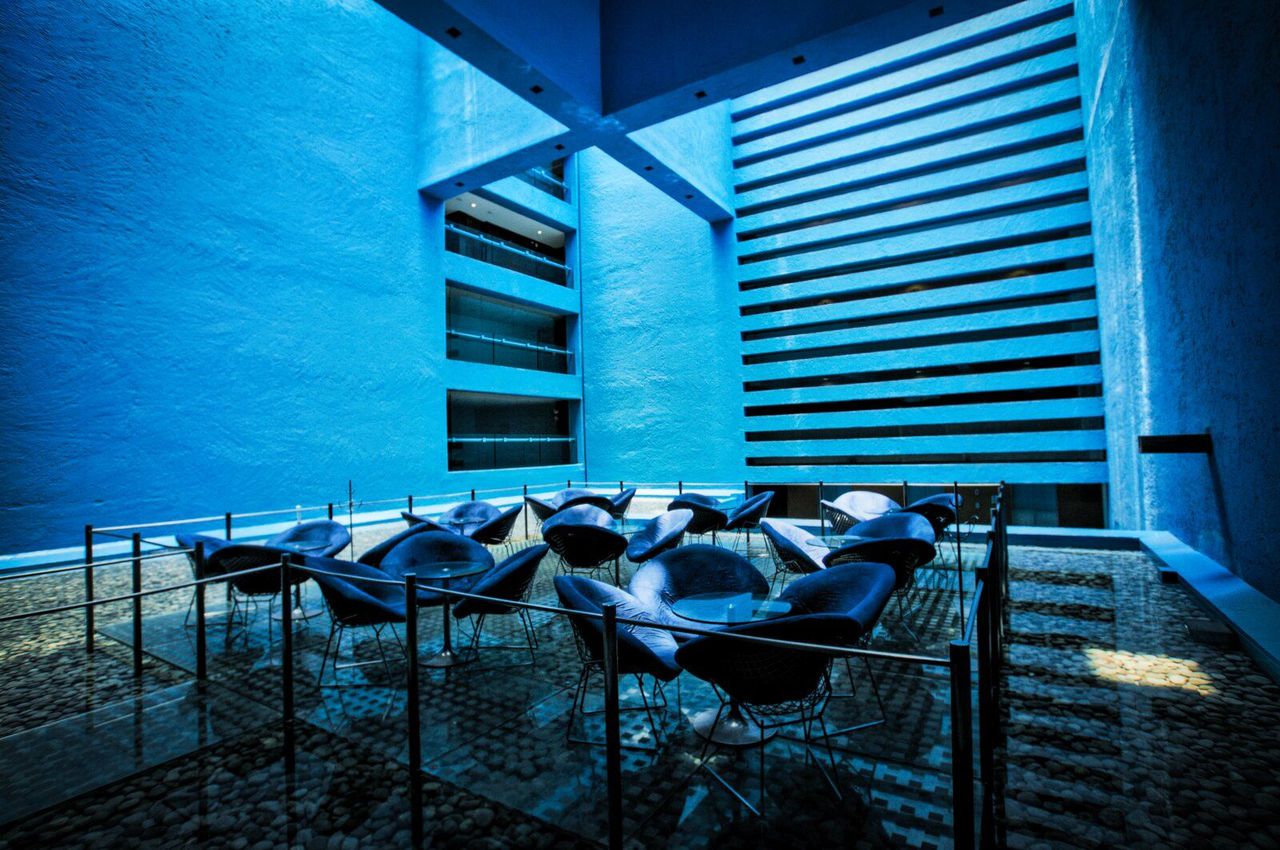


An emblem of the 1968 Olympics held in Mexico City, the Camino Real in the upscale neighborhood of Polanco offers museum-quality art and furnishings.

Architect Ricardo Legorreta was a mere three years into his own practice-and recovering from a long illness-when he got the life-changing commission to design Camino Real Polanco in advance of the 1968 Summer Olympics held in Mexico City. It was a tight timeline, with the games just a year and a half out.

But with the good fortune of a vast plot of land near the city center, Legoretta took a chance. While other firms might have designed vertically, Legorreta created an expansive five-story building with an inviting, residential feel, weaving in a central courtyard, private patios, gardens, and rooftop terraces.

"When coming out of an illness, you realize life is short, and you have to take advantage of it," says his son, Victor Legorreta, now partner and managing and design director at Legorreta. "He thought, Now is the opportunity to do something more unique, more brave-a chance to take more risks. For him, it was a personal challenge to be able to do something unique."
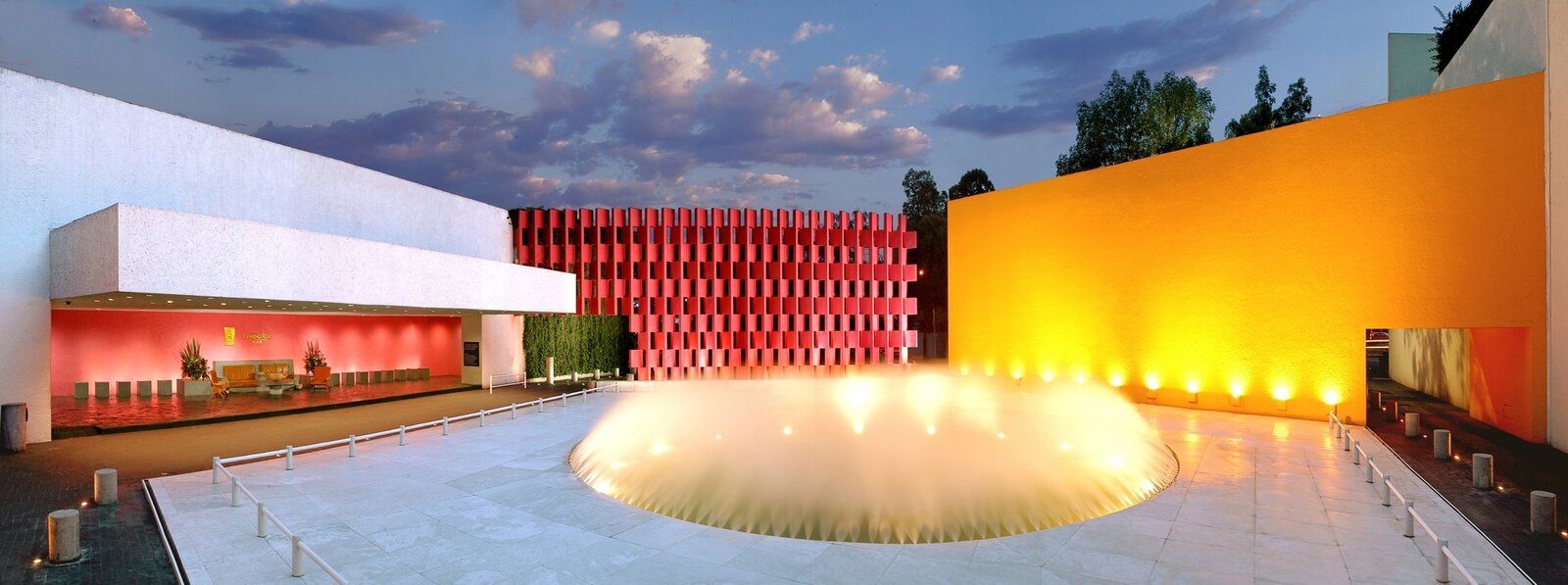


"My father was getting out of this really rationalistic approach from the International Movement, and knowing [Luis] Barragán at that time, he blended functional and romantic aspects," says Victor Legorreta, son of Ricardo Legorreta, who designed the Hotel Camino Real. "It's one of the qualities of the hotel: architecture that uses emotion and courtyards. That uniqueness—it's the first time you see that element in homes now in a large setting."

Immersive walls of color meet rough plaster walls, common in Mexican architecture, and the effect is most striking in the hot pink screen and yellow wall that shields a grandiose fountain in the motor court. It’s a poetic intersection of modernity and nature, and a sure influence of his friend Luis Barragán. "It’s architecture that’s relevant to the place, relevant to the culture," says Victor.

Camino Real Polanco represents the zeitgeist of time and place, of modernism at its peak, of collaborative artists and creatives, and of the Summer Olympics, which gave permission to push boundaries. "In the ‘60s with the Olympics, there was a boom in Mexico, and now I’m very optimistic that we are again looking at an interesting period of time," says Victor. His firm is taking on the remodel of the hotel, complete with modern-day lighting and restaurant terraces, an omnipresent pivot across architecture as a result of COVID-19. But for the restoration, the firm will remain true to its roots, respectfully reviving the original work of his late father. As Victor says, "It will be an intervention of Legorreta by Legorreta."

Torres de Satélite



Luis Barragán and Mathias Goeritz’s enchanting Torres de Satélite, built in 1957, announce the gateway to Ciudad Satélite, which was conceived as a commuter community when the population of Mexico City was booming.

He is the father of "emotional architecture," a recipient of the Pritzker Architecture Prize, the architect and engineer with an oeuvre so vast and pivotal to modern architecture’s growth in Mexico City that he’s become a household name. And while Luis Barragán may be better known for projects like Cuadra San Cristóbal, his Torres de Satélite, or Satellite Towers-a collaboration with sculptor Mathias Goertiz and painter Jesús "Chucho" Reyes-redefined the skyline in 1957.

Envisioned as a gateway to the adjacent community of Satélite, designed by architect and urban planner Mario Pani, the Torres de Satélite was to be one of two sculptures (another on the northern edge remains unbuilt) announcing themselves from afar-and viewed by car. You see, the towers sit in a busy median, smack-dab in the middle of the highway. From miles away, you notice an eruption of color from the lanes. Interest turns to curiosity, and then fascination, as the five isosceles pyramids seem to change shape and color during the approach.

When originally designed, they donned white, yellow, and ochre hues. During the Summer Olympics, a monochromatic orange palette contrasted the sky. Today, you’ll see blue, white, yellow, and red prisms that shift depending on the weather, time of day, and where you stand.

"Barragán was more of an artist," says Victor Legorreta. "He was going back to the vernacular and using color in a very romantic approach to architecture. You see the emotions." And the closer you look, the more you discover. The towers’ masonry emphasizes the horizontal, a technique seen in several Frank Lloyd Wright–designed homes. The vertical seams are smooth, broadening the horizon. Some 60 years later, the sculptures still beg the question: Are the Torres de Satélite art or architecture?

Torre Banobras
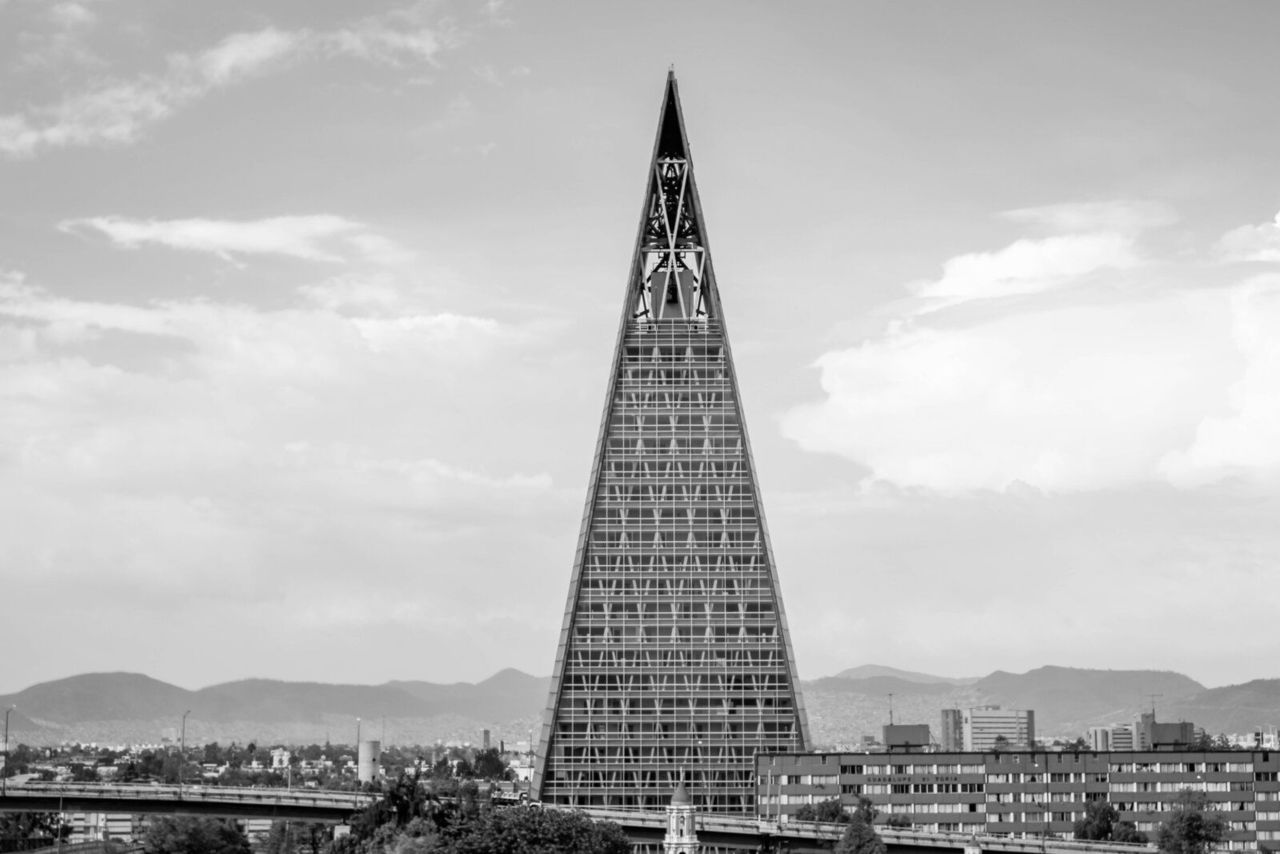


Architect Mario Pani’s 1962 Torre Banobras was built as part of the Nonoalco Tlatelolco Housing Project, the second-largest complex in North America. At the time, it was the second-tallest building in the country.

It’s a disservice to try to reduce the work of architect and urbanist Mario Pani to just one building. Torre Banobras, or Insignia Tower, is only one skyscraper among the 100-plus buildings that comprise the Nonoalco Tlatelolco Housing Project in northern Mexico City. That’s right, a housing complex of more than 100 buildings-the second largest in North America after New York’s Co-op City.

Tlatelolco was a redevelopment project with an aim of introducing a new way of life. The independent city-within-a-city would integrate diverse socioeconomic classes and hold schools, hospitals, and grocery stores for some 70,000 residence. Each block would offer all services one could need, and at Torre Banobras, that meant banking.

Completed in 1962, it served as the headquarters of the National Bank of Public Works and Services. Today its 24 floors serve as office space. The triangular prism is made of reinforced concrete, glass, and aluminum, and while the 1985 earthquake caused much damage to the housing complex at large, Torre Banobras endured-and is considered one of the safest tall buildings in the city. Fun fact: It is home to the largest carillon in the Americas with 47 bells.

Museo Casa Estudio Diego Rivera y Frida Kahlo
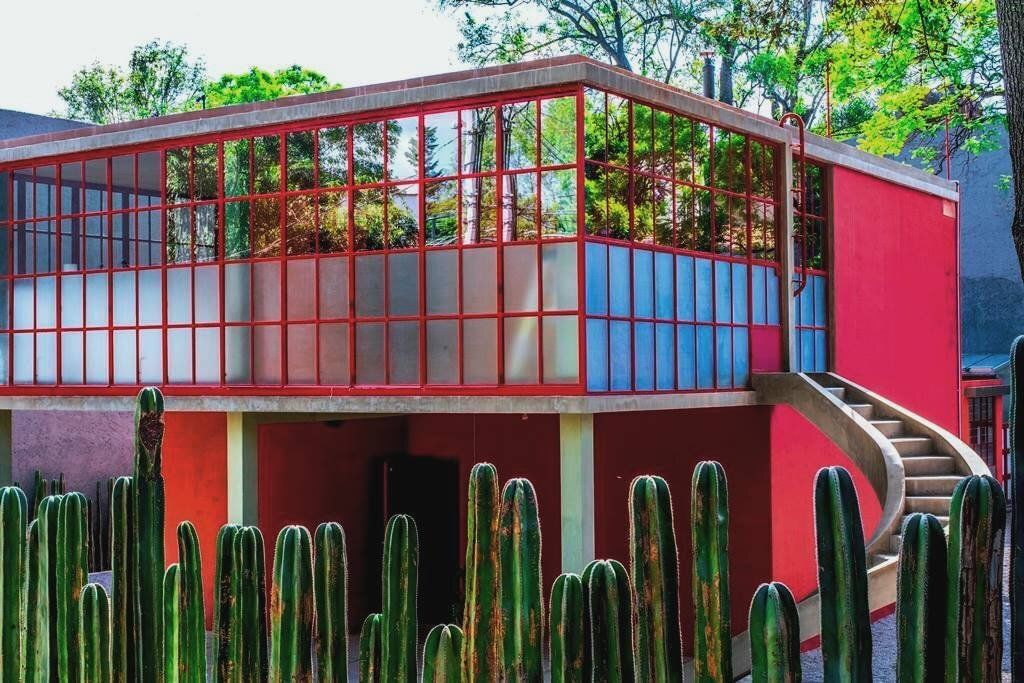


A view of Diego Rivera’s home studio at Museo Casa Estudio Diego Rivera y Frida Kahlo features a subtle replica of the grand helicoid stair that spirals from the adjacent main house.

While many visitors rightfully flock to the famed La Casa Azul, or the Frida Kahlo Museum, the lesser-known museum of Kahlo and Diego Rivera sits a mere 15 minutes away, and is an icon in its own right.

Architect and painter Juan O’Gorman designed Museo Casa Estudio Diego Rivera y Frida Kahlo at just 26 years old in 1931, making it far ahead of its time. Here you’ll find the functionalist influence of Le Corbusier, but with undeniable modernist Mexican aesthetics and artistic flourishes. Rich hues, the use of clay, a helicoid stair, and a signature cacti fence complete the three home-studios. O’Gorman went on to design many modernist structures, including the famed Central Library at the Universidad Nacional Autonoma de Mexico (UNAM), which we'd be remiss not to mention-and brings us to our next stop.

Ciudad Universitaria
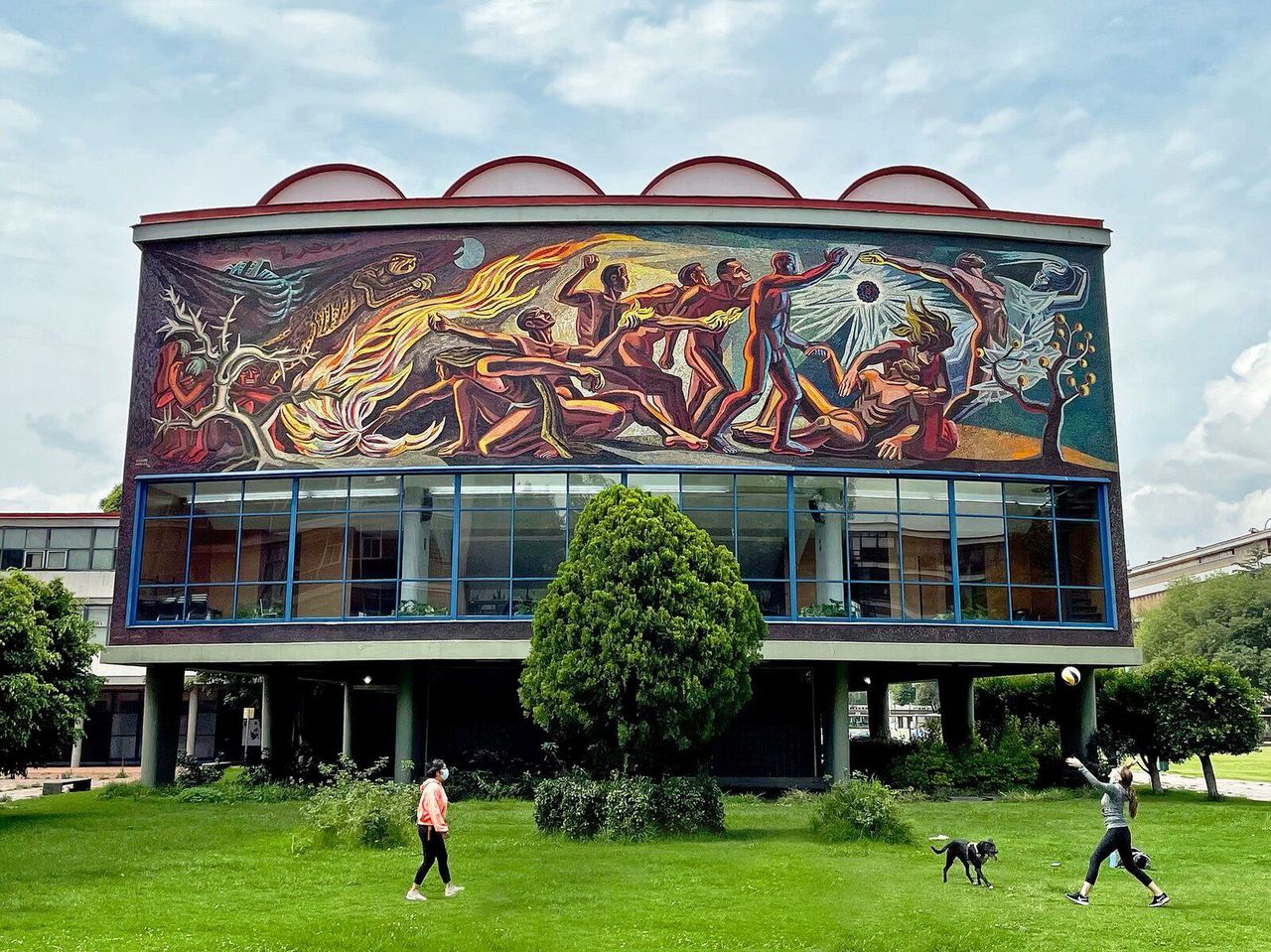


The Alfonso Caso Auditorium within Ciudad Universitaria was designed in 1954 and widely recognized for its glass mosaic mural by José Chávez Morado. It’s one of the many examples of art's intersection with architecture on the campus. Named "La Conquista de la Energía," or "The Conquest of Energy," the mural depicts new cycles of human life and pays homage to the former sciences and labor building.

There’s not one building, but rather the entire campus that makes Universidad Nacional Autónoma de México (UNAM) a modernist icon and a must-see. A UNESCO World Heritage Site, UNAM comprises over 2,000 buildings spread across 2,500 acres. And here at the main campus, Ciudad Universitaria, design has an even more monumental presence.

Created by more than 60 designers and master planned by Mario Pani and Enrique del Moral, the site touts a veritable who’s who of famed midcentury architects and artists. "The most important architects of Mexican modernity took part in Ciudad Universitaria," says Dr. Juan Ignacio del Cueto Ruiz-Funes, director of the Faculty of Architecture at UNAM. Teams of three architects developed the executive projects, and he says: "This makes it choral-a collective work with very clear guidelines set by Pani and del Moral, but with different expressions in each of the projects. This also makes it very rich. It provides it with architectural wealth."

Everywhere you look, there are entire facades made of steel-framed windows, painted blue on one building, yellow on another. Again, we see cues from Le Corbusier with many of the structures lifted on stilts, expanding the vistas and creating greater human scale and community.

"When we talk about Ciudad Universitaria, the architects had been-for 15, almost 20 years-in this process of internalizing these ideas that came from Europe," says del Cueto. "It’s a very Mexican expression of the principles of modern architecture and modernity."

Artists like Diego Rivera, David Alfaro Siqueiros, José Chávez Morado, and Francisco Eppens produced some of the most significant murals in Ciudad Universitaria. Totaling more than 100, the artworks capture time, place, and history. Says del Cueto, "The pre-Hispanic buildings, architecture, painting, and even sculpture are integrated, so the idea was to bring back these principles."

Los Manantiales Restaurant
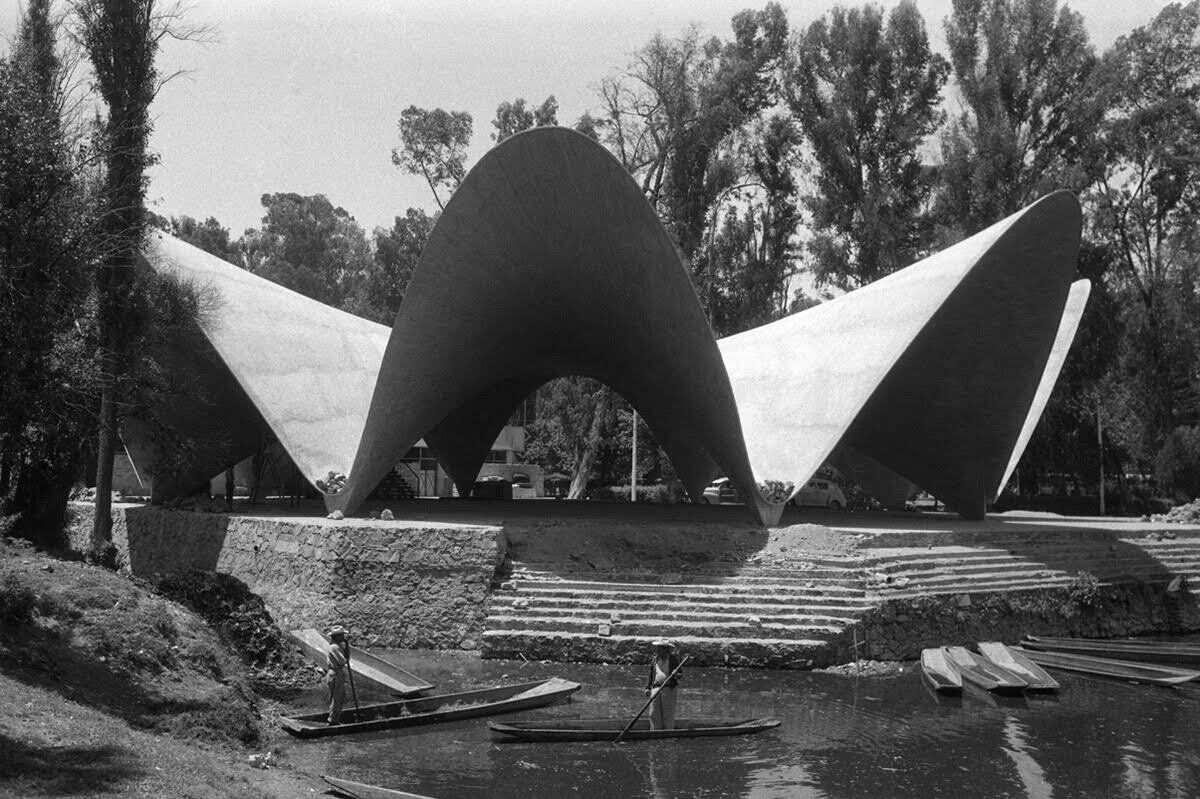


Félix Candela, Los Manantiales Restaurant, Xochimilco, Mexico City, 1958

Locals and tourists alike know Xochimilco for its beloved floating gardens, enjoyed while lazing in a colorful trajinera, or wooden boat, alongside mariachis. Yet within this UNESCO World Heritage Site, you’ll discover a striking juxtaposition-a hyperbolic paraboloid, of all things, amid lush pre-Hispanic riverbeds.

Designed by Joaquín Álvarez Ordóñez and engineered by Spanish exiled architect Félix Candela in 1958, Los Manantiales Restaurant touts eight petals of concrete with canted edges as thin as two inches. Dr. Juan Ignacio del Cueto had the opportunity to interview Candela when he was 92 years old. "He told me he had a lot of doubts about what to study," says del Cueto. "A friend of his father convinced him to study architecture. He said he had trouble drawing-he didn’t have a good hand for it-but he was very good with structural calculus, and what he liked most were the reinforced concrete shells made in Europe during the interwar period."

When Candela arrived from Spain, he was just 29 years old. A decade later, he designed his first experimental shell, "and from that moment on, he began to become famous," says del Cueto.

While structurally intact, the now-defunct restaurant is in the midst of restoration-with the help of Álvarez and del Cueto. For now, it is best enjoyed along a canal ride with a cold cerveza.

Indonesian authorities arrested 72 people accused of using illegal fires to clear land across Borneo and Sumatra as a worsening dry season generated heavy transboundary haze and contributed to the closure of nearly 600 schools in neighboring Malaysian states.
Prime Minister Anutin Charnvirakul convened senior military and intelligence officials after more than 50 bombings and arson attacks targeted infrastructure in Narathiwat, Pattani and Yala, prompting an urgent review of security measures amid fears of renewed insurgent violence.
Prime Minister Lawrence Wong announced that every Singaporean child will receive about 70,000 Singapore dollars in financial support through cash payments and grants by age seventeen, as the government steps up efforts to address the country’s declining fertility rate.
Thailand has begun enforcing updated electric vehicle requirements that oblige foreign automakers to produce two vehicles locally for every one imported this year, alongside new battery sourcing rules intended to deepen domestic supply chains in the Eastern Economic Corridor.
Singapore’s Ministry of Trade and Industry upgraded its annual economic growth forecast to as much as 5.5 percent, citing robust global electronics demand and a sharp increase in the adoption of agentic artificial intelligence among local businesses.
President Prabowo Subianto inaugurated Indonesia’s national electric motorcycle initiative in West Java, backed by state financing and designed to build domestic capacity in electric vehicle and battery manufacturing while positioning Indonesia as a global production hub.
Thailand received investment applications worth 1.4 trillion baht, or about 43.6 billion US dollars, in the first half of the year, a 37 percent increase from a year earlier as global technology companies expanded data centers, cloud infrastructure and advanced electronics manufacturing.
An Indonesian court convicted twenty-six-year-old Luzian Andrin Zgraggen of blasphemy after he breached strict holiday restrictions and posted an explicit video from an empty beach.
An Indonesian court on the island of Bali has sentenced twenty-six-year-old Swiss national Luzian Andrin Zgraggen to one year in prison for publicly insulting Nyepi, the sacred Balinese Hindu Day of Silence.

The verdict follows Zgraggen's arrest in March after he recorded and published a social media video that violated island-wide religious restrictions and sparked widespread public outrage.

During Nyepi, Bali enforces strict, mandatory observances requiring residents and tourists alike to remain indoors, extinguish lights, cease travel, and refrain from loud noises or public activities.

The island's international airport suspends operations and commercial internet connectivity is largely restricted for twenty-four hours to maintain complete silence.

Zgraggen violated the curfew by walking onto a deserted beach, filming the empty surroundings, and sharing the footage online alongside captions containing expletives.

Presiding judges ruled that Zgraggen's deliberate breach and subsequent social media broadcast caused profound offense to the Balinese population and desecrated religious customs.

In court, Zgraggen expressed remorse and offered a public apology, testifying that he had failed to comprehend the scope and religious gravity of the annual holiday before violating the rules.

The prison sentence reflects an intensifying campaign by Indonesian authorities to enforce local laws and religious standards amid record post-pandemic tourism volumes.

While immigration officials have historically deported or briefly detained foreign visitors who violated local ordinances, local prosecutors have increasingly sought formal custodial sentences for deliberate acts of public blasphemy and disruptive behavior at cultural and religious sites across the province.
Japanese police intervened after the child was discovered abandoned for hours in rainy, foggy conditions at 2,000 meters while his father continued hiking toward the peak.
Japanese police have castigated a forty-eight-year-old father who abandoned his seven-year-old son on Mount Fuji in poor weather conditions to continue climbing toward the summit with his older child.

Mountain hut staff discovered the boy sitting alone on a bench near the trail's sixth station at an altitude exceeding two thousand meters, prompting an emergency call to local law enforcement.

The boy, left behind with only a soft drink and a snack after complaining of fatigue, was found waiting in dense fog and rain.

Police officers located the father hours later between the seventh and eighth stations, approximately a three-hour hike further up the mountain.

By the time authorities brought the father back down to reunite with his son, the child had been left unsupervised for approximately eight hours.

Police reprimanded the father upon his return, emphasizing that abandoning a young child on the mountain under adverse weather was entirely unacceptable, regardless of climbing ambitions.

The father apologized for what he described as a rash decision.

The incident occurred along the popular Fujinomiya route, which begins at the fifth station and typically requires an eight-hour round trip to reach the 3,776-meter summit.

The mountain, an active volcano and designated UNESCO World Heritage site that attracts roughly two hundred thousand hikers annually, has experienced a series of safety incidents and overcrowding issues, leading local authorities to enforce stricter route management and daily visitor caps.
Malaysian policymakers are examining expanded social care arrangements after federal welfare spending reached seven hundred twenty-eight million ringgit, warning that responsibility for elderly and social care cannot rest entirely with families.
Philippine security forces arrested a wanted bombing suspect and a Lanao del Sur vice mayor facing murder charges in separate operations in Mindanao, strengthening the government’s efforts to combat crime in the volatile southern region.
Gold industry representatives are preparing talks with Thai ministers to oppose proposed taxation measures, warning that the changes could disrupt one of Southeast Asia’s most active physical gold markets.
Indonesian police arrested one hundred ninety-seven people, including Singaporean nationals, in a raid on an illegal gambling network in Batam and seized hundreds of thousands of dollars in cash and other assets.
Thai authorities have widened investigations into three companies in Pattaya as part of a broader crackdown on nominee arrangements allegedly used to circumvent restrictions on foreign ownership of property.
Executive Secretary Ralph Recto has rejected claims of a systemic garbage crisis while blaming improper waste disposal for clogging waterways and worsening severe flooding across Metro Manila.
Thai transport authorities are assessing a seventy-four-kilometer rail expansion intended to connect with existing national infrastructure, reduce logistics costs and improve urban and regional connectivity.
Cambodian policymakers are channeling workforce-development funding into electric vehicles and agricultural processing to build industrial skills and attract higher-value manufacturing activity.
Prime Minister Anutin Charnvirakul has ordered faster humanitarian relief as severe flooding affects Nan and eight other northern provinces, with authorities also strengthening early-warning systems to protect communities and agricultural production.
Private-sector executives are calling for greater technology adoption, knowledge sharing and access to finance to unlock the potential of Thailand’s three point three million small and medium-sized enterprises amid a volatile global economy.
Chinese luxury companies in jewelry, watches and premium wine are increasingly targeting Southeast Asia’s affluent consumers as a testing ground for international expansion, intensifying competition across the region’s high-end retail market.
Thai policymakers are examining new frameworks to strengthen trade and logistics links with New Zealand, as Bangkok seeks to diversify international commercial partnerships and expand its role as a regional distribution hub.
The ASEAN Observer Team has inspected parts of Banteay Meanchey province after Cambodia protested the deployment of shipping containers by Thai forces, highlighting continued tensions over territorial demarcation.
Vietnam has deployed thousands of emergency personnel after Storm Narra brought extreme rainfall to northern and central provinces, triggering landslides, damaging infrastructure and disrupting local supply chains.
Strong public registration for the new TH-AI Passport and growing interest in digital asset tokenization point to accelerating adoption of advanced digital financial technologies in Thailand.
A series of coordinated arson and bomb attacks in Pattani, Yala and Narathiwat led to the suspension of State Railway of Thailand services and prompted Malaysia to advise citizens to postpone non-essential travel to the border region.
The Armed Forces of the Philippines has rejected demands from China’s embassy to remove the grounded naval vessel from Ayungin Shoal, reaffirming Manila’s position on its territorial claims in the South China Sea.
President Prabowo Subianto has ordered a major emergency response to forest and land fires in Kalimantan and traveled to the region to oversee containment efforts, while authorities pledged tougher enforcement against environmental violations.
Prime Minister Lawrence Wong used his National Day Rally to warn that intensifying US-China tensions and fragmented supply chains are creating a more uncertain global environment, urging Singapore to deepen partnerships that protect its position as an international hub.
Thailand’s Civil Aviation Authority is advancing modernization plans across regional airports to distribute rising tourism flows more effectively and strengthen the country’s role as a major aviation hub in Southeast Asia.
Malaysia’s Immigration Department detained one hundred ninety-eight undocumented workers during an operation in Subang Jaya, as authorities continue a nationwide crackdown on unauthorized foreign labour and warn businesses against employing unregistered workers.
Public health experts say the high cost of newer dengue vaccines is a major barrier to wider protection as severe outbreaks across Southeast Asia claim dozens of lives this season.
Bangkok municipal inspectors have identified severely overcrowded residential facilities housing migrant workers with official identification cards, prompting reviews of sanitary conditions, housing standards and possible labour exploitation.
Conservation groups and residents are urging Singapore’s planning authorities to reconsider proposed residential development near Gillman Barracks, citing concerns over the ecological value and biodiversity of Maju Forest.
A fatal shooting at Ateneo de Zamboanga University, in which a student killed a peer before taking his own life during a livestream, has prompted renewed discussion in the Philippines about campus security and institutional responses to student safety.
Thailand’s disaster authorities are coordinating relief operations across six provinces affected by persistent flooding, while officials in Nan province are strengthening flood preparations ahead of further heavy rain.
Malaysia’s government is advancing legislation to repeal a university law dating back fifty-five years, responding to longstanding demands for greater campus autonomy and more space for student political activity.
Thai authorities have ordered the removal of unauthorized durian plantations covering six hundred rai of protected state land in Trat province as the government tightens enforcement around the country’s rapidly expanding export-oriented durian industry.
A series of coordinated bomb and arson attacks targeted infrastructure in Thailand’s southern Narathiwat province, injuring two people and underscoring continuing security challenges in the area bordering Malaysia.
Indonesia is preparing stricter local content requirements for electric vehicles as policymakers seek to attract more investment in domestic manufacturing and make greater use of the country’s large nickel reserves.
Government officials, central bankers and business executives are meeting in Singapore for the Reuters NEXT Asia Summit to discuss artificial intelligence, supply-chain shifts and the outlook for economic growth across Southeast Asia.
Early economic data indicate that Thailand’s latest co-payment subsidy has increased domestic consumer spending and retail activity, providing additional support for the government’s efforts to strengthen the economic recovery.
Malaysia has temporarily halted the extradition of a Malaysia Airlines pilot arrested in Jakarta over alleged drug trafficking as Indonesian authorities investigate whether the case is linked to a wider international smuggling network.
Thai authorities have raided more than sixty companies suspected of using illegal foreign nominee structures in major tourist destinations, intensifying enforcement of rules governing foreign participation in property and hospitality businesses.
Malaysia and Brunei are using ASEAN channels to address hazardous air pollution after high Air Pollutant Index readings in Sarawak and elsewhere, with the two countries pressing for action against peatland and agricultural fires.
Trade analysts warn that US investigations into alleged tariff evasion by Chinese manufacturers could disrupt legitimate exporters across Southeast Asia, where production networks are closely integrated with Chinese manufacturing.
Google is working with Thailand’s Ministry of Digital Economy and Society on data privacy and regulatory frameworks as the company prepares for major cloud infrastructure investment in the country.
Indonesia’s disaster agency says seventy-five people have died following a seven point seven magnitude earthquake off Flores island, while tens of thousands remain displaced as authorities repair damaged infrastructure and provide emergency assistance.
Singapore has allocated two hundred megawatts of additional power capacity to four major data center operators as the city-state seeks to meet rising demand for cloud computing and artificial intelligence infrastructure.
Swiss Tourist Sentenced to One Year in Prison for Insulting Bali's Sacred Day of Silence
Father Reprimanded After Leaving Seven-Year-Old Son Alone on Mount Fuji During Summit Climb
Google Launches Pixel 11 With Gemini AI at the Center of Its Hardware Strategy
China’s Kimi Launches AI-Focused Credit Card With Agricultural Bank of China and American Express
Success: Nvidia Turned Gaming Chips Into the Engine of the AI Boom
AI’s Next Bottleneck Is Power, Not Just Nvidia Chips
Meta Raises AI Spending Target to as Much as $145bn Despite Pressure Over Returns
Joe Biden’s Cancer Has Spread Beyond His Bones, Hunter Biden Says
Why 2027 Could Be a Strong Year for Stocks—and Why the Forecast Is Fragile
Why Markets May Look Quiet in August After Big Tech Earnings
UFO: Pentagon Releases Video of Unidentified Object Tracked Over Middle East
Ukraine Tells Senate Republicans Its Drone War Offers a Blueprint for America
Weight-Loss Drug Boom Tests the Limits of Prescription Advertising Rules
Taiwan’s President Joins Wartime Command Drill as China Pressure Grows
Lightning Strike Kills Yala FC Player During Match in Southern Thailand
AI Is Remaking the US Economy, From GDP Growth to iPhone Prices
Indonesia’s Free School Meals Plan Has Been Hit by Poisoning, Corruption and Cuts
US and Japan Step In to Support the Yen in Rare Joint Intervention
FIFA’s Retreat Leaves a Larger Question Over Who Guards the Game
Valued at $109 Million: F-35B Fighter Jet Crashes in Southern California
US Says It Has Carried Out Heavy Strikes on Iran After Attempted Attacks on Its Forces
Over 24 Hours in the Air: Qantas Airbus Completes Record-Breaking Test Flight
Nvidia Reportedly Takes Vast Texas Data-Centre Lease to Underwrite AI Expansion
FIFA’s Private-Investment Plan for World Cup Rights Draws European Revolt
Following OpenAI's Cyberattack: 'Most Companies Still Do Not Understand What Is Coming'
OpenAI Sued After ChatGPT Allegedly Discouraged Emergency Care Before Near-Fatal Embolism
Miliband Sets Climate and International Law at Centre of UK Diplomacy
Trump Readies New Tariffs as Temporary Global Levy Nears Expiry
EU Imposes Record €550 Million Digital Services Fine on AliExpress
Between Deliveries, Wang Jibing Wrote His Way to China’s Literary Heights
Morgan Stanley Builds a Wall Street Lead in AI Infrastructure Finance
High Prices Push Coffee Drinkers Toward Whole Beans and Home Brewing
Trump Draws Boos and Podium Scrutiny at Spain’s World Cup Triumph
Spain Defeats Argentina in Extra Time to Win Second World Cup
Police Block Cockroach Janta Party’s March to Parliament as Education Protests Intensify
Singapore Considers Lower Taxes for Fund Managers as Hong Kong Intensifies Talent Contest
Proposed U.S.-Saudi Nuclear Pact Could Permit Limited Uranium Enrichment Under International Safeguards
Why Kentucky Fried Chicken Became KFC—and Why the False Explanations Persist
Ukrainian Drones Strike Wildberries Warehouses Deep Inside Russia
Reported CIA Mission Helped Clear the UAE’s Path to Advanced US AI Chips
Artificial Intelligence Capital Fuels Markets While Governments and Regulators Face Mounting Strategic Tests
China’s Moonshot’s Kimi K3 Narrows the Gap With Anthropic Through Scale, Openness and Lower Cost
Gold and Cash Seizure Puts Indonesia’s Senior Anti-Corruption Prosecutor Under Investigation
The Ledger Will Not Trust on Faith
Ukraine’s Leadership Rift Spills Into the Streets as Protesters Target Army Chief
The Ten World Cup Finals That Defined Football History
Smartphones Are Getting More Expensive, Sales Are Collapsing, and Even Apple Admits: "Prices Will Rise"
Leadership Change and Strategic Rivalry Redraw the Political Map
The AI Race Enters Its Infrastructure Era
Britain Nationalises British Steel to Protect Scunthorpe Production and Strategic Supply