President Prabowo Subianto awarded Indonesia's highest civilian honor to Indian Prime Minister Narendra Modi as both countries advanced discussions on cross-border digital payments and broader technology cooperation.

An experienced flight instructor in Argentina died after jumping from a training aircraft during a lesson, leaving his twenty-two-year-old student to land the plane alone. Authorities are continuing to investigate the circumstances of the incident.
Authorities in Argentina are reporting an extraordinarily rare and tragic incident in which a flight instructor jumped to his death during a training flight, leaving his stunned student to land the aircraft by herself.
According to reports from the South American country, Leandro Bertazzo, forty-two, jumped from a Cessna C-150 light aircraft on July 4 after taking off with his twenty-two-year-old student, whose identity has not been released, from an airport near the city of Córdoba.
The student told investigators that, moments before jumping, Bertazzo said to her, "You know what you need to do.
Keep going." He then removed his headset, unfastened his seat belt, opened the aircraft door, and leapt from the plane.
His body was found about twenty minutes later in the area where the student had informed authorities he had likely fallen.
Eduardo Álvarez, director of the flight school in Córdoba where Bertazzo had worked as an instructor for the past four years, said the student was deeply shaken but remained composed throughout the emergency.
"She was extremely distressed, but with complete professionalism she flew the aircraft back to the airport and executed a perfect landing," Álvarez said.
"She maintained an exceptionally high level of professionalism."
According to the reports, Bertazzo was an experienced pilot who had previously worked as a flight instructor in Chile.
Earlier on the day of his death, he had also conducted another training flight with a different student.
Álvarez described him as a highly professional instructor who "was always smiling" and was well liked by his students.
"He was a wonderful person with a big smile," he said.
However, he added that Bertazzo had been struggling with mental health issues and had received counseling at a psychiatric hospital during the week before his death.
According to Álvarez, Bertazzo's father said his son had been going through "a difficult period." Reports also stated that he had no children and had been living with his parents in Córdoba.
Álvarez emphasized that neither he nor anyone at the flight school had noticed any warning signs that might have prevented the tragedy.
"He made this tragic decision while aboard an aircraft with another person beside him," he said.
"It's impossible to comprehend or make sense of it, but the human mind is an extraordinarily complex thing."
He also noted that opening the door of an aircraft in flight is extremely difficult, comparing it to trying to open the door of a car traveling at two hundred kilometers per hour.
According to the reports, the authorities' investigation into the circumstances surrounding the incident is ongoing.
If someone in your surroundings is experiencing a crisis and may be at risk of suicide, do not hesitate to speak with them, encourage them to seek professional help, and emphasize the importance of doing so.
Try to help them connect with mental health professionals or national support services, including ERAN's hotline at 1201 or via WhatsApp at 052-8451201, or through the SAHAR website or www.headspace.org.il.
According to reports from the South American country, Leandro Bertazzo, forty-two, jumped from a Cessna C-150 light aircraft on July 4 after taking off with his twenty-two-year-old student, whose identity has not been released, from an airport near the city of Córdoba.
The student told investigators that, moments before jumping, Bertazzo said to her, "You know what you need to do.
Keep going." He then removed his headset, unfastened his seat belt, opened the aircraft door, and leapt from the plane.
His body was found about twenty minutes later in the area where the student had informed authorities he had likely fallen.
Eduardo Álvarez, director of the flight school in Córdoba where Bertazzo had worked as an instructor for the past four years, said the student was deeply shaken but remained composed throughout the emergency.
"She was extremely distressed, but with complete professionalism she flew the aircraft back to the airport and executed a perfect landing," Álvarez said.
"She maintained an exceptionally high level of professionalism."
According to the reports, Bertazzo was an experienced pilot who had previously worked as a flight instructor in Chile.
Earlier on the day of his death, he had also conducted another training flight with a different student.
Álvarez described him as a highly professional instructor who "was always smiling" and was well liked by his students.
"He was a wonderful person with a big smile," he said.
However, he added that Bertazzo had been struggling with mental health issues and had received counseling at a psychiatric hospital during the week before his death.
According to Álvarez, Bertazzo's father said his son had been going through "a difficult period." Reports also stated that he had no children and had been living with his parents in Córdoba.
Álvarez emphasized that neither he nor anyone at the flight school had noticed any warning signs that might have prevented the tragedy.
"He made this tragic decision while aboard an aircraft with another person beside him," he said.
"It's impossible to comprehend or make sense of it, but the human mind is an extraordinarily complex thing."
He also noted that opening the door of an aircraft in flight is extremely difficult, comparing it to trying to open the door of a car traveling at two hundred kilometers per hour.
According to the reports, the authorities' investigation into the circumstances surrounding the incident is ongoing.
If someone in your surroundings is experiencing a crisis and may be at risk of suicide, do not hesitate to speak with them, encourage them to seek professional help, and emphasize the importance of doing so.
Try to help them connect with mental health professionals or national support services, including ERAN's hotline at 1201 or via WhatsApp at 052-8451201, or through the SAHAR website or www.headspace.org.il.

An analysis of electromagnetic attenuation, appliance interference, and structural limitations affecting modern home router efficiency.
The systemic architectural framework of unlicensed radio frequency allocation and the immutable physics of electromagnetic wave propagation dictate the performance limits of modern wireless local area networks, or Wi-Fi. Operating primarily within the globally saturated two-point-four gigahertz spectrum, standard domestic internet routing systems must perpetually navigate structural, electronic, and environmental impediments that weaken or alter signal integrity.
While newer protocols like Wi-Fi Six-E and Wi-Fi Seven introduce less congested five and six gigahertz bands to bypass legacy interference, the fundamental mechanics of wave attenuation, absorption, and reflection continue to present persistent challenges for consumer-grade connectivity.
Electromagnetic interference from everyday consumer electronics represents one of the most pervasive systemic disruptions within the two-point-four gigahertz frequency.
This specific slice of spectrum is legally designated for unlicensed public utility, meaning household routers directly compete with appliances that rely on identical wavelengths.
Microwave ovens are a primary culprit; despite internal metal shielding designed to confine radiation, minor degradation of door seals or structural aging frequently allows radiation leakage during operation.
What is confirmed is that this leakage introduces intense localized electromagnetic noise, overwhelming the router's transmissions and severely degrading data throughput.
Similar co-channel degradation regularly emanates from poorly shielded fluorescent light ballasts, vehicle ignition architectures, and legacy short-range wireless devices like older baby monitors or cordless telephony systems.
Beyond active electronic interference, physical structures and domestic materials induce severe signal attenuation through an effect known as shadowing.
Radio waves interact with physical matter based on atomic density and molecular composition.
Liquid volumes, such as large household aquariums, act as highly effective electromagnetic absorbers due to the dielectric properties of water molecules, which polarize and sap the kinetic energy of passing radio signals.
Similarly, structural engineering components such as reinforced concrete, brickwork, and wire-mesh stucco lath present dense physical boundaries that resist wave penetration.
A clear consequence of routing wireless signals through these dense matrices is the immediate creation of dead zones, where the amplitude of the signal falls below the threshold required for multi-link connectivity or reliable data packets.
Specular reflection further distorts signal propagation when radio waves encounter flat, highly conductive surfaces.
Because radio signals are a form of non-visible electromagnetic radiation, they mimic light when contacting reflective boundaries.
Large mirrors, which utilize thin metallic backings, do not merely obstruct the signal; they reflect waves away from their intended trajectory, causing multi-path distortion where overlapping signals arrive at receiving devices out of phase.
Large liquid crystal display panels and architectural metallic frames cause identical reflective deflection.
To resolve these spatial limitations without modifying architectural layouts, network deployment increasingly relies on hardware-level adjustments.
Integrating localized range extenders or deploying dynamic mesh network topologies with interconnected nodes effectively bypasses obstructions by routing signals via alternative physical pathways.
Environmental and meteorological extremes present the final systemic barrier to domestic and wide-area wireless infrastructure.
While internal building environments remain somewhat isolated, the macro-networks supplying data to residential routers face direct exposure to seasonal atmospheric disruption.
Severe winter storms can compromise data delivery infrastructure through thermal contraction of physical cabling or the accumulation of frozen precipitation on satellite reception hardware.
Conversely, high-temperature anomalies strain local network infrastructure and accelerate hardware degradation.
As localized grid strain and severe weather events become more frequent, telecommunications providers face growing regulatory and operational pressure to winterize infrastructure and harden regional distributions against environmental volatility.
While newer protocols like Wi-Fi Six-E and Wi-Fi Seven introduce less congested five and six gigahertz bands to bypass legacy interference, the fundamental mechanics of wave attenuation, absorption, and reflection continue to present persistent challenges for consumer-grade connectivity.
Electromagnetic interference from everyday consumer electronics represents one of the most pervasive systemic disruptions within the two-point-four gigahertz frequency.
This specific slice of spectrum is legally designated for unlicensed public utility, meaning household routers directly compete with appliances that rely on identical wavelengths.
Microwave ovens are a primary culprit; despite internal metal shielding designed to confine radiation, minor degradation of door seals or structural aging frequently allows radiation leakage during operation.
What is confirmed is that this leakage introduces intense localized electromagnetic noise, overwhelming the router's transmissions and severely degrading data throughput.
Similar co-channel degradation regularly emanates from poorly shielded fluorescent light ballasts, vehicle ignition architectures, and legacy short-range wireless devices like older baby monitors or cordless telephony systems.
Beyond active electronic interference, physical structures and domestic materials induce severe signal attenuation through an effect known as shadowing.
Radio waves interact with physical matter based on atomic density and molecular composition.
Liquid volumes, such as large household aquariums, act as highly effective electromagnetic absorbers due to the dielectric properties of water molecules, which polarize and sap the kinetic energy of passing radio signals.
Similarly, structural engineering components such as reinforced concrete, brickwork, and wire-mesh stucco lath present dense physical boundaries that resist wave penetration.
A clear consequence of routing wireless signals through these dense matrices is the immediate creation of dead zones, where the amplitude of the signal falls below the threshold required for multi-link connectivity or reliable data packets.
Specular reflection further distorts signal propagation when radio waves encounter flat, highly conductive surfaces.
Because radio signals are a form of non-visible electromagnetic radiation, they mimic light when contacting reflective boundaries.
Large mirrors, which utilize thin metallic backings, do not merely obstruct the signal; they reflect waves away from their intended trajectory, causing multi-path distortion where overlapping signals arrive at receiving devices out of phase.
Large liquid crystal display panels and architectural metallic frames cause identical reflective deflection.
To resolve these spatial limitations without modifying architectural layouts, network deployment increasingly relies on hardware-level adjustments.
Integrating localized range extenders or deploying dynamic mesh network topologies with interconnected nodes effectively bypasses obstructions by routing signals via alternative physical pathways.
Environmental and meteorological extremes present the final systemic barrier to domestic and wide-area wireless infrastructure.
While internal building environments remain somewhat isolated, the macro-networks supplying data to residential routers face direct exposure to seasonal atmospheric disruption.
Severe winter storms can compromise data delivery infrastructure through thermal contraction of physical cabling or the accumulation of frozen precipitation on satellite reception hardware.
Conversely, high-temperature anomalies strain local network infrastructure and accelerate hardware degradation.
As localized grid strain and severe weather events become more frequent, telecommunications providers face growing regulatory and operational pressure to winterize infrastructure and harden regional distributions against environmental volatility.
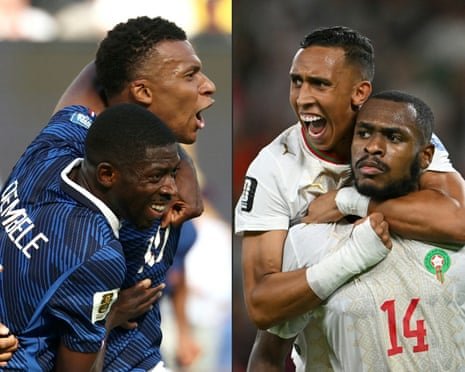
France face Morocco in the opening World Cup quarter-final while FIFA refereeing chief Pierluigi Collina rejects allegations of bias, and football developments continue across the tournament and beyond.
The 2026 FIFA World Cup enters the quarter-final stage with France meeting Morocco in Boston in a repeat of their 2022 semi-final.
France have impressed throughout the tournament despite a difficult victory over Paraguay, while Morocco arrive after eliminating the Netherlands and defeating Canada, becoming the first African nation to reach consecutive World Cup quarter-finals.
French authorities appealed for calm ahead of the match.
Sports minister Marina Ferrari urged supporters to act responsibly, describing the occasion as a celebration, while interior minister Laurent Nunez warned that misconduct would not be tolerated following the disorder that accompanied Paris Saint-Germain's Champions League final victory.
FIFA refereeing chief Pierluigi Collina defended match officials following criticism from Egypt after Argentina's 3-2 victory in the round of 16. In an interview published by inside.fifa.com, he rejected suggestions that refereeing decisions could be influenced.
"Constructive discussion about decisions will always be part of football, but unfounded allegations have no place in our sport," Collina said.
"Nobody can question the integrity of the Fifa World Cup match officials ...
Nobody can claim that Fifa refereeing can be influenced by anyone, not even by the Fifa president (Gianni Infantino)."
Egypt argued that Mostafa Zico's second-half goal had been wrongly disallowed and believed Mohamed Salah should have received a penalty shortly before Argentina scored the winner.
Collina said VAR correctly identified a foul by Marwan Attia on Lisandro Martinez during the attacking phase before Zico's goal.
"We believe that a foul is a foul," Collina said.
"Regardless of whether the foul appears 'obvious', if the referee did not see it on the field of play, the VAR can intervene."
He also defended the decision not to award Egypt a penalty, saying officials considered the incident involving Salah and Julian Alvarez to be normal football contact.
Away from the pitch, reports showed the France national team has used Global Crossing Airlines for several domestic World Cup flights.
The airline has also operated more than half of U.S. Immigration and Customs Enforcement removal flights during 2024 and 2025.
England continued preparations for their quarter-final against Norway.
Dan Burn said his side must improve on its performance against Mexico to stop Erling Haaland, while Morgan Rogers described Ezri Konsa as "one of the best centre-backs in football." Reece James remained a doubt through injury and Djed Spence was expected to replace the suspended Jarell Quansah.
Elsewhere, Steve Cherundolo was appointed head coach of the United States men's under-23 team through the 2028 Olympics.
Arsenal signed goalkeeper Illan Meslier after the expiry of his Leeds United contract, Newcastle United completed the signing of Sean Steur from Ajax and agreed a £51.5 million deal for Freiburg midfielder Johan Manzambi, while Manchester United acknowledged that plans for a proposed 100,000-capacity stadium could increase the club's debt.
The United States also expressed interest in hosting the 2029 Club World Cup following the commercial and sporting success of staging the 2026 World Cup.
Elsewhere, an inquest into the death of Sheffield United midfielder Maddy Cusack was adjourned again after additional documents were lodged.
Campaigners also warned that increasingly divisive political rhetoric is contributing to rising levels of racism directed at footballers during the tournament.
The day's coverage also featured analysis of Norway's youth development model, previews of France against Morocco and England against Norway, transfer news, fan reaction, tournament statistics and features examining the wider political, cultural and sporting stories surrounding the World Cup.
France have impressed throughout the tournament despite a difficult victory over Paraguay, while Morocco arrive after eliminating the Netherlands and defeating Canada, becoming the first African nation to reach consecutive World Cup quarter-finals.
French authorities appealed for calm ahead of the match.
Sports minister Marina Ferrari urged supporters to act responsibly, describing the occasion as a celebration, while interior minister Laurent Nunez warned that misconduct would not be tolerated following the disorder that accompanied Paris Saint-Germain's Champions League final victory.
FIFA refereeing chief Pierluigi Collina defended match officials following criticism from Egypt after Argentina's 3-2 victory in the round of 16. In an interview published by inside.fifa.com, he rejected suggestions that refereeing decisions could be influenced.
"Constructive discussion about decisions will always be part of football, but unfounded allegations have no place in our sport," Collina said.
"Nobody can question the integrity of the Fifa World Cup match officials ...
Nobody can claim that Fifa refereeing can be influenced by anyone, not even by the Fifa president (Gianni Infantino)."
Egypt argued that Mostafa Zico's second-half goal had been wrongly disallowed and believed Mohamed Salah should have received a penalty shortly before Argentina scored the winner.
Collina said VAR correctly identified a foul by Marwan Attia on Lisandro Martinez during the attacking phase before Zico's goal.
"We believe that a foul is a foul," Collina said.
"Regardless of whether the foul appears 'obvious', if the referee did not see it on the field of play, the VAR can intervene."
He also defended the decision not to award Egypt a penalty, saying officials considered the incident involving Salah and Julian Alvarez to be normal football contact.
Away from the pitch, reports showed the France national team has used Global Crossing Airlines for several domestic World Cup flights.
The airline has also operated more than half of U.S. Immigration and Customs Enforcement removal flights during 2024 and 2025.
England continued preparations for their quarter-final against Norway.
Dan Burn said his side must improve on its performance against Mexico to stop Erling Haaland, while Morgan Rogers described Ezri Konsa as "one of the best centre-backs in football." Reece James remained a doubt through injury and Djed Spence was expected to replace the suspended Jarell Quansah.
Elsewhere, Steve Cherundolo was appointed head coach of the United States men's under-23 team through the 2028 Olympics.
Arsenal signed goalkeeper Illan Meslier after the expiry of his Leeds United contract, Newcastle United completed the signing of Sean Steur from Ajax and agreed a £51.5 million deal for Freiburg midfielder Johan Manzambi, while Manchester United acknowledged that plans for a proposed 100,000-capacity stadium could increase the club's debt.
The United States also expressed interest in hosting the 2029 Club World Cup following the commercial and sporting success of staging the 2026 World Cup.
Elsewhere, an inquest into the death of Sheffield United midfielder Maddy Cusack was adjourned again after additional documents were lodged.
Campaigners also warned that increasingly divisive political rhetoric is contributing to rising levels of racism directed at footballers during the tournament.
The day's coverage also featured analysis of Norway's youth development model, previews of France against Morocco and England against Norway, transfer news, fan reaction, tournament statistics and features examining the wider political, cultural and sporting stories surrounding the World Cup.
ASEAN Secretary-General Dr. Kao Kim Hourn told a regional symposium in Jakarta that closer alignment between ASEAN initiatives and broader Indo-Pacific frameworks will be essential to strengthening regional cooperation on the tenth anniversary of the Free and Open Indo-Pacific concept.
The Philippines will host a series of major regional meetings from July 18 to 24, including the ASEAN Foreign Ministers' Meeting and events marking the fiftieth anniversary of the Treaty of Amity and Cooperation, with participation from major dialogue partners including Australia, India, Japan, and the European Union.
Foreign ministers from the Association of Southeast Asian Nations are scheduled to meet Myanmar's foreign minister in Bangkok on July 12 as the bloc seeks to revive dialogue with the administration in Naypyitaw and encourage reconciliation efforts amid the country's prolonged civil conflict.

A radio briefing on the latest developments in artificial intelligence, digital wellbeing, and the tech industry.
Welcome to today’s tech briefing.
We’re starting with a big question about the future of artificial intelligence. Experts are debating whether AI is really as smart as we think, and they’re asking what’s actually next for the field
Our relationship with our screens is under the microscope, too. Some tech leaders are pushing a new vision for a world where we spend way less time looking at our phones
In the business world, things are a bit of a rollercoaster. Samsung’s profits are up a huge 1,800%, largely thanks to soaring AI chip sales
Here are a few other stories making waves today:.
Meta is facing a lot of backlash for letting users create AI images using public Instagram profile photos, with privacy campaigners calling it a "recipe for disaster"
The consumer group Which? found that online marketplaces are still selling unsafe baby products, like pillows and sleeping bags that have already been flagged for safety issues
If you’re looking at the housing market in San Francisco, prices have hit a record high of $1.7 million, and reports suggest that wealthy AI workers are a major reason why
Finally, on a more positive note, a UK hospital has become the first to use AI to help spot infections
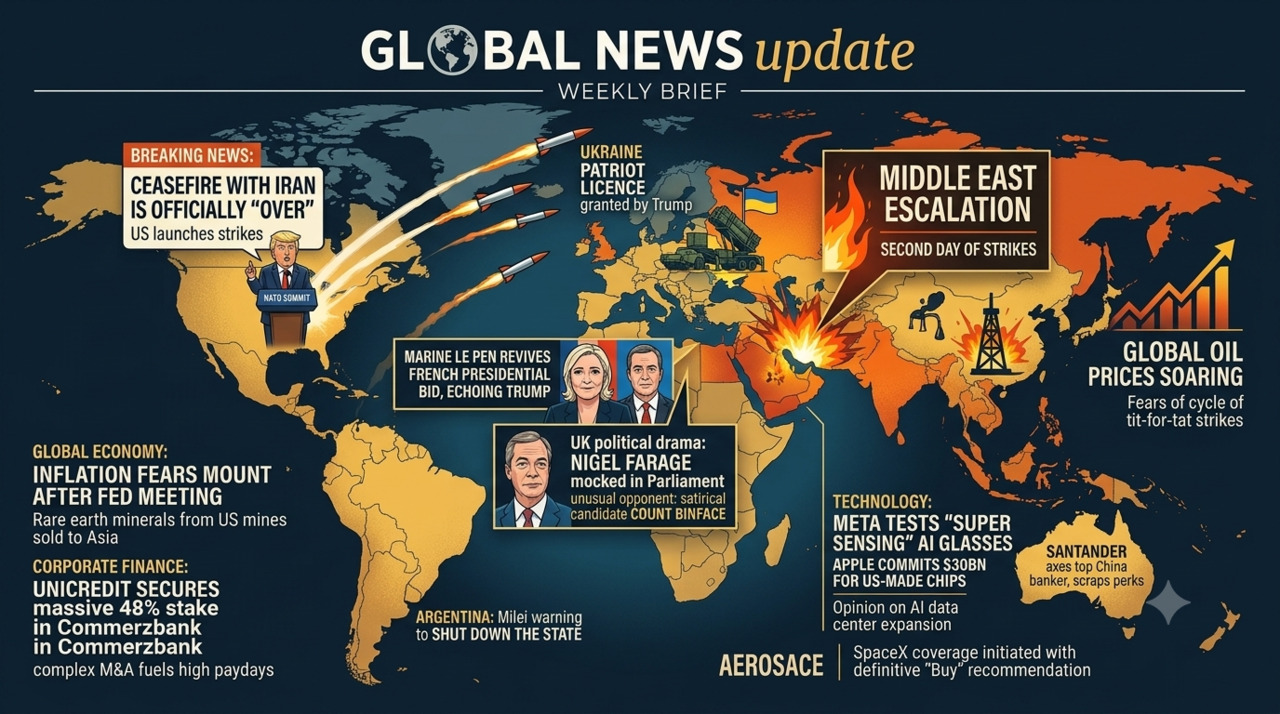
A comprehensive radio report detailing renewed US-Iran conflict, NATO defense shifts, and major developments in the global tech and financial markets.
We begin with breaking news from the Middle East, where the United States has launched a second day of strikes against Iran. This escalation comes just hours after US President Donald Trump told a NATO summit that the ceasefire with Tehran is officially "over".
The renewed conflict follows recent attacks on oil tankers and has already sent shockwaves through global markets, with oil prices rising sharply after Washington renewed hostilities. Analysts are warning of a dangerous, ongoing cycle of tit-for-tat strikes between the two nations.
Meanwhile, at the NATO summit, President Trump’s surprise shift on foreign policy regarding Ukraine has steadied nervous allies. As part of this defense shift, Trump has granted Ukraine a licence to produce Patriot missiles to aid in their ongoing war. Simultaneously, Ukraine is intensifying its own military operations, stepping up attacks on Russian ships in the Azov Sea.
Turning to the global economy and finance, inflation fears are mounting following Kevin Warsh’s first Federal Reserve meeting. In commodities, an exclusive report reveals that rare earth minerals from Trump-backed US mines are being sold to Asia. In corporate finance, UniCredit has secured a massive 48 percent stake in Commerzbank, while a complex M&A environment is fueling historic paydays for megadeal traders due to a rising "complexity premium".
In political news from Europe, Marine Le Pen has revived her French presidential bid, heavily echoing Donald Trump's political style. Over in the UK, political drama is unfolding as Nigel Farage was ridiculed in parliament while a controversial by-election received the official go-ahead.
Farage will face a highly unusual opponent in the race: the satirical candidate Count Binface, in what critics are calling a "farce" by-election. In technology and corporate news, Meta is pushing boundaries by testing new "super sensing" AI glasses designed to capture every moment. Meanwhile, Apple has committed to buying 30 billion dollars worth of US-made microchips from Broadcom.
However, the rapid expansion of technology is drawing scrutiny; a prominent opinion piece by Pilita Clark takes aim at "The Great AI Data Centre Cover-Up". In aerospace, Alphaville LLC has officially initiated coverage of Elon Musk’s SpaceX with a definitive "Buy" recommendation. Looking at global developments, an outspoken Chinese economist who famously doubted Beijing’s official GDP data has died. In South America, Argentinian President Javier Milei has issued a stark warning, declaring that Argentina should completely shut down the state if the national budget runs out. Finally, in banking overhauls, Santander has axed its top China banker and scrapped traditional perks across its Asian operations.
That is your global news update. Thank you for listening.

A comprehensive roundup of today's top international headlines, covering breaking news, global sports, tech updates, and human interest stories.
This is your global news update.
We begin with breaking news from the Middle East, where the US has launched more strikes on Iran. Local media are reporting explosions along the south coast. This follows statements from US President Donald Trump, who warned the US would "hit them hard again" after both nations exchanged fire the previous night.
Meanwhile, at the NATO summit, the NATO chief Mark Rutte has downplayed friction, telling reporters that Trump’s recent comments are like a "family argument." Rutte insisted that the alliance is stronger than ever and expressed complete confidence in the US president’s commitment. In a separate development from the summit, UK Prime Minister Keir Starmer was gifted a gun and ammunition by the Turkish president. On the defense front, President Trump also announced that Ukraine will receive a licence to produce Patriot missiles. While highly effective against Russian ballistic missiles, officials note they come with lengthy production times.
Turning to public health and environmental disasters in Asia, a severe healthcare crisis is unfolding in Bangladesh, where more than 120,000 suspected and confirmed measles cases have been reported. Hospitals are completely overwhelmed in a country that had previously made huge progress against the disease. Tragedies continue in the region as heavy monsoon rains batter Bangladesh's south-eastern coast, causing a devastating landslide that hit a girls' school, killing eight people. In neighboring India, motorists are expressing widespread unhappiness over the government adding biofuels to petrol. Drivers claim the E-20 fuel blend has significantly reduced vehicle fuel efficiency and will lead to higher maintenance costs. In Pakistan, the Airports Authority reports that five crew members remain missing after the wreckage of a private cargo plane was located.
Over in China, extreme weather is causing chaos as a typhoon triggers severe floods and rare tornadoes. Stranded villagers have told reporters they are struggling to get basic food and emergency help. In a major legal development out of China, a high-ranking official has been sentenced to death after being convicted of taking 325 million dollars in bribes.
In the United States, a staggering medical mystery is making headlines. An Arizona toddler who was declared dead from drowning was miraculously found alive inside a hospital morgue. In the US legal system, a 67-year-old former US judge has been spared prison time after being arrested for helping an undocumented migrant evade federal immigration agents by ushering them out of a courtroom side door.
Looking at European news, Russian fuel shortages are beginning to bite, with authorities even in Moscow unable to guarantee supplies. This leaves experts wondering if mounting economic pressure will force President Vladimir Putin to change tack in the Ukraine war or lead to further escalation. In Germany, a doctor has been jailed for the murder of 15 patients and is currently suspected of more. And in the UK, a historic legal milestone has been reached as a conditional pardon has been granted for Ruth Ellis, the last woman executed in the United Kingdom.
Now to the business and technology desk. Meta is facing a massive public outcry after revealing that it is allowing users to generate AI images using public Instagram profile pictures. While the tech giant states users can opt out, privacy campaigners have labeled the move a "recipe for disaster." Meanwhile, artificial intelligence has taken center stage in Australian labor relations, as dock workers call for a 28-hour work week during AI automation talks, stating that port workers are firmly in the crosshairs of automation.
In UK politics, questions are being raised about an upcoming by-election. Following the announcement that Reform UK leader Nigel Farage will quit his Clacton constituency to stand in a by-election, serial election candidate Count Binface posted online, "Game on, Nige."
In entertainment, the Emmy nominations are out. Drama series The Pitt is leading the pack, though fan-favorite Stranger Things was completely snubbed in the top categories. Also trending, DJ Greg James spilled details on Taylor Swift's star-studded wedding in New York City, describing multiple cakes and stolen keepsakes.
Finally, we turn to sports and the 2026 World Cup, where fans and players have experienced three weeks of joy and despair at the biggest World Cup in history. Drama is brewing off the pitch as Egypt has alleged bias and favoritism toward Argentina and their star player, Lionel Messi. On the pitch, England is preparing to meet Norway in a highly anticipated quarter-final clash, a fixture reviving memories of historic football rivalries. Co-hosting duties have officially come to an end for a "forgotten" host, Canada, following an eventful journey for their national team. Meanwhile, in Gaza, hundreds of football fans were seen watching the tournament and cheering for neighboring Egypt from atop the rubble of destroyed buildings.
The tournament's closing festivities are also locked in, as Justin Bieber is set to join Madonna, Shakira, and BTS for a Super Bowl-style FIFA World Cup final half-time show, marking the Canadian singer's latest massive performance following his Coachella comeback. Meanwhile, the race for the Golden Boot is shaping up to be one for the ages.
In other sports news, Great Britain's most-decorated Paralympian, Dame Sarah Storey, has announced her retirement from international competition with immediate effect. In tennis, Wimbledon witnessed an extraordinary day on Centre Court as British wildcard Arthur Fery defied the odds to reach the semi-finals. In women's football, London City Lionesses have pulled off one of the biggest signings in WSL history by persuading Alexia Putellas to move from Barcelona to Bromley. However, England batter Tammy Beaumont has announced her retirement, stating she has lost the fire to regain her spot in the new-look side. And in mixed martial arts, former bantamweight champion Cody Garbrandt has publicly called on the UFC to offer better healthcare and transition support for retired fighters.
That is your latest world news update.
Thai Prime Minister Anutin Charnvirakul is meeting Malaysian Prime Minister Anwar Ibrahim to sign an agricultural cooperation agreement and open a new customs and quarantine road link between Sadao and Bukit Kayu Hitam, further strengthening cross-border trade and regional integration.
Record-breaking temperatures and rising mortality rates are forcing a debate over the necessity of cooling in a changing climate.
As heatwaves become an annual fixture across the European continent, a profound cultural and political debate is emerging regarding the use of air conditioning.
For decades, much of Europe relied on traditional architecture designed to retain warmth during winter, but as temperatures now frequently exceed 40 degrees Celsius, many residents find themselves trapped in buildings that function more like ovens than shelters.
The scale of the recent heatwave was unprecedented, with record-breaking temperatures reported from the United Kingdom and Sweden to Spain and the Czech Republic.
The human cost has been significant; estimates suggest over 200,000 deaths across the continent in the last four years, primarily among the elderly and homeless populations.
In just three nations—France, Belgium, and the Netherlands—more than 3,700 deaths were recorded during the late June heatwave alone.
Despite this, widespread air conditioning remains rare in Western Europe, with only about 20 percent of households equipped with cooling units, compared to 90 percent in the United States and Japan.
The resistance to cooling is driven by several complex factors.
Economically, high energy prices and a persistent energy crisis make the cost of running AC units a heavy burden for many families.
Environmentally, there is a recognized paradox: while air conditioning provides relief, the gases emitted by these units can accelerate global warming.
Furthermore, the bureaucratic hurdles of installing modern infrastructure in historic European buildings—often involving strict preservation committees—can be as daunting as the heat itself.
However, the market is shifting rapidly under the pressure of extreme weather.
Retailers like Carrefour have reported selling approximately 30,000 air conditioning units per day during peak heat, and manufacturers such as Samsung and LG are seeing sales increases of hundreds of percent.
In some regions, the demand has led to visible social friction, with videos surfacing of heated disputes in electronics stores.
The debate has also become deeply political.
In France, candidates have offered opposing visions: far-right candidate Marine Le Pen has promised air conditioning reform, while far-left candidate Jean-Luc Mélenchon has argued against further installations due to environmental harm.
While Italy and Spain have seen higher adoption rates—with 50 percent and over 40 percent of households respectively—even cooler nations like Germany and England are seeing a slow rise in demand.
As the continent adapts, the impact is being felt in architecture and labor productivity.
Many businesses are now adjusting working hours to avoid the midday heat, and architects are increasingly focused on providing natural shade.
As projections suggest that the number of AC units in European homes could double by 2050, the continent stands at a crossroads between preserving its environmental values and ensuring public safety in an era of rising temperatures.
For decades, much of Europe relied on traditional architecture designed to retain warmth during winter, but as temperatures now frequently exceed 40 degrees Celsius, many residents find themselves trapped in buildings that function more like ovens than shelters.
The scale of the recent heatwave was unprecedented, with record-breaking temperatures reported from the United Kingdom and Sweden to Spain and the Czech Republic.
The human cost has been significant; estimates suggest over 200,000 deaths across the continent in the last four years, primarily among the elderly and homeless populations.
In just three nations—France, Belgium, and the Netherlands—more than 3,700 deaths were recorded during the late June heatwave alone.
Despite this, widespread air conditioning remains rare in Western Europe, with only about 20 percent of households equipped with cooling units, compared to 90 percent in the United States and Japan.
The resistance to cooling is driven by several complex factors.
Economically, high energy prices and a persistent energy crisis make the cost of running AC units a heavy burden for many families.
Environmentally, there is a recognized paradox: while air conditioning provides relief, the gases emitted by these units can accelerate global warming.
Furthermore, the bureaucratic hurdles of installing modern infrastructure in historic European buildings—often involving strict preservation committees—can be as daunting as the heat itself.
However, the market is shifting rapidly under the pressure of extreme weather.
Retailers like Carrefour have reported selling approximately 30,000 air conditioning units per day during peak heat, and manufacturers such as Samsung and LG are seeing sales increases of hundreds of percent.
In some regions, the demand has led to visible social friction, with videos surfacing of heated disputes in electronics stores.
The debate has also become deeply political.
In France, candidates have offered opposing visions: far-right candidate Marine Le Pen has promised air conditioning reform, while far-left candidate Jean-Luc Mélenchon has argued against further installations due to environmental harm.
While Italy and Spain have seen higher adoption rates—with 50 percent and over 40 percent of households respectively—even cooler nations like Germany and England are seeing a slow rise in demand.
As the continent adapts, the impact is being felt in architecture and labor productivity.
Many businesses are now adjusting working hours to avoid the midday heat, and architects are increasingly focused on providing natural shade.
As projections suggest that the number of AC units in European homes could double by 2050, the continent stands at a crossroads between preserving its environmental values and ensuring public safety in an era of rising temperatures.
Flight Instructor Jumped to His Death — Student Landed the Plane: "You Know What You Need to Do"
The Physical and Electronic Barriers Disrupting Domestic Wireless Networks
France and Morocco Open World Cup Quarter-Finals as Collina Defends Refereeing
Tech Pulse: The Future of AI and Screen Culture
Global News Briefing: Escalating Geopolitical Tensions and Corporate Shakeups
Global News Brief: Escalating Conflicts, Public Health Crises, and World Cup Drama
Europe's Growing Struggle with Extreme Heat and Air Conditioning
Anthropic Reengineers Agentic Architecture to Shift Autonomous Workplace Automation to the Cloud
Apple Advances Late-Stage Operating Systems with Fourth Beta Deployments
Global Crisis Alert: Escalating Middle East Tensions and UK Political Upheaval
"A New Era of Testing": The Rare Launch of a Missile from a Chinese Nuclear Submarine - That Could Reach U.S. Soil
Japanese Technology Firm Fujitsu Launches Advanced Artificial Intelligence Tool for Corporate Disclosures
South Africa Officially Launches Nationwide Campaign for Highly Contested Local Government Elections
United Kingdom Commits Additional Funding for Unexploded Ordnance Clearance in Laos
Singapore Announces Stringent New Greenhouse Gas Regulations for Commercial Cooling Systems
Cambodia and Thailand Hold High-Level Border Security Talks at United Nations Headquarters
Myanmar Military Government and China Sign Major Agreement to Upgrade Media and Cultural Cooperation
Knife Attack at Swiss Train Station Leaves Three Injured in Suspected Act of Domestic Terrorism
Transnational Extortion Gang Threatens Canadian Police With Army of One Thousand Armed Operatives
Australia Imposes Forty-Two-Day Quarantine on Cruise Ship Passengers Following Deadly Hantavirus Outbreak
International Monetary Fund Unlocks Seven Hundred Million United States Dollars for Sri Lanka Following Economic Reforms
China and Canada Foreign Ministers Meet in Ottawa in Effort to Stabilize Strained Diplomatic Ties
Indonesia Demands Urgent United Nations Security Council Reform Amid Escalating Global Conflicts
Extreme Weather Patterns Trigger Severe Drought in Madagascar and Destructive Flooding in East Africa
Indian State of Karnataka Faces Political Upheaval as Chief Minister Siddaramaiah Abruptly Resigns
Philippines and Japan Reaffirm Defense Ties as Crucial for Indo-Pacific Regional Stability
Norway Joins French Nuclear Deterrence Initiative in Major Shift for European Security Architecture
Global Critical Mineral Alliances Expand as Western Nations Move to Counter Chinese Supply Dominance
United States Imposes Fifty Percent Tariffs on Mexican Steel and Aluminum Ahead of Trade Pact Review
European Union and China Head Toward Major Trade Conflict Over Clean Technology Exports
United States Economic Growth Severely Downgraded to One Point Six Percent as Stagflation Fears Mount
World Health Organization Warns Central African Ebola Epidemic is Outpacing Containment Efforts
United States Treasury Department Conditions Sanctions Relief on Reopening of the Strait of Hormuz
Iranian Air Defenses Intercept and Destroy United States Military Drone Over Bushehr Province
Iranian Armed Forces Launch Ballistic Missiles Toward Unspecified Targets Prompting Regional Condemnation
United Nations Secretary-General Warns Global Order Facing Highest Level of Conflict Since 1945
Israel Issues Sweeping Evacuation Orders in Southern Lebanon Amid Intensified Hezbollah Conflict
Russia Announces Systemic Military Strikes Targeting Ukrainian Defense and Energy Infrastructure
United States and Iranian Negotiators Reach Draft Agreement to Extend Ceasefire and Resume Nuclear Talks
United Nations Security Council Deeply Divided Over United States Capture of Venezuelan President
US and Iran Exchange Direct Military Strikes Amid Fragile Gulf Ceasefire
World Health Organization Warns of Catastrophic Ebola Outbreak in DR Congo
Russia Threatens New Wave of Strikes on Ukrainian Infrastructure and Embassies
Scientists Warn Atlantic Ocean Currents Could Collapse Faster Than Projected
Anthropic Reaches $900 Billion Valuation in Historic AI Funding Round
Washington Imposes Crippling Sanctions on Iranian Maritime Authority
Japan and the Philippines Initiate Strategic Intelligence-Sharing Pact
Microsoft Deploys Autonomous Computer-Using AI Agents to Global Markets
Anthropic Secures $45 Billion Compute Infrastructure Agreement With SpaceX
U.S. Director of National Intelligence Resigns Amid Administration Shakeup