No new Covid restrictions will be brought in for England before Christmas, the prime minister has said.

But Boris Johnson said ministers "can't rule out" any further measures after 25 December, with Omicron spreading at a speed never seen before.

He added the government would continue to closely monitor the data and would "not hesitate to act" after Christmas if needed.

On Tuesday, Scotland announced tough new measures to start from Boxing Day.

Large events will have limits on the number of people that can attend, and Edinburgh's Hogmanay celebrations have been cancelled.

In a video clip released on Tuesday, Mr Johnson said the government couldn't rule out additional restrictions after Christmas and pledged to "do whatever it takes" to protect the health of the nation.

He added that given the ongoing uncertainty over Omicron's severity and the impact of vaccines, there was not enough evidence to justify any tougher measures before Christmas.

He said people can go ahead with their Christmas plans but should exercise caution - and repeated his appeal for everyone to get a booster jab.

Scotland - where people have already been told to limit their socialising in the run-up to Christmas - announced new rules earlier. For at least three weeks from 26 December, all outdoor events will be limited to just 500 people and indoor events like concerts will be limited to 200 people if they are seated, or 100 for standing.

Wales has already announced plans for sporting events to be held without crowds from Boxing Day, and London has cancelled its New Year's Eve event in Trafalgar Square.

Wales is also closing nightclubs from 27 December - and more post-Christmas plans will be set out on Wednesday. In Northern Ireland, there is a limit of 30 on people mixing from different households in homes, and another announcement is due on Wednesday.

'England different to Scotland'


Virologist Dr Eleanor Gaunt, from the University of Edinburgh, said England's NHS would be "under incredible pressure come the end of January", and that it should follow Scotland with similar measures.

But Prof Paul Hunter, from the University of East Anglia, said the situation in England was slightly different to that in Scotland.

"It does seem to be the case that Omicron at least seems to be plateauing out in England, in a way that maybe it's not in Scotland. Until we understand that more it's difficult to suggest further restrictions," he told BBC Radio 4's PM programme.

England's case rate is currently higher than Scotland's - and Prof Hunter suggested that England might be closer to its peak than Scotland.

"South Africa had a very sharp peak but actually is now seeing a very rapid decline on the other side of that peak. One hopes we're going to see that in the UK."

Why judging the threat of Omicron is tricky

It's clear that this new variant is highly spreadable, but what experts still don't know is how much illness a massive wave of infections might cause.

Up until now, vaccines have been doing a great job of keeping many people out of hospital by breaking the link between cases and serious disease.

It's hoped booster shots will top up our immunity and continue this trend, but only time will tell.

Hospitals are already busy with patients who urgently need treatment for other things, as well as some who are ill with Covid.

More restrictions - along with testing - would help prevent some infections while more jabs are given and could ease some of the pressure on the NHS.

But they also come at a cost for society too. Protecting lives and livelihoods is a balancing act.

Labour said while everyone was relieved that Christmas was going ahead as planned, "the country also deserves some certainty about what comes after Christmas".

"The virus won't be taking Christmas off and there's still a risk of the NHS being overwhelmed in the new year," said shadow health secretary Wes Streeting.

He accused Mr Johnson of being "too weak to get any measures to keep the country safe through his cabinet".

It is understood that many in cabinet remain unconvinced that new measures are needed without further evidence on the impact of Omicron.

The highly-mutated Omicron variant has already become the dominant strain in England and Scotland, health experts say.

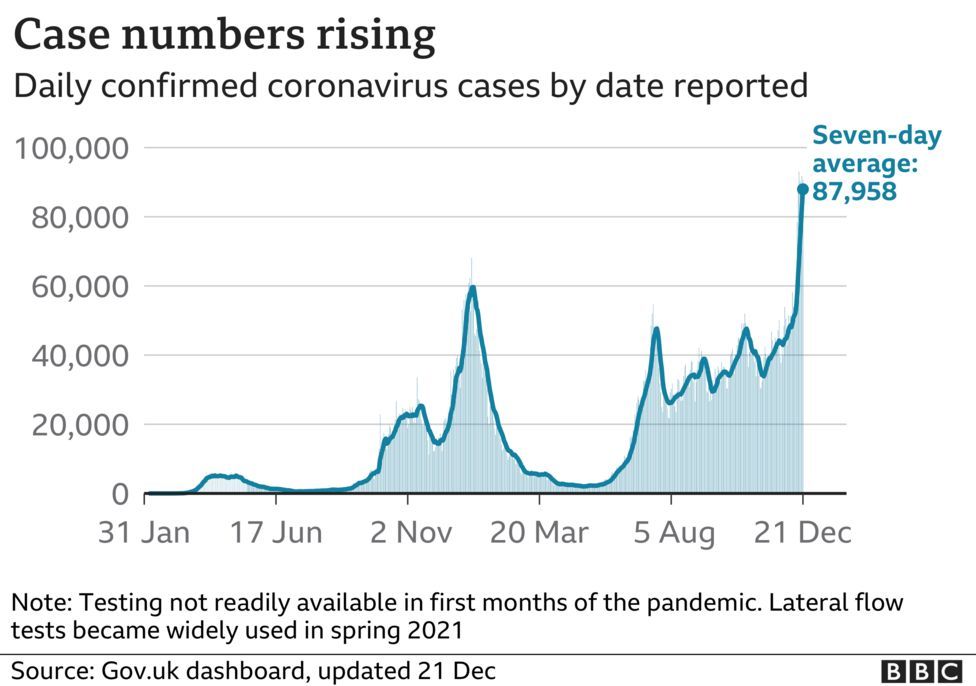
Another 90,629 new Covid cases were reported across the UK on Tuesday - slightly down on the all-time highs announced last week. And a further 897,979 people received their booster jab or third dose.

Train services across the country are also now being cancelled as rising numbers of staff fall ill with Covid.

Although England is sticking with its Plan B measures until Christmas, businesses say they are facing a wave of cancellations and low footfall as people limit their activity before Christmas.

Responding to their concerns, the government said on Tuesday it would be providing cash grants of up to £6,000 per premises to hospitality and leisure businesses affected by the surge in cases.

There is also £30m more for the arts and £100m for councils to help small firms.

But many businesses say the money is not enough, and they still want certainty over whether there will be more restrictions in future.

Regional governments are advancing digital trade and cross-border connectivity while building stronger cooperation against cyber fraud and transnational financial crime.
Major Southeast Asian tourism destinations are placing greater emphasis on higher-spending travelers, stricter visa enforcement and infrastructure upgrades as governments seek more sustainable economic returns from tourism.
Countries across mainland and maritime Southeast Asia are expanding semiconductor packaging and electric vehicle manufacturing capacity, increasing their integration into global technology and automotive supply chains.
Global cloud and technology companies are concentrating more capital in Thailand and Malaysia as they compete for suitable land, electricity and renewable energy supplies for large-scale regional data centers.
International hospitality companies announced new high-end resorts in Phuket, Chiang Mai and coastal Vietnam as demand from affluent travelers continues to support premium tourism investment.
Brunei’s economic development authorities introduced new incentives for technology and specialized manufacturing investment as the country seeks to reduce its long-standing dependence on hydrocarbons.
Timorese delegations continued legal and institutional harmonization talks with the ASEAN Coordinating Council as the country works through requirements for full integration into the regional bloc.
Bank of Thailand indicators showed continued growth in spending across hotels, restaurants and retail during late summer, supported by government stimulus measures, long-holiday demand and strong international tourist arrivals.
Cambodian leaders and the ASEAN secretary-general launched construction of the Phnom Penh Logistics Complex, a multimodal freight hub intended to reduce transport costs and improve trade flows across the Mekong region.
The Laos-China Railway recorded its highest cargo tonnage between Vientiane and Kunming, supported by stronger Chinese demand for Southeast Asian agricultural products and processed minerals.
Indonesia is advancing public-private investment in its new capital, prioritizing autonomous public transport, green building standards, renewable power and high-speed fiber infrastructure.
Malaysian transport authorities approved major investment in Port Klang terminal capacity as shifting supply chains and growing intra-ASEAN manufacturing trade increase regional container volumes.
Bangko Sentral ng Pilipinas kept key policy rates unchanged, citing stabilizing food prices and resilient domestic consumption as inflation moves closer to target levels.
The ASEAN+3 Macroeconomic Research Office said regional economies maintained positive revenue growth, supported in part by corporate earnings tied to the semiconductor and artificial intelligence upcycle despite persistent energy-price pressures.
Industrial planners in Indonesia and Vietnam advanced coordination on battery minerals and electric vehicle assembly standards as global automakers and clean-energy companies increase investment across Southeast Asia.
Naval and coast guard forces from ASEAN claimant states increased cooperative maritime surveillance aimed at protecting commercial shipping lanes and supporting adherence to international law in contested waters.
Malaysia and Singapore completed major legal and tax frameworks for the Johor-Singapore Special Economic Zone, paving the way for closer talent mobility, joint industrial development and integrated financial services.
Authorities in northern Vietnam announced fresh commitments from global semiconductor testing and packaging companies, strengthening the country’s position in advanced electronics manufacturing and regional technology supply chains.
Telecommunications ministers, regulators and industry leaders meeting at the GSMA M360 ASEAN summit in Kuala Lumpur moved to establish a regional intelligence exchange aimed at combating increasingly sophisticated cross-border digital financial scams.
The Thai government introduced a 30-day limit for visa-free visitors from 60 countries, replacing the previous 60-day allowance and restricting land-border visa runs as authorities seek to curb misuse and strengthen immigration oversight.
Thailand’s exports reached $34.8 billion in July, rising 21.6% as overseas demand strengthened for computers, integrated circuits and electronic components across US and European markets.
Thailand’s Board of Investment added nine projects worth 52 billion baht to its FastPass program while advancing direct renewable power purchase frameworks designed to secure clean electricity for incoming hyperscale technology investments.
Cushman & Wakefield projects Thailand will attract about 570 billion baht in data center investment between 2026 and 2030, driven by limited existing capacity and a ninefold increase in pre-leasing activity.
Thailand’s Board of Investment approved six major projects worth 958 billion baht, led by investments from TikTok System and Dubai-based DAMAC Group’s Skyline Data Center, accelerating the country’s push to become a major Southeast Asian cloud and digital infrastructure hub.
Singapore Health Minister Ong Ye Kung told business and labor leaders that artificial intelligence is increasingly automating repetitive tasks while more often augmenting, rather than entirely replacing, human occupations.
Agoda ranked Bangkok behind Tokyo as Asia’s second-most revisited urban destination for a second consecutive year, highlighting the Thai capital’s continued appeal to regional and international travelers.
Delegates from across Southeast Asia met in Yangon for the 23rd regional Red Cross and Red Crescent leadership meeting to develop stronger cross-border disaster-response and humanitarian assistance frameworks.
Chinese and Lao military medical units began humanitarian assistance and disaster-response exercises under the Peace Train framework, strengthening bilateral emergency cooperation in the Mekong region.
Cambodian logistics companies are expanding automated cargo-clearance and port digitalization systems to reduce supply-chain friction and increase manufacturing exports under the Regional Comprehensive Economic Partnership.
Vietnam and Russia signed agreements covering digital farming, precision agriculture and automated crop management as Hanoi seeks to improve agricultural productivity and export competitiveness.
Economic planners in Laos said commerce in Luang Prabang and northern logistics centers expanded by nearly 4% in the first half, supported by tourism and freight flows along the Laos-China railway.
Authorities in Chiang Rai activated emergency barriers and mobile warning systems after heavy upstream rainfall pushed the Mae Sai River close to the underside of the Thai-Myanmar Friendship Bridge.
The Philippine Agriculture Department opened additional outlets selling subsidized rice at 20 pesos per kilogram as authorities seek to cushion lower-income households from persistent food-price pressures.
Thailand’s Fuel Fund Management Committee changed diesel and gasohol compensation mechanisms to protect the fund’s long-term liquidity while limiting the impact of international crude-price volatility on consumers.
Bangkok Governor Chadchart Sittipunt and Thailand’s Digital Economy and Society Ministry launched reviews of central-city data centers following questions over planning compliance and pressure on municipal electricity capacity.
Malaysia ranked joint third in Southeast Asia for planned European corporate expansion in an EU-ASEAN Business Council survey, supported by its semiconductor manufacturing base and clean-energy policies.
Thailand’s State Enterprise Policy Office said state-owned enterprises exceeded annual targets with more than 197 billion baht in treasury remittances, supported by higher dividends from the Vayuakij Fund and major energy companies including PTT.
ASEAN Secretary-General Kao Kim Hourn joined a Hong Kong forum focused on regional interoperability, cross-border digital trade and trusted financial infrastructure as the bloc targets a $2 trillion digital economy by 2030.
Thailand’s Securities and Exchange Commission imposed multimillion-baht penalties and multi-year executive bans on 18 individuals found responsible for false trading volumes and share-price manipulation.
Indonesian aviation authorities said volcanic ash from Mount Anak Krakatau disrupted travel for more than 300,000 passengers, forcing regional airlines including Singapore Airlines to cancel or reschedule connecting flights.
Indonesia’s Finance Ministry said sufficient public funds are available to meet upcoming debt obligations for the Whoosh high-speed railway ahead of a scheduled mid-September transfer of operational ownership.
Deputy Prime Minister and Finance Minister Ekniti Nitithanprapas outlined a growth plan centered on public-private coordination, World Bank alignment, artificial intelligence and higher productivity as Thailand prepares for its upcoming ASEAN chairmanship.
The Thai Meteorological Department warned of heavy to very heavy monsoon rain across Bangkok, surrounding areas and northern provinces through Sept. 13, prompting disaster-response teams to activate flood defenses.
Thailand will reduce visa-free stays from 60 days to 30 days for travelers from 60 countries and territories starting Sept. 15, tightening immigration oversight while keeping the program open to international tourists.
Brunei is introducing trade measures aimed at diversifying exports beyond oil and gas, with a focus on specialized chemical products and certified halal consumer goods for Asian markets.
Ho Chi Minh City equities posted strong weekly gains as foreign institutional investors increased exposure to major Vietnamese banks and digital-infrastructure companies.
Timor-Leste is working with regional bodies to complete legal harmonization and customs-alignment requirements ahead of its planned integration into the ASEAN economic community.
Singapore Airlines and other regional carriers are adjusting flight paths to avoid unstable Middle Eastern airspace, balancing passenger safety with additional fuel use and travel time.
Glacier Collapse, Not Earthquake, Triggered Deadly Nepal-Tibet Flood
Swiss Tourist Sentenced to One Year in Prison for Insulting Bali's Sacred Day of Silence
Father Reprimanded After Leaving Seven-Year-Old Son Alone on Mount Fuji During Summit Climb
Google Launches Pixel 11 With Gemini AI at the Center of Its Hardware Strategy
China’s Kimi Launches AI-Focused Credit Card With Agricultural Bank of China and American Express
Success: Nvidia Turned Gaming Chips Into the Engine of the AI Boom
AI’s Next Bottleneck Is Power, Not Just Nvidia Chips
Meta Raises AI Spending Target to as Much as $145bn Despite Pressure Over Returns
Joe Biden’s Cancer Has Spread Beyond His Bones, Hunter Biden Says
Why 2027 Could Be a Strong Year for Stocks—and Why the Forecast Is Fragile
Why Markets May Look Quiet in August After Big Tech Earnings
UFO: Pentagon Releases Video of Unidentified Object Tracked Over Middle East
Ukraine Tells Senate Republicans Its Drone War Offers a Blueprint for America
Weight-Loss Drug Boom Tests the Limits of Prescription Advertising Rules
Taiwan’s President Joins Wartime Command Drill as China Pressure Grows
Lightning Strike Kills Yala FC Player During Match in Southern Thailand
AI Is Remaking the US Economy, From GDP Growth to iPhone Prices
Indonesia’s Free School Meals Plan Has Been Hit by Poisoning, Corruption and Cuts
US and Japan Step In to Support the Yen in Rare Joint Intervention
FIFA’s Retreat Leaves a Larger Question Over Who Guards the Game
Valued at $109 Million: F-35B Fighter Jet Crashes in Southern California
US Says It Has Carried Out Heavy Strikes on Iran After Attempted Attacks on Its Forces
Over 24 Hours in the Air: Qantas Airbus Completes Record-Breaking Test Flight
Nvidia Reportedly Takes Vast Texas Data-Centre Lease to Underwrite AI Expansion
FIFA’s Private-Investment Plan for World Cup Rights Draws European Revolt
Following OpenAI's Cyberattack: 'Most Companies Still Do Not Understand What Is Coming'
OpenAI Sued After ChatGPT Allegedly Discouraged Emergency Care Before Near-Fatal Embolism
Miliband Sets Climate and International Law at Centre of UK Diplomacy
Trump Readies New Tariffs as Temporary Global Levy Nears Expiry
EU Imposes Record €550 Million Digital Services Fine on AliExpress
Between Deliveries, Wang Jibing Wrote His Way to China’s Literary Heights
Morgan Stanley Builds a Wall Street Lead in AI Infrastructure Finance
High Prices Push Coffee Drinkers Toward Whole Beans and Home Brewing
Trump Draws Boos and Podium Scrutiny at Spain’s World Cup Triumph
Spain Defeats Argentina in Extra Time to Win Second World Cup
Police Block Cockroach Janta Party’s March to Parliament as Education Protests Intensify
Singapore Considers Lower Taxes for Fund Managers as Hong Kong Intensifies Talent Contest
Proposed U.S.-Saudi Nuclear Pact Could Permit Limited Uranium Enrichment Under International Safeguards
Why Kentucky Fried Chicken Became KFC—and Why the False Explanations Persist
Ukrainian Drones Strike Wildberries Warehouses Deep Inside Russia
Reported CIA Mission Helped Clear the UAE’s Path to Advanced US AI Chips
Artificial Intelligence Capital Fuels Markets While Governments and Regulators Face Mounting Strategic Tests
China’s Moonshot’s Kimi K3 Narrows the Gap With Anthropic Through Scale, Openness and Lower Cost
Gold and Cash Seizure Puts Indonesia’s Senior Anti-Corruption Prosecutor Under Investigation
The Ledger Will Not Trust on Faith
Ukraine’s Leadership Rift Spills Into the Streets as Protesters Target Army Chief
The Ten World Cup Finals That Defined Football History
Smartphones Are Getting More Expensive, Sales Are Collapsing, and Even Apple Admits: "Prices Will Rise"
Leadership Change and Strategic Rivalry Redraw the Political Map
The AI Race Enters Its Infrastructure Era