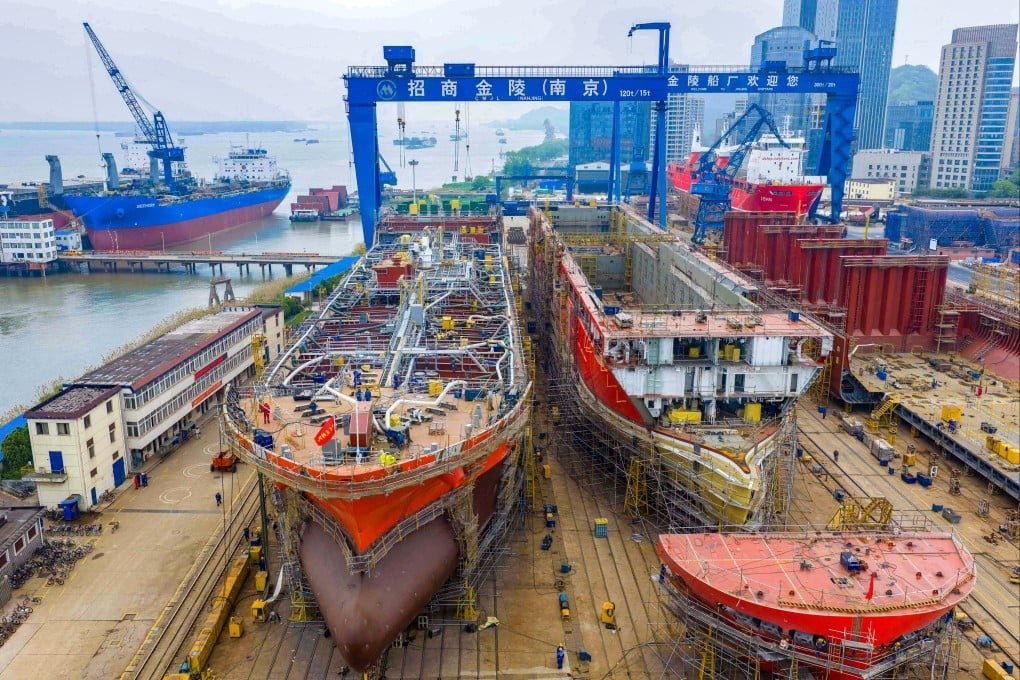
A surge in tanker demand, deep industrial capacity and limited Western alternatives have pushed Chinese shipyards to nearly 85 per cent of new global orders, undermining Washington’s strategy to rebuild maritime leverage.
China’s shipbuilding industry has emerged even stronger after a year of escalating US efforts to curb its dominance, underscoring how deeply the global maritime economy now depends on Chinese industrial capacity.
The story is fundamentally system-driven: it is about the structure of global manufacturing, shipping finance and industrial policy rather than a single commercial boom.
What is confirmed is that Chinese shipyards secured 59.53 million deadweight tonnes of new orders in the first quarter of 2026, a year-on-year increase of more than 195 per cent.
Chinese yards captured 84.9 per cent of all global new ship orders during the period, while South Korea accounted for roughly 12.8 per cent and Japan just 1.4 per cent.
The scale of the gap is extraordinary.
China now dominates not only bulk commercial shipbuilding but also many of the world’s most strategically important vessel categories, including very large crude carriers, large container ships and vehicle carriers.
In several segments, Chinese yards control more than 90 per cent of international orders.
The resurgence comes after Washington attempted to use trade pressure and maritime penalties to slow China’s advance.
The United States introduced measures targeting Chinese-linked vessels and shipbuilders, including planned port fees on Chinese-built or Chinese-operated ships entering US ports.
The policy was designed to discourage shipping companies from relying on Chinese shipyards while reviving the nearly collapsed US commercial shipbuilding sector.
The strategy has so far failed to materially alter market behaviour.
Shipping companies continue placing large orders in China because Chinese yards remain faster, cheaper and more scalable than competitors.
Global operators face a basic commercial reality: few alternatives can deliver complex vessels at comparable speed and cost.
The imbalance reflects decades of industrial consolidation.
China invested heavily in steel production, marine engineering, export financing, port infrastructure and state-supported shipbuilding groups while Western commercial shipbuilding steadily contracted.
The United States now produces only a tiny fraction of the commercial vessels built annually in China.
That industrial advantage is reinforced by supply-chain concentration.
Chinese shipbuilders benefit from dense domestic networks producing engines, electronics, steel plates, propulsion systems and increasingly advanced green-shipping technologies.
Many yards also maintain direct links to state financing and export credit systems, allowing them to absorb cyclical downturns more effectively than private competitors elsewhere.
The immediate catalyst for the latest order surge has been turmoil in global energy shipping markets.
Rising geopolitical instability around the Middle East and fears of disruptions linked to the US-Iran conflict sharply increased demand for oil tankers during late 2025 and early 2026.
Very large crude carriers, known as VLCCs, became the focal point of the boom.
Industry data shows 75 new VLCC orders were placed in the first quarter alone, the highest quarterly total ever recorded.
Freight rates surged as insurers, charterers and shipowners reassessed risks tied to Gulf shipping routes and the Strait of Hormuz.
The mechanism behind the tanker rush is straightforward.
When geopolitical tension threatens energy supply chains, shipping companies seek additional vessel capacity both to secure transport availability and to hedge against future shortages.
Longer shipping routes caused by sanctions, rerouting or conflict also increase demand for tankers because ships spend more time at sea.
Chinese yards were uniquely positioned to absorb that demand spike.
South Korean shipbuilders remain highly competitive in advanced LNG carriers and some premium segments, but many Korean yards are already operating near capacity through the end of the decade.
Japanese shipbuilding, once globally dominant, has steadily lost market share over the past two decades due to higher costs and reduced investment.
Western shipowners therefore continue returning to Chinese yards despite political pressure from Washington.
The situation exposes a broader weakness in US industrial strategy.
Maritime power depends not only on naval strength but also on commercial shipbuilding capacity, shipping logistics and industrial manufacturing ecosystems.
The United States retains overwhelming naval capabilities, but its commercial shipbuilding base has deteriorated sharply.
That decline now carries strategic consequences.
Chinese shipyards increasingly build both commercial and military vessels, allowing industrial expertise, labour pools and supply chains to reinforce each other.
Analysts have long argued that Beijing’s maritime expansion is not simply an economic story but also part of a broader strategic effort to strengthen national power through industrial self-sufficiency and export dominance.
The green-shipping transition has further strengthened China’s position.
Chinese yards are aggressively expanding into methanol-powered vessels, LNG-fuelled ships and electric-powered maritime technologies as shipping companies prepare for tighter environmental regulations.
This matters because decarbonisation is forcing shipowners to replace ageing fleets faster than previously expected.
Environmental compliance rules in Europe and elsewhere are increasing pressure on carriers to order newer, more efficient ships.
China’s shipbuilders are now using that transition to move beyond volume manufacturing into higher-value engineering.
The country is no longer competing only on low-cost labour.
It increasingly competes on technology integration, production speed and financing scale.
Washington still retains tools that could affect the market.
Additional sanctions, stricter port-fee structures, financing restrictions or coordinated industrial policies with allies could increase pressure on Chinese shipbuilders over time.
The Trump administration has also pushed for stronger maritime partnerships with allies including South Korea.
But rebuilding Western shipbuilding capacity would likely require years of subsidies, industrial coordination and labour-force development.
Shipyards cannot be expanded rapidly, especially after decades of contraction.
For now, the commercial market is delivering a clear verdict.
Global shipping companies continue ordering from China because the country has become the central infrastructure provider for the maritime economy itself.
The consequence is that Beijing’s dominance is no longer confined to manufacturing consumer goods or batteries.
China now sits at the core of the global system that physically moves energy, commodities and trade across the world’s oceans, and the first-quarter order data shows that position is strengthening rather than weakening.
The story is fundamentally system-driven: it is about the structure of global manufacturing, shipping finance and industrial policy rather than a single commercial boom.
What is confirmed is that Chinese shipyards secured 59.53 million deadweight tonnes of new orders in the first quarter of 2026, a year-on-year increase of more than 195 per cent.
Chinese yards captured 84.9 per cent of all global new ship orders during the period, while South Korea accounted for roughly 12.8 per cent and Japan just 1.4 per cent.
The scale of the gap is extraordinary.
China now dominates not only bulk commercial shipbuilding but also many of the world’s most strategically important vessel categories, including very large crude carriers, large container ships and vehicle carriers.
In several segments, Chinese yards control more than 90 per cent of international orders.
The resurgence comes after Washington attempted to use trade pressure and maritime penalties to slow China’s advance.
The United States introduced measures targeting Chinese-linked vessels and shipbuilders, including planned port fees on Chinese-built or Chinese-operated ships entering US ports.
The policy was designed to discourage shipping companies from relying on Chinese shipyards while reviving the nearly collapsed US commercial shipbuilding sector.
The strategy has so far failed to materially alter market behaviour.
Shipping companies continue placing large orders in China because Chinese yards remain faster, cheaper and more scalable than competitors.
Global operators face a basic commercial reality: few alternatives can deliver complex vessels at comparable speed and cost.
The imbalance reflects decades of industrial consolidation.
China invested heavily in steel production, marine engineering, export financing, port infrastructure and state-supported shipbuilding groups while Western commercial shipbuilding steadily contracted.
The United States now produces only a tiny fraction of the commercial vessels built annually in China.
That industrial advantage is reinforced by supply-chain concentration.
Chinese shipbuilders benefit from dense domestic networks producing engines, electronics, steel plates, propulsion systems and increasingly advanced green-shipping technologies.
Many yards also maintain direct links to state financing and export credit systems, allowing them to absorb cyclical downturns more effectively than private competitors elsewhere.
The immediate catalyst for the latest order surge has been turmoil in global energy shipping markets.
Rising geopolitical instability around the Middle East and fears of disruptions linked to the US-Iran conflict sharply increased demand for oil tankers during late 2025 and early 2026.
Very large crude carriers, known as VLCCs, became the focal point of the boom.
Industry data shows 75 new VLCC orders were placed in the first quarter alone, the highest quarterly total ever recorded.
Freight rates surged as insurers, charterers and shipowners reassessed risks tied to Gulf shipping routes and the Strait of Hormuz.
The mechanism behind the tanker rush is straightforward.
When geopolitical tension threatens energy supply chains, shipping companies seek additional vessel capacity both to secure transport availability and to hedge against future shortages.
Longer shipping routes caused by sanctions, rerouting or conflict also increase demand for tankers because ships spend more time at sea.
Chinese yards were uniquely positioned to absorb that demand spike.
South Korean shipbuilders remain highly competitive in advanced LNG carriers and some premium segments, but many Korean yards are already operating near capacity through the end of the decade.
Japanese shipbuilding, once globally dominant, has steadily lost market share over the past two decades due to higher costs and reduced investment.
Western shipowners therefore continue returning to Chinese yards despite political pressure from Washington.
The situation exposes a broader weakness in US industrial strategy.
Maritime power depends not only on naval strength but also on commercial shipbuilding capacity, shipping logistics and industrial manufacturing ecosystems.
The United States retains overwhelming naval capabilities, but its commercial shipbuilding base has deteriorated sharply.
That decline now carries strategic consequences.
Chinese shipyards increasingly build both commercial and military vessels, allowing industrial expertise, labour pools and supply chains to reinforce each other.
Analysts have long argued that Beijing’s maritime expansion is not simply an economic story but also part of a broader strategic effort to strengthen national power through industrial self-sufficiency and export dominance.
The green-shipping transition has further strengthened China’s position.
Chinese yards are aggressively expanding into methanol-powered vessels, LNG-fuelled ships and electric-powered maritime technologies as shipping companies prepare for tighter environmental regulations.
This matters because decarbonisation is forcing shipowners to replace ageing fleets faster than previously expected.
Environmental compliance rules in Europe and elsewhere are increasing pressure on carriers to order newer, more efficient ships.
China’s shipbuilders are now using that transition to move beyond volume manufacturing into higher-value engineering.
The country is no longer competing only on low-cost labour.
It increasingly competes on technology integration, production speed and financing scale.
Washington still retains tools that could affect the market.
Additional sanctions, stricter port-fee structures, financing restrictions or coordinated industrial policies with allies could increase pressure on Chinese shipbuilders over time.
The Trump administration has also pushed for stronger maritime partnerships with allies including South Korea.
But rebuilding Western shipbuilding capacity would likely require years of subsidies, industrial coordination and labour-force development.
Shipyards cannot be expanded rapidly, especially after decades of contraction.
For now, the commercial market is delivering a clear verdict.
Global shipping companies continue ordering from China because the country has become the central infrastructure provider for the maritime economy itself.
The consequence is that Beijing’s dominance is no longer confined to manufacturing consumer goods or batteries.
China now sits at the core of the global system that physically moves energy, commodities and trade across the world’s oceans, and the first-quarter order data shows that position is strengthening rather than weakening.